Path: Home > GB/T > Page721 > GB/T 46572-2025 || Home > Standard_List > GB/T > Page721 > GB/T 46572-2025 Price & DeliveryUS$359.00 · In stock
Delivery: <= 4 days. True-PDF full-copy in English will be manually translated and delivered via email.
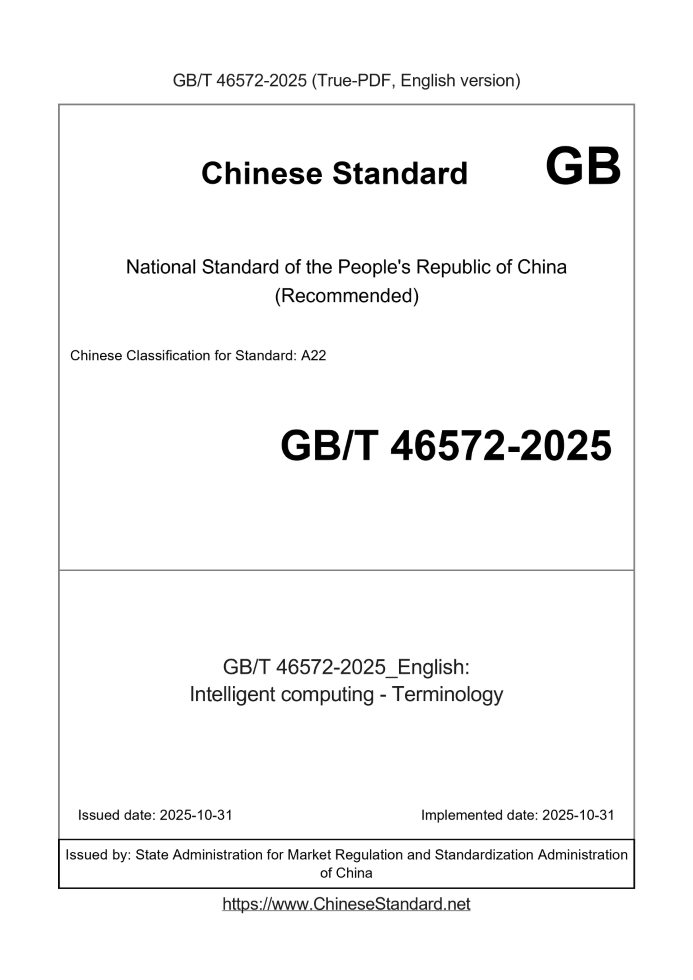
GB/T 46572-2025: Intelligent computing - Terminology
Status: Valid
| Std ID | Contents [version] | USD | STEP2 | [PDF] delivered in | Standard Title (Description) | Status |
| GB/T 46572-2025 | English | 359 |
Add to Cart
|
4 days [Need to translate]
|
Intelligent computing - Terminology
| Valid |
Basic data | Standard ID | GB/T 46572-2025 (GB/T46572-2025) | | Description (Translated English) | Intelligent computing - Terminology | | Sector / Industry | National Standard (Recommended) | | Classification of Chinese Standard | A22 | | Classification of International Standard | 01.040.35 | | Word Count Estimation | 18,130 | | Date of Issue | 2025-10-31 | | Date of Implementation | 2025-10-31 | | Issuing agency(ies) | State Administration for Market Regulation and Standardization Administration of China | GB/T 46572-2025: Intelligent computing - Terminology---This is a DRAFT version for illustration, not a final translation. Full copy of true-PDF in English version (including equations, symbols, images, flow-chart, tables, and figures etc.) will be manually/carefully translated upon your order.
ICS 01.040.35
CCSA22
National Standards of the People's Republic of China
Intelligent computing terminology
Published on 2025-10-31
Implemented on October 31, 2025
State Administration for Market Regulation
The State Administration for Standardization issued a statement.
Table of contents
Preface III
Introduction IV
1.Scope 1
2 Normative References 1
3.General Basic Terminology 1
4.Terminology for Intelligent Computing Infrastructure 2
5.Intelligent Computing Architecture Terminology 3
6.Intelligent Computing Performance Terminology 4
7.Terminology for Intelligent Computing Technologies and Applications 5
References 7
Index 8
Foreword
This document complies with the provisions of GB/T 1.1-2020 "Standardization Work Guidelines Part 1.Structure and Drafting Rules of Standardization Documents".
Drafting.
Please note that some content in this document may involve patents. The issuing organization of this document assumes no responsibility for identifying patents.
This document was proposed and is under the jurisdiction of the National Intelligent Computing Standardization Working Group (SAC/SWG32).
This document was drafted by. Zhejiang Lab, Institute of Computing Technology, Chinese Academy of Sciences, Alibaba Cloud Computing Co., Ltd., and China Academy of Information and Communications Technology.
Research Institute, Dawning Information Industry (Beijing) Co., Ltd., Inspur Cloud Information Technology Co., Ltd., Peking University, Tsinghua University, Beijing University of Aeronautics and Astronautics
Learning, ZTE Corporation, China United Network Communications Corporation Research Institute, Chengdu Supercomputing Center Operation and Management Co., Ltd., China Mobile
Suzhou Software Technology Co., Ltd., Shandong Provincial Computing Center (National Supercomputing Center in Jinan), Ant Group Co., Ltd.
Super Fusion Digital Technology Co., Ltd., Inspur Electronic Information Industry Co., Ltd., Computer Network Information Center of Chinese Academy of Sciences, China Science
The Institute of Software, China Telecom Cloud Technology Co., Ltd., H3C Technologies Co., Ltd., Shanghai Suiyuan Technology Co., Ltd., and Hangzhou Aijie Optoelectronics Co., Ltd.
Electric Technology Co., Ltd., Shanghai Xizhi Technology Co., Ltd., Jinan Quantum Technology Research Institute, Zhejiang University, Huazhong University of Science and Technology, China United Network
Network Communications Co., Ltd. Guangdong Branch, Shanghai Supercomputing Center, Shanghai Academy of Sciences, Peking University Changsha Institute of Computational and Mathematical Economics
China Mobile (Hangzhou) Information Technology Co., Ltd., China Southern Power Grid Big Data Service Co., Ltd., Zhejiang Dahua Technology Co., Ltd., and Zhejiang Chuanglin
Technology Co., Ltd., China Telecom Digital Technology Co., Ltd., China Electronics Hikvision Group Co., Ltd., Shenzhen Jiutian Ruixin Technology Co., Ltd., Hangzhou
Hikvision Digital Technology Co., Ltd., Shenzhen Simou Information Technology Co., Ltd., China Electronics Technology Nanhu Research Institute, Beijing Lingxi Technology
Technology Co., Ltd., Shanghai Zhangjiang Institute of Mathematics, Shanxi Taihang Laboratory Co., Ltd., China National Institute of Standardization, Shanghai Tianwu Technology Co., Ltd.
Company, Shenzhen Guoxin Hengyun Information Security Co., Ltd., Guangzhou Guangdian Wuzhou Technology Co., Ltd., Hangzhou High-tech Zone (Binjiang) Blockchain and
Data Security Research Institute.
The main drafters of this document are. Sun Ninghui, Huang Dandan, He Shuibing, Jin Hai, Huang Kai, Fan Chun, Liu Yi, Huang Zhenchun, Zeng Lingfang, Yu Xiaobo, and Li Xiang.
Li Tao, Guo Yang, Li Yonghui, Pan Gang, Shi Luping, Huang Wei, Han Shujun, Zhao Huan, Zou Lei, Jin Zhong, Yang Chao, Ma Yinping, Guo Zhihui, Zheng Jiajia
Liang Lingyan, Ge Jing, Liang Yonggui, Huang Tinglei, Qu Long, Wang Sishan, Hou Huihuang, Shen Yichen, Wang Chaofan, Li Shanshan, Deng Shixian, Zhang Yu, Wang Jun
Liu Hongjie, Liu Yun, Zhou Yan, Kong Weisheng, Lou Zhibin, Peng Jianfeng, Zhang Chi, Cai Yansong, Hua Baohong, Zhang Dandan, Xu Lingyi, Wang Chen, Zhang Hongwei
Wang Mengxiang, Hong Liang, Zhang Sidong, Zhang Fan, and Shou Lidan.
Introduction
Computing has become a crucial cornerstone supporting social development and national innovation capacity building, characterized by its computational intensity, data-driven nature, and model-based approach.
Intelligent computing technologies, characterized by features such as [specific characteristics not provided], are driving a new round of industrial and technological revolution. With the development of intelligent computing technology, the connotation and [specific characteristics not provided] of intelligent computing are [expanding/renewing/evolving].
The scope of intelligent computing continues to expand, with new technologies, methods, and business models constantly emerging.
This document is based on the current state of technology and industry, addresses development needs, and focuses on commonly used terms related to intelligent computing and its subfields.
The report summarizes the key points of intelligent computing in five aspects. general foundations, intelligent computing infrastructure, intelligent computing architecture, intelligent computing performance, and intelligent computing technologies and applications.
Establish a theoretical terminology system and standardize term definitions to provide basic support and reference for the development, application, and standardization of intelligent computing-related fields.
Intelligent computing terminology
1 Scope
This document defines the general foundations of intelligent computing, intelligent computing infrastructure, intelligent computing architecture, intelligent computing performance, and intelligent computing technologies.
Related terms and definitions in application.
This document is intended for the understanding and exchange of concepts related to intelligent computing, and provides a framework for the terminology used in intelligent computing-related activities.
To provide a common understanding for the development of relevant standards and the preparation of technical documents.
2 Normative references
This document has no normative references.
3.General Basic Terminology
3.1
Intelligent computing
A class of computing technologies characterized by computational intensity, data-driven nature, and model-based approach, employing next-generation architectures and/or computational methods.
Note 1.The model mainly refers to the artificial intelligence model; the new generation architecture includes computing power interconnection and interoperability, in-memory computing, etc.; the new generation computing methods include neuromorphic computing,
Optoelectronic computing, biological computing, etc.
Note 2.Intelligent computing has two meanings. first, computing relies on intelligence, that is, using intelligent technology to enhance the ability and effectiveness of computing; second, computing is for intelligence.
It can, in other words, achieve intelligent applications through computation to solve complex problems.
3.2
computing power computing power; computing force; computing power
The ability to comprehensively process information.
Note. Computing power includes computing power (3.3), storage capacity (3.4), and network carrying capacity (3.5).
3.3
computing capability
The ability to perform computational and data processing tasks.
3.4
storage capacity
The ability to store, read, and write data.
3.5
The ability to transmit data over a network.
3.6
Tongsuan
Computing power (3.2) is mainly provided by the central processing unit (CPU) (3.3).
Tips & Frequently Asked Questions:Question 1: How long will the true-PDF of GB/T 46572-2025_English be delivered?Answer: Upon your order, we will start to translate GB/T 46572-2025_English as soon as possible, and keep you informed of the progress. The lead time is typically 2 ~ 4 working days. The lengthier the document the longer the lead time. Question 2: Can I share the purchased PDF of GB/T 46572-2025_English with my colleagues?Answer: Yes. The purchased PDF of GB/T 46572-2025_English will be deemed to be sold to your employer/organization who actually pays for it, including your colleagues and your employer's intranet. Question 3: Does the price include tax/VAT?Answer: Yes. Our tax invoice, downloaded/delivered in 9 seconds, includes all tax/VAT and complies with 100+ countries' tax regulations (tax exempted in 100+ countries) -- See Avoidance of Double Taxation Agreements (DTAs): List of DTAs signed between Singapore and 100+ countriesQuestion 4: Do you accept my currency other than USD?Answer: Yes. If you need your currency to be printed on the invoice, please write an email to Sales@ChineseStandard.net. In 2 working-hours, we will create a special link for you to pay in any currencies. Otherwise, follow the normal steps: Add to Cart -- Checkout -- Select your currency to pay. |