Path: Home > MISC > Page347 > WS/T 360-2024 || Home > Standard_List > MISC > Page347 > WS/T 360-2024 Price & DeliveryUS$379.00 · In stock
Delivery: <= 4 days. True-PDF full-copy in English will be manually translated and delivered via email.
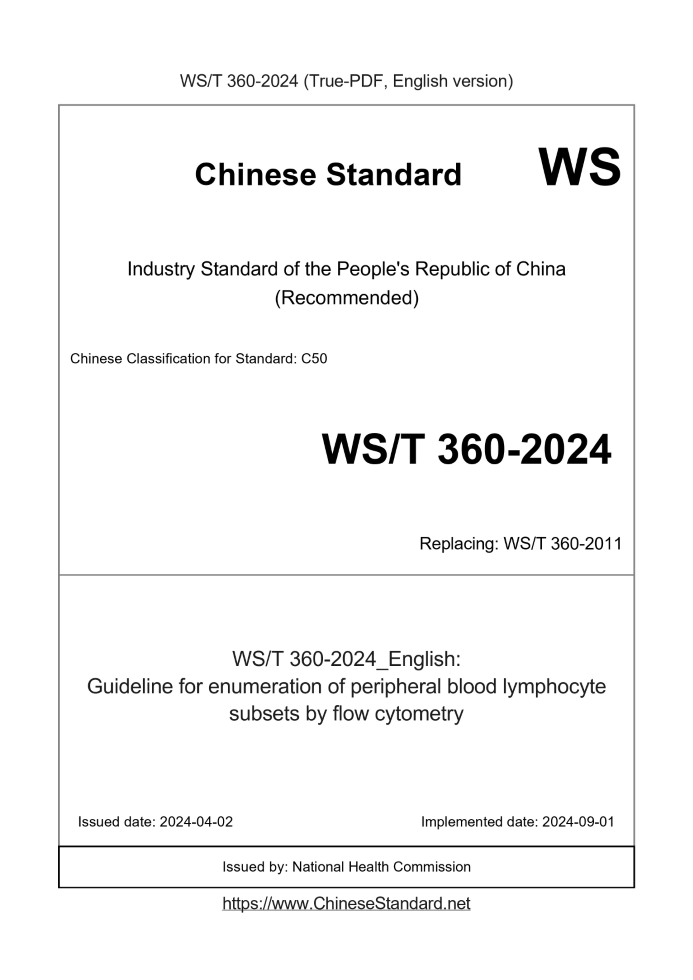
WS/T 360-2024: Guideline for enumeration of peripheral blood lymphocyte subsets by flow cytometry
Status: Valid
WS/T 360: Evolution and historical versions
| Std ID | Contents [version] | USD | STEP2 | [PDF] delivered in | Standard Title (Description) | Status |
| WS/T 360-2024 | English | 379 |
Add to Cart
|
4 days [Need to translate]
|
Guideline for enumeration of peripheral blood lymphocyte subsets by flow cytometry
| Valid |
| WS/T 360-2011 | English | 919 |
Add to Cart
|
4 days [Need to translate]
|
Guidelines for peripheral lymphocyte subsets by flow cytometry
| Obsolete |
Basic data | Standard ID | WS/T 360-2024 (WS/T360-2024) | | Description (Translated English) | Guideline for enumeration of peripheral blood lymphocyte subsets by flow cytometry | | Sector / Industry | Health Industry Standard (Recommended) | | Classification of Chinese Standard | C50 | | Classification of International Standard | 11.020 | | Word Count Estimation | 17,193 | | Date of Issue | 2024-04-02 | | Date of Implementation | 2024-09-01 | | Older Standard (superseded by this standard) | WS/T 360-2011 | | Issuing agency(ies) | National Health Commission | | Summary | This standard specifies the technical requirements for flow cytometry detection of peripheral blood lymphocyte subsets: T lymphocytes (including CD4+T cells and CD8+T cells), B lymphocytes and NK cells. This standard is applicable to the flow cytometry detection of peripheral blood lymphocyte subsets in clinical laboratories of medical institutions. | WS/T 360-2011: Guidelines for peripheral lymphocyte subsets by flow cytometry---This is a DRAFT version for illustration, not a final translation. Full copy of true-PDF in English version (including equations, symbols, images, flow-chart, tables, and figures etc.) will be manually/carefully translated upon your order.
Guidelines for peripheral lymphocyte subsets by flow cytometry
People's Republic of China Health Industry Standard
Issued by the Ministry of Health of the People's Republic of China
2011-12-14 released
2012-o6-o1 implementation
This standard was drafted in accordance with the rules given in GB/T 1.1-2009.
This standard was proposed by the Professional Committee of Clinical Laboratory Standards of the Ministry of Health.
The main drafting unit of this standard. Chinese Academy of Medical Sciences Peking Union Medical College Hospital.
The main drafters of this standard. Cui Wei, Huang Chunmei, Wang Fei, Yang Zhuo, Chen Qian.
Guidelines for detecting peripheral blood lymphocyte subsets by flow cytometry
l Range
This standard specifies the flow cytometry to detect peripheral blood lymphocyte subsets (T cells, B cells, NK cells, CDl T cells and
CD8 T cells) technical points, including specimen collection and transportation, immunofluorescence staining technology, flow cytometry detection and analysis, result reporting
Reporting and auditing.
2 Terms and definitions
The following terms and definitions apply to this document.
2.1
Differentiation antigen
Cells of different lineages appear or disappear during the process of differentiation, maturation and activation. Single gram
Long antibody to identify. Each antibody has a designated CD number, and a specific antigen that can be recognized by a specific antibody usually has the same number.
For example, the antigen recognized by the "CD1 antibody" is called the "tlD1 antigen".
2.2
Look away
The low-angle light signal collected by the optical detector directly in front of the human light is related to the size of the cell or particle.
2.3
Side scattered light
The light signal scattered by the cells collected by the optical detector at right angles to the light emitted by the person is complicated with the internal and surface structure of the cell or particle
The degree is related, such as cytoplasmic granularity, membrane irregularity and nuclear shape.
2.4
Hai Faluan' Qiangdianqian
The amount of fluorescein bound to cells or particles. The greater the number of channels of the fluorescence signal, the stronger the fluorescence intensity. In the right conditions
Below, the fluorescence intensity is related to the number of sites where a cell binds to a specific fluorescein.
2.5
Autofluorescence
Fluorescence from white bodies of unstained cells. Usually produced by pyrimidine and flavin nucleotides, the intensity of white fluorescence depends on the excitation light
The wavelength varies with the type of cell analyzed and (or) the cell activation state. Through a special specimen processing method, gray hair can be reduced
The intensity of light.
2.6
Color compensation coIor compensation
Because the fluorescence emitted by one type of fluorescein is superimposed on the wavelength range emitted by other
He Fluorescent Letter Bow scarf deducts a part of the measured fluorescent signal to correct counting errors caused by color overlap. The amount of fluorescence subtracted is appropriate
The single-stained control is determined. The corrected signal reflects the emission of a single fluorescent signal.
2.7
Zhimen gate
Based on a set of parameters (female fluorescence vs. sSC, sC/sSC, etc.) on the quadrant chart displayed by the flow cytometer, the target to be analyzed is determined
The cell population. The target cell population in the limited area is further analyzed by other parameters (such as fluorescence parameters).
2.8
Dual platform approach
A method used for flow cytometry to determine the absolute cell count. The results are derived from the detection of flow cytometry and the second instrument. First
The two instruments are usually blood cell analyzers. Flow cytometry is used to obtain the ratio of target cell subpopulations that appear in a larger number of target cell populations.
For example, the target cell population is usually lymphocyte population or white blood cell population. Analyze the absolute concentration of the target cell population of the same specimen with the first type of instrument
The result of multiplying these results is the absolute concentration of the target cell population. The disadvantage of this method is that it contains systematic errors of two systems.
2,9
Single platform approach
A method used to determine the absolute concentration of cells by flow cytometry. All results are determined by a flow cytometer. concentrated
The degree of measurement can be calculated directly by the method of measuring the volume or by adding fluorescent microspheres of known concentration. Single platform method
Going to the systematic error of the second instrument.
3 reagent
3,1 Fluorescein-labeled monoclonal antibody
Monoclonal antibodies (monoclonal antibodies) directly labeled with fluorescein are called direct-labeled antibodies. Selection of direct-labeled antibodies is the key to lymphocyte subpopulation analysis
In the key step, the reactivity of the selected antibody to the cell should be considered.
3.1.1 mAb
3.1.2 Reactivity of monoclonal antibodies to cells
CD45 is expressed on all white blood cells; CD3 is expressed on T lymphocytes; CD4 is expressed on T helper/inducible lymphocytes (CD4 T lymphocytes).
Cells) and monocytes; CD8 is expressed on cytotoxic T cells (CD8·T) and NK cells; CD19 is expressed on B lymphocytes; CD16 is expressed
In NK cells, monocytes, macrophages, granulocytes and dendritic cells, etc.; CD56 is expressed in NK cells and cytotoxic T cells.
3.1.3 Identification of lymphocyte subsets by monoclonal antibodies
3.1.4 Commonly used fluorescent dyes for direct-labeled antibodies
Fluorescein isothiocyanate (FITC), phycoerythrin (PE/RD1), phycoerythrin conjugate (PECY5), polydinoflagellate chlorophyll protein
(Pe£P), Phycoerythrin-Dezhou Red Conjugate (ECD) and Allophycocyanin (APC). Except allophycocyanin (APC), other fluorescent stains
The materials are excited by a 488nm excitation light source, and the maximum emission wavelengths are 525nm, 575nm, 670nm, 675nm and 613nm respectively.
The excitation light source of allophycocyanin (APC) is 630nm, and the maximum emission wavelength is 660nm.
3.2 Hemolysin
Use hemolysin (contains fixative) that matches the instrument, and operate in strict accordance with the instructions and precautions. If using
For hemolytic agents without fixation (such as ammonium chloride and hypotonic buffer, etc.), the stained specimens need to be stored at 4°C and completed within 1h.
Detection.
4 Specimen collection and processing
4.1 Biosecurity
There may be pathogenic or even lethal living pathogenic microorganisms in blood and body fluid samples, and all samples should be potential sources of infection
To deal with.
4.1.1 Specimen collection
Avoid being stabbed by the needle. Discard the needle in a sharps box. It is strictly prohibited to recap, bend, break the needle or remove the needle from the syringe.
4.1,2 Safe dress
All personnel who come into contact with blood samples should wear gloves and laboratory overalls. When there is a possibility of splashing during specimen processing, you should bring
Good masks and protective goggles to avoid contact with the specimens in the eyes, mouth, nose and other parts. After all work is over and before leaving the laboratory, you should take off your gloves and
handwashing.
4.1.3 Biological safety cabinet (BsC)
All operations should be carried out in a biological safety cabinet (Class I or Class II BSC); even if the conditions do not permit, the
Or aerosol operations (such as vortexing, opening the vacuum tube, etc.) still need to be performed in the BSC.
4.1.4 Centrifugation
The specimen should be placed in a closed container during centrifugation to avoid aerosol formation.
4.1.5 Suction denier
Manual or electric pipettes are used, and mouth suction is strictly prohibited.
4.1.6 Sharp weapon
Avoid using sharp tools, such as needles, glass Pasteur pipettes, glass containers, etc.
4.1.7 Spilled blood
When blood spills, wipe it off with a suitable reagent immediately, such as freshly prepared 0.71mol/L sodium hypochlorite diluted 1.10 (not diluted
Released household bleach) or appropriately diluted medical disinfectant.
4.1.8 Waste treatment and specimen inactivation
The management of laboratory waste disposal should comply with relevant national and local requirements. All specimens and other biological materials that are no longer needed should be discarded.
Put them in a yellow sealed and leak-proof plastic bag with biohazard signs. Used needles and other sharp objects should be placed in the sharps box.
Laboratory specimens need to be inactivated in advance, and the specimens are mixed with broad-spectrum iodophor and bleach for 24 hours before proper processing. by
Since bleaching agent reacts with ammonium chloride to produce toxic chlorine gas, bleaching agent cannot be used to treat solutions containing ammonium chloride.
4.1.9 Fixative
0.1%~2,0% paraformaldehyde or formaldehyde buffer are commonly used fixatives, which are used to inactivate infected specimens before analysis.
Inactivate 3 to 5 logarithmic viral loads of viruses such as HIV. After the last centrifugation in the staining process, use paraformaldehyde
Or formaldehyde buffer (pH7,0~7,4), store at 4℃ for testing. It is recommended to prepare fresh paraformaldehyde or formaldehyde buffer every week. use
When commercial lysates containing non-standard solution components, there is no need to reuse paraformaldehyde or formaldehyde buffer.
4.1, 10 Non-fixed specimens
For non-fixed specimens, laboratories should formulate appropriate biosafety rules to minimize the exposure of infectious pathogens. Due to exposure
The aerosol produced by the flow cytometer liquid flow system in the air is potentially dangerous, so you should be vigilant and strictly follow the manufacturer's hygiene.
It is recommended to proceed with material safety.
4.1.ll Equipment disinfection
The waste liquid bucket of the flow cytometer needs to be filled with 0.71 mol/L sodium hypochlorite (undiluted household bleach) which accounts for 1/10 of its volume.
Laboratory equipment should be disinfected with a solution that has the effect of inactivating the source of infection or a newly prepared 10% household bleach, especially in equipment maintenance and maintenance.
Give strict disinfection before raising.
4.2 Specimen identification
All test specimens should be labeled in time, and the label should be marked with the name of the sick person, the unique identification code of the patient, the test items, and the collection of specimens.
The date and time of the collection, if necessary, mark the testing laboratory. If an inspection application form is used, the application form should be pasted with the specimen and sent for inspection.
The request form should indicate the patient's name, test items, age, gender, date and time of specimen collection, the name of the applicant and the type of specimen
(E.g. whole blood), label the testing laboratory if necessary.
4.3 Anticoagulant and collection container
Ethylenediaminetetraacetate (EDTA-K2/EDTA-K3) anticoagulation vacuum tube is the first choice for specimen collection, and heparin sodium anticoagulation or citric acid
Sodium citrate anticoagulation (ACD) vacuum tube is used for collection, and EDTA salt anticoagulation specimens are stored stably at room temperature for 12h-24h, more than 30h
The number of granulocytes in EDTA salt anticoagulation specimens may decrease, and the anticoagulation specimens of sodium heparin or sodium citrate can be stored stably for 48h. If the specimen is used
If the blood cell analyzer performs white blood cell count and classification at the same time, EDTA salt should be selected as an anticoagulant.
4.4 Specimen quality
4.4.1 Visual observation of specimens
There are two common types of observable specimen problems. one is the degenerate or damaged specimen, which needs to be discarded immediately. The second is in specimen processing
Wrong operation occurred during the process, which requires further evaluation. The problem of incorrect operation needs to be recorded.
And the interpretation of the results are very helpful.
4.4.2 Hemolysis
Severely hemolyzed specimens should be abandoned for testing, and all abnormalities that may damage the integrity of the specimens should be closely observed and recorded
In order to facilitate subsequent processing, analysis and result interpretation.
4,4.3 Coagulation
Even a small blood clot can cause selective loss or change of certain components in the blood, and coagulated specimens should be discarded as much as possible.
4.4.4 Temperature limit
If the specimen is sent to the laboratory over a long distance, the specimen may be exposed to an environment that does not allow storage temperature, so
After receiving the specimen, confirm whether the specimen is too hot or too cold. Even if all other identification standards are normal, they should be recorded to facilitate follow-up
Processing, analysis and interpretation of results.
4.4.5 Wrong specimen label
If the specimen does not have a unique identification or the specimen label does not match the patient information (the patient's name does not match the identification), the specimen should be rejected and promptly
Communicate with relevant medical staff.
4.4.6 Specimen storage time and storage conditions
The maximum acceptable storage time for a specimen depends on the type of anticoagulant, hemolytic agent, storage conditions and cell concentration. The laboratory should be based on
The anticoagulant and hemolytic agent used determine the maximum acceptable storage time for the specimen. The laboratory should select an appropriate storage environment and hemolysis method
Method, so that there is no obvious difference between the test results of preserved specimens and fresh specimens. In principle, the specimen should be tested immediately after collection, but in practice
It is often impossible to do in operation. Specimens that cannot be detected immediately should be stored at room temperature (18°C ~ 25°C). Subsequent specimen processing
And immunostaining should be carried out in strict accordance with the reagent instructions.
4,4,7 Specimen processing method
The whole blood hemolysis method is used to recover all white blood cells as much as possible. However, for specimens from patients with chronic liver disease or hyperlipidemia,
Because the abnormal lipid metabolism leads to the decrease of red blood cell fragility, hemolysin is often unable to completely lyse red blood cells, so density gradient centrifugation is required; but
It should be noted that the density gradient centrifugation method uses density gradients or lengthy centrifugation steps, which can easily lead to uneven loss of special subpopulations.
The more steps in specimen processing, the more cells are lost. The proportion of this loss in the classification of white blood cells is not even. For all
Blood samples cannot be washed after hemolysis, which can minimize the steps of sample processing.
4.5 Transport of specimens
4.5.1 Internal inspection
For blood samples transferred in the same laboratory, the container containing the blood sample tube should be marked with a biohazard symbol, and the blood sample tube should be broken.
In the case of damage, the specimen can still be contained, and a plastic bag with a leak-proof sealing layer or a plastic container with a safety cover can be used.
4.5.2 External inspection
The regulations on the transportation of dangerous goods and the International Air Transport Association (IATA) dangerous goods rules have the same effect on the transportation of blood samples containing pathogens.
Related regulations. HIV has been listed as a UN2814 hazardous substance, with an infection level of 6.2.Packaging should comply with UN6.2 level of highly pathogenic venereal diseases
The original safe transport packaging standard, the standard packaging requires a three-tier system.
a) Waterproof inner container;
b) The second inner container that is waterproof and contains absorbent material;
c) Strong outer packaging.
The collected specimens should be submitted for inspection as soon as possible at room temperature (18℃ ~ 25℃).
5 Absolute cell counting method
5,1 Single platform approach
5.1.1 White blood cell concentration and antibody use
Pre-calculate the white blood cell concentration in the specimen by counting with a counting plate or using a hematology analyzer, and adjust it strictly in accordance with the operating instructions
Optimal ratio of specimen and antibody. Samples with too few lymphocytes should reduce the amount of monoclonal antibody. Specimens with excessive lymphocytes should be used with 1% white
Dilute the protein or other protein in phosphate buffered saline (PBS) to an appropriate concentration.
5.1.2 Pipetting volume
The pipetting volume of specimens and fluorescent microspheres should be precise to ensure accurate counting of the concentration and sample volume of quantitative microspheres added.
5.1.3 Number of pipetting
When using a specimen processing tube coated with a known number of fluorescent microspheres, you only need to pipette once; while directly adding a known concentration of fluorescent microspheres to the specimen
The photomicrosphere suspension requires pipetting twice.
5.1.4 Centrifugation
To avoid the loss of fluorescent microspheres, do not centrifuge and wash the cells after lysis.
5.2 Dual platform approach
The absolute count of lymphocyte subsets is calculated from the white blood cell count determined by the complete blood cell analyzer.
Line calculation.
The single-platform method is the preferred method, which reduces the inter-room variability and avoids the systematic errors among multiple instruments.
6 Immunofluorescence staining
6.2.2 Lysis of red blood cells
The method of lysing red blood cells is related to the hemolysin used, and the lysis time and method are operated in accordance with the instructions of the hemolysin used.
6.2.3 Centrifugation
The centrifugal washing method is related to the hemolysin, and the operation is carried out according to the instructions of the hemolysin used. Single-platform absolute counting method for lysing red blood cells
After that, do not centrifuge and wash, and add quantitative fluorescent microspheres to the sample to be tested before testing.
6.2.4 Preservation of specimens after staining
The prepared specimens should be stored in the dark at 40 ℃ ~ 1o ℃ before analysis on the computer, and tested on the computer within 24 hours. Mix the cells before testing.
It is recommended to use in vitro diagnostic reagents with commercial combination antibodies. If the laboratory prepares the combined monoclonal antibody itself, it is required to be fresh before each test
Preparation. Each antibody in the combination antibody needs to be titrated separately to determine the best separation titer of its noise and positive signal, and detect it as
The average fluorescence intensity and positive rate of the combined antibody used and used alone as one of the components of the combined antibody must be comparable in the mean value
Within ±2SD.
7 Control specimen
7.1 Isotype control
Lymphocyte subpopulation analysis does not require isotype control, because the CD3, CD4, and CD8 positive cells cluster independently, and the negative cell population
Easy to distinguish.
7.2 Positive control for methodology
7.2.1 Purpose
Monitor whether there are problems in the link before the flow cytometer on-board analysis. The results of the methodology positive control due to a certain disease
Outside the scope of examination, it will not cause errors in the test results of other specimens processed at the same time. Due to incomplete red blood cell lysis or staining effect
Poor, all specimens including the positive control will have result bias.
7.2.2 Type
Whole blood samples, commercial fluorescent microsphere reagents.
7,2.3 Frequency of use
You need to use it every time you get on the machine.
7.3 Positive control of evaluation reagent
7.3.1 Purpose
Check whether there is a problem with the staining efficiency of the new batch of reagents and the current batch of reagents. When a problem with the reagent is suspected, use the reagent
Simultaneous operation with reagents with known acceptable performance batch numbers for verification.
7.3.2 Type
Whole blood samples, freeze-dried lymphocytes.
7.3.3 Frequency of use
Before and after replacing reagents.
8 Quality control of flow cytometer
8.1 Verify and adjust the optical path and standardize the optical path settings
8.1.1 Voltage and gain
Every time you turn on the machine, first use the fluorescent microsphere light path quality control product to set and adjust the voltage and gain of the optical detection channel of the instrument to ensure its
It is within the acceptable range set by the manufacturer or laboratory according to the specific experimental state, and the performance of the instrument is stable every time it is turned on.
Fluorescent antibodies or whole blood specimens are most suitable.
8.1.2 Peak value and coefficient of variation
Adjust the scattered light peak and fluorescence peak to be placed in the same narrow range of the corresponding channel, requiring the light used by all optical detection channels
The academic parameters and fluorescence parameters are homogeneous peaks, and the coefficient of variation should meet the technical requirements of the flow cytometer used.
8.1.3 Standardization of instrument settings
Measure the average channel number and coefficient of variation (CV%) of fluorescent microspheres in each optical detection channel for 5 consecutive days.
4 times, and then calculate the mean (Ξ) and standard deviation (SD) of these parameters, with Ξ±2SD as the acceptable range. When deviations occur, check
Find and solve the problem, and then re-adjust the light path. Maintain the above-mentioned instrument settings for subsequent instrument sensitivity and fluorescence compensation
Set up monitoring.
8.2 Adjust fluorescence resolution
8.2.1 Optical circuit voltage
The voltage of the photomultiplier tube (PMT) was adjusted with a fresh whole blood sample without direct-labeled antibody but lysed with hemolysin. Unstained lymphoid cells
The autofluorescence of the cells should be completely in the negative area, and the positive rate of lymphocytes in the fluorescence histogram in the detection channel used is < 2%, and the double fluorescence is scattered.
The unstained cells in the dot plot are located in the lower left quadrant of the scatter plot.
Keep the same PMT voltage setting as when testing clinical specimens, and use fluorescent microspheres with known relative fluorescence intensity to measure on the machine, such as an instrument
The standard product provided by the manufacturer. The acceptable average fluorescence intensity range of each type of fluorescent microspheres is obtained by repeating the measurement for 5 consecutive days and ⒛ times.
Surrounding. The average fluorescence intensity detection value of each type of fluorescent microsphere is required, and its correlation coefficient should be ≥0,98.When the instrument PMT voltage is unchanged
Under the circumstances, the fluorescence linearity and average fluorescence intensity difference of various fluorescent microspheres should remain unchanged. The drawing of the fluorescence line graph complies with the manufacturer’s
Suggest.
8.2.2 Weak expression and autofluorescence
Evaluate the ability of standards or calibrators or cells to distinguish between weakly expressed fluorescence and autofluorescence.
8.2.3 Coefficient of variation between peaks
Determine the minimum acceptable data between peaks, monitor this difference and correct for any daily deviations.
The flow cytometer should enable each fluorescence detection channel to distinguish between weak expression peaks and autofluorescence peaks.
The recommended cycle of the device manufacturer.
8.3 Adjust fluorescence compensation
8.3.1 Purpose
When two or more antibody combinations are used for lymphocyte subpopulation analysis, or when the voltage and gain of the optical detection channel occur
When changes, or when the instrument is repaired and maintained, fluorescence compensation adjustments are required.
8.3.2 Method
8.3.2.1 Fluorescence compensation reagent
Select the compensation reagent that matches the strongest fluorescent signal. When analyz...
Tips & Frequently Asked Questions:Question 1: How long will the true-PDF of WS/T 360-2024_English be delivered?Answer: Upon your order, we will start to translate WS/T 360-2024_English as soon as possible, and keep you informed of the progress. The lead time is typically 2 ~ 4 working days. The lengthier the document the longer the lead time. Question 2: Can I share the purchased PDF of WS/T 360-2024_English with my colleagues?Answer: Yes. The purchased PDF of WS/T 360-2024_English will be deemed to be sold to your employer/organization who actually pays for it, including your colleagues and your employer's intranet. Question 3: Does the price include tax/VAT?Answer: Yes. Our tax invoice, downloaded/delivered in 9 seconds, includes all tax/VAT and complies with 100+ countries' tax regulations (tax exempted in 100+ countries) -- See Avoidance of Double Taxation Agreements (DTAs): List of DTAs signed between Singapore and 100+ countriesQuestion 4: Do you accept my currency other than USD?Answer: Yes. If you need your currency to be printed on the invoice, please write an email to Sales@ChineseStandard.net. In 2 working-hours, we will create a special link for you to pay in any currencies. Otherwise, follow the normal steps: Add to Cart -- Checkout -- Select your currency to pay. Question 5: Should I purchase the latest version WS/T 360-2024?Answer: Yes. Unless special scenarios such as technical constraints or academic study, you should always prioritize to purchase the latest version WS/T 360-2024 even if the enforcement date is in future. Complying with the latest version means that, by default, it also complies with all the earlier versions, technically. |