Path: Home > MISC > Page347 > WS/T 359-2024 || Home > Standard_List > MISC > Page347 > WS/T 359-2024 Price & DeliveryUS$179.00 · In stock
Delivery: <= 3 days. True-PDF full-copy in English will be manually translated and delivered via email.
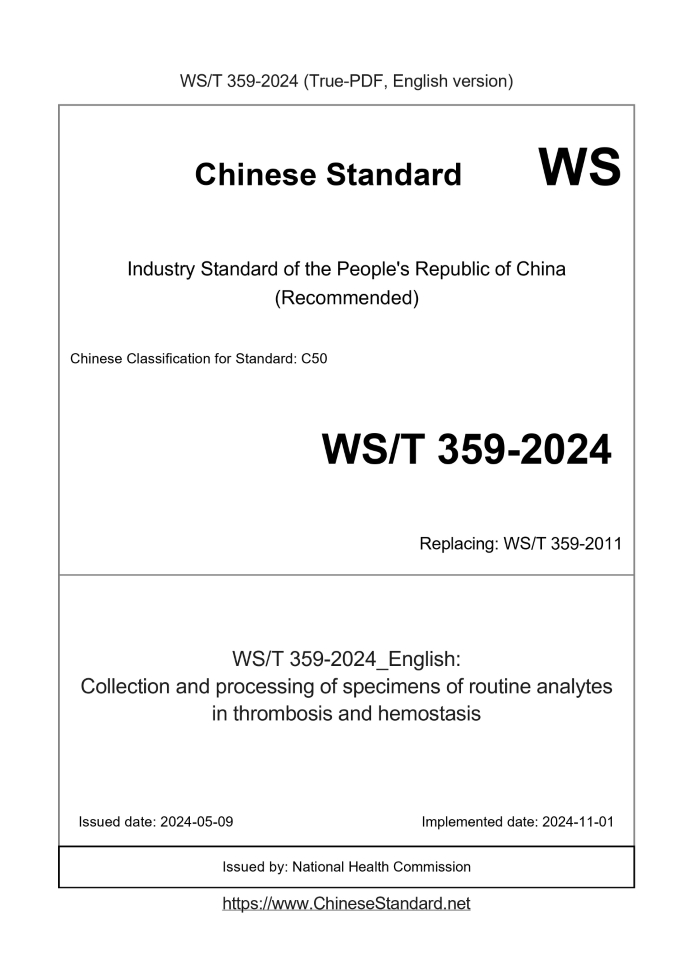
WS/T 359-2024: Collection and processing of specimens of routine analytes in thrombosis and hemostasis
Status: Valid
WS/T 359: Evolution and historical versions
| Std ID | Contents [version] | USD | STEP2 | [PDF] delivered in | Standard Title (Description) | Status |
| WS/T 359-2024 | English | 179 |
Add to Cart
|
3 days [Need to translate]
|
Collection and processing of specimens of routine analytes in thrombosis and hemostasis
| Valid |
| WS/T 359-2011 | English | 399 |
Add to Cart
|
3 days [Need to translate]
|
Collection and processing of blood specimens for testing plasma-based coagulation assays
| Obsolete |
Basic data | Standard ID | WS/T 359-2024 (WS/T359-2024) | | Description (Translated English) | Collection and processing of specimens of routine analytes in thrombosis and hemostasis | | Sector / Industry | Health Industry Standard (Recommended) | | Classification of Chinese Standard | C50 | | Classification of International Standard | 11.020 | | Word Count Estimation | 8,816 | | Date of Issue | 2024-05-09 | | Date of Implementation | 2024-11-01 | | Older Standard (superseded by this standard) | WS/T 359-2011 | | Issuing agency(ies) | National Health Commission | | Summary | This standard specifies the requirements for specimen collection and processing of common test items for thrombosis and hemostasis (including coagulation screening test, anticoagulant protein, coagulation factor and platelet function test, etc.). This standard is applicable to the specimen collection and processing of common test items for thrombosis and hemostasis in clinical laboratories of medical institutions. | WS/T 359-2011: Collection and processing of blood specimens for testing plasma-based coagulation assays
---This is a DRAFT version for illustration, not a final translation. Full copy of true-PDF in English version (including equations, symbols, images, flow-chart, tables, and figures etc.) will be manually/carefully translated upon your order.
Collection and processing of blood specimens for testing plasma-based coagulation assays
ICs 11.020
C50
People's Republic of China Health Industry Standard
Issued by the Ministry of Health of the People's Republic of China
Plasma coagulation test blood specimen
Collection and processing guide
2011-12-14 released
2012-o6-o1 implementation
This standard was drafted in accordance with the rules given in GB/T 1.1-2009.
This standard was proposed by the Professional Committee of Clinical Laboratory Standards of the Ministry of Health.
The main drafting unit of this standard. Clinical Laboratory Center of the Ministry of Health.
The main drafters of this standard. Peng Mingting, Gu Xiaolin, Shi Lifei, Li Chenbin, Shen Ziyu.
1 Scope
This standard specifies the requirements for the collection and processing of blood specimens for plasma coagulation experiments.
This standard applies to institutions responsible for collecting patient specimens and preparing plasma for plasma coagulation testing, as well as related manufacturers.
2 Terms and definitions
The following terms and definitions apply to this document.
2.1
Prothrombin time
The time required for plasma to coagulate after reacting with thromboplastin reagents (for example, tissue factor and calcium chloride).
2.2
Activated partial thromboplastin time
"Plasma reacts with an appropriate amount of calcium chloride (CaC12), partial thromboplastin reagent and contact factor activator (such as kaolin), and coagulation occurs.
time needed.
2.3
Fibrinogen determination
When excess thrombin is added to the diluted plasma, the plasma clotting time is negatively correlated with the fibrinogen concentration in the plasma.
Time, the content of fibrinogen can be obtained.
2.4
Thrombin time
The time required to form a fibrin clot after adding a certain active unit of thrombin to the plasma.
2.5
International normalized ratio
INR is the abbreviation for International Normalized Ratio. The ratio of the patient's plasma PT value measured by thromboplastin to the average PT value of normal people
And the ISI value of the thromboplastin reagent used (the calibration of the ISI value should be traced to the World Health Organization international reference material), and calculate the INR.
2.6
Xia Rixi; Every Xun layer An Yu decrees to stay Xun
A mathematical index reflecting the responsiveness of the PT detection system to vitamin K-dependent coagulation factor deficiency.
Note 1.It is a relative slope for calculating INR.
Note 2.A low IsI value indicates the high reactivity of the PT detection system, and a high IsI value indicates the low reactivity of the PT detection system.
Note 3.The IsI value is determined according to the method specified in the World Health Organization guidelines and is provided to the user by the manufacturer of the specific instrument/reagent.
2.7
Quality Control Plasma
It is derived from human or animal blood, or artificially made fresh, frozen or freeze-dried plasma for quality control.
2.8
Blood collection equipment
Vacuum blood collection tubes, syringes or other instruments that have no active surface.
2.9
Blood collection system
A system composed of some components, such as catheters, connecting devices, syringes, needles, and collection equipment, is used for blood collection.
2.10
Vascular access device
Insert a vein or artery into the circulatory system to implement intravenous fluid and/or drug infusion.
2.11
Knife EⅡ empty ring only
When the catheter is placed for blood collection, the blood fills the entire inner cavity of the catheter.
2.12
Hematocrit
The relative proportion of the volume of red blood cells in a certain volume of whole blood.
3 Collection of specimens
3.1 Collection equipment
3.1.1 Needle
Different types of needles are selected according to the blood volume, the age of the patient and the thickness of the vein.
3.1.2 Blood collection equipment
3.1.2.1 Vacuum blood collection system
The vacuum blood collection system is most commonly used. The system consists of three parts. a sterile blood sampling needle, a needle holder, and a vacuum blood sampling with anticoagulant
tube. If these components are provided by different manufacturers, the effect of supporting use should be checked and evaluated.
3.1.2.2 Syringe
It is required to use a disposable plastic syringe, and the recommended volume of the syringe should be ≤zO mL.
3.2 Anticoagulant
3.2.1 Selection of anticoagulant
The anticoagulant used for plasma coagulation experiments should be 105mmol/L~109mmol/L (3.13%~3.2%, usually set at 3.2%)
Trisodium citrate hydrate (Na3c6H5O7·2H20). Other anticoagulants (such as oxalate, heparin or EDTA) cannot be used.
3.2,2 blood/anticoagulant ratio
The volume ratio of blood to hydrated sodium citrate anticoagulant should be 9.1.When the amount of collected specimens is not enough, the ratio will be reduced, which may lead to detection
The result is incorrect.
3.2.3 Adjustment of citrate concentration
When the hematocrit value is ≥0.55L/L (55%), the final concentration of citrate in the blood of the patient needs to be adjusted.
Note. For the hematocrit value ≤ 0.20L/L (20%), there is not enough data to determine the adjustment of citrate concentration.
3.3 Label
The label is made of a material that can still stick to the refrigerator. The label should be affixed to the test tube, not the lid. The information provided should go to
Include the following at least.
a) Patient's name;
b) Unique identification;
c) The date and time of blood sampling.
3.4 Application Form
The laboratory should establish an application procedure for plasma coagulation experiments. The information provided in the application form should include the following.
a) Patient's name;
b) age or date of birth;
c) gender;
d) The area where the patient is located (inpatient or outpatient, emergency, etc.);
e) Unique identification;
f) The items to be tested;
g) Diagnosis or main symptoms;
h) The use of anticoagulant drugs;
i) Apply for the signature of the doctor;
j) Date and time of blood collection.
3.5 Venipuncture procedures
3.5.1 Check patient information.
3.5.2 Equipped with blood collection equipment, wear gloves, comfort the patient, and adjust the patient's blood collection posture.
3.5.3 Ask the patient to make a fist and choose the vein position. Clean the venipuncture site, tie the cuff, check the blood collection equipment, perform venipuncture,
After the required blood volume is drawn, the cuff is removed, the patient's hand is loosened, and the puncture site is pressed with gauze or cotton ball to pull out the needle. Requirements during blood collection
The cuff strapping time should not exceed 1 min.
3.5.4 If a syringe is used, the needle of the syringe should be removed after blood sampling, and the blood should be slowly injected along the test tube wall until it contains an appropriate volume of anticoagulant
In the test tube, gently invert to mix the blood and anticoagulant thoroughly.
3.5.5 Label the test tube, record the time of specimen collection, and send the labeled blood test tube to the testing laboratory.
3.6 Precautions for specimen collection
3.6.1 Under certain circumstances, a blood collection system or syringe can be used to collect blood samples from a vascular access device (VAD). From
When collecting blood samples in VAD, carefully check all parts of the blood collection system (VAD, connecting equipment, syringe, needle, and collection device).
To avoid hemolysis and inaccurate blood sampling volume that may be caused by air leakage. It is necessary to avoid sampling through heparin flushed tubing as much as possible.
Collect blood. If VAD must be used for blood sampling, the possible heparin contamination and specimen dilution should be considered. In this case, the pipeline should be
Flush with 5mL saline, the initial 5mL blood or 6 times the volume of the VAD dead space should be discarded.
3.6.2 Regardless of whether a vacuum blood collection tube, a syringe or a closed venous indwelling needle is used for venous blood collection, a second tube of blood must be collected.
Used for the detection of coagulation specimens.
3,6.3 All specimens should be collected in a container on the activated surface.
3.6.4 For any unexpected abnormal plasma coagulation test results, re-collect specimens and repeat the experiment.
3.6.5 All test tubes should be inverted at least 4 times to mix well. Excessive mixing may cause hemolysis and/or platelet activation, leading to errors
Wrong result.
4 Transport of specimens
After the specimens are collected, the transportation links should be reduced and the transit time should be shortened. The transmission of the specimens should be handled by trained personnel and regulated by the system.
When transporting specimens by means of pneumatic transmission, it should be confirmed whether factors such as severe vibration and temperature affect the test results.
5 Receipt of specimens
5.1 The application form is consistent with the information on the test tube label.
5.2 The time from specimen collection to receipt of the specimen by the laboratory shall comply with the laboratory's regulations.
5.3 The laboratory should establish standards for identifying unqualified specimens. If the specimen has a clot, the wrong anticoagulant is used or the blood volume is not enough (with the label
When the difference is greater than 10%), the specimen should be rejected.
5.4 If the specimen is unqualified, the laboratory should contact the clinic immediately to take further measures and reach an agreement with the clinical medical staff
Before, “unqualified” specimens cannot be discarded.
6 Handling of specimens
6.1 Preparation of specimens
When separating plasma, place the capped test tube containing the specimen under the specified speed and time conditions (room temperature, 1500g, no less than 15min)
Centrifuge to obtain platelet-poor plasma (platelet count (10×109/L). The centrifuge should use a swing-out rotor to reduce plasma and blood
Remixing of plates.
6.2 Precautions for specimen handling
6.2.1 It should not be used when the specimen has visible hemolysis, because it may activate coagulation factors and interfere with the end point determination.
6.2.2 When using optical principle detection equipment, when the specimen has jaundice, lipemia or interfering substances that affect the intensity of light scattering, it may be
The results have an impact and alternative methods should be used.
6.2.3 Every 6 months or after the centrifuge is repaired, the centrifugal force and the centrifugation time should be verified to ensure that the number of plasma platelets after centrifugation is available.
Acceptable.
7 Preservation of specimens
7.1 The allowable time interval between specimen collection and measurement depends on the temperature during specimen storage and transportation. Plasma coagulation test specimen
It should be saved according to the following procedure.
7.2 The specimens used for PT determination without centrifugation or unseparated plasma after centrifugation should be stored in unopened test tubes at 18℃ ~ 24℃
It should be determined within 24h after specimen collection. Storage at 2℃~4℃ may cause cold activation of factor Ⅶ and change the PT
result.
7.3 When testing APTT specimens from patients not using heparin, the specimens without plasma (not centrifuged or centrifuged) are stored in unopened test tubes.
In the presence of 2 ℃ ~ 4 ℃ or 18 ℃ ~ 24 ℃ conditions, it should be determined within 4 hours after specimen collection.
7.4 When specimens suspected of containing unfractionated heparin are used for APTT determination, they should be stored at 2°C ~ 4°C or 18°C ~24°C.
Centrifugation within 1h after collection, plasma determination should be determined within 4h after specimen collection.
7.5 Specimens used for other determinations (such as thrombin time determination, protein C) should be stored at 2℃~4℃ or 18℃~24℃.
Centrifugation and determination within 4h after specimen collection.
7.6 If the specimen used for PT determination is within 24 hours, and the specimen used for APTT and other item determination cannot be completed within 4 hours,
The plasma should be separated and frozen at a temperature of zO°C, and can be stored at a maximum of 2 weeks or at a temperature of 70°C for a maximum of 6 months. Frozen plasma specimens should be in
Melt quickly in a 37℃ water bath, mix gently and measure immediately. If the melted specimen cannot be measured immediately, it should be temporarily stored at 4℃, and
The measurement was completed within 2h.
7.7 When the testing location is far from the location of specimen collection and centrifugation, the plasma should be separated within 1 h after specimen collection, and 4 h after specimen collection
Internal determination.
7.8 The laboratory shall ensure the integrity of the specimen identification, and ensure that the specimen is in good condition from receipt to analysis.
Tips & Frequently Asked Questions:Question 1: How long will the true-PDF of WS/T 359-2024_English be delivered?Answer: Upon your order, we will start to translate WS/T 359-2024_English as soon as possible, and keep you informed of the progress. The lead time is typically 1 ~ 3 working days. The lengthier the document the longer the lead time. Question 2: Can I share the purchased PDF of WS/T 359-2024_English with my colleagues?Answer: Yes. The purchased PDF of WS/T 359-2024_English will be deemed to be sold to your employer/organization who actually pays for it, including your colleagues and your employer's intranet. Question 3: Does the price include tax/VAT?Answer: Yes. Our tax invoice, downloaded/delivered in 9 seconds, includes all tax/VAT and complies with 100+ countries' tax regulations (tax exempted in 100+ countries) -- See Avoidance of Double Taxation Agreements (DTAs): List of DTAs signed between Singapore and 100+ countriesQuestion 4: Do you accept my currency other than USD?Answer: Yes. If you need your currency to be printed on the invoice, please write an email to Sales@ChineseStandard.net. In 2 working-hours, we will create a special link for you to pay in any currencies. Otherwise, follow the normal steps: Add to Cart -- Checkout -- Select your currency to pay. Question 5: Should I purchase the latest version WS/T 359-2024?Answer: Yes. Unless special scenarios such as technical constraints or academic study, you should always prioritize to purchase the latest version WS/T 359-2024 even if the enforcement date is in future. Complying with the latest version means that, by default, it also complies with all the earlier versions, technically. |