Path: Home > GB/T > Page318 > GB/T 32151.50-2025 || Home > Standard_List > GB/T > Page318 > GB/T 32151.50-2025 Price & DeliveryUS$679.00 · In stock
Delivery: <= 5 days. True-PDF full-copy in English will be manually translated and delivered via email.
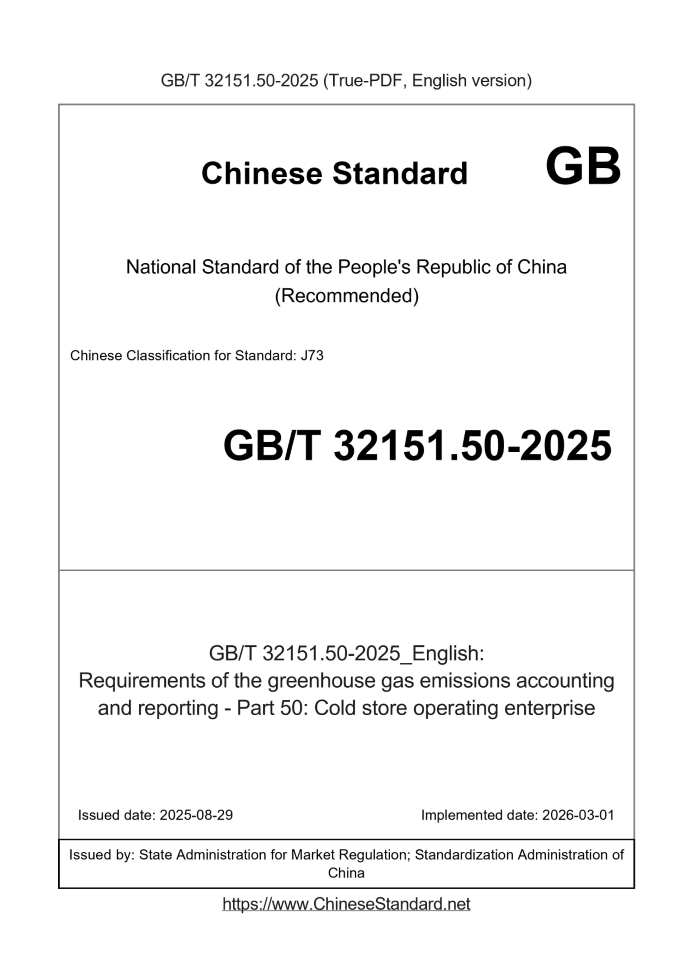
GB/T 32151.50-2025: Requirements of the greenhouse gas emissions accounting and reporting - Part 50: Cold store operating enterprise
Status: Valid
| Std ID | Contents [version] | USD | STEP2 | [PDF] delivered in | Standard Title (Description) | Status |
| GB/T 32151.50-2025 | English | 679 |
Add to Cart
|
5 days [Need to translate]
|
Requirements of the greenhouse gas emissions accounting and reporting - Part 50: Cold store operating enterprise
| Valid |
Basic data | Standard ID | GB/T 32151.50-2025 (GB/T32151.50-2025) | | Description (Translated English) | Requirements of the greenhouse gas emissions accounting and reporting - Part 50: Cold store operating enterprise | | Sector / Industry | National Standard (Recommended) | | Classification of Chinese Standard | J73 | | Classification of International Standard | 97.130.20 | | Word Count Estimation | 34,320 | | Date of Issue | 2025-08-29 | | Date of Implementation | 2026-03-01 | | Issuing agency(ies) | State Administration for Market Regulation; Standardization Administration of China | GB/T 32151.50-2025: Requirements of the greenhouse gas emissions accounting and reporting - Part 50: Cold store operating enterprise
---This is an excerpt. Full copy of true-PDF in English version (including equations, symbols, images, flow-chart, tables, and figures etc.), auto-downloaded/delivered in 9 seconds, can be purchased online: https://www.ChineseStandard.net/PDF.aspx/GBT32151.50-2025
ICS 97.130.20
CCSJ73
National Standards of the People's Republic of China
Greenhouse gas emissions accounting and reporting requirements
Part 50.Cold Storage Operating Companies
Published on 2025-08-29
Implemented on 2026-03-01
State Administration for Market Regulation
The State Administration for Standardization issued a statement.
Table of Contents
Preface III
Introduction V
1.Scope 1
2 Normative References 1
3.Terms and Definitions 1
4.Accounting Boundaries 2
4.1 General Rules 2
4.2 Scope of Accounting and Reporting 3
5.Accounting Steps and Methods 3
5.1 Accounting Steps 3
5.2 Accounting Methods 3
6.Data Quality Management
7.Report Content and Format
7.1 General Rules 7
7.2 Basic Information of the Reporting Entity
7.3 Greenhouse gas emissions 7
7.4 Activity Data and Sources 7
7.5 Emission Factors and Sources 7
7.6 Other Reporting Information 7
Appendix A (Informative) Schematic Diagram of Greenhouse Gas Emissions Accounting Boundaries for Cold Storage Operating Enterprises 8
Appendix B (Informative) Report Format Template 9
Appendix C (Informative) Default values for relevant parameters. 14
Appendix D (Informative) GWP values of common refrigerant greenhouse gases 18
Appendix E (Normative) Principles and Supporting Documents for Determining the Values of Non-Fossil Energy Electricity Emission Factors 19
E.1 Principles for Determining Electricity Emission Factor Values 19
E.2 Relevant supporting documents 19
Appendix F (Informative) Data Quality Control Plan Template 20
References 25
Foreword
This document complies with the provisions of GB/T 1.1-2020 "Standardization Work Guidelines Part 1.Structure and Drafting Rules of Standardization Documents".
Drafting.
This document is Part 50 of GB/T 32151, "Requirements for Accounting and Reporting of Greenhouse Gas Emissions". GB/T 32151 has been published as follows.
Part 2.
---Part 1.Power Generation Enterprises;
---Part 2.Power Grid Enterprises;
---Part 3.Magnesium Smelting Enterprises;
---Part 4.Aluminum Smelting Enterprises;
---Part 5.Steel Production Enterprises;
---Part 6.Civil Aviation Enterprises;
---Part 7.Flat Glass Manufacturers;
---Part 8.Cement Production Enterprises;
---Part 9.Ceramic Manufacturing Enterprises;
---Part 10.Chemical Production Enterprises;
---Part 11.Coal Production Enterprises;
---Part 12.Textile and Apparel Enterprises;
---Part 13.Independent Coking Plants;
---Part 14.Other Non-ferrous Metal Smelting and Rolling Enterprises;
---Part 15.Petrochemical Enterprises;
---Part 16.Oil and Gas Production Enterprises;
---Part 17.Fluorochemical Enterprises;
---Part 18.Forging Enterprises;
---Part 19.Heat Treatment Enterprises;
---Part 20.Furniture Manufacturers;
---Part 21.Foundry Enterprises;
---Part 22.Livestock and Poultry Farming Enterprises;
---Part 23.Plantation Institutions;
---Part 24.Electronic Equipment Manufacturers;
---Part 25.Food, Tobacco, Alcohol, Beverages and Refined Tea Enterprises;
---Part 27.Land Transport Enterprises;
---Part 28.Mining Enterprises;
---Part 29.Machinery and Equipment Manufacturing Enterprises;
---Part 30.Water Transport Enterprises;
---Part 31.Timber Processing Enterprises;
---Part 32.Paint Manufacturers;
---Part 34.Carbon Materials Manufacturing Enterprises;
---Part 35.Manufacturers of Fiberglass Products;
---Part 36.Thermal Insulation Material Manufacturers;
---Part 37.Manufacturers of sintered building materials for walls, roofs, and roads;
---Part 38.Cement Product Manufacturers;
---Part 39.Building Plaster Manufacturers;
---Part 40.Manufacturers of Building Waterproofing Materials;
---Part 41.Industrial Silicon Production Enterprises;
---Part 42.Copper Smelting Enterprises;
---Part 43.Lead Smelting Enterprises;
---Part 44.Zinc Smelting Enterprises;
---Part 45.Phosphoric Acid and Phosphate Enterprises;
---Part 46.Waste Battery Processing and Disposal Companies;
---Part 47.Chemical Fiber Production Enterprises;
---Part 50.Cold Storage Operating Companies
Please note that some content in this document may involve patents. The issuing organization of this document assumes no responsibility for identifying patents.
This document was jointly proposed by the Ministry of Ecology and Environment of the People's Republic of China and the China National Light Industry Council.
This document was prepared by the National Technical Committee on Refrigeration Standardization (SAC/TC119) and the National Technical Committee on Carbon Emission Management Standardization (SAC/TC119).
TC548) is jointly under the jurisdiction of the State.
This document was drafted by. Huashang International Engineering Co., Ltd., Tianjin University of Commerce, Chengdu Yinli Cold Chain Logistics Co., Ltd., and Guangdong Xin
Gongxiao Tianye Cold Chain Group Co., Ltd., Beijing Shoufa Smart Logistics Co., Ltd., Guangzhou University, Binglun Environmental Technology Co., Ltd.
Iceberg Refrigeration & Heating Technology Co., Ltd., Weihai Yunshan Technology Co., Ltd., COFCO Engineering & Testing & Certification Co., Ltd., Guangzhou Business College, Denver
Si (China) Investment Co., Ltd., Jiangsu Jingchuang Electric Co., Ltd., Zhejiang Commercial Machinery Factory Co., Ltd., Guangdong Guanghong Food Group
Group Limited Company.
The main drafters of this document are. Yin Congxu, Liu Bin, Xie Bin, Liu Shengyan, Liu Guanghai, Jin Xin, Ma Jin, Wang Liqun, Tan Yong'an, and Si Chunqiang.
Sun Zhili, Huang Zhihua, Han Xiao, Chen Huan, Lü Shiliang, Xu Yong, Gao Wei, Ma Chao, Han Guangrun, Li Kun, Song Jianfei.
introduction
Climate change caused by human activities is widely recognized as one of the greatest challenges facing the world and will continue to do so for decades to come.
Climate change impacts humans and related activities. It affects both humans and natural systems, impacting resource availability, economic activity, and human well-being.
This has a significant impact on human well-being. Relevant international organizations, countries, and regions are developing and implementing international, regional, national, and local greenhouse gas emission standards.
The goal is to implement management programs to reduce the concentration of greenhouse gases (GHG) in the Earth's atmosphere and help humanity adapt to climate change.
Relevant greenhouse gas emission management solutions need to be based on the best scientific knowledge and adopt effective, gradual measures to address the challenges posed by climate change.
Various threats. Standards help transform this scientific knowledge into tools to address climate change. Greenhouse gas emission management schemes rely on...
It relies on the quantification, monitoring, and reporting of greenhouse gases.
GB/T 32151, "Requirements for Greenhouse Gas Emission Accounting and Reporting," specifies greenhouse gas emission accounting and reporting requirements at different enterprise levels.
The purpose of these requirements is to specify greenhouse gas emission boundaries, measurement and testing requirements, accounting procedures, and accounting methods for different types of enterprises.
Methods, data quality management, report content and format, etc. GB/T 32151 is proposed to consist of the following parts.
---Part 1.Power Generation Enterprises;
---Part 2.Power Grid Enterprises;
---Part 3.Magnesium Smelting Enterprises;
---Part 4.Aluminum Smelting Enterprises;
---Part 5.Steel Production Enterprises;
---Part 6.Civil Aviation Enterprises;
---Part 7.Flat Glass Manufacturers;
---Part 8.Cement Production Enterprises;
---Part 9.Ceramic Manufacturing Enterprises;
---Part 10.Chemical Production Enterprises;
---Part 11.Coal Production Enterprises;
---Part 12.Textile and Apparel Enterprises;
---Part 13.Independent Coking Plants;
---Part 14.Other Non-ferrous Metal Smelting and Rolling Enterprises;
---Part 15.Petrochemical Enterprises;
---Part 16.Oil and Gas Production Enterprises;
---Part 17.Fluorochemical Enterprises;
---Part 18.Forging Enterprises;
---Part 19.Heat Treatment Enterprises;
---Part 20.Furniture Manufacturers;
---Part 21.Foundry Enterprises;
---Part 22.Livestock and Poultry Farming Enterprises;
---Part 23.Plantation Institutions;
---Part 24.Electronic Equipment Manufacturers;
---Part 25.Food, Tobacco, Alcohol, Beverages and Refined Tea Enterprises;
---Part 26.Paper and Paper Products Manufacturing Enterprises;
---Part 27.Land Transport Enterprises;
---Part 28.Mining Enterprises;
---Part 29.Machinery and Equipment Manufacturing Enterprises;
---Part 30.Water Transport Enterprises;
---Part 31.Timber Processing Enterprises;
---Part 32.Paint Manufacturers;
---Part 33.Pigment Manufacturers;
---Part 34.Carbon Materials Manufacturing Enterprises;
---Part 35.Manufacturers of Fiberglass Products;
---Part 36.Thermal Insulation Material Manufacturers;
---Part 37.Manufacturers of sintered building materials for walls, roofs, and roads;
---Part 38.Cement Product Manufacturers;
---Part 39.Building Plaster Manufacturers;
---Part 40.Manufacturers of Building Waterproofing Materials;
---Part 41.Industrial Silicon Production Enterprises;
---Part 42.Copper Smelting Enterprises;
---Part 43.Lead Smelting Enterprises;
---Part 44.Zinc Smelting Enterprises;
---Part 45.Phosphoric Acid and Phosphate Enterprises;
---Part 46.Waste Battery Processing and Disposal Companies;
---Part 47.Chemical Fiber Production Enterprises;
---Part 48.Urban Gas Supply Enterprises;
---Part 49.Waste Landfill Management Companies;
---Part 50.Cold Storage Operating Companies
To facilitate domestic and international exchanges, and in accordance with the relevant requirements of the Intergovernmental Panel on Climate Change (IPCC), this series of documents...
The unit of measurement is expressed in the form of "International Unit of Measurement for Substance (Element)" or "Substance (Element) International Unit of Measurement", such as in the tC table.
t< sub>carbon< /sub> represents tons of carbon, t< sub>CO2< /sub> represents tons of carbon dioxide, t< sub>CO2e< /sub> represents tons of carbon dioxide equivalent, t< sub>CH4< /sub> represents tons of methane, and t< sub>C/GJ< /sub> represents tons of carbon per gigabyte.
Joules and Nm3 represent cubic meters under standard conditions, etc.
Greenhouse gas emissions accounting and reporting requirements
Part 50.Cold Storage Operating Companies
1.Scope
This document specifies the accounting boundaries, data quality management, reporting content, and format for greenhouse gas emissions of cold storage operators.
This document applies to the accounting and reporting of greenhouse gas emissions by cold storage operators.
2 Normative references
The contents of the following documents, through normative references within the text, constitute essential provisions of this document. Dated citations are not included.
For references to documents, only the version corresponding to that date applies to this document; for undated references, the latest version (including all amendments) applies.
This document.
GB 17167 General Rules for the Configuration and Management of Energy Measuring Instruments in Energy-Using Units
GB/T 32150 General Rules for Greenhouse Gas Emission Accounting and Reporting by Industrial Enterprises
3.Terms and Definitions
The terms and definitions defined in GB/T 32150 and the following terms and definitions apply to this document.
3.1
Greenhouse gases
Naturally occurring and human-generated elements in the atmosphere that can absorb and disperse pollutants generated by the Earth's surface, atmosphere, and clouds.
Gaseous components of radiation with wavelengths in the infrared spectrum.
Note. The greenhouse gases discussed in this document mainly include carbon dioxide (CO2), hydrofluorocarbons (HFCs), hydrochlorofluorocarbons (HCFCs), and mixtures thereof.
[Source. GB/T 32150-2015, 3.1, with modifications]
3.2
Reporting entity
Legal entities or independent accounting units that are treated as legal entities and have greenhouse gas emission activities.
[Source. GB/T 32150-2015, 3.2]
3.3
facilities
A mobile or stationary device, group of devices, or series of production processes belonging to a specific geographical boundary, organizational unit, or production process.
process.
[Source. GB/T 32150-2015, 3.3]
3.4
A legal entity or sole proprietorship whose main production facility is a cold storage facility, and whose main business includes pre-cooling, quick-freezing, ice making, cold storage, and refrigerated transportation.
Establish accounting units.
Tips & Frequently Asked Questions:Question 1: How long will the true-PDF of GB/T 32151.50-2025_English be delivered?Answer: Upon your order, we will start to translate GB/T 32151.50-2025_English as soon as possible, and keep you informed of the progress. The lead time is typically 3 ~ 5 working days. The lengthier the document the longer the lead time. Question 2: Can I share the purchased PDF of GB/T 32151.50-2025_English with my colleagues?Answer: Yes. The purchased PDF of GB/T 32151.50-2025_English will be deemed to be sold to your employer/organization who actually pays for it, including your colleagues and your employer's intranet. Question 3: Does the price include tax/VAT?Answer: Yes. Our tax invoice, downloaded/delivered in 9 seconds, includes all tax/VAT and complies with 100+ countries' tax regulations (tax exempted in 100+ countries) -- See Avoidance of Double Taxation Agreements (DTAs): List of DTAs signed between Singapore and 100+ countriesQuestion 4: Do you accept my currency other than USD?Answer: Yes. If you need your currency to be printed on the invoice, please write an email to Sales@ChineseStandard.net. In 2 working-hours, we will create a special link for you to pay in any currencies. Otherwise, follow the normal steps: Add to Cart -- Checkout -- Select your currency to pay. |