GB 5009.13-2017 English PDF
Price & Delivery
US$70.00 · In stock · Download in 9 secondsGB 5009.13-2017: National food safety standard - Determination of copper in foods
Delivery: 9 seconds. True-PDF full-copy in English & invoice will be downloaded + auto-delivered via email. See step-by-step procedure
Status: Valid
GB 5009.13: Historical versions
| Standard ID | USD | BUY PDF | Delivery | Standard Title (Description) | Status |
| GB 5009.13-2017 | 70 | Add to Cart | Auto, 9 seconds. | National food safety standard - Determination of copper in foods | Valid |
| GB/T 5009.13-2003 | 239 | Add to Cart | 3 days | Determination of copper in foods | Obsolete |
| GB/T 5009.13-1996 | 199 | Add to Cart | 2 days | Method for determination of copper in foods | Obsolete |
| GB 5009.13-1985 | 199 | Add to Cart | 2 days | Method for determination of copper in foods | Obsolete |
Click to Preview this PDF
Similar standards
GB 5009.13-2017: National food safety standard - Determination of copper in foods
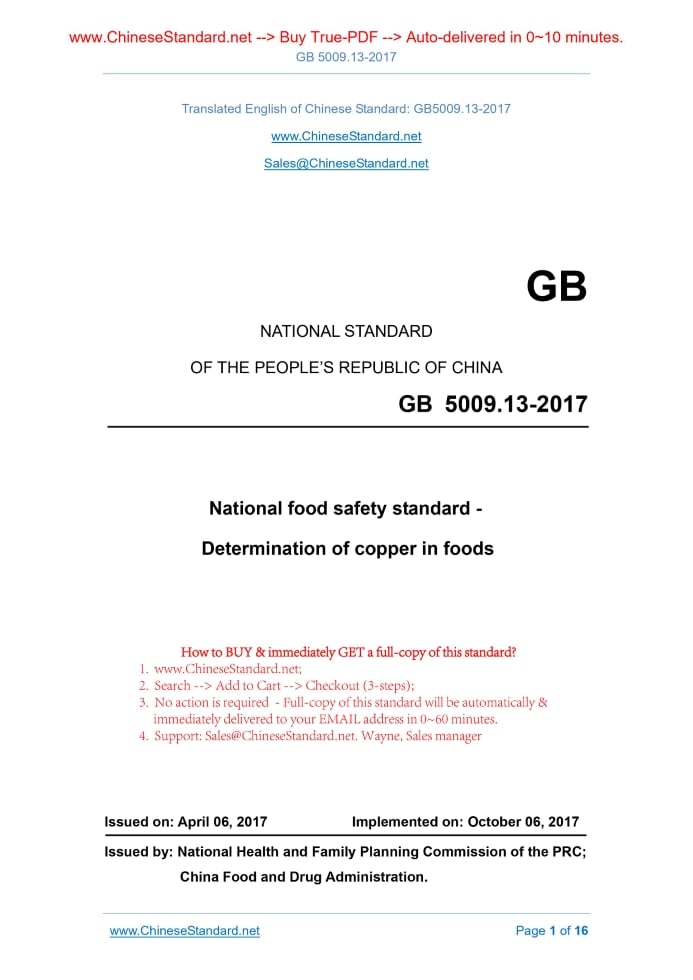
---This is an excerpt. Full copy of true-PDF in English version (including equations, symbols, images, flow-chart, tables, and figures etc.), auto-downloaded/delivered in 9 seconds, can be purchased online: https://www.ChineseStandard.net/PDF.aspx/GB5009.13-2017GB NATIONAL STANDARD National food safety standard - Determination of copper in foods Issued on. APRIL 06, 2017 Implemented on. OCTOBER 06, 2017 Issued by. National Health and Family Planning Commission of the PRC; China Food and Drug Administration.
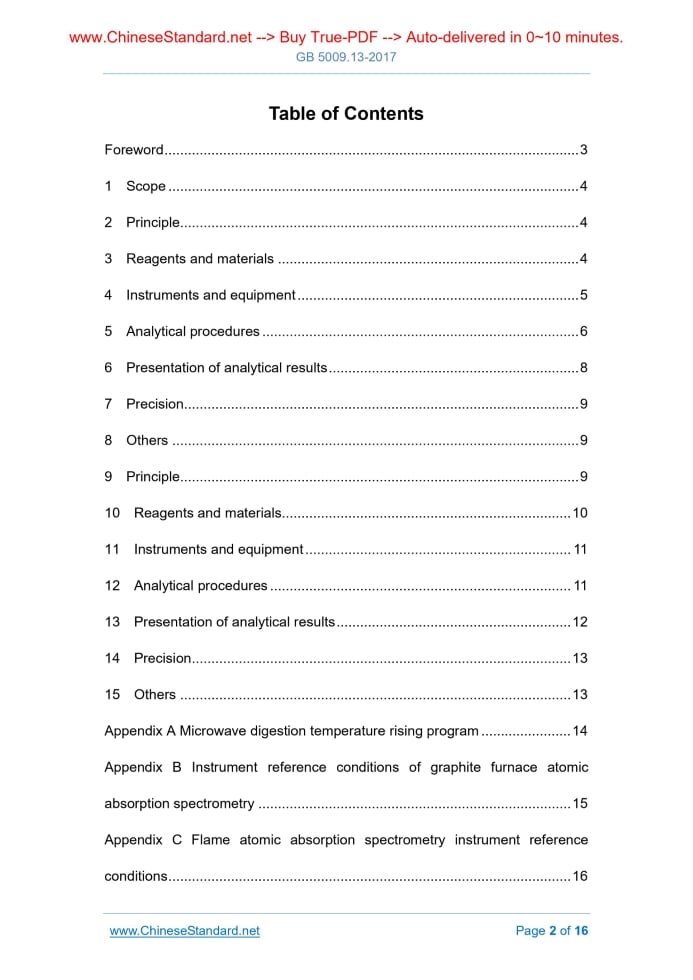
Table of Contents
Foreword... 3 1 Scope... 4 2 Principle... 4 3 Reagents and materials... 4 4 Instruments and equipment... 5 5 Analytical procedures... 6 6 Presentation of analytical results... 8 7 Precision... 9 8 Others... 9 9 Principle... 9 10 Reagents and materials... 9 11 Instruments and equipment... 11 12 Analytical procedures... 11 13 Presentation of analytical results... 12 14 Precision... 13 15 Others... 13 Appendix A Microwave digestion temperature rising program... 14 Appendix B Instrument reference conditions of graphite furnace atomic absorption spectrometry... 15 Appendix C Flame atomic absorption spectrometry instrument reference conditions... 16Foreword
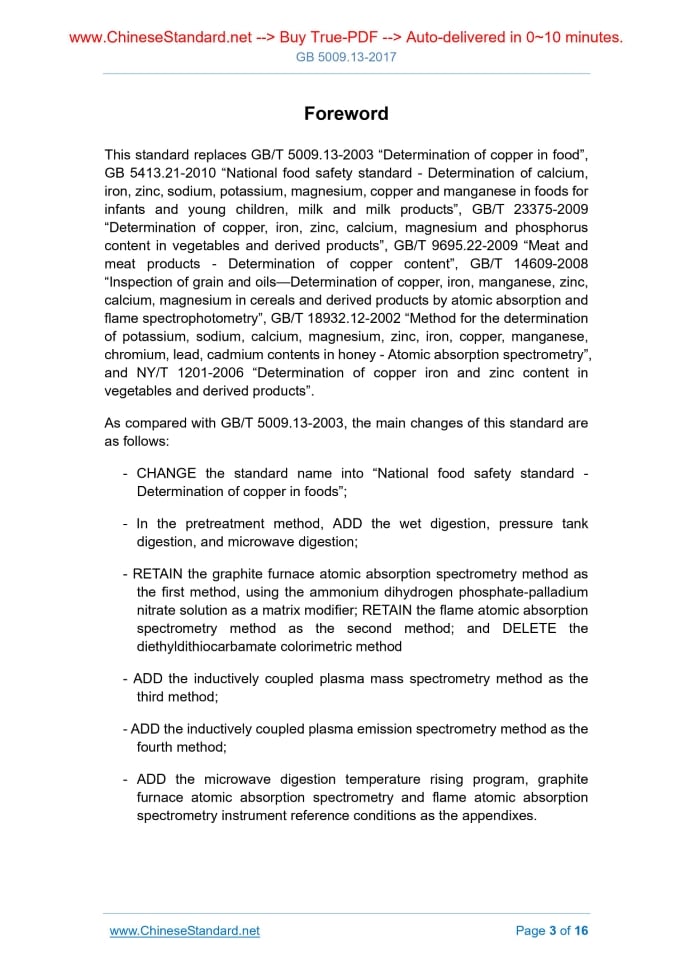
This standard replaces GB/T 5009.13-2003 “Determination of copper in food”, GB 5413.21-2010 “National food safety standard - Determination of calcium, iron, zinc, sodium, potassium, magnesium, copper and manganese in foods for infants and young children, milk and milk products”, GB/T 23375-2009 “Determination of copper, iron, zinc, calcium, magnesium and phosphorus content in vegetables and derived products”, GB/T 9695.22-2009 “Meat and meat products - Determination of copper content”, GB/T 14609-2008 “Inspection of grain and oils - Determination of copper, iron, manganese, zinc, calcium, magnesium in cereals and derived products by atomic absorption and flame spectrophotometry”, GB/T 18932.12-2002 “Method for the determination of potassium, sodium, calcium, magnesium, zinc, iron, copper, manganese, chromium, lead, cadmium contents in honey - Atomic absorption spectrometry”, NY/T 1201-2006 “Determination of copper iron and zinc content in vegetables and derived products”. As compared with GB/T 5009.13-2003, the main changes of this standard are as follows. - CHANGE the standard name into “National food safety standard - Determination of copper in foods”; - In the pretreatment method, ADD the wet digestion, pressure tank digestion, and microwave digestion; - RETAIN the graphite furnace atomic absorption spectrometry method as Method 1, using the ammonium dihydrogen phosphate-palladium nitrate solution as a matrix modifier; RETAIN the flame atomic absorption spectrometry method as Method 2; DELETE the diethyldithiocarbamate colorimetric method; - ADD the inductively coupled plasma mass spectrometry method as Method 3; - ADD the inductively coupled plasma emission spectrometry method as Method 4; - ADD the microwave digestion temperature rising program, graphite furnace atomic absorption spectrometry, flame atomic absorption spectrometry instrument reference conditions as the appendixes. National food safety standard - Determination of copper in foods1 Scope
This standard specifies the determination of copper content in food, by graphite furnace and flame atomic absorption spectrometry, inductively coupled plasma mass spectrometry, inductively coupled plasma-atomic emission spectrometry. This standard applies to the determination of copper in all types of foods. Method 1 -- Graphite furnace atomic absorption spectrometry2 Principle
After digestion, the specimen is atomized in graphite furnace AND the absorbance is measured at 324.8 nm. In a certain concentration range, the copper absorbance value is proportional to the copper content, which is compared with the standard series for quantitative.3 Reagents and materials
Unless otherwise indicated, the reagents used in this method are excellent pure AND the water is the grade 2 water as specified in GB/T 6682. 3.1 Reagents 3.1.1 Nitric acid (HNO3). 3.2 Reagent preparation 3.2.1 Nitric acid solution (5 + 95). MEASURE 50 mL of nitric acid; slowly ADD it into 950 mL of water; MIX it uniformly. 3.2.2 Nitric acid solution (1 + 1). MEASURE 250 mL of nitric acid; slowly ADD it into 250 mL of water; MIX it uniformly. 3.3 Standard substance Copper sulfate pentahydrate (CuSO4 • 5H2O, CAS No.. 7758-99-8). purity > 99.99%, OR the copper standard solution of a certain concentration certified and awarded with the standard substance certificate by the state. 3.4 Standard solution preparation 3.4.1 Standard copper stock solution (1000 mg/L). Accurately WEIGH 3.9289 g (accurate to 0.0001 g) of copper sulfate pentahydrate; USE a small amount of nitric acid (1 + 1) to dissolve it; TRANSFER t into a 1000 mL volumetric flask; ADD water to the mark; MIX it uniformly. 3.4.2 Copper standard intermediate solution (1.00 mg/L). Accurately PIPETTE 1.00 mL of copper standard stock solution (1000 mg/L) into a 1000 mL volumetric flask; ADD nitric acid solution (5 + 95) to the mark; MIX it uniformly.4 Instruments and equipment
Note. All glassware and Teflon digestion inner tanks must be soaked in nitric acid (1 + 5) overnight; rinsed repeatedly with tap water; finally rinsed clean with water. 4.1 Atomic absorption spectrometer. Equipped with graphite furnace atomizer and copper hollow cathode lamp. 4.2 Analytical balance. Sensitivity of 0.1 mg and 1 mg. 4.3 Adjustable electric furnace. 4.6 Pressure digestion tank. Equipped with polytetrafluoroethylene digestion inner tank. 4.7 Constant temperature drying oven. 4.8 Muffle furnace.5 Analytical procedures
5.1 Specimen preparation Note. Specimen contamination shall be avoided during sampling and sample preparation. 5.2 Specimen preparation 5.2.1 Wet digestion WEIGH 0.2 g ~ 3 g (accurate to 0.001 g) of solid specimen or accurately PIPETTE 0.500 mL ~ 5.00 mL of liquid specimen into in the graduated digestion tube; ADD 10 mL of nitric acid and 0.5 mL of perchloric acid; MAKE it digested on the adjustable electric furnace (reference conditions. 120 °C / 0.5 h ~ 1 h; 5.2.3 Pressure tank digestion WEIGH 0.2 g ~ 1 g (accurate to 0.001 g) of solid specimen or accurately PIPETTE 0.500 mL ~ 5.00 mL of liquid specimen into the digestion inner tank; ADD 5 mL of nitric acid. 5.2.4 Dry ashing Weigh 0.5 g ~ 5 g (accurate to 0.001 g) of solid specimen or accurately PIPETTE 0.500 mL ~ 10.0 mL of liquid specimen into a crucible; USE gentle fire to heat it to carbonize it to smokeless; TRANSFER it into a muffle furnace; MAKE it subject to ashing at 550 °C for 3 h ~ 4 h. 5.3 Determination 5.3.1 Instrument reference conditions Each instrument is adjusted to its optimal state based on its performance. The reference conditions are as shown in Appendix B. 5.3.3 Determination of specimen solution Under the same test conditions as the determination of standard solutions, INJECT 10 μL of blank solution or sample solution and 5 μL of ammonium dihydrogen phosphate-palladium nitrate solution (the optimal injection volume may be determined in accordance with the instruments used), into the graphite furnace at the same time;6 Presentation of analytical results
The copper content in the specimen is calculated in accordance with the formula (1).7 Precision
The absolute difference between two independent determinations obtained under repeatability conditions shall not exceed 20% of the arithmetic mean.8 Others
When the weighed sample amount is 0.5 g (or 0.5 mL) and the constant volume is 10 mL, the method detection limit is 0.02 mg/kg (or 0.02 mg/L) AND the limit of quantification is 0.05 mg/kg (or 0.05 mg/L).9 Principle
After digestion, the specimen is flame atomized AND the absorbance is measured at 324.8 nm.10 Reagents and materials
Unless otherwise specified, the reagents used in this method are excellent pure, AND the water is the grade 2 water as specified in GB/T 6682. 10.1 Reagents 10.2 Reagent preparation 10.2.1 Nitric acid solution (5 + 95). MEASURE 50 mL of nitric acid and slowly ADD it into 950 mL of water; MIX it uniformly. 10.2.2 Nitric acid solution (1 + 1). MEASURE 250 mL of nitric acid and slowly ADD it into 250 mL of water; MIX it uniformly. 10.3 Standard substance Copper sulfate pentahydrate (CuSO4 • 5H2O, CAS No.. 7758-99-8). Purity > 99.99%, OR the copper standard solution of a certain concentration certified and issued with the standard substance certificate by the state. 10.4 Standard solution preparation 10.4.1 Standard copper stock solution (1000 mg/L). Accurately WEIGH 3.9289 g (accurate to 0.0001 g) of copper sulfate pentahydrate; USE a small amount of nitric acid (1 + 1) to dissolve it; TRANSFER t into a 1000 mL volumetric flask; ADD water to the mark; MIX it uniformly. ......Source: Above contents are excerpted from the full-copy PDF -- translated/reviewed by: www.ChineseStandard.net / Wayne Zheng et al.