GB 5009.139-2014 English PDF
Price & Delivery
US$110.00 · In stock · Download in 9 secondsGB 5009.139-2014: National food safety standard -- Determination of caffeine in beverages
Delivery: 9 seconds. True-PDF full-copy in English & invoice will be downloaded + auto-delivered via email. See step-by-step procedure
Status: Valid
GB 5009.139: Historical versions
| Standard ID | USD | BUY PDF | Delivery | Standard Title (Description) | Status |
| GB 5009.139-2014 | 110 | Add to Cart | Auto, 9 seconds. | National food safety standard -- Determination of caffeine in beverages | Valid |
| GB/T 5009.139-2003 | 279 | Add to Cart | 3 days | Determination of caffeine in beverages | Obsolete |
Click to Preview this PDF
Similar standards
GB 5009.139-2014: National food safety standard -- Determination of caffeine in beverages
---This is an excerpt. Full copy of true-PDF in English version (including equations, symbols, images, flow-chart, tables, and figures etc.), auto-downloaded/delivered in 9 seconds, can be purchased online: https://www.ChineseStandard.net/PDF.aspx/GB5009.139-2014GB NATIONAL STANDARD OF THE PEOPLE’S REPUBLIC OF CHINA National food safety standard - Determination of caffeine in beverages ISSUED ON: DECEMBER 01, 2014 IMPLEMENTED ON: MAY 01, 2015 Issued by: National Health and Family Planning Commission of the People's Republic of China
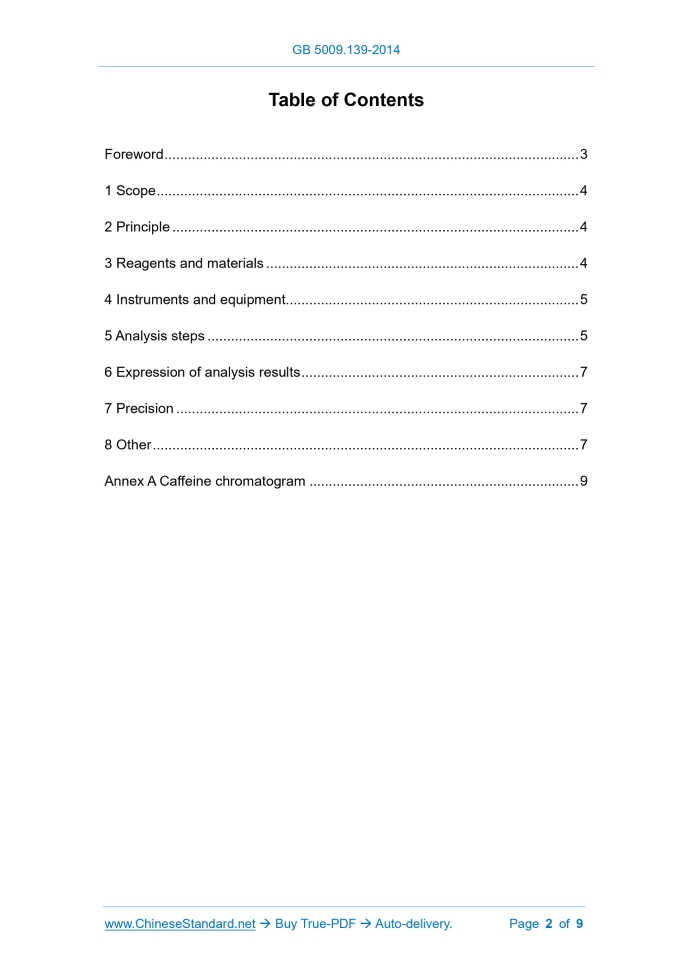
Table of Contents
Foreword ... 3 1 Scope ... 4 2 Principle ... 4 3 Reagents and materials ... 4 4 Instruments and equipment... 5 5 Analysis steps ... 5 6 Expression of analysis results ... 7 7 Precision ... 7 8 Other ... 7 Annex A Caffeine chromatogram ... 9 National food safety standard - Determination of caffeine in beverages1 Scope
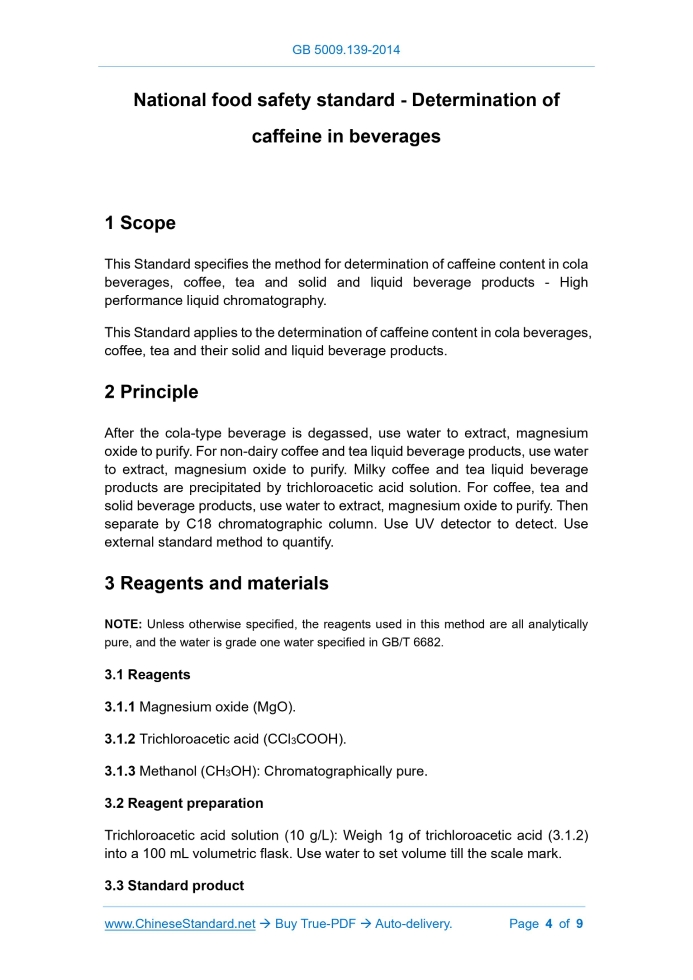
This Standard specifies the method for determination of caffeine content in cola beverages, coffee, tea and solid and liquid beverage products - High performance liquid chromatography. This Standard applies to the determination of caffeine content in cola beverages, coffee, tea and their solid and liquid beverage products.2 Principle
After the cola-type beverage is degassed, use water to extract, magnesium oxide to purify. For non-dairy coffee and tea liquid beverage products, use water to extract, magnesium oxide to purify. Milky coffee and tea liquid beverage products are precipitated by trichloroacetic acid solution. For coffee, tea and solid beverage products, use water to extract, magnesium oxide to purify. Then separate by C18 chromatographic column. Use UV detector to detect. Use external standard method to quantify.3 Reagents and materials
NOTE: Unless otherwise specified, the reagents used in this method are all analytically pure, and the water is grade one water specified in GB/T 6682. 3.1 Reagents 3.1.1 Magnesium oxide (MgO). 3.1.2 Trichloroacetic acid (CCl3COOH). 3.1.3 Methanol (CH3OH): Chromatographically pure. 3.2 Reagent preparation Trichloroacetic acid solution (10 g/L): Weigh 1g of trichloroacetic acid (3.1.2) into a 100 mL volumetric flask. Use water to set volume till the scale mark. 3.3 Standard product through a microporous membrane for use. 5.1.2 Non-dairy coffee and tea liquid products: Weigh 5 g of (to the nearest of 0.001 g) sample. Add water to set volume to 5 mL (make the caffeine content in the sample solution within the range of the standard curve). Shake well. Add 0.5 g of magnesium oxide. Shake well. Stand still. Take the supernatant and filter it through a microporous membrane for use. 5.1.3 Milky coffee and tea liquid products: Weigh 1 g of (to the nearest of 0.001g) sample. Add trichloroacetic acid solution to make the volume up to 10 mL (make the caffeine content in the sample solution within the range of the standard curve). Shake well. Stand still. Make protein subside. Take the supernatant and filter through a microporous membrane for use. 5.1.4 Coffee, tea and solid products: Weigh 1 g of (to the nearest of 0.001g) of crushed homogeneous sample with less than 30 meshes into a 250 mL Erlenmeyer flask. Add about 200 mL of water. Put in boiling water bath for 30 min. Shake from time to time. Take out and cool by running water for 1 min. Add 5 g of magnesium oxide. Shake. Put in the boiling water bath for 20 min again. Take out the Erlenmeyer flask. Cool to room temperature. Transfer to a 250 mL volumetric flask. Add water to the mark (make the caffeine content in the sample solution within the range of the standard curve). Shake well. Stand still. Take the supernatant and filter through a microporous membrane for use. 5.2 Instrument reference conditions Chromatographic column: C18 column (particle size is 5 μm, column length of 150 mm × diameter of 3.9 mm) or a chromatographic column with equivalent performance. Mobile phase: methanol + water=24+76. Flow rate: 1.0 mL/min. Detection wavelength: 272 nm. Column temperature: 25°C. Injection volume: 10 μL. 5.3 Production of standard curve Inject the standard series of working fluids into the liquid chromatograph. Determine the corresponding peak area. Take the concentration of the standard working fluid as the abscissa and the peak area as the ordinate to draw a standard curve (the standard chromatogram of caffeine is shown in Figure A.1 in Annex A). ......Source: Above contents are excerpted from the full-copy PDF -- translated/reviewed by: www.ChineseStandard.net / Wayne Zheng et al.