GB/T 31114-2024 PDF English
GB/T 31114: Historical versions
| Standard ID | USD | BUY PDF | Delivery | Standard Title (Description) | Status |
| GB/T 31114-2024 | 215 | Add to Cart | Auto, 9 seconds. | Quality requirement for ice cream | Valid |
| GB/T 31114-2014 | 75 | Add to Cart | Auto, 9 seconds. | Frozen drinks - Ice cream | Valid |
Similar standards
GB/T 31114-2024: Quality requirement for ice cream
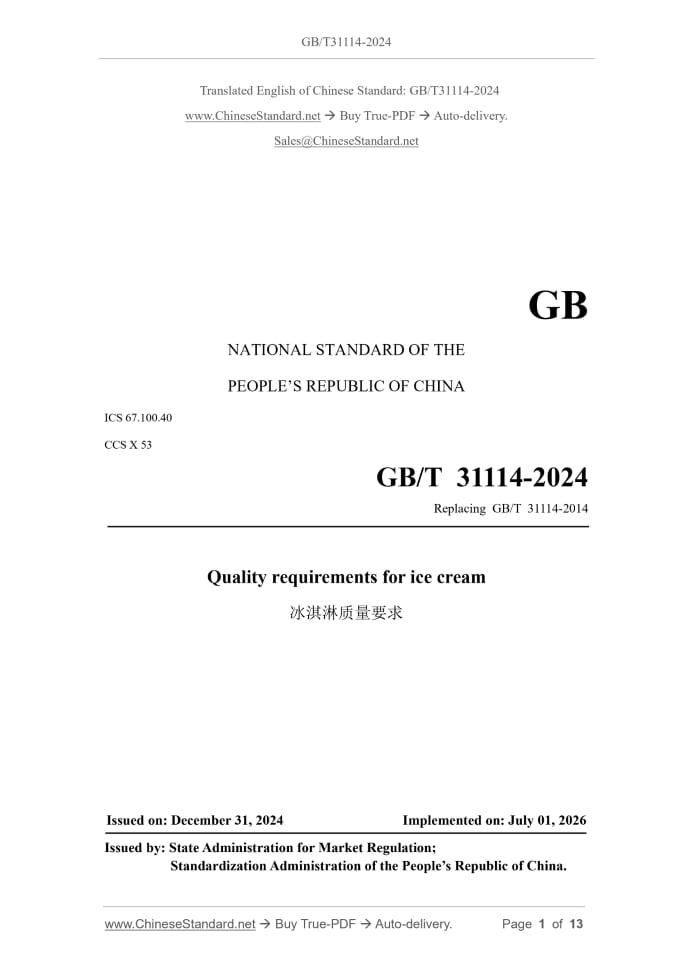
---This is an excerpt. Full copy of true-PDF in English version (including equations, symbols, images, flow-chart, tables, and figures etc.), auto-downloaded/delivered in 9 seconds, can be purchased online: https://www.ChineseStandard.net/PDF.aspx/GBT31114-2024GB NATIONAL STANDARD OF THE PEOPLE’S REPUBLIC OF CHINA ICS 67.100.40 CCS X 53 GB/T 31114-2024 Replacing GB/T 31114-2014 Quality requirements for ice cream Issued on: DECEMBER 31, 2024 Implemented on: JULY 01, 2026 Issued by. State Administration for Market Regulation; Standardization Administration of the People’s Republic of China.
Table of Contents
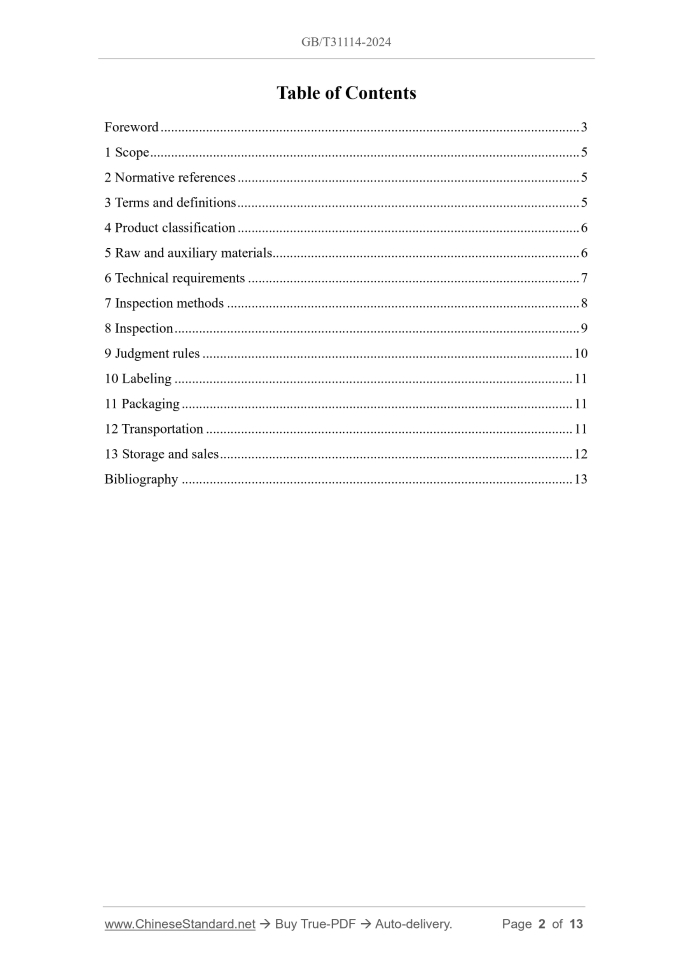
Foreword... 3 1 Scope... 5 2 Normative references... 5 3 Terms and definitions... 5 4 Product classification... 6 5 Raw and auxiliary materials... 6 6 Technical requirements... 7 7 Inspection methods... 8 8 Inspection... 9 9 Judgment rules... 10 10 Labeling... 11 11 Packaging... 11 12 Transportation... 11 13 Storage and sales... 12 Bibliography... 13Foreword
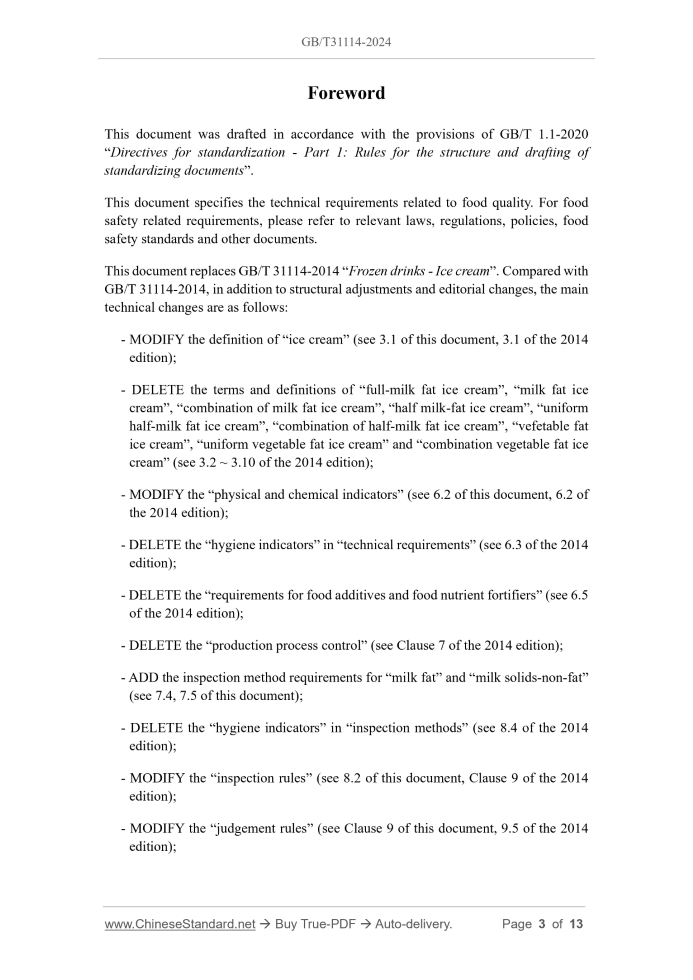
This document was drafted in accordance with the provisions of GB/T 1.1-2020 “Directives for standardization - Part 1.Rules for the structure and drafting of standardizing documents”. This document specifies the technical requirements related to food quality. For food safety related requirements, please refer to relevant laws, regulations, policies, food safety standards and other documents. This document replaces GB/T 31114-2014 “Frozen drinks - Ice cream”. Compared with GB/T 31114-2014, in addition to structural adjustments and editorial changes, the main technical changes are as follows. - MODIFY the definition of “ice cream” (see 3.1 of this document, 3.1 of the 2014 edition); - DELETE the terms and definitions of “full-milk fat ice cream”, “milk fat ice cream”, “combination of milk fat ice cream”, “half milk-fat ice cream”, “uniform half-milk fat ice cream”, “combination of half-milk fat ice cream”, “vefetable fat ice cream”, “uniform vegetable fat ice cream” and “combination vegetable fat ice cream” (see 3.2 ~ 3.10 of the 2014 edition); - MODIFY the “physical and chemical indicators” (see 6.2 of this document, 6.2 of the 2014 edition); - DELETE the “hygiene indicators” in “technical requirements” (see 6.3 of the 2014 edition); - DELETE the “requirements for food additives and food nutrient fortifiers” (see 6.5 of the 2014 edition); - DELETE the “production process control” (see Clause 7 of the 2014 edition); - ADD the inspection method requirements for “milk fat” and “milk solids-non-fat” (see 7.4, 7.5 of this document); - DELETE the “hygiene indicators” in “inspection methods” (see 8.4 of the 2014 edition); - MODIFY the “inspection rules” (see 8.2 of this document, Clause 9 of the 2014 edition); - MODIFY the “judgement rules” (see Clause 9 of this document, 9.5 of the 2014 edition); Quality requirements for ice cream1 Scope
This document gives the product classification of ice cream, specifies raw and auxiliary materials, technical requirements, inspection, judgment rules, labeling, packaging, transportation, storage and sales, and describes the corresponding inspection methods. This document applies to the production, inspection and sales of pre-packaged ice cream products that can be eaten directly. This document does not apply to soft ice cream products that are made and sold on the spot.2 Normative references
The following referenced documents are indispensable for the application of this document. For dated references, only the edition cited applies. For undated references, the latest edition of the referenced document (including any amendments) applies. GB 5009.3 National food safety standard - Determination of water content in food GB 5009.6 National food safety standard - Determination of fat in food GB/T 31321 Test methods for frozen drink products JJF 1070 RuIes of metrological testing for net quantity of products in prepackages with fixed content3 Terms and definitions
For the purpose of this document, the following terms and definitions apply. 3.1 ice cream Food with expanded volume made from milk and/or dairy products with or without other auxiliary materials through mixing, sterilization, homogenization, cooling, aging, freezing, hardening and other processes. 3.2 milk solids-non-fat Remaining substances after deducting milk fat from milk solids. 3.3 collapse Softening and collapse of ice cream. 3.4 shrinkage Phenomenon of volume reduction of ice cream after it is formed. 3.5 expansion Phenomenon of volume increase of ice cream slurry after it is formed into ice cream through relevant processes.4 Product classification
4.1 According to the content of milk fat, it can be divided into. - full-milk fat ice cream, ice cream with a milk fat mass fraction greater than or equal to 8 % (for combination ice cream, it is calculated based on the main part) and no non-milk fat is added (except those brought in by ingredients); - half milk-fat ice cream, ice cream with a milk fat mass fraction greater than or equal to 2.2 % (for combination ice cream, it is calculated based on the main part); - vegetable fat ice cream, ice cream with a milk fat mass fraction less than 2.2 % (for combination ice cream, it is calculated based on the main part). 4.2 According to product components, it can be divided into. - uniform ice cream, ice cream without granules or block-shaped auxiliary materials; - combination ice cream, a product with ice cream as the main part, containing granules or block-shaped auxiliary materials, and/or combined with other types of food or frozen drinks, in which the mass fraction of ice cream is greater than 50 %.5 Raw and auxiliary materials
It shall comply with the provisions of relevant national standards or industry standards. 8.2 Inspection rules 8.2.1 Factory-exit inspection 8.2.1.1 Products shall be inspected batch by batch according to the methods specified in this document before leaving the factory, and may only leave the factory after passing the inspection. 8.2.1.2 Factory-exit inspection items include sensory requirements and net content. 8.2.2 Type inspection 8.2.2.1 Type inspection is conducted once a year. Type inspection shall also be conducted in any of the following situations. - when the main raw and auxiliary materials or key processes are changed; - when the production of the product is discontinued for more than half a year and then resumed; - when the factory-exit inspection results are significantly different from the previous type inspection results; - when the national regulatory authorities propose type inspection requirements. 8.2.2.2 Type inspection items include sensory requirements, physical and chemical indicators and net content.9 Judgment rules
9.1 Factory-exit inspection judgment and re-inspection 9.1.1 When all of the factory-exit inspection items comply with the provisions of this document, the batch of products is judged to be compliant with this document. 9.1.2 When one of the factory-exit inspection items does not meet the requirements of this document, it can double sampling from the same batch of products for re-inspection. If the re-inspection results still do not meet the requirements of this document, the batch of products is judged to be non-compliant with this document. 9.2 Type inspection judgment and re-inspection 9.2.1 If all of the type inspection items comply with the provisions of this document, it is judged to be compliant with this document. 9.2.2 If no more than 2 (including 2) type inspection items do not meet the requirements of this document, it can double sampling for re-inspection. If there is 1 item still do not meet the requirements of this document after re-inspection, the batch of products is judged as unqualified products. If more than 2 type inspection items do not meet the requirements of this document, the batch of products is judged as unqualified products and shall not be re-inspected.10 Labeling
10.1 The product labeling shall indicate product categories according to the product classification in Clause 4. 10.2 Full-milk fat ice cream of which the main part is made from raw milk, sterilized milk, pasteurized milk and concentrated milk as the main raw materials, and without the addition of non-milk fat and non-milk protein (except those brought in by the raw materials), can be named “cow (sheep) milk ice cream”. Products named “cow (sheep) milk ice cream” shall indicate the amount of raw milk, sterilized milk, pasteurized milk and concentrated milk added in the ingredient list. 10.3 Ice cream with a total amount of fruit and fruit products (in terms of original juice/pulp, fruit particles/pieces) added greater than or equal to 2.5 % in the formula can be named “×× ice cream”; ice cream with an amount of fruit and fruit products added less than 2.5 % can be named “×× flavored ice cream”.11 Packaging
11.1 The packaging materials shall comply with the relevant national standards or industry standards. 11.2 The single-piece packaging shall be complete, tightly sealed and undamaged. 11.3 The packaging box shall be firm, neat, complete, undamaged, clean, consistent with the contents and sealed on the outside.12 Transportation
12.1 The transportation vehicles shall meet the hygiene requirements. For short- distance transportation, refrigerated trucks shall be used; for long-distance transportation, the temperature of the refrigerated compartment shall not be higher than -18 ℃. 12.2 The products shall not be packaged and transported with toxic or contaminated items and shall prevent squeezing. 12.3 The products shall be handled with care and shall not be dropped, hit or squeezed. ......Source: Above contents are excerpted from the full-copy PDF -- translated/reviewed by: www.ChineseStandard.net / Wayne Zheng et al.