GB 5009.241-2017 PDF English
| Standard ID | USD | BUY PDF | Delivery | Standard Title (Description) | Status |
| GB 5009.241-2017 | 70 | Add to Cart | Auto, 9 seconds. | National food safety standard - Determination of Magnesium in Food | Valid |
Similar standards
GB 5009.241-2017: National food safety standard - Determination of Magnesium in Food
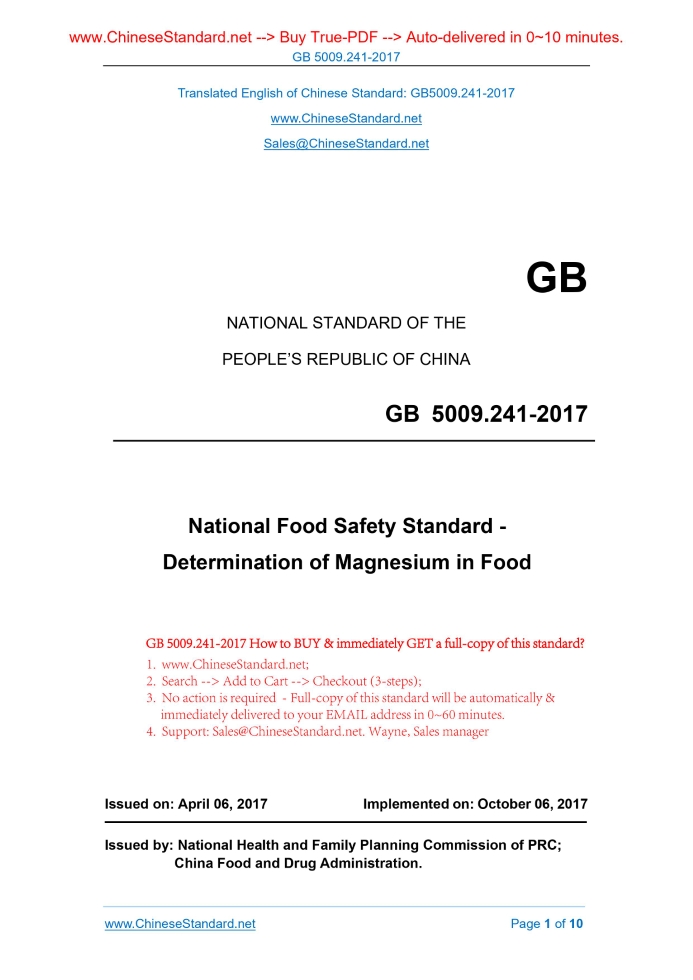
---This is an excerpt. Full copy of true-PDF in English version (including equations, symbols, images, flow-chart, tables, and figures etc.), auto-downloaded/delivered in 9 seconds, can be purchased online: https://www.ChineseStandard.net/PDF.aspx/GB5009.241-2017GB NATIONAL STANDARD OF THE PEOPLE’S REPUBLIC OF CHINA National Food Safety Standard - Determination of Magnesium in Food Issued on. APRIL 06, 2017 Implemented on. OCTOBER 06, 2017 Issued by. National Health and Family Planning Commission of PRC; China Food and Drug Administration.
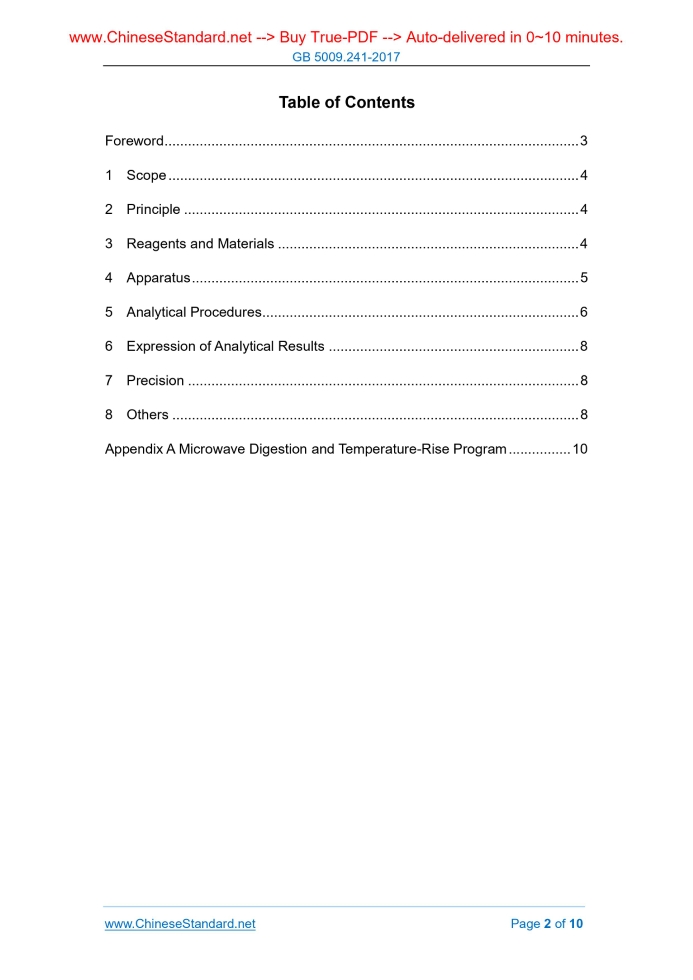
Table of Contents
Foreword... 3 1 Scope... 4 2 Principle... 4 3 Reagents and Materials... 4 4 Apparatus... 5 5 Analytical Procedures... 6 6 Expression of Analytical Results... 8 7 Precision... 8 8 Others... 8 Appendix A Microwave Digestion and Temperature-Rise Program... 10Foreword
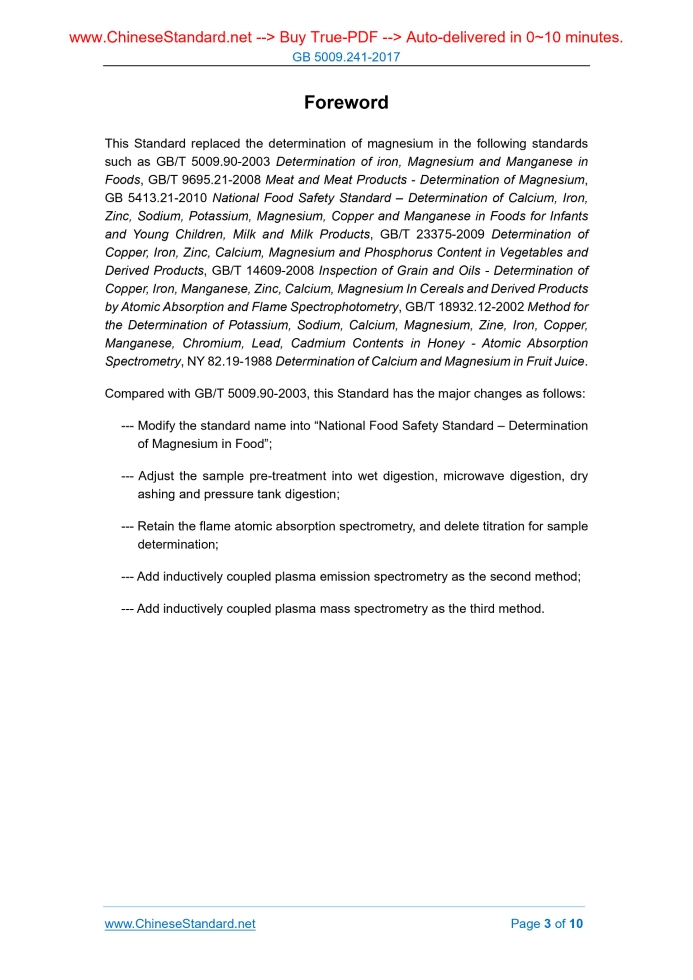
This Standard replaced the determination of magnesium in the following standards such as GB/T 5009.90-2003 Determination of iron, Magnesium and Manganese in Foods, GB/T 9695.21-2008 Meat and Meat Products - Determination of Magnesium, GB 5413.21-2010 National Food Safety Standard – Determination of Calcium, Iron, Zinc, Sodium, Potassium, Magnesium, Copper and Manganese in Foods for Infants and Young Children, Milk and Milk Products, GB/T 23375-2009 Determination of Copper, Iron, Zinc, Calcium, Magnesium and Phosphorus Content in Vegetables and Derived Products, GB/T 14609-2008 Inspection of Grain and Oils - Determination of Copper, Iron, Manganese, Zinc, Calcium, Magnesium In Cereals and Derived Products by Atomic Absorption and Flame Spectrophotometry, GB/T 18932.12-2002 Method for the Determination of Potassium, Sodium, Calcium, Magnesium, Zine, Iron, Copper, Manganese, Chromium, Lead, Cadmium Contents in Honey - Atomic Absorption Spectrometry, NY 82.19-1988 Determination of Calcium and Magnesium in Fruit Juice. Compared with GB/T 5009.90-2003, this Standard has the major changes as follows. --- Modify the standard name into “National Food Safety Standard – Determination of Magnesium in Food”; --- Adjust the sample pre-treatment into wet digestion, microwave digestion, dry ashing and pressure tank digestion; --- Retain the flame atomic absorption spectrometry, and delete titration for sample determination; --- Add inductively coupled plasma emission spectrometry as Method 2; --- Add inductively coupled plasma mass spectrometry as Method 3. National Food Safety Standard - Determination of Magnesium in Food1 Scope
This Standard specifies use flame atomic absorption spectrometry, inductively coupled plasma emission spectrometry, and inductively coupled plasma mass spectrometry to determine the magnesium in food. This Standard is applicable to the determination of magnesium in various foods. Method 1 -- Flame Atomic Absorption Spectrometry2 Principle
After digestion, the sample was flame atomized, then measure the absorbance at 285.2nm.3 Reagents and Materials
Unless otherwise is specified, the reagents used in this method shall be guarantee reagent; while water used in this method shall be Class-II water stipulated in GB/T 6682. 3.1 Reagents 3.2 Reagents preparation 3.2.1 Nitric acid solution (5+95). take 50mL of nitric acid; pour into 950mL of water; mix evenly. 3.2.2 Nitric acid solution (1+1). take 250mL of nitric acid; pour into 250mL of water; mix evenly. 3.3 Standard substance Magnesium metal (Mg, CAS No.. 7439-95-4) or magnesia (MgO, CAS No.. 1309-48- 4). purity >99.99%. The standard magnesium solution with certain concentration that has been certified by the state and issued standard substance certificate. 3.4 Preparation of standard solution 3.4.1 Standard magnesium stock solution (1000g/L). accurately take 0.1g (accurate to 0.0001g) of magnesium metal or 0.1658g (accurate to 0.0001g) of magnesia calcined to constant weight at 800°C±50°C; 3.4.2 Standard magnesium intermediate solution (10.0mg/L). accurately pipette 1.00mL of standard magnesium stock solution (1000mg/L); use nitric acid solution (5+95) to make constant volume into the 100mL volumetric flask; then mix evenly.4 Apparatus
NOTE. all glassware and Teflon digestion inner tank must be soaked in nitric acid solution (1+5) overnight; use tap water to wash repeatedly; finally rinsed with water. 4.1 Atomic absorption spectrometer. equipped with flame atomizer; magnesium hollow cathode lamp. 4.5 Microwave digestion system. equipped with Teflon digestion inner tank. 4.6 Thermostat drying oven. 4.7 Pressure digestion tank. equipped with Teflon digestion inner tank. 4.8 Muffle furnace.5 Analytical Procedures
5.1 Specimen preparation NOTE. During the sampling and preparing processes, avoid the specimen contamination. 5.1.1 Grain and bean samples After removing the foreign matters, the sample shall be stored in the plastic bottles. 5.2 Specimen digestion 5.2.1 Wet digestion Take 0.2g~3g (accurate to 0.001g) of solid specimen or accurately transfer 0.500mL~5.00mL of liquid specimen into the graduated digestion tube; add 10mL of nitric acid, 0.5mL of perchloric acid; then digest on the adjustable electric hot furnace (reference conditions. 5.2.2 Microwave digestion Take 0.2g~0.8g (accurate to 0.001g) of solid specimen or accurately transfer 0.500mL~3.00mL of liquid specimen into the microwave digestion tank; add 5mL of nitric acid; then digest the specimen as per the microwave digestion operation steps; 5.2.4 Dry ashing Take 0.5g~5g (accurate to 0.001g) of solid specimen or accurately pipette 0.500mL~10.0mL of liquid specimen into the crucible; slowly heat the crucible onto the electric hot plate; carbonize with slight fire to no longer smoke. After carbonizing, place the specimen into the muffle furnace; ashing for 4h at 550°C. 5.3 Determination 5.3.1 Instrument reference conditions According to the performance of their instruments adjusted to the best condition, reference conditions.6 Expression of Analytical Results
The magnesium content in the specimen shall be calculated by the Formula (1).7 Precision
The absolute difference between two independent test results obtained under repeatability conditions shall not exceed 10% of the arithmetic mean.8 Others
When the sample weight is 1g (or 1mL), constant volume is 25mL, the method’s limit of detection is 0.6mg/kg (or 0.6mg/L), the quantification limit is 2.0mg/kg (or 2.0mg/L).Appendix A
Microwave Digestion and Temperature-Rise Program The microwave digestion and temperature-rise program can refer to Table A.1. ......Source: Above contents are excerpted from the full-copy PDF -- translated/reviewed by: www.ChineseStandard.net / Wayne Zheng et al.