Path: Home > MISC > Page53 > DBT93.1-2022 || Home > Standard_List > MISC > Page53 > DBT93.1-2022 Price & DeliveryUS$619.00 · In stock
Delivery: <= 5 days. True-PDF full-copy in English will be manually translated and delivered via email.
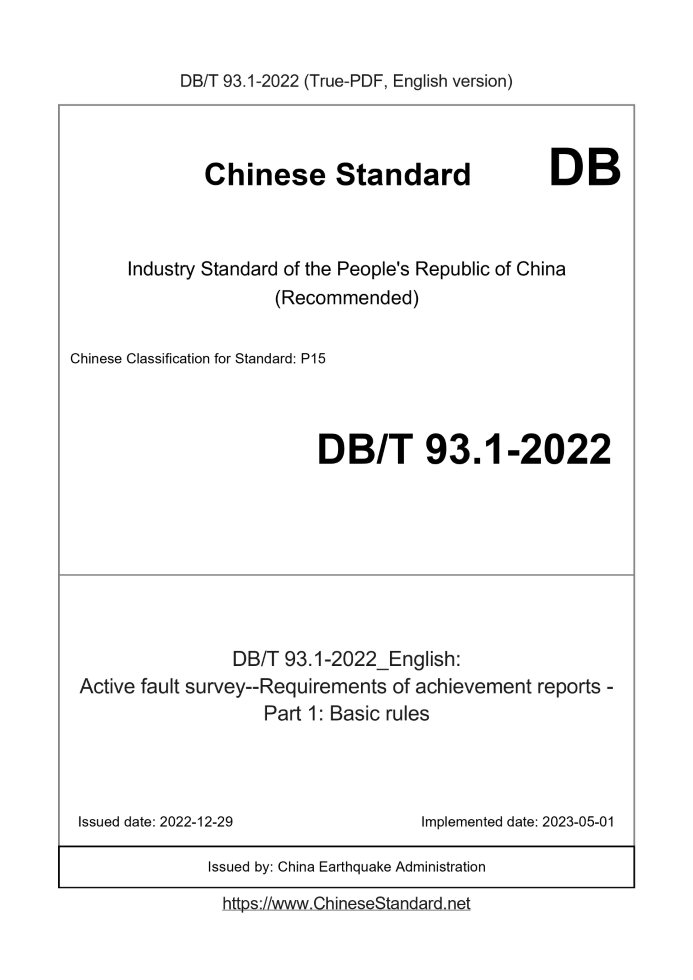
DBT93.1-2022: Active fault survey--Requirements of achievement reports - Part 1: Basic rules
Status: Valid
| Std ID | Contents [version] | USD | STEP2 | [PDF] delivered in | Standard Title (Description) | Status |
| DB/T 93.1-2022 | English | 619 |
Add to Cart
|
5 days [Need to translate]
|
Active fault survey--Requirements of achievement reports - Part 1: Basic rules
| Valid |
Standard similar to DBT93.1-2022 GB/T 17742 | DB/T 60 | GB 50111 | DB/T 105 | DB/T 104 | DB/T 93.2 | Basic data | Standard ID | DB/T 93.1-2022 (DB/T93.1-2022) | | Description (Translated English) | Active fault survey--Requirements of achievement reports - Part 1: Basic rules | | Sector / Industry | Chinese Industry Standard (Recommended) | | Classification of Chinese Standard | P15 | | Classification of International Standard | 91.120.25 | | Word Count Estimation | 28,284 | | Date of Issue | 2022-12-29 | | Date of Implementation | 2023-05-01 | | Issuing agency(ies) | China Earthquake Administration | DBT93.1-2022: Active fault survey--Requirements of achievement reports - Part 1: Basic rules---This is a DRAFT version for illustration, not a final translation. Full copy of true-PDF in English version (including equations, symbols, images, flow-chart, tables, and figures etc.) will be manually/carefully translated upon your order.
ICS 91:120:25
CCSP15
Seismic Industry Standard of the People's Republic of China
Compilation rules for reports on active fault detection results
Part 1: Basic provisions
Released on 2022-12-29
2023-05-01 implementation
Released by the China Earthquake Administration
table of contents
Preface III
Introduction IV
1 Scope 1
2 Normative references 1
3 Terms and Definitions 1
4 Basic Rules 2
5 Classification of Outcome Reports 5
6 Results reporting structure 5
7 Components 8
Appendix A (Informative) Results Report Document Format 10
Reference 24
foreword
This document is in accordance with the provisions of GB/T 1:1-2020 "Guidelines for Standardization Work Part 1: Structure and Drafting Rules for Standardization Documents"
drafting:
This document is part 1 of DB/T 93 "Rules for Compiling Reports on Active Fault Exploration Results": DB/T 93 has issued the following
part:
--- Part 1: Basic provisions;
--- Part 2: General project report:
Please note that some contents of this document may refer to patents: The issuing agency of this document assumes no responsibility for identifying patents:
This document is proposed by the China Earthquake Administration:
This document is under the jurisdiction of the Earthquake Disaster Prevention Standardization Technical Committee:
This document was drafted by: China Earthquake Disaster Prevention Center, Jiangsu Earthquake Administration, China National Institute of Standardization, Fujian Earthquake Administration, Ningxia
The Seismological Bureau of the Hui Autonomous Region, the National Academy of Natural Disaster Prevention and Control of the Ministry of Emergency Management, and the Institute of Geology of the China Earthquake Administration:
The main drafters of this document: Li Yishi, Xu Xu, Bai Dianyi, Lu Haiyan, Wang Xiu, Liu Jianda, Zhang Liang, Xu Hangang, Chai Chizhang, Zhang Shimin,
Li Limei and Yu Guihua:
Introduction
A large number of earthquake cases at home and abroad show that active faults are the source of earthquake disasters: Identify the distribution of active faults and their properties and seismic hazards
It is the basic work of earthquake prevention and disaster reduction to make an evaluation of the nature of the disaster: Since the "Ninth Five-Year Plan" period, my country has gradually promoted the detection of active faults:
More than 130 active fault mappings have been completed, and active fault detection has been carried out in more than 100 cities:
Site exploration and fault avoidance of buildings (structures), earthquake disaster risk assessment and earthquake prediction are playing an increasingly important role:
In order to standardize the application of technical methods, ensure the scientific and orderly development of active fault detection work, and improve the quality and practicality of output results:
In recent years, the Seismic Department has carried out practical cases of active fault detection, clarifying the work process, work content, technical methods and work results:
On this basis, a series of standard frameworks were constructed, and GB/T 36072-2018 "Active Fault Detection" and "Active Fault Detection" were formulated successively:
Its supporting series of standards, but so far no relevant standards have been formulated for the requirements of output and expression: Currently, active fault exploration
Reports of test results vary in form, content and structure, and vary in complexity: The lack of relevant standards has brought great harm to the acceptance of projects and the promotion and application of achievements:
To influence and restrict the sustainable and healthy development of active fault detection:
DB/T 93 "Rules for Compiling Active Fault Exploration Results Report" is precisely to overcome the lack of rules, projects and topics in the preparation of results reports
It is formulated for the unclear technical points of acceptance: DB/T 93 is proposed to be composed of three parts:
--- Part 1: Basic provisions: Aims to establish the basic rules for the form, content and logic of active fault detection report compilation
and requirements, providing general rules and requirements for Parts 2 and 3:
--- Part 2: General project report: The purpose is to specify the content of the project completion report, technical report and short version of the active fault exploration project
and its hierarchical framework, Part 2 is used in conjunction with Part 1:
--- Part 3: Special work report: It aims to specify the content and hierarchical structure of each special work report of the active fault exploration project
Framework, Part 3 is used in conjunction with Part 1:
This part of DB/T 93 is based on the actual situation of compiling reports on active fault detection results in my country over the years, and with reference to other
Compiled according to relevant industry standards: On the basis of adhering to the principles of practicability and normativeness and ensuring operability, the standard users are given
Maximum flexibility, promote the orderly development of active fault detection work, improve the quality of output results, and enhance the promotion and application of output results
benefit:
Compilation rules for reports on active fault detection results
Part 1: Basic provisions
1 Scope
This document specifies the basic rules and requirements for the classification, structure, elements and expression of active fault detection results reports:
This document is applicable to the compilation and technical review of the results report of active fault detection and seismic hazard assessment:
2 Normative references
The contents of the following documents constitute the essential provisions of this document through normative references in the text: Among them, dated references
For documents, only the version corresponding to the date is applicable to this document; for undated reference documents, the latest version (including all amendments) is applicable to
this document:
GB/T 958 Regional geological map legend
GB/T 1526 Information Processing Data Flowchart, Program Flowchart, System Flowchart, Program Network Diagram and System Resource Diagram Documentation
Compiling symbols and conventions
GB 3100 International system of units and its application
GB/T 3101 General Principles Relating to Quantities, Units and Symbols
GB/T 7714 Information and bibliographic reference description rules
GB/T 8170 Numerical rounding off rules and expression and determination of limit values
GB/T 14499 Technical Symbols for Geophysical Exploration
GB/T 15834 Usage of Punctuation Marks
Number usage in GB/T 15835 publications
GB 17741 Seismic Safety Evaluation of Engineering Sites
GB/T 18207 (all parts) Terminology for Earthquake Prevention and Disaster Mitigation
GB/T 36072 active fault detection
DB/T 25 Earthquake Observation Quantities and Units
DB/T 72 Graphical symbols for active fault detection
3 Terms and Definitions
The following terms and definitions defined in GB/T 18207 (all parts), GB/T 36072 and GB 17741 apply to this document:
3:1
achievement report achievement report
In accordance with the specified format and content requirements, it is a document that expresses the relevant work situation and output results of the implementation of the active fault exploration project:
3:2
Briefly introduce the main achievements of the active fault exploration project in concise and popular words, accompanied by intuitive graphs and tables
presented files:
Tips & Frequently Asked Questions:Question 1: How long will the true-PDF of DBT93.1-2022_English be delivered?Answer: Upon your order, we will start to translate DBT93.1-2022_English as soon as possible, and keep you informed of the progress. The lead time is typically 3 ~ 5 working days. The lengthier the document the longer the lead time. Question 2: Can I share the purchased PDF of DBT93.1-2022_English with my colleagues?Answer: Yes. The purchased PDF of DBT93.1-2022_English will be deemed to be sold to your employer/organization who actually pays for it, including your colleagues and your employer's intranet. Question 3: Does the price include tax/VAT?Answer: Yes. Our tax invoice, downloaded/delivered in 9 seconds, includes all tax/VAT and complies with 100+ countries' tax regulations (tax exempted in 100+ countries) -- See Avoidance of Double Taxation Agreements (DTAs): List of DTAs signed between Singapore and 100+ countriesQuestion 4: Do you accept my currency other than USD?Answer: Yes. If you need your currency to be printed on the invoice, please write an email to Sales@ChineseStandard.net. In 2 working-hours, we will create a special link for you to pay in any currencies. Otherwise, follow the normal steps: Add to Cart -- Checkout -- Select your currency to pay. |