GB 7101-2022 PDF English
GB 7101: Historical versions
| Standard ID | USD | BUY PDF | Delivery | Standard Title (Description) | Status |
| GB 7101-2022 | 80 | Add to Cart | Auto, 9 seconds. | National food safety standard - Drinks | Valid |
| GB 7101-2015 | 70 | Add to Cart | Auto, 9 seconds. | National standard on food safety -- Beverage | Obsolete |
| GB 7101-2003 | 90 | Add to Cart | Auto, 9 seconds. | Hygienic standard for solid drink [including MODIFICATION 1] | Obsolete |
| GB 7101-1994 | 199 | Add to Cart | 2 days | Hygienic standard of solid drink | Obsolete |
| GB 7101-1986 | 199 | Add to Cart | 2 days | Hygienic standard for Mai Ru Jing (Solid beverage containing milk) | Obsolete |
GB 7101-2022: National food safety standard - Drinks
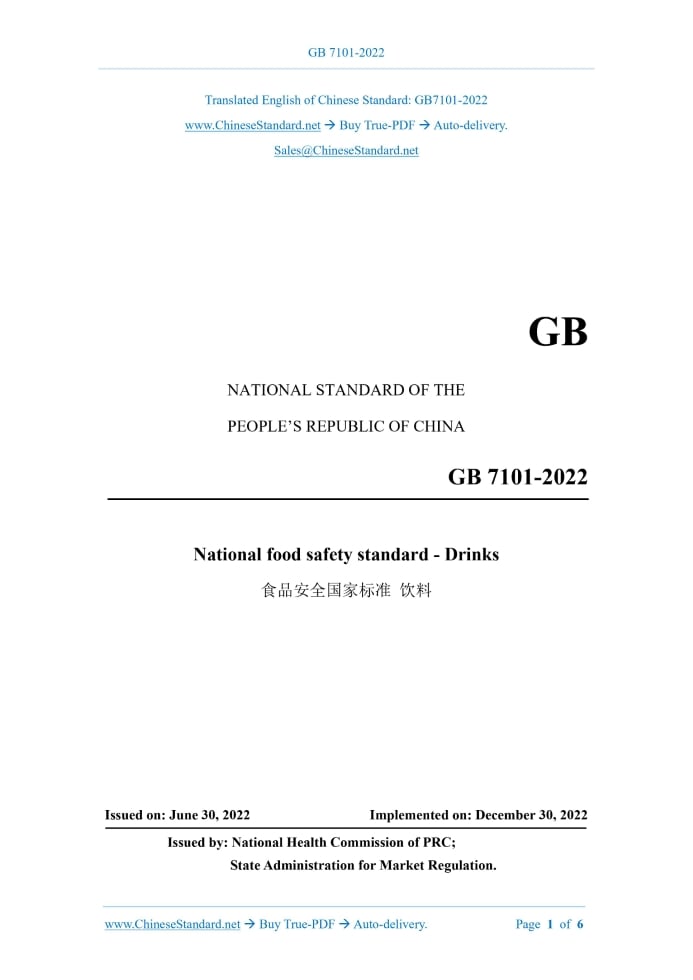
---This is an excerpt. Full copy of true-PDF in English version (including equations, symbols, images, flow-chart, tables, and figures etc.), auto-downloaded/delivered in 9 seconds, can be purchased online: https://www.ChineseStandard.net/PDF.aspx/GB7101-2022NATIONAL STANDARD OF THE PEOPLE’S REPUBLIC OF CHINA National food safety standard - Drinks Issued on. JUNE 30, 2022 Implemented on. DECEMBER 30, 2022 Issued by. National Health Commission of PRC; State Administration for Market Regulation.
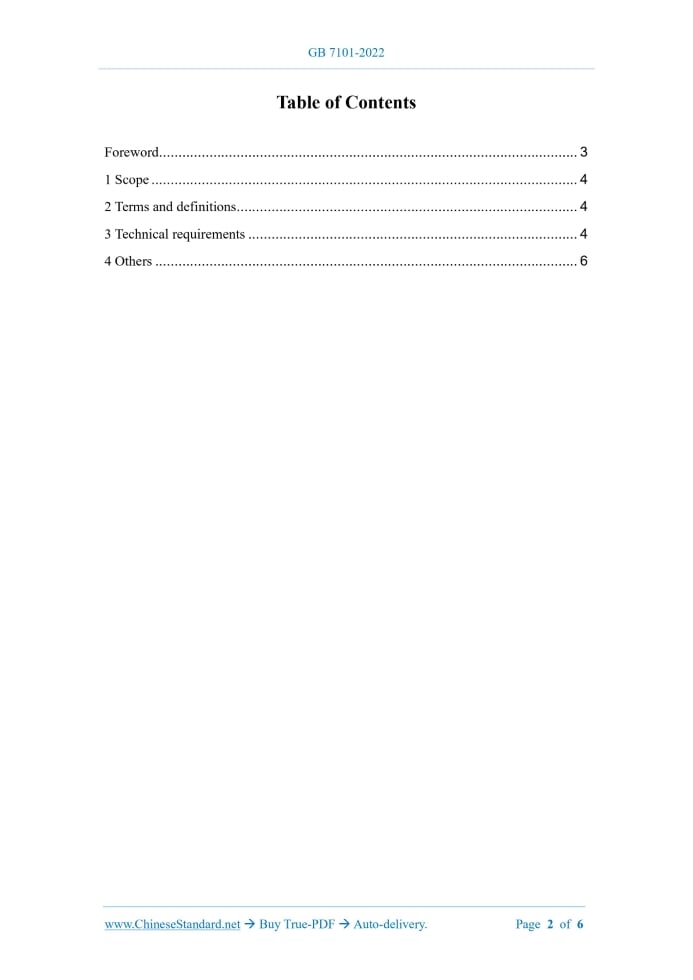
Table of Contents
Foreword... 3 1 Scope... 4 2 Terms and definitions... 4 3 Technical requirements... 4 4 Others... 6Foreword
This standard replaces GB 7101-2015 "National food safety standard - Drinks". Compared with GB 7101-2015, the main changes are as follows. - MODIFY the terms and definitions; - MODIFY the sensory requirements; - MODIFY the physical and chemical indicators; - MODIFY the microbial limits; - MODIFY the other requirements. National food safety standard - Drinks1 Scope
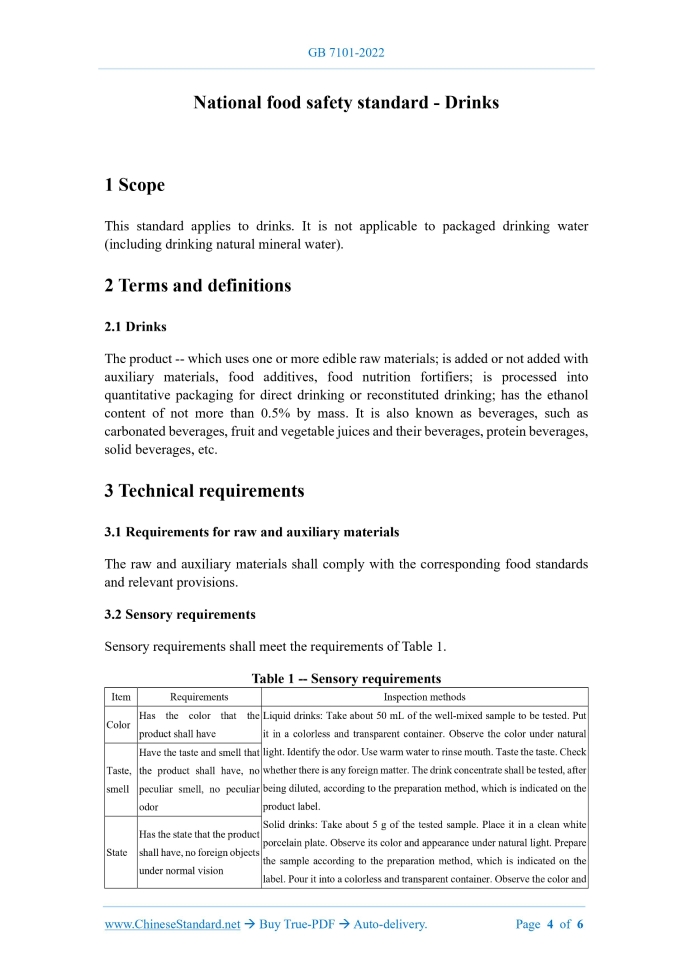
This standard applies to drinks. It is not applicable to packaged drinking water (including drinking natural mineral water).2 Terms and definitions
2.1 Drinks The product -- which uses one or more edible raw materials; is added or not added with auxiliary materials, food additives, food nutrition fortifiers; is processed into quantitative packaging for direct drinking or reconstituted drinking; has the ethanol content of not more than 0.5% by mass. It is also known as beverages, such as carbonated beverages, fruit and vegetable juices and their beverages, protein beverages, solid beverages, etc.3 Technical requirements
3.1 Requirements for raw and auxiliary materials The raw and auxiliary materials shall comply with the corresponding food standards and relevant provisions. 3.2 Sensory requirements Sensory requirements shall meet the requirements of Table 1. 3.3 Physical and chemical indicators Physical and chemical indicators shall meet the requirements of Table 2. 3.4 Limits of pollutants and mycotoxins 3.5 Residue limits of pesticide The pesticide residue limit shall comply with the provisions of GB 2763. 3.6 Microbial limit 3.6.1 Products, which are produced by commercial sterility, shall meet the requirements of commercial sterility. It shall be tested, according to the method specified in GB 4789.26. 3.7 Food additives and food nutrition fortifiers 3.7.1 The use of food additives shall comply with the provisions of GB 2760.4 Others
4.1 The label of the product with added bacteria shall indicate the live bacteria (unsterilized) type or the non-viable bacteria (sterilized) type. 4.2 The number of lactic acid bacteria, in live bacteria (unsterilized) products with added lactic acid bacteria, shall be ≥ 106 CFU/g (mL); the content of lactic acid bacteria shall be marked on the product label. Lactic acid bacteria are tested, according to the method specified in GB 4789.35. ......Source: Above contents are excerpted from the full-copy PDF -- translated/reviewed by: www.ChineseStandard.net / Wayne Zheng et al.