GB 10770-2025 PDF English
GB 10770: Historical versions
| Standard ID | USD | BUY PDF | Delivery | Standard Title (Description) | Status |
| GB 10770-2025 | 65 | Add to Cart | Auto, 9 seconds. | National food safety standard - Canned complementary foods for infants and young children | Valid |
| GB 10770-2010 | 139 | Add to Cart | 3 days | National food safety standard -- Canned complementary foods for infants and young children | Valid |
| GB 10770-1997 | 439 | Add to Cart | 4 days | Supplementary weaning foods for infants and young children | Obsolete |
| GB 10770-1989 | 359 | Add to Cart | 3 days | Foods for infant and young children--Weaning supplementary food | Obsolete |
GB 10770-2025: National food safety standard - Canned complementary foods for infants and young children
---This is an excerpt. Full copy of true-PDF in English version (including equations, symbols, images, flow-chart, tables, and figures etc.), auto-downloaded/delivered in 9 seconds, can be purchased online: https://www.ChineseStandard.net/PDF.aspx/GB10770-2025
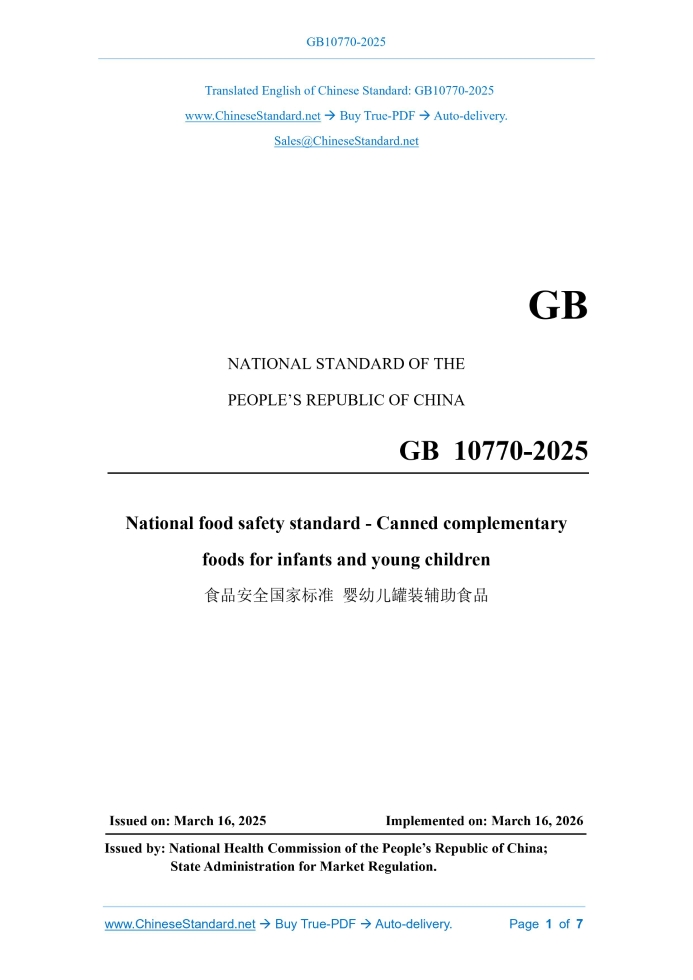
GB NATIONAL STANDARD OF THE PEOPLE’S REPUBLIC OF CHINA National food safety standard - Canned complementary foods for infants and young children Issued on: MARCH 16, 2025 Implemented on: MARCH 16, 2026 Issued by. National Health Commission of the People’s Republic of China; State Administration for Market Regulation.
Table of Contents
Foreword... 3 1 Scope... 4 2 Terms and definitions... 4 3 Product form classification... 4 4 Technical requirements... 5 5 Others... 7 National food safety standard - Canned complementary foods for infants and young children1 Scope
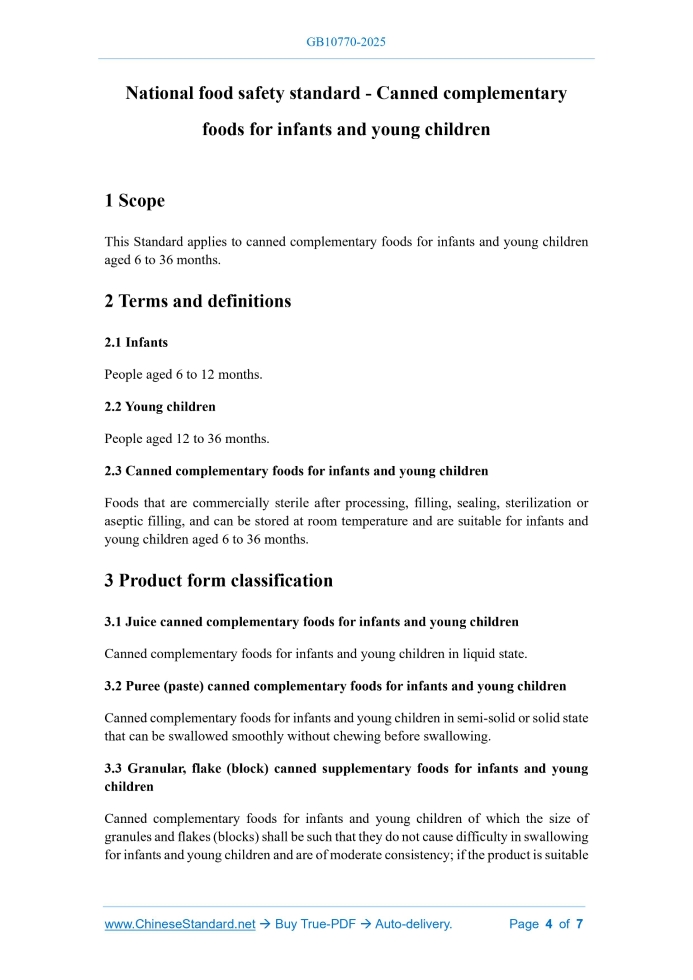
This Standard applies to canned complementary foods for infants and young children aged 6 to 36 months.2 Terms and definitions
2.1 Infants People aged 6 to 12 months. 2.2 Young children People aged 12 to 36 months. 2.3 Canned complementary foods for infants and young children Foods that are commercially sterile after processing, filling, sealing, sterilization or aseptic filling, and can be stored at room temperature and are suitable for infants and young children aged 6 to 36 months.3 Product form classification
3.1 Juice canned complementary foods for infants and young children Canned complementary foods for infants and young children in liquid state. 3.2 Puree (paste) canned complementary foods for infants and young children Canned complementary foods for infants and young children in semi-solid or solid state that can be swallowed smoothly without chewing before swallowing. 3.3 Granular, flake (block) canned supplementary foods for infants and young children Canned complementary foods for infants and young children of which the size of granules and flakes (blocks) shall be such that they do not cause difficulty in swallowing for infants and young children and are of moderate consistency; if the product is suitable 4.3.1 For products in which livestock, poultry, fish, shrimp, and animal liver are the only ingredients or the only protein source other than water in the product (excluding juice products), their proportion in the total mass of the product shall not be less than 40 % (calculated by ingredients). The protein content of the product shall not be less than 1.7 g/100 kJ (7 g/100 kcal), and the fat content shall not be greater than 1.4 g/100 kJ (6 g/100 kcal). 4.3.2 For products made from livestock, poultry, fish, shrimp, animal liver, etc. separately (or in combination) with other food raw materials (excluding juice products), the ingredients with the highest content of livestock, poultry, fish, shrimp, and animal liver shall not be less than 8 % of the total mass of the product (calculated by ingredients). The protein content of the product shall not be less than 0.7 g/100 kJ (3 g/100 kcal), and the fat content shall not be greater than 1.4 g/100 kJ (6 g/100 kcal). 4.3.3 For products containing fish, the amount of histamine in the product shall not exceed 10 mg/100g. 4.3.4 For juice, puree, granules or flakes (blocks) made from fruits and/or vegetables as the main raw materials, sodium chloride shall not be added. 4.3.5 The sodium content of the product shall not exceed 200 mg/100g in the ready-to- eat state. 4.3.6 The energy value of the product shall be calculated according to the method in GB 10769.The protein inspection method is shown in GB 5009.5; the fat inspection method is shown in GB 5009.6; the sodium inspection method is shown in GB 5009.91; the histamine inspection method is shown in GB 5009.208. 4.4 Contaminant limits It shall comply with the provisions of GB 2762. 4.5 Mycotoxin limits It shall comply with the provisions of GB 2761. 4.6 Microbial limits It shall meet the requirements for commercial sterility of canned foods and be inspected according to the method specified in GB 4789.26; tomato sauce and tomato juice products shall also comply with the provisions of Table 2. ......Source: Above contents are excerpted from the full-copy PDF -- translated/reviewed by: www.ChineseStandard.net / Wayne Zheng et al.