GB 5009.3-2016 English PDF
Price & Delivery
US$75.00 · In stock · Download in 9 secondsGB 5009.3-2016: National food safety standard - Determination of Moisture Content in Foods
Delivery: 9 seconds. True-PDF full-copy in English & invoice will be downloaded + auto-delivered via email. See step-by-step procedure
Status: Valid
GB 5009.3: Historical versions
| Standard ID | USD | BUY PDF | Delivery | Standard Title (Description) | Status |
| GB 5009.3-2016 | 75 | Add to Cart | Auto, 9 seconds. | National food safety standard - Determination of Moisture Content in Foods | Valid |
| GB 5009.3-2010 | 319 | Add to Cart | 3 days | National food safety standard -- Determination of moisture in foods | Obsolete |
| GB/T 5009.3-2003 | 239 | Add to Cart | 2 days | Determination of moisture in foods | Obsolete |
| GB/T 5009.3-1985 | 199 | Add to Cart | 2 days | Method for determination of moisture in foods | Obsolete |
Click to Preview this PDF
Similar standards
GB 5009.3-2016: National food safety standard - Determination of Moisture Content in Foods
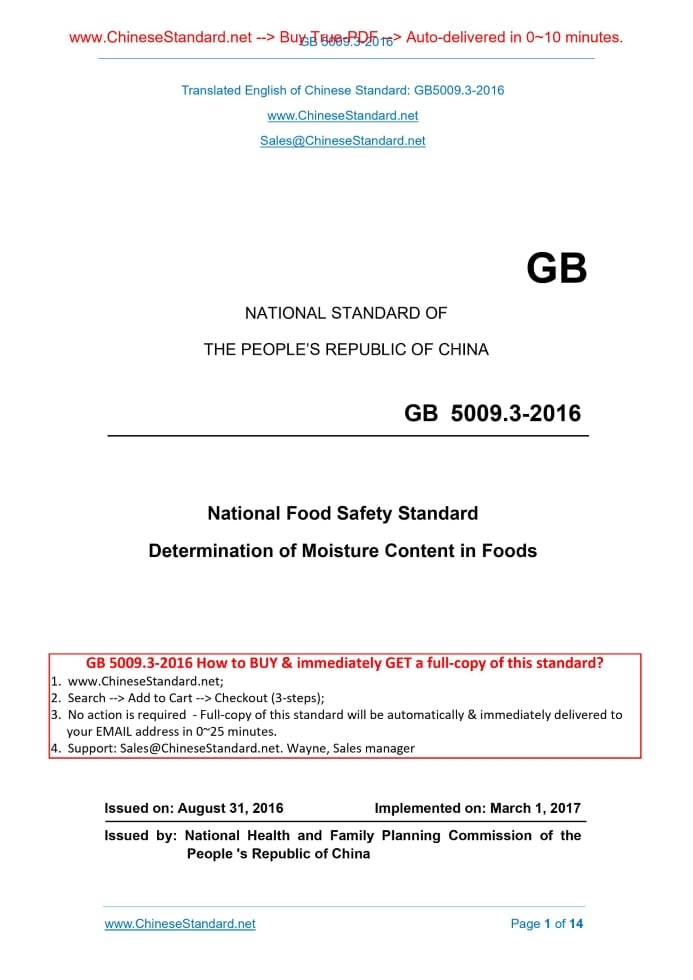
---This is an excerpt. Full copy of true-PDF in English version (including equations, symbols, images, flow-chart, tables, and figures etc.), auto-downloaded/delivered in 9 seconds, can be purchased online: https://www.ChineseStandard.net/PDF.aspx/GB5009.3-2016GB NATIONAL STANDARD OF THE PEOPLE’S REPUBLIC OF CHINA National Food Safety Standard Determination of Moisture Content in Foods Issued on. AUGUST 31, 2016 Implemented on. MARCH 1, 2017 Issued by. National Health and Family Planning Commission of the People 's Republic of China
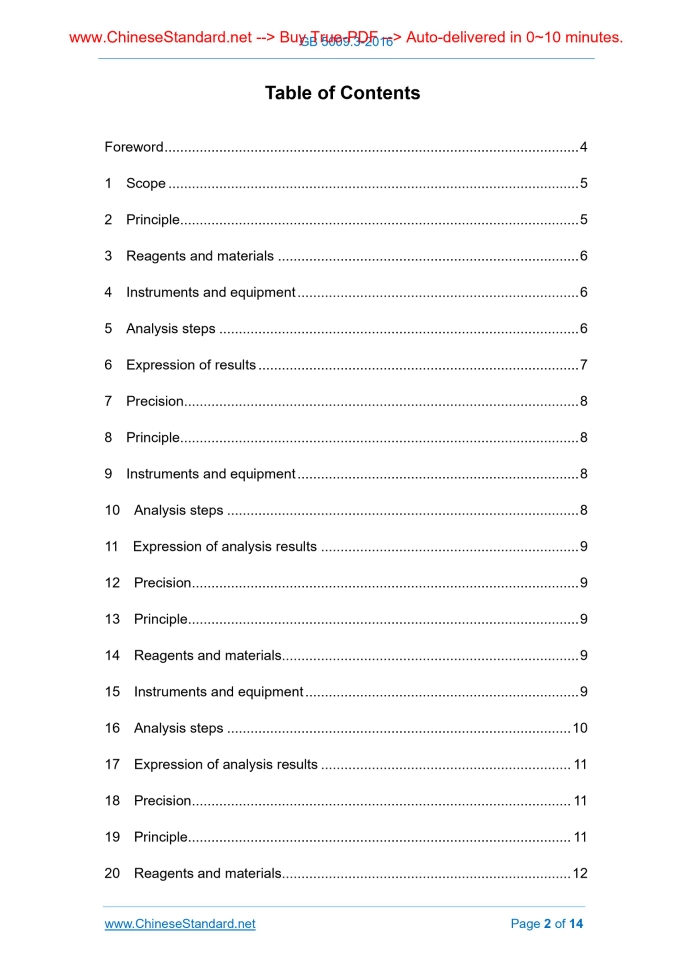
Table of Contents
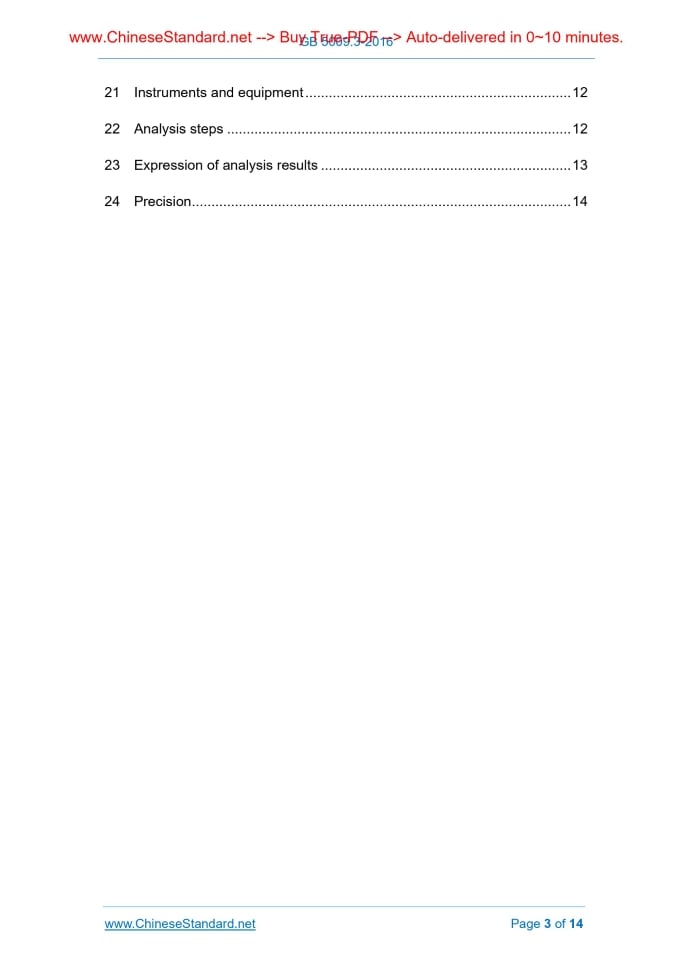
Foreword... 4 1 Scope... 5 2 Principle... 5 3 Reagents and materials... 6 4 Instruments and equipment... 6 5 Analysis steps... 6 6 Expression of results... 7 7 Precision... 8 8 Principle... 8 9 Instruments and equipment... 8 10 Analysis steps... 8 11 Expression of analysis results... 9 12 Precision... 9 13 Principle... 9 14 Reagents and materials... 9 15 Instruments and equipment... 9 16 Analysis steps... 10 17 Expression of analysis results... 11 18 Precision... 11 19 Principle... 11 20 Reagents and materials... 12 21 Instruments and equipment... 12 22 Analysis steps... 12 23 Expression of analysis results... 13 24 Precision... 14Foreword
This Standard replaces GB/T 5009.3-2010 National food safety standard Determination of moisture in foods, GB/T 12087-2008 Starch - Determination of moisture content - Oven-drying method, GB/T 18798.3-2008 Instant tea in solid form - Part 3.Determination of moisture content, GB/T 21305-2007 Cereals and cereal products - Determination of moisture content - Routine reference method, GB/T 5497-1985 Inspection of grain and oilseeds; Methods for determination of moisture content, GB/T 8304-2013 Tea - Determination of Moisture Content, GB/T 12729.6-2008 Spices and condiments - Determination of moisture content(entrainment method), GB/T 9695.15-2008 Meat and meat products - Determination of moisture content, GB/T 8858-1988 Method for determination of dry matter and water content in fruit and vegetable products, SN/T 0919-2000 Method for the determination of moisture of tea for import and export. Compared with GB 5009.3-2010, the main modifications in this Standard are as follows. - modified the scopes of Method 1 - Direct drying method, Method 2 - Decompression drying method, Method 3 - Distillation method and Method 4 - Karl Fischer volumetric method; - modified the reagents, precision, annotation and analysis steps of Method 1 - Direct drying method; - modified the analysis steps of Method 3 - Distillation method; - deleted the description of the Karl Fischer coulomb method of Method 4 - Karl Fischer volumetric method. National Food Safety Standard Determination of Moisture Content in Foods1 Scope
This Standard specifies the determination method for moisture content in foods. Method 1 (Direct drying method) of this Standard is applicable to the determinations of moisture content in foods such as vegetables, cereals and their products, aquatic products, soy products, dairy products, meat products, braised food products, grain (moisture content of less than 18%), oil (moisture content of less than 13%), starch and tea at 101°C ~ 105°C; not applicable to the sample of which the moisture content is less than 0.5g/100g. Method 2 (Decompression drying method) is applicable to the determination of moisture content in high temperature easily decomposed sample and more moisture samples (such as sugar, monosodium glutamate and other food); not applicable to the determination of moisture in sugars added with other raw materials (such as cream candy, soft sweets); not applicable to the sample of which the moisture content is less than 0.5g/100g (excluding sugar and monosodium glutamate). Method 3 (Distillation method) is applicable to the determination of moisture in fruit of more water and more volatile ingredients, spices and condiments, meat and meat products; not applicable to the sample of which the moisture content is less than 1g/100g. Method 4 (Karl Fischer volumetric method) is applicable to the determination of trace moisture in foods; not applicable to the determination of moisture in foods containing oxidizing agents, reducing agents, basic oxides, hydroxides, carbonates, boric acid. Karl Fischer volumetric method is applicable to the sample of which the moisture content is greater than 1.0 x 10⁻³g/100g. Method 1 -- Direct drying method2 Principle
Using the physical properties of water in food, at 101.3kPa (one atmospheric pressure), the temperature of 101°C ~ 105°C, it shall use volatile method to determine the dry weight loss in sample, including absorbent water, partially crystallized water and substances that are volatile under these conditions. Calculate the moisture content by the weighing values before and after drying.3 Reagents and materials
Unless otherwise stated, the reagents used in this method are of analytical grade and water is Grade 3 water specified in GB/T 6682. 3.1 Reagents 3.1.1 Sodium hydroxide (NaOH) 3.1.2 Hydrochloric acid (HCl) 3.1.3 Sea sand 3.2 Reagent preparation 3.2.1 Hydrochloric acid solution (6 mol/L). weigh 50 mL of hydrochloric acid, dilute it with water to 100 mL. 3.2.2 Sodium hydroxide solution (6 mol/L). weigh 24 g of sodium hydroxide, dissolve it in water and dilute it with water to 100 mL.4 Instruments and equipment
4.1 Flat aluminum or glass weighing bottle 4.2 Electric heating oven 4.3 Dryer. with effective desiccant 4.4 Balance. resolution of 0.1 mg5 Analysis steps
5.1 Solid sample. take a clean flat aluminum or glass weighing bottle, place in the 101°C ~ 105°C dryer. The cap is obliquely attached to the bottle. Heat for 1.0 h. Remove the cover. Place it in dryer to cool 0.5 h. Weigh. Repeat drying till the mass difference of twice before and after shall not exceed 2 mg. That is constant weight. Mix the sample evenly to the particles less than 2 mm. The samples that are not easily ground should be chopped as much as possible. 5.2 Semi-solid or liquid sample. take a clean weighing bottle. Add 10 g of sea sands (during the experiment, the mass of sea sand can be increased as needed) and a glass bar. Place in the 101°C ~ 105°C dryer to dry about 1.0 h. Take out. Place into the dryer to cool for 0.5 h. Then weigh. Repeat drying till constant weight. Weigh 5 g ~ 10 g of samples (nearest to 0.0001 g). Place in the weighing bottle.6 Expression of results
The moisture content in sample shall be calculated according to equation (1).7 Precision
The absolute difference between the two independent determinations obtained under repeatability shall not exceed 10% of the arithmetic mean.8 Principle
Using the physical properties of moisture in food, after reaching to 40 kPa ~ 53 kPa pressure, heat to 60°C ± 5°C. Use the decompression drying method to remove moisture from the sample.9 Instruments and equipment
9.1 Flat aluminum or glass weighing bottle 9.2 Vacuum oven 9.3 Dryer. with effective desiccant10 Analysis steps
10.1 Sample preparation. powder and crystalline samples are directly weighed; the larger pieces of hard candy are crushed by a mortar and mixed for use. 10.2 Determination. use a constant weight weighing bottle to weigh 2 g ~ 10 g (nearest to 0.0001 g) of samples. Place into the vacuum oven. Connect the vacuum oven to the vacuum pump. Take the air inside the vacuum oven out (the required pressure is generally 40 kPa ~ 53 kPa) while heating to the required temperature of 60°C ± 5°C.11 Expression of analysis results
Same with Clause 6.12 Precision
The absolute difference between the two independent determinations obtained under repeatability shall not exceed 10% of the arithmetic mean.13 Principle
Using the physical properties of moisture in food, distill the moisture in food and toluene or xylene by moisture tester. Calculate the moisture in sample according to the volume of water received. This method is applicable to foods containing more other volatile substances, such as spices.14 Reagents and materials
14.1 Reagents Toluene (C7H8) or xylene (C8H10) 14.2 Reagent preparation Toluene or xylene preparation. take toluene or xylene, after water saturation, remove the water layer, distill and collect the distillate for use. ......Source: Above contents are excerpted from the full-copy PDF -- translated/reviewed by: www.ChineseStandard.net / Wayne Zheng et al.