GB/T 43115-2023 PDF English
Price & Delivery
US$325.00 · In stock · Download in 9 secondsGB/T 43115-2023: Metallic materials - Sheet and strip - Shear test method at room temperature
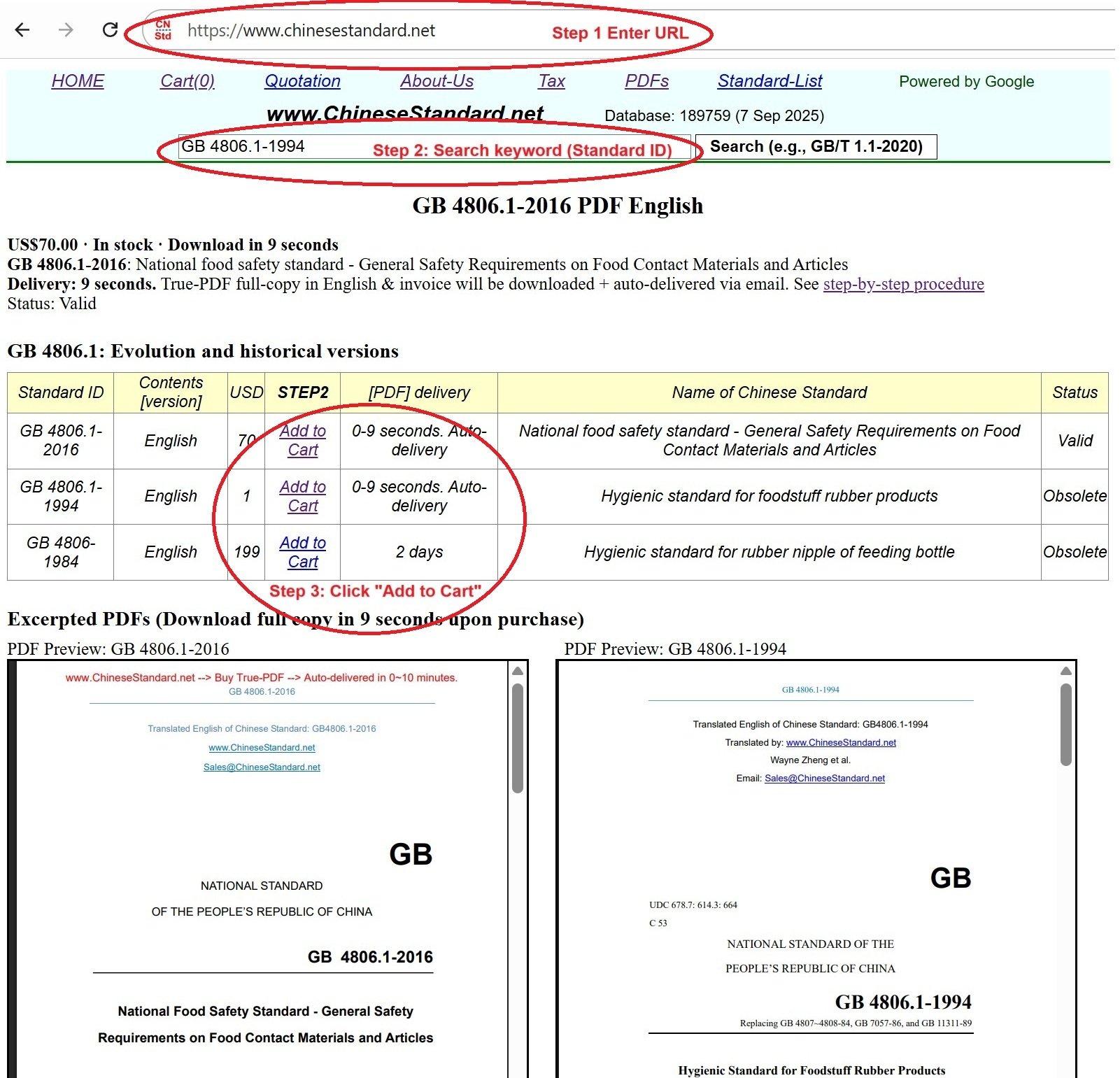
Delivery: 9 seconds. True-PDF full-copy in English & invoice will be downloaded + auto-delivered via email. See step-by-step procedure
Status: Valid
| Standard ID | USD | BUY PDF | Delivery | Standard Title (Description) | Status |
| GB/T 43115-2023 | 325 | Add to Cart | Auto, 9 seconds. | Metallic materials - Sheet and strip - Shear test method at room temperature | Valid |
Click to Preview this PDF
Similar standards
GB/T 44030
GB/T 43115-2023: Metallic materials - Sheet and strip - Shear test method at room temperature
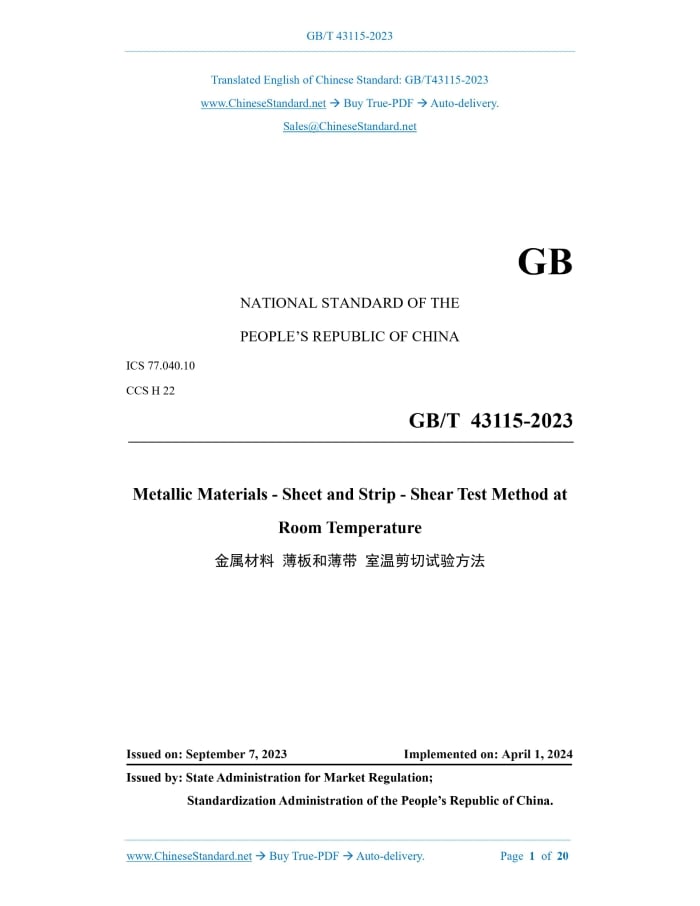
---This is an excerpt. Full copy of true-PDF in English version (including equations, symbols, images, flow-chart, tables, and figures etc.), auto-downloaded/delivered in 9 seconds, can be purchased online: https://www.ChineseStandard.net/PDF.aspx/GBT43115-2023GB NATIONAL STANDARD OF THE PEOPLE’S REPUBLIC OF CHINA ICS 77.040.10 CCS H 22 Metallic Materials - Sheet and Strip - Shear Test Method at Room Temperature ISSUED ON: SEPTEMBER 7, 2023 IMPLEMENTED ON: APRIL 1, 2024 Issued by: State Administration for Market Regulation; Standardization Administration of the People’s Republic of China.
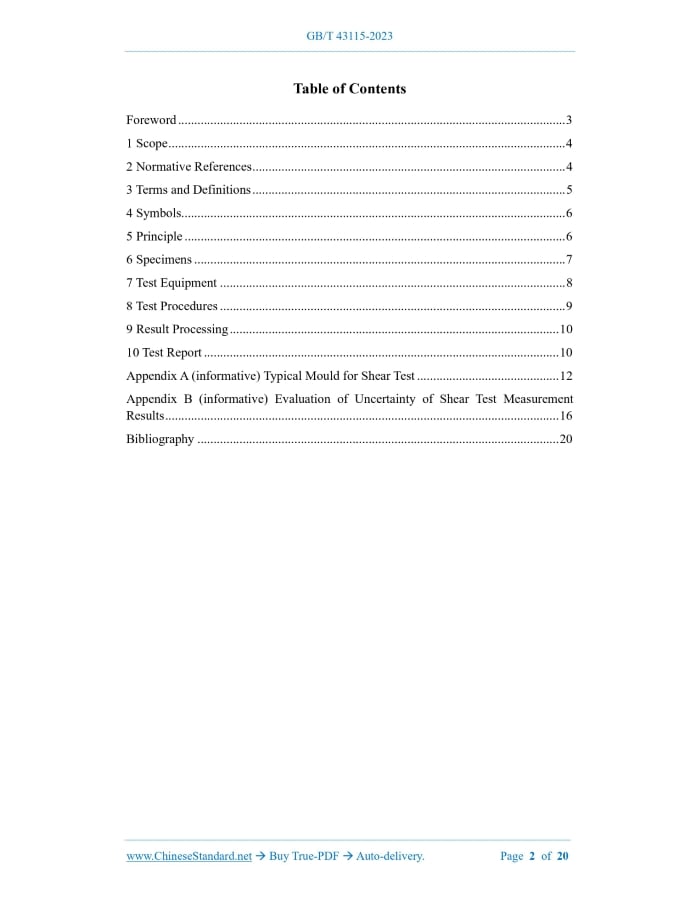
Table of Contents
Foreword ... 3 1 Scope ... 4 2 Normative References ... 4 3 Terms and Definitions ... 5 4 Symbols ... 6 5 Principle ... 6 6 Specimens ... 7 7 Test Equipment ... 8 8 Test Procedures ... 9 9 Result Processing ... 10 10 Test Report ... 10 Appendix A (informative) Typical Mould for Shear Test ... 12 Appendix B (informative) Evaluation of Uncertainty of Shear Test Measurement Results ... 16 Bibliography ... 20 Metallic Materials - Sheet and Strip - Shear Test Method at Room Temperature1 Scope
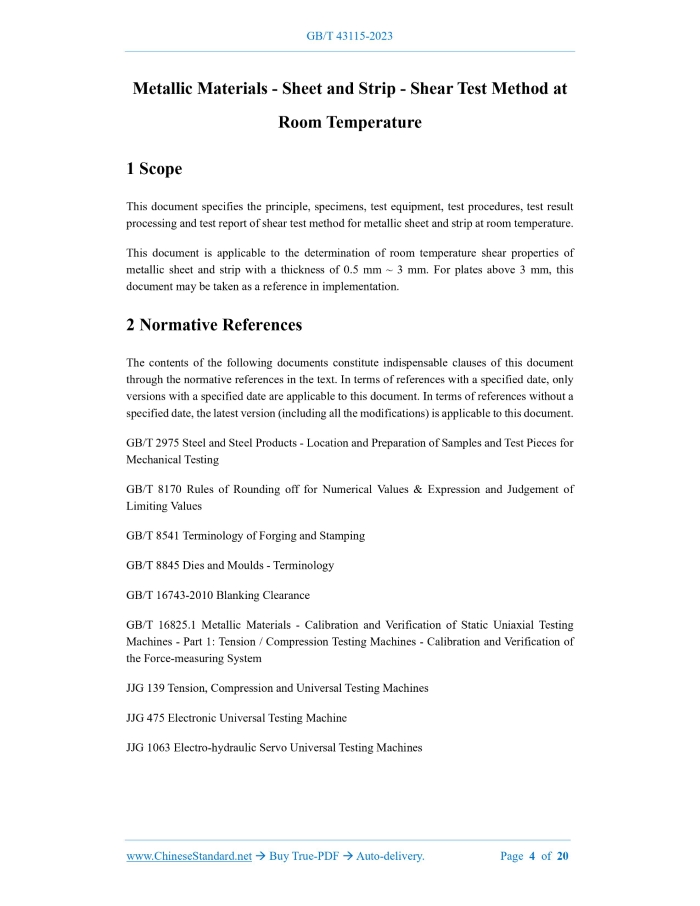
This document specifies the principle, specimens, test equipment, test procedures, test result processing and test report of shear test method for metallic sheet and strip at room temperature. This document is applicable to the determination of room temperature shear properties of metallic sheet and strip with a thickness of 0.5 mm ~ 3 mm. For plates above 3 mm, this document may be taken as a reference in implementation.2 Normative References
The contents of the following documents constitute indispensable clauses of this document through the normative references in the text. In terms of references with a specified date, only versions with a specified date are applicable to this document. In terms of references without a specified date, the latest version (including all the modifications) is applicable to this document. GB/T 2975 Steel and Steel Products - Location and Preparation of Samples and Test Pieces for Mechanical Testing GB/T 8170 Rules of Rounding off for Numerical Values & Expression and Judgement of Limiting Values GB/T 8541 Terminology of Forging and Stamping GB/T 8845 Dies and Moulds - Terminology GB/T 16743-2010 Blanking Clearance GB/T 16825.1 Metallic Materials - Calibration and Verification of Static Uniaxial Testing Machines - Part 1: Tension / Compression Testing Machines - Calibration and Verification of the Force-measuring System JJG 139 Tension, Compression and Universal Testing Machines JJG 475 Electronic Universal Testing Machine JJG 1063 Electro-hydraulic Servo Universal Testing Machines3 Terms and Definitions
What is defined in GB/T 8541 and GB/T 8845, and the following terms and definitions are applicable to this document. 3.1 shear Use two adjacent and mutually parallel cutting edges to cut a material. 3.2 shear force The resistance of a material to cutting or shearing (3.1). 3.3 maximum shear force Fm The maximum force required to cut a material. 3.4 original cross-sectional area S0 The initial shear-bearing cross-sectional area of one side of the specimen. 3.5 shear strength τb The maximum shear stress, to which, a material is subject. NOTE: in a shear test, the shear strength is the stress obtained by dividing the maximum shear force by 2 times the original cross-sectional area. 3.6 single-sided clearance The distance between the side walls of the punch and die edges. 3.7 relative clearance The percentage of single-sided clearance to specimen thickness. be Level 1 or superior to Level 1. 7.2 The working surfaces of the upper and lower platens of the testing machine shall be parallel. The center line of the punch of the mould shall be as consistent as possible with the force application axis of the testing machine, and the loading shall be continuous, smooth, and without vibration. 7.3 During the test, various forms of double-sided shear moulds can be used. See Appendix A for the recommended shear moulds. 7.4 Shearing and supporting materials shall be made of high-strength alloy steel or materials with sufficient hardness. The hardness of the die and punch shall be 56 HRC ~ 60 HRC, and the hardness of the blank holder, guide plate and positioning pin shall be 38 HRC ~ 42 HRC.8 Test Procedures
8.1 Determination of Original Cross-sectional Area The original cross-sectional area of the specimens shall be calculated in accordance with Formula (1). At both ends and in the middle of the specimen, respectively measure the width and thickness, and take the average value. The resolution of thickness measuring gauge shall be superior to 0.005 mm. 8.2 Inspection of Test Moulds Before installing the specimen, the impurities in the die cavity shall be inspected and cleaned up. 8.3 Single-sided Clearance and Punch Selection 8.3.1 The single-sided clearance is selected in accordance with 3.1.2 and 3.1.3 of GB/T 16743- 2010. It is recommended to use the intermediate value of Class II single-sided clearance. The single-sided clearance shall be calculated in accordance with Formula (2). 8.3.2 The dimensions of the punch edge shall be calculated in accordance with Formula (3). 8.3.3 Place the specimen on the die close to the positioning pin and tightly press it. The blank holder shall avoid the punch. 8.3.4 Weigh-take the mass (m) of the punch, accurate to 1 g, and calculate the punch weight G1 = 9.8 m. 8.4 Test Speed The test speed shall comply with the requirements of relevant standards; if there is no such requirement, 15 mm/min is recommended. 8.5 Zero-point Setting of Measuring System After assembly of the test loading chain is completed, the zero point of the shear force measuring system shall be set. 8.6 Application of Force Apply the test force and record the maximum force indication value F1 when the specimen is sheared. 8.7 Calculation of Shear Strength The shear strength (τb) shall be calculated in accordance with Formula (4):9 Result Processing
9.1 The value of test results shall be rounded off in accordance with the requirements of relevant product standards. If no specific requirements are specified, the shear strength value shall be rounded off to 1 MPa in accordance with GB/T 8170. 9.2 If the specimen is bent, incompletely sheared, the shear edge is not perpendicular to the positioning edge, the cross section is not flush, or the mould is damaged, the test results will be invalid, and re-sampling shall be conducted for the test. 9.3 Take the arithmetic mean of the shear strength as the reported value. 9.4 Evaluate the uncertainty of the shear test measurement results. See Appendix B for an example of the evaluation of the uncertainty of the shear test measurement results.10 Test Report
The test report shall at least include the following main content: a) Serial No. of this document; In accordance with Formula (B.3) and Formula (B.4), establish a mathematical model. Where, ucrel(τb)---the relative combined uncertainty of shear strength; urel(Fm)---the relative uncertainty generated by the maximum shear force; urel(S0)---the relative uncertainty generated by the measurement of the original cross-sectional area; urel(rep)---the relative uncertainty generated by repeatability; urel(τbv)---the relative uncertainty generated by shear rate. B.2.2 Relative uncertainty urel(rep) generated by repeatability (Type A relative standard uncertainty) Type A relative standard uncertainty sub-item mainly considers the relative uncertainty urel(rep) generated by repeatability, and the repeatability measurement shall comply with Formula (B.5). Where, u---the uncertainty; s---the standard deviation of measurement; n---the average number of observations for reporting measurement results under normal circumstances. This example evaluates the uncertainty of the average measurement value of three specimens, so it shall be divided by √3, see Formula (B.6). B.2.3 Evaluation of Type B relative standard uncertainty sub-item urel(Fm) of maximum shear force (Fm) B.2.3.1 The relative uncertainty urel(F1) brought by the indication error of the testing machine’s force measuring system. ......Source: Above contents are excerpted from the full-copy PDF -- translated/reviewed by: www.ChineseStandard.net / Wayne Zheng et al.