GB/T 39514-2020 PDF English
Price & Delivery
US$260.00 · In stock · Download in 9 secondsGB/T 39514-2020: Terminology, Definition, Identification of Biobased Materials
Delivery: 9 seconds. True-PDF full-copy in English & invoice will be downloaded + auto-delivered via email. See step-by-step procedure
Status: Valid
| Standard ID | USD | BUY PDF | Delivery | Standard Title (Description) | Status |
| GB/T 39514-2020 | 260 | Add to Cart | Auto, 9 seconds. | Terminology, Definition, Identification of Biobased Materials | Valid |
Click to Preview this PDF
Similar standards
GB/T 39514-2020: Terminology, Definition, Identification of Biobased Materials
---This is an excerpt. Full copy of true-PDF in English version (including equations, symbols, images, flow-chart, tables, and figures etc.), auto-downloaded/delivered in 9 seconds, can be purchased online: https://www.ChineseStandard.net/PDF.aspx/GBT39514-2020GB NATIONAL STANDARD OF THE PEOPLE’S REPUBLIC OF CHINA ICS 83.140 G 33 Terminology, Definition, Identification of Biobased Materials Issued on. NOVEMBER 19, 2020 Implemented on. JUNE 1, 2021 Issued by. State Administration for Market Regulation; Standardization Administration of the People’s Republic of China.
Table of Contents
Foreword... 3 1 Scope... 4 2 Normative References... 4 3 Terms and Definitions... 4 4 Identification... 13 Appendix A (informative) Classification of Biobased Materials... 17 Bibliography... 18 Indexes of English Terms... 19Foreword
This Standard was drafted in accordance with the rules in GB/T 1.1-2009. Please be noted that certain content of this document might involve patents. The institution issuing this document does not undertake the responsibility of identifying these patents. This Standard was proposed by and shall be under the jurisdiction of National Technical Committee 380 on Biobased Degradable Materials and Products of Standardization Administration of China (SAC/TC 380). The drafting organizations of this Standard. Beijing Technology and Business University; Sichuan University; Tsinghua University; Nanjing Tech University; Zhejiang Junke New Material Co., Ltd.; Jiangxi Province Pingxiang City Xuan Pin Plastic Cement Products Co., Ltd.; Shenzhen Hongcai New Material Technology Co., Ltd.; Wuhan Ecoplast Technologies Inc. The main drafters of this Standard. Weng Yunxuan, Wang Yuzhong, Guo Baohua, Hu Jing, Zhu Chenjie, Chen Xiaojie, Wang Peng, Wang Xiuli, Yang Keke, Song Fei, Wu Gang, Chen Sichong, Chen Xiaojiang, Zhang Xianbing. Terminology, Definition, Identification of Biobased Materials1 Scope
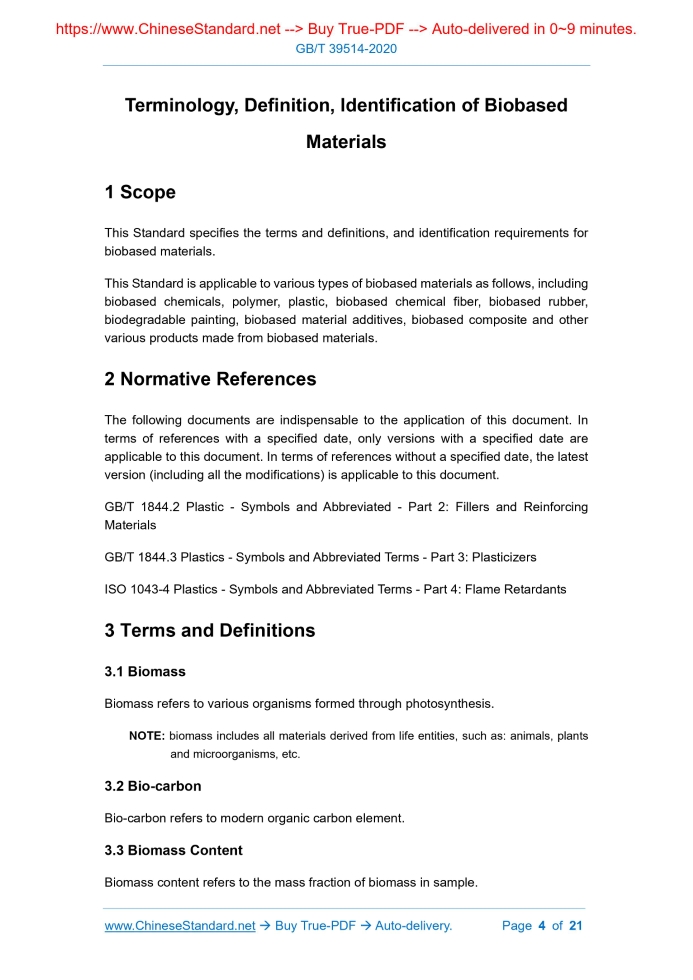
This Standard specifies the terms and definitions, and identification requirements for biobased materials. This Standard is applicable to various types of biobased materials as follows, including biobased chemicals, polymer, plastic, biobased chemical fiber, biobased rubber, biodegradable painting, biobased material additives, biobased composite and other various products made from biobased materials.2 Normative References
The following documents are indispensable to the application of this document. In terms of references with a specified date, only versions with a specified date are applicable to this document. In terms of references without a specified date, the latest version (including all the modifications) is applicable to this document. GB/T 1844.2 Plastic - Symbols and Abbreviated - Part 2.Fillers and Reinforcing Materials GB/T 1844.3 Plastics - Symbols and Abbreviated Terms - Part 3.Plasticizers ISO 1043-4 Plastics - Symbols and Abbreviated Terms - Part 4.Flame Retardants3 Terms and Definitions
3.1 Biomass Biomass refers to various organisms formed through photosynthesis. NOTE. biomass includes all materials derived from life entities, such as. animals, plants and microorganisms, etc. 3.2 Bio-carbon Bio-carbon refers to modern organic carbon element. 3.3 Biomass Content Biomass content refers to the mass fraction of biomass in sample. 3.4 Renewable Resource Renewable resource refers to a resource that is replenished by natural processes at a rate commensurate with its utilization. 3.7 Biobased Content Biobased content refers to a percentage of the ratio of organic carbon radioactivity per gram of sample to organic carbon radioactivity per gram of modern carbon reference material. 3.8 Biocompatibility Biocompatibility refers to the property of life entity tissues in response to inactive foreign materials, and the compatibility between materials and the life entity tissues. 3.9 Biobased Material; BBM Biobased material refers to a material that uses biomass as the raw material or (and) obtained through biological manufacturing. 3.10 Biobased Chemicals Biobased chemicals refer to chemicals converted from biomass with the participation of microorganisms or through biochemical methods.4 Identification
4.1 Identification Method of Biobased Materials The identification method of biobased materials is shown in Figure 1. 4.2 Identification Method of Product Texture 4.2.1 General requirements When product identification is used, it shall be marked on the product or the outer package in accordance with the stipulations of 4.3. 4.2.2 Single-component product If the product is made of a single polymer, then, it shall be marked in accordance with the stipulations of 4.3.See Table 1 for identification examples of some polymers. 4.2.4 Products with additives1) 4.2.4.1 Products with fillers or reinforcing agents In terms of products with a single filler or a single reinforcing agent, the filler or reinforcing agent shall be marked together with the polymer. 4.2.4.2 Products with plasticizers In terms of products with plasticizers, add a hyphen after the abbreviation of polymer. Then, mark the symbol “P”, followed by the abbreviation of plasticizer specified in GB/T 1844.3 enclosed in parentheses. 4.2.4.3 Products with flame retardants In terms of products with flame retardants, add a hyphen after the abbreviation of polymer. Then, mark the symbol “FR”, followed by the digital code of the flame retardant specified in ISO 1043-4 enclosed in parentheses. 4.3 Production of Identification The production of identification may adopt molding, printing, embossing, branding or other clear and indelible marking methods. ......Source: Above contents are excerpted from the full-copy PDF -- translated/reviewed by: www.ChineseStandard.net / Wayne Zheng et al.