GB/T 28011-2021 PDF English
Price & Delivery
US$185.00 · In stock · Download in 9 secondsGB/T 28011-2021: Shanks for footwear
Delivery: 9 seconds. True-PDF full-copy in English & invoice will be downloaded + auto-delivered via email. See step-by-step procedure
Status: Valid
GB/T 28011: Historical versions
| Standard ID | USD | BUY PDF | Delivery | Standard Title (Description) | Status |
| GB/T 28011-2021 | 185 | Add to Cart | Auto, 9 seconds. | Shanks for footwear | Valid |
| GB 28011-2011 | 95 | Add to Cart | Auto, 9 seconds. | [GB/T 28011-2011] Shanks for footwear [including MODIFICATION 1] | Obsolete |
Click to Preview this PDF
Similar standards
GB/T 28011-2021: Shanks for footwear
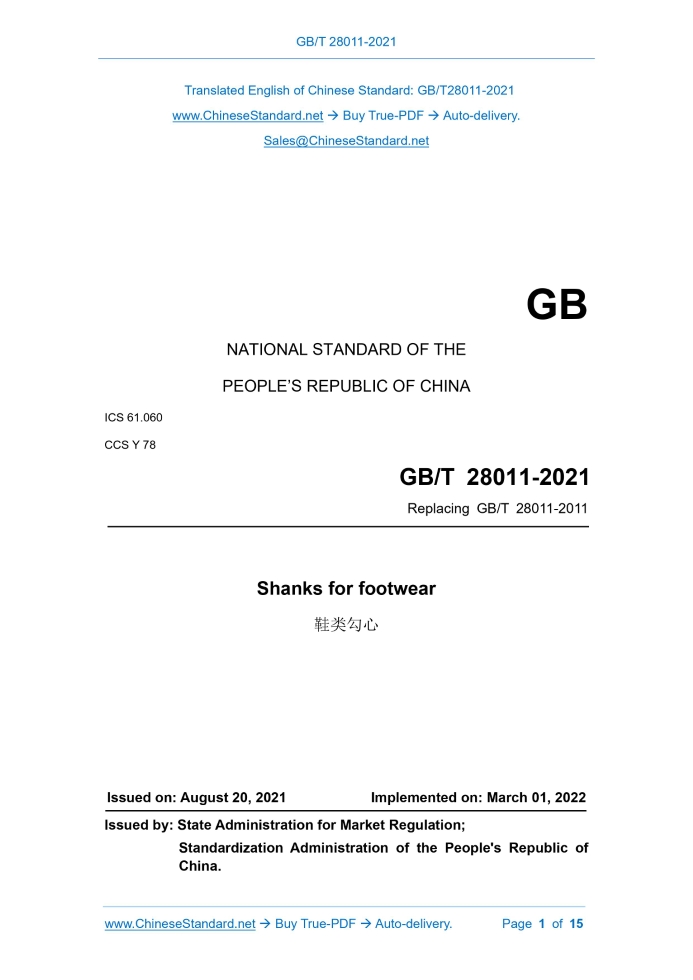
---This is an excerpt. Full copy of true-PDF in English version (including equations, symbols, images, flow-chart, tables, and figures etc.), auto-downloaded/delivered in 9 seconds, can be purchased online: https://www.ChineseStandard.net/PDF.aspx/GBT28011-2021NATIONAL STANDARD OF THE PEOPLE’S REPUBLIC OF CHINA ICS 61.060 CCS Y 78 Replacing GB/T 28011-2011 Shanks for footwear Issued on. AUGUST 20, 2021 Implemented on. MARCH 01, 2022 Issued by. State Administration for Market Regulation; Standardization Administration of the People's Republic of China.
Table of Contents
Foreword... 3 1 Scope... 5 2 Normative references... 5 3 Terms and definitions... 5 4 Product classification... 6 5 Technical requirements... 6 6 Number of specimens... 9 7 Test methods... 9 8 Inspection rules... 13 9 Marks, packaging, transportation, storage... 14Foreword
This Standard was drafted in accordance with the rules given in GB/T 1.1-2020 “Directives for standardization - Part 1.Rules for the structure and drafting of standardizing documents". This Standard replaces GB/T 28011-2011 "Shanks for footwear". Compared with GB/T 28011-2011, the main technical changes in this Standard are as follows. - modified the standard's name; - modified the "Scope" (see Chapter 1 of this Edition, Chapter 1 of Edition 2011); - added the definitions for "type I shank", "type L shank" and "type Y shank" (see 3.1, 3.2, 3.3 of this Edition); - modified the product classification (see Chapter 4 of this Edition, Chapter 4 of Edition 2011); - modified the requirements for "marks" (see 5.1 of this Edition, 5.1 of Edition 2011); - modified the requirements for "sensory quality" (see 5.2 of this Edition, 5.2 of Edition 2011); - modified the requirements for "longitudinal stiffness" (see 5.4 of this Edition, 5.4 of Edition 2011); - modified the requirements for "fatigue resistance" (see 5.5 of this Edition, 5.5 of Edition 2011); - modified the requirements for "hardness" (see 5.6 of this Edition, 5.6 of Edition 2011); - modified the requirements for "bending performance" (see 5.7 of this Edition, 5.7 of Edition 2011); - added the graphic for length measurement of type I shank, type L shank and type Y shank (see 7.2.1, 7.2.2, 7.2.3 of this Edition); - modified the test methods for "bending performance" (see 7.8 of this Edition, 7.8 of Edition 2011); - modified the methods for "result judgement" (see 8.3 of this Edition, 8.3 of Edition 2011). Attention is drawn to the possibility that some of the elements of this Standard may be the subject of patent rights. The issuing authority shall not be held responsible for identifying any or all such patent rights. This Standard was proposed by China National Light Industry Council. This Standard shall be under the jurisdiction of National Technical Committee on Shoemaking of Standardization Administration of China (SAC/TC 305). The drafting organizations of this Standard. China Leather and Shoes Research Institute Co., Ltd., Zaozhuang Tianzhu Hardware Technology Co., Ltd., China Textile Association Inspection (Quanzhou) Technical Service Co., Ltd. Main drafters of this Standard. Chang Wenkai, Xiao Houzhu, Wang Zhe, Meng Hongwei. Version of standard substituted by this Standard is. - GB/T 28011-2011. Shanks for footwear1 Scope
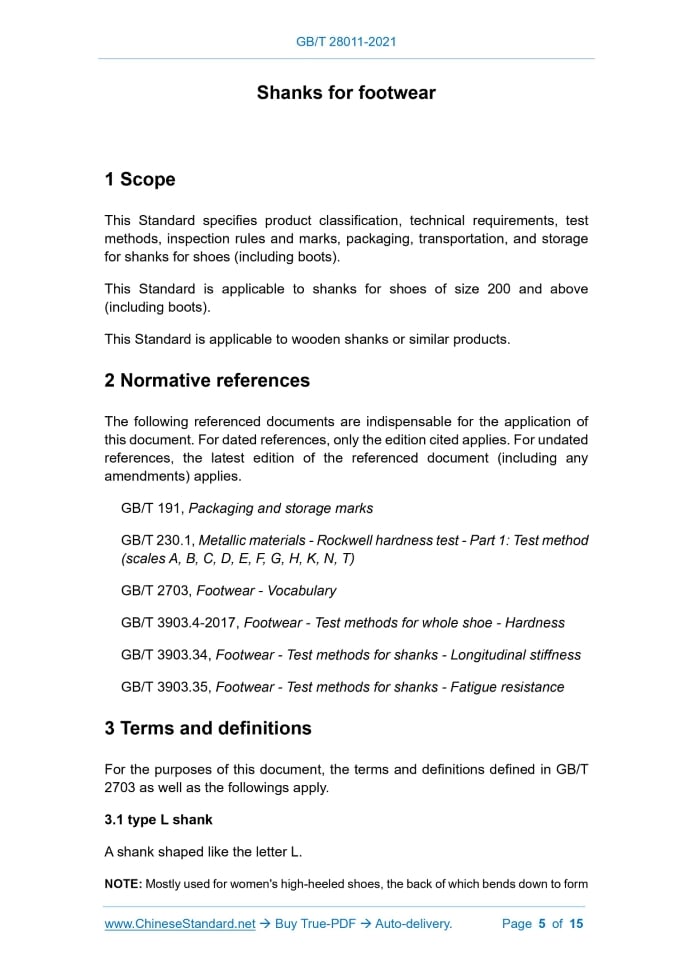
This Standard specifies product classification, technical requirements, test methods, inspection rules and marks, packaging, transportation, and storage for shanks for shoes (including boots). This Standard is applicable to shanks for shoes of size 200 and above (including boots). This Standard is applicable to wooden shanks or similar products.2 Normative references
The following referenced documents are indispensable for the application of this document. For dated references, only the edition cited applies. For undated references, the latest edition of the referenced document (including any amendments) applies. GB/T 191, Packaging and storage marks GB/T 230.1, Metallic materials - Rockwell hardness test - Part 1.Test method (scales A, B, C, D, E, F, G, H, K, N, T) GB/T 2703, Footwear - Vocabulary GB/T 3903.4-2017, Footwear - Test methods for whole shoe - Hardness GB/T 3903.34, Footwear - Test methods for shanks - Longitudinal stiffness GB/T 3903.35, Footwear - Test methods for shanks - Fatigue resistance3 Terms and definitions
For the purposes of this document, the terms and definitions defined in GB/T 2703 as well as the followings apply. 3.1 type L shank A shank shaped like the letter L. 3.2 type Y shank A shank shaped like the letter Y. 3.3 type I shank A shank shaped like the letter I.4 Product classification
The shanks can be classified according to the following conditions.5 Technical requirements
5.1 Marks 5.1.1 The shank shall be marked with the effective heel height or the applicable effective heel height range, expressed in Arabic numerals, and the unit is millimeters. 5.2 Sensory quality The surface of the shank has no burrs, corrosion, cracks, bending deformation, smooth and flat. The positions of ribs, nail holes and forks are correct. 5.3 Size 5.3.1 Size tolerance The length tolerance is the difference between the maximum value and the minimum value in the measured value of the specimen. 5.3.2 Length 5.3.2.1 Length requirements for type I shanks of men's shoes See Table 1 for the length requirements for type I shanks of men's shoes. 5.3.2.3 Length requirements for type L shank The length of the type L shank shall be the length of the type I shank for women's shoes and children's shoes corresponding to different heel heights in Table 2, minus 15mm. 5.4 Longitudinal stiffness The longitudinal stiffness requirements for the shank are shown in Table 3. 5.5 Fatigue resistance After the metal shank is tested for fatigue resistance according to the number of tests specified in Table 4, the specimen shall not be broken. 5.6 Hardness The shank hardness requirements are shown in Table 5.6 Number of specimens
Take the shanks of the same material, the same specification, and a continuous production batch as a sampling batch. Randomly select 6 shanks as specimens, of which 2 shanks are used for the inspection of mark, sensory quality, size, longitudinal rigidity and hardness.7 Test methods
7.1 Marks and sensory quality Inspect visually under normal light. 7.2 Shank length 7.3 Shank width Use vernier calipers with an accuracy of not less than 0.05mm. Measure a point on the head and tail of the shank without burrs respectively. The result is to one decimal place. The width values of the head and tail of each shank are expressed separately. 7.4 Shank thickness Use vernier calipers with an accuracy of not less than 0.05mm. Measure a point on the head and tail of the shank without burrs respectively. The arithmetic mean of the thickness of the head and tail is the thickness of the shank. The result is to one decimal place. The thickness value of each shank is indicated separately. 7.5 Longitudinal stiffness Test according to GB/T 3903.34.The test results of each shank are shown separately. 7.6 Fatigue resistance Test according to GB/T 3903.35.The test results of each shank are shown separately. 7.8 Bending performance8 Inspection rules
8.1 Inspection of shank products 8.1.1 Batching Products are inspected and accepted in batches. Continuously produced products of the same model and specification can be used as an inspection lot. 8.1.4 Type inspection 8.1.4.1 In one of the following situations, type inspection shall also be carried out. tested for other items. 8.3 Result judgment 8.3.1 Batch judgement If in each individual test, if one or more shanks fail to meet the requirements of this Standard, the item will be judged as nonconforming. 8.3.2 Shoe shank judgement Remove the shank from the shoe. Determine the individual test results of the shank based on the effective heel height of the tested shoe. The performance of the shank shall conform to the product standard corresponding to the tested shoe.9 Marks, packaging, transportation, storage
9.1 Marks 9.1.1 Mark content on domestic product packaging Product name, specification (length, width, thickness), applicable effective heel height (or applicable effective heel height range), quantity, manufacturer name, factory address, telephone number, postal code, trademark, production date, moisture-proof mark, certificate and implementation standard number. 9.1.3 Storage and transportation marks The packaging, storage and transportation pictorial marks shall meet the requirements of GB/T 191. 9.2 Packaging There are protective measures in the package. The packaging form can be carton, wooden box or the form agreed upon by the supplier and the purchaser. 9.3 Transportation, storage During transportation and storage, no heavy pressure, rain, or contact with corrosive substances such as acids or alkalis shall be allowed. ......Source: Above contents are excerpted from the full-copy PDF -- translated/reviewed by: www.ChineseStandard.net / Wayne Zheng et al.