GB/T 20066-2006 PDF English
Price & Delivery
US$135.00 · In stock · Download in 9 secondsGB/T 20066-2006: Steel and iron -- Sampling and preparation of samples for the determination of chemical composition
Delivery: 9 seconds. True-PDF full-copy in English & invoice will be downloaded + auto-delivered via email. See step-by-step procedure
Status: Valid
| Standard ID | USD | BUY PDF | Delivery | Standard Title (Description) | Status |
| GB/T 20066-2006 | 135 | Add to Cart | Auto, 9 seconds. | Steel and iron -- Sampling and preparation of samples for the determination of chemical composition | Valid |
Click to Preview this PDF
Similar standards
GB/T 20066-2006: Steel and iron -- Sampling and preparation of samples for the determination of chemical composition
---This is an excerpt. Full copy of true-PDF in English version (including equations, symbols, images, flow-chart, tables, and figures etc.), auto-downloaded/delivered in 9 seconds, can be purchased online: https://www.ChineseStandard.net/PDF.aspx/GBT20066-2006
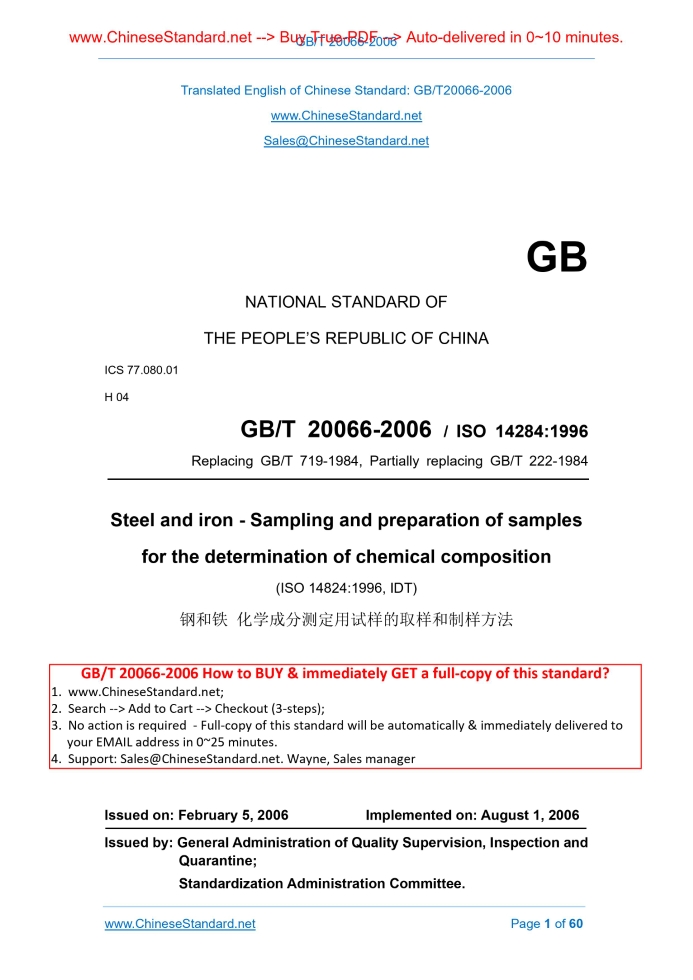
GB NATIONAL STANDARD OF THE PEOPLE’S REPUBLIC OF CHINA ICS 77.080.01 H 04 GB/T 20066-2006 / ISO 14284.1996 Replacing GB/T 719-1984, Partially replacing GB/T 222-1984 Steel and iron - Sampling and preparation of samples for the determination of chemical composition (ISO 14824.1996, IDT) Issued on. FEBRUARY 5, 2006 Implemented on. AUGUST 1, 2006 Issued by. General Administration of Quality Supervision, Inspection and Quarantine; Standardization Administration Committee.
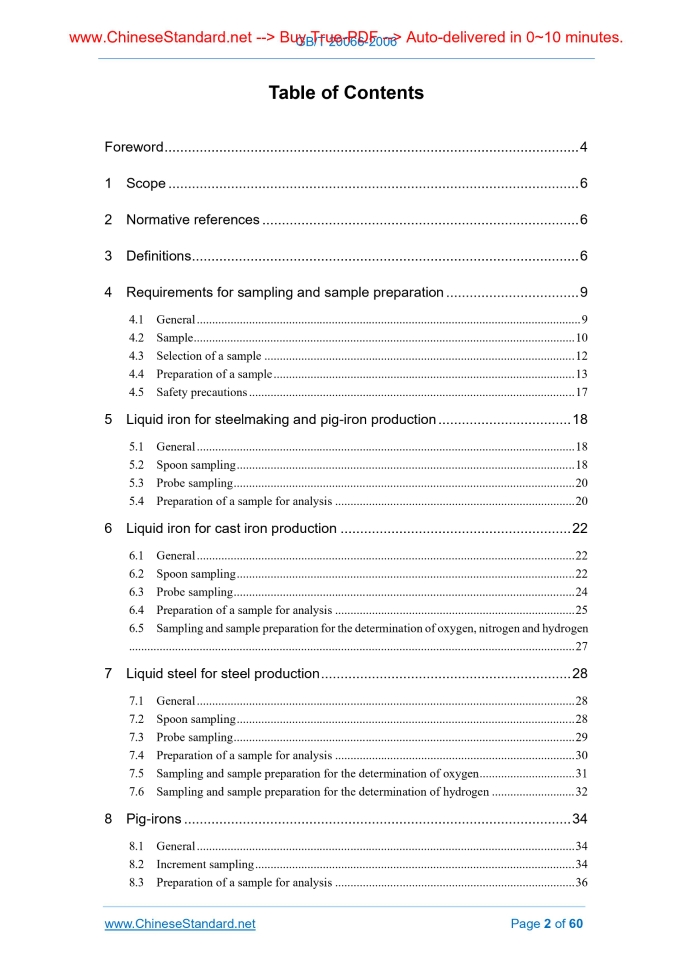
Table of Contents
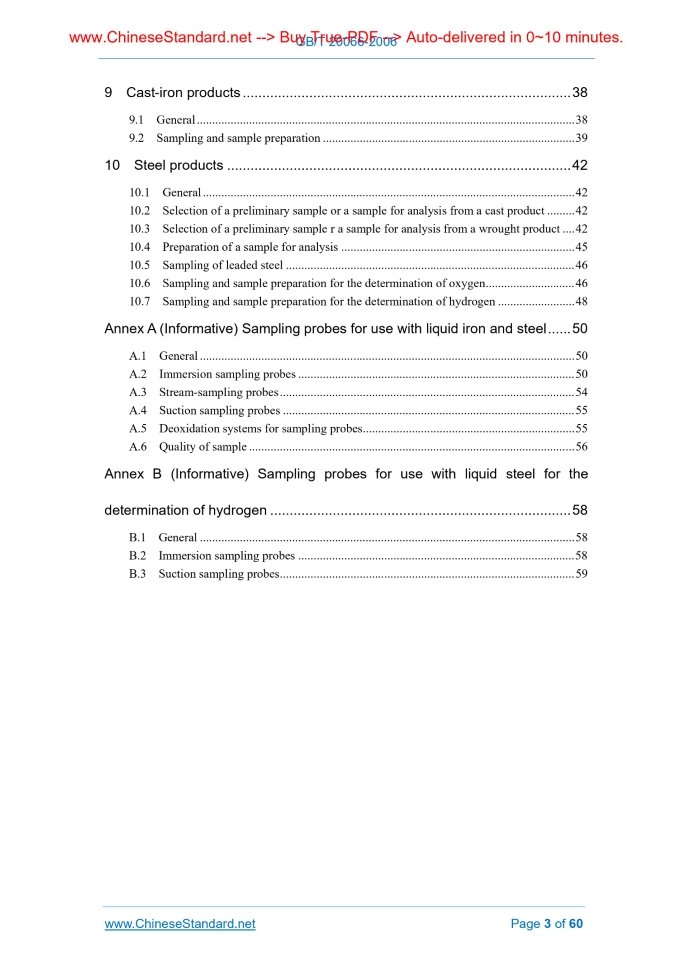
Foreword... 4 1 Scope... 6 2 Normative references... 6 3 Definitions... 6 4 Requirements for sampling and sample preparation... 9 4.1 General... 9 4.2 Sample... 10 4.3 Selection of a sample... 12 4.4 Preparation of a sample... 13 4.5 Safety precautions... 17 5 Liquid iron for steelmaking and pig-iron production... 18 5.1 General... 18 5.2 Spoon sampling... 18 5.3 Probe sampling... 20 5.4 Preparation of a sample for analysis... 20 6 Liquid iron for cast iron production... 22 6.1 General... 22 6.2 Spoon sampling... 22 6.3 Probe sampling... 24 6.4 Preparation of a sample for analysis... 25 6.5 Sampling and sample preparation for the determination of oxygen, nitrogen and hydrogen ... 27 7 Liquid steel for steel production... 28 7.1 General... 28 7.2 Spoon sampling... 28 7.3 Probe sampling... 29 7.4 Preparation of a sample for analysis... 30 7.5 Sampling and sample preparation for the determination of oxygen... 31 7.6 Sampling and sample preparation for the determination of hydrogen... 32 8 Pig-irons... 34 8.1 General... 34 8.2 Increment sampling... 34 8.3 Preparation of a sample for analysis... 36 9 Cast-iron products... 38 9.1 General... 38 9.2 Sampling and sample preparation... 39 10 Steel products... 42 10.1 General... 42 10.2 Selection of a preliminary sample or a sample for analysis from a cast product... 42 10.3 Selection of a preliminary sample r a sample for analysis from a wrought product... 42 10.4 Preparation of a sample for analysis... 45 10.5 Sampling of leaded steel... 46 10.6 Sampling and sample preparation for the determination of oxygen... 46 10.7 Sampling and sample preparation for the determination of hydrogen... 48 Annex A (Informative) Sampling probes for use with liquid iron and steel... 50 A.1 General... 50 A.2 Immersion sampling probes... 50 A.3 Stream-sampling probes... 54 A.4 Suction sampling probes... 55 A.5 Deoxidation systems for sampling probes... 55 A.6 Quality of sample... 56 Annex B (Informative) Sampling probes for use with liquid steel for the determination of hydrogen... 58 B.1 General... 58 B.2 Immersion sampling probes... 58 B.3 Suction sampling probes... 59Foreword
Steel and iron - sampling and preparation of samples for the determination of chemical composition is not a key link to accurately, objectively and comprehensively reflect the quality of steel product, but also an important link of quality control during the production process. This Standard identically uses ISO 14824.1996 Steel and iron - Sampling and preparation of samples for the determination of chemical composition (English version). This Standard replaces the part of sampling method for samples of chemical analysis of steel in GB/T 222-1984 Sampling method for chemical analysis of steel and allowable deviation of chemical composition of finished product and GB/T 719-1984 Sampling method for sample analysis of pig iron chemical analysis. Compared this Standard with the relevant part of GB/T 222-1984 and GB/T 719- 1984, there are great differences. About the sampling method for analysis of chemical composition for the determination of chemical composition of steel, the original standard only made a principle or a simple provision on sample representation, sampling timing, location, number of samples, size and cleaning requirements. It did not specify the method for preparing sample for the determination of chemical composition of steel. However, this Standard not only clearly specifies these respects, it also made detailed and specific provisions on sampling equipment, operating procedures (including process diagrams) and operating conditions, sample storage, identification, safety and hygiene, as well as different requirements for chemical analysis, thermal analysis and physical analysis of samples, different requirements for determination of hydrogen, oxygen, nitrogen and other different elements of the sample. Annex A and Annex B of this Standard are informative. This Standard was proposed by National Technical Committee on Steel of Standardization Administration of China. This Standard shall be under the jurisdiction of National Technical Committee on Steel of Standardization Administration of China. Drafting organization of this Standard. Metallurgical Industry Information Standards Institute. Main drafters of this Standard. Chen Zibin, Wu Qiansi. Versions of standard substituted by this Standard are. GB/T 719-1984, GB/T 222-1984, GB/T 222-1963. Steel and iron - Sampling and preparation of samples for the determination of chemical composition1 Scope
This Standard specifies methods for sampling and sample preparation for the determination of the chemical composition of pig iron, cast iron and steel. Methods are specified for use with both liquid and solid metal.2 Normative references
The following standards contain the provisions which, through reference in this Standard, constitute the provisions of this Standard. For dated references, subsequent amendments (excluding corrections) or revisions do not apply to this Standard. However, the parties who enter into agreement based on this Standard are encouraged to investigate whether the latest versions of these documents are applicable. For undated reference documents, the latest versions apply to this Standard.3 Definitions
For the purposes of this Standard, the following definitions apply. method in which the sample is taken from the melt, or during the pouring of the melt, using a long-handled spoon, and cast into a small mould4 Requirements for sampling and sample preparation
Sampling practices shall be designed to provide a sample for analysis that is representative of the mean chemical composition of the melt or the sample product.5 Liquid iron for steelmaking and pig-iron production
For sampling from a melt, immerse a preheated steel spoon into the melt and fill with liquid iron. Withdraw the spoon and remove any slag by skimming the surface of the liquid iron in the spoon. Particular care is required when preparing the surface of thin samples. A chuck shall be specially designed to hold the sample securely grinding and linishing operations.6 Liquid iron for cast iron production
In batch processes, two or more samples should be taken from melting furnaces, preferably when approximately one-third and two-thirds of the melt has been discharged, and an average analysis determined. In continuous processes, samples should be taken at regular intervals of time.7 Liquid steel for steel production
For sampling stainless steel, a refractory ring placed on a cast iron plate may be used as a mould; the ring should have a wall thickness of 10 mm to 12 mm. The sample is removed from the mould by breaking off the refractory. Some tundishes may contain a sufficient depth of liquid metal to permit the use of an immersion sampling probe.8 Pig-irons
In the case of a stockpile, throw a rope having a certain number of knots onto the pile and take the pigs touched by these knots. Repeat the operation until a sufficient number of pigs is obtained.9 Cast-iron products
In the case of a hollow casting such as a pipe, drill completely through the wall of the pipe at each end and in the middle, with the axes of the three drill holes at 120° to each other. ......Source: Above contents are excerpted from the full-copy PDF -- translated/reviewed by: www.ChineseStandard.net / Wayne Zheng et al.