GB/T 1689-2014 PDF English
Price & Delivery
US$70.00 · In stock · Download in 9 secondsGB/T 1689-2014: Rubber vulcanized -- Determination of abrasion resistance (Akron machine)
Delivery: 9 seconds. True-PDF full-copy in English & invoice will be downloaded + auto-delivered via email. See step-by-step procedure
Status: Valid
GB/T 1689: Historical versions
| Standard ID | USD | BUY PDF | Delivery | Standard Title (Description) | Status |
| GB/T 1689-2014 | 70 | Add to Cart | Auto, 9 seconds. | Rubber vulcanized -- Determination of abrasion resistance (Akron machine) | Valid |
| GB/T 1689-1998 | 279 | Add to Cart | 3 days | Rubber vulcanized--Determination of abrasion resistance (Akron machine) | Obsolete |
| GB 1689-1982 | 199 | Add to Cart | 2 days | Rubber, vulcanized--Determination of abrasion resistance (Akron machine) | Obsolete |
Click to Preview this PDF
Similar standards
GB/T 1689-2014: Rubber vulcanized -- Determination of abrasion resistance (Akron machine)
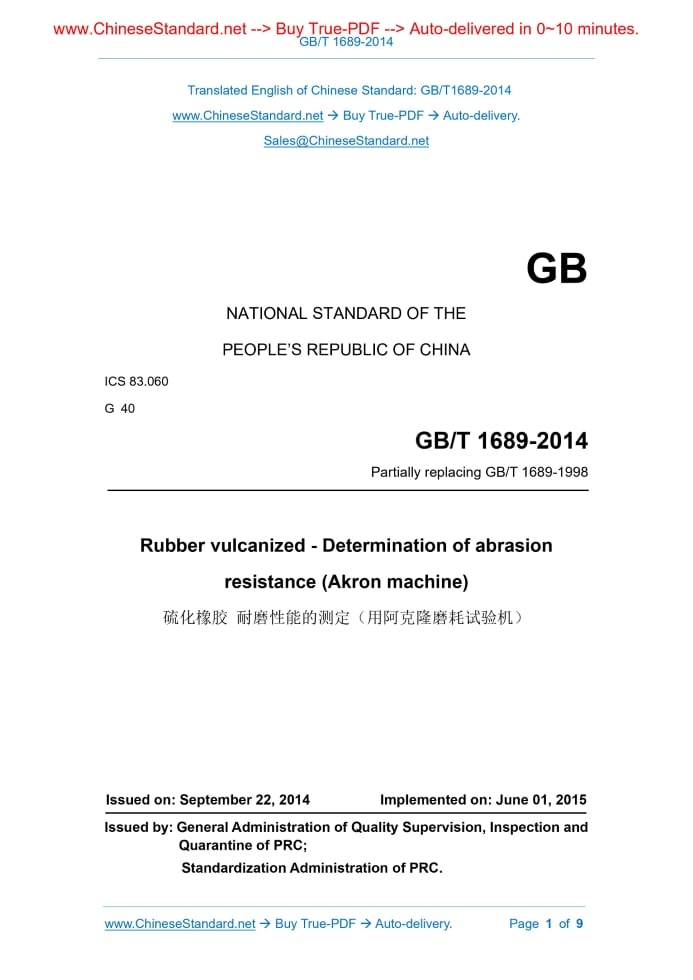
---This is an excerpt. Full copy of true-PDF in English version (including equations, symbols, images, flow-chart, tables, and figures etc.), auto-downloaded/delivered in 9 seconds, can be purchased online: https://www.ChineseStandard.net/PDF.aspx/GBT1689-2014NATIONAL STANDARD OF THE PEOPLE’S REPUBLIC OF CHINA ICS 83.060 G 40 Partially replacing GB/T 1689-1998 Rubber vulcanized - Determination of abrasion resistance (Akron machine) Issued on. SEPTEMBER 22, 2014 Implemented on. JUNE 01, 2015 Issued by. General Administration of Quality Supervision, Inspection and Quarantine of PRC; Standardization Administration of PRC.
Table of Contents
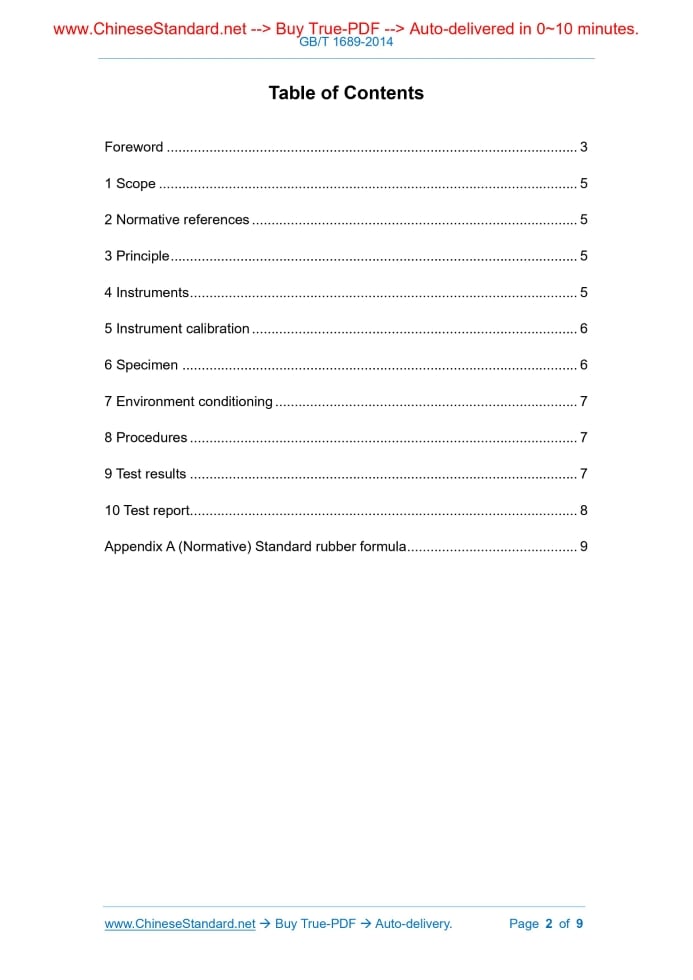
Foreword... 3 1 Scope... 5 2 Normative references... 5 3 Principle... 5 4 Instruments... 5 5 Instrument calibration... 6 6 Specimen... 6 7 Environment conditioning... 7 8 Procedures... 7 9 Test results... 7 10 Test report... 8 Appendix A (Normative) Standard rubber formula... 9Foreword
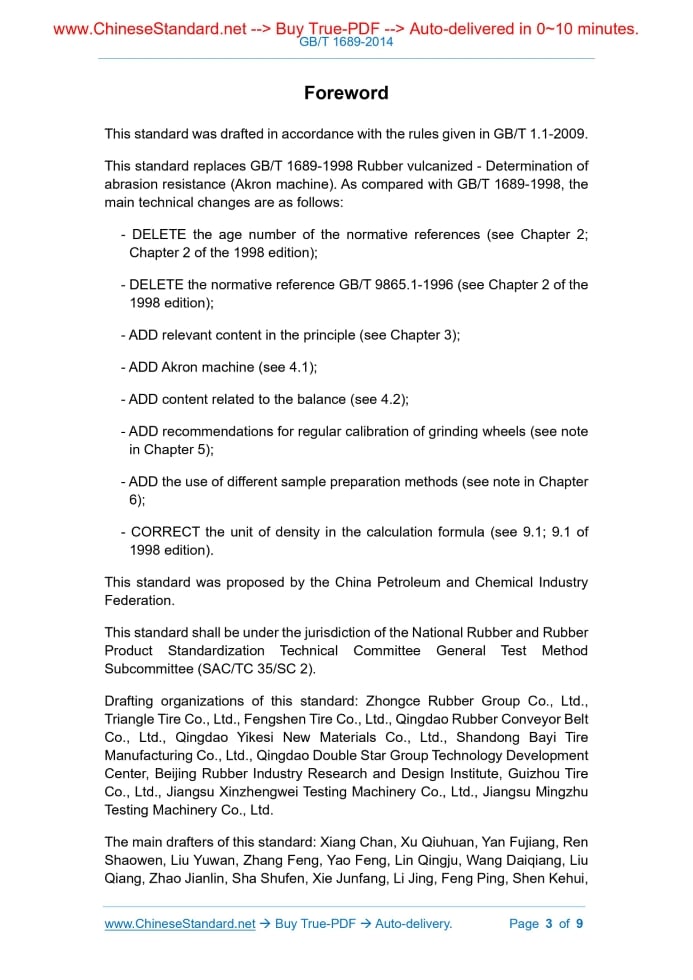
This standard was drafted in accordance with the rules given in GB/T 1.1-2009. This standard replaces GB/T 1689-1998 Rubber vulcanized - Determination of abrasion resistance (Akron machine). As compared with GB/T 1689-1998, the main technical changes are as follows. - DELETE the age number of the normative references (see Chapter 2; Chapter 2 of the 1998 edition); - DELETE the normative reference GB/T 9865.1-1996 (see Chapter 2 of the 1998 edition); - ADD relevant content in the principle (see Chapter 3); - ADD Akron machine (see 4.1); - ADD content related to the balance (see 4.2); - ADD recommendations for regular calibration of grinding wheels (see note in Chapter 5); - ADD the use of different sample preparation methods (see note in Chapter 6); - CORRECT the unit of density in the calculation formula (see 9.1; 9.1 of 1998 edition). This standard was proposed by the China Petroleum and Chemical Industry Federation. This standard shall be under the jurisdiction of the National Rubber and Rubber Product Standardization Technical Committee General Test Method Subcommittee (SAC/TC 35/SC 2). Drafting organizations of this standard. Zhongce Rubber Group Co., Ltd., Triangle Tire Co., Ltd., Fengshen Tire Co., Ltd., Qingdao Rubber Conveyor Belt Co., Ltd., Qingdao Yikesi New Materials Co., Ltd., Shandong Bayi Tire Manufacturing Co., Ltd., Qingdao Double Star Group Technology Development Center, Beijing Rubber Industry Research and Design Institute, Guizhou Tire Co., Ltd., Jiangsu Xinzhengwei Testing Machinery Co., Ltd., Jiangsu Mingzhu Testing Machinery Co., Ltd. The main drafters of this standard. Xiang Chan, Xu Qiuhuan, Yan Fujiang, Ren Shaowen, Liu Yuwan, Zhang Feng, Yao Feng, Lin Qingju, Wang Daiqiang, Liu Qiang, Zhao Jianlin, Sha Shufen, Xie Junfang, Li Jing, Feng Ping, Shen Kehui, Zhu Ming. This standard replaces the standards previously issued as follows. - GB/T 1689-1979, GB/T 1689-1982 (1989), GB/T 1689-1998. Rubber vulcanized - Determination of abrasion resistance (Akron machine)1 Scope
This standard specifies the method for determining the abrasion resistance of vulcanized rubber. This standard is applicable to the determination of the abrasion resistance of vulcanized rubber by the Akron machine.2 Normative references
The following documents are indispensable for the application of this document. For dated references, only the dated version applies to this document. For undated references, the latest version (including all amendments) applies to this document. GB/T 533 Rubber vulcanized or thermoplastic - Determination of density (GB/T 533-2008, ISO 2781.2007, IDT)3 Principle
In this test, the specimen and the grinding wheel are rubbed under a certain inclination angle and a certain load, to determine the wear volume or wear index of a certain mileage of the specimen.4 Instruments
4.1 Akron machine 4.1.1 The rotation speed of the rubber wheel shaft is 76 r/min ± 2 r/min. The rotation speed of the grinding wheel shaft is 34 r/min ± 1 r/min. 4.1.2 When the angle between the rubber wheel shaft and the grinding wheel shaft is zero degrees, the two shafts shall remain parallel and horizontal. 4.1.3 Add the test weight to the load bracket so that the specimen is subjected to a load of 26.7 N ± 0.2 N. 4.1.6 The size of the test wheel is 150 mm in diameter, the center hole diameter is 32 mm, the thickness is 25 mm; the abrasive material is alumina, the particle size is 36, the binder is clay, the hardness is medium hardness 2. 4.2 Balance Accurate to 0.001 g.5 Instrument calibration
5.1 The angle between the rubber wheel shaft and the grinding wheel shaft as well as the load on the specimen are important factors affecting the test results and shall be calibrated periodically. 5.2 Adjust the test machine’s base to the horizontal state before calibration. 5.4 Install the load calibrator on the rubber wheel shaft. The right side of the calibrator shall be close to the working surface of the grinding wheel. Place the test weight and adjust the position of the balance weight, so that the load on the specimen is 26.7 N ± 0.2 N.6 Specimen
6.1 The specimen is strip-shaped with a length of (D + 2h) π mm, a width of 12.7 mm ± 0.2 mm, a thickness of 3.2 mm ± 0.2 mm. 6.2 The surface of the specimen shall be flat and shall be free from cracks and impurities. 6.3 After the two sides of the specimen are polished, they are glued to the rubber wheel. The specimen shall not be subjected to tension when bonding. The joint shall be smoothly transitioned during binding. The bonded sample wheel shall be conditioned for at least 16 h. 6.4 The rubber wheel has a diameter of 68 mm, a thickness of 12.7 mm ± 0.2 mm, a hardness of 75 to 80 degrees (Shore A). The diameter of the center hole shall correspond to the diameter of the rotary shaft of the rubber wheel.7 Environment conditioning
The environment conditioning of the sample shall be carried out in accordance with the provisions of GB/T 2941.8 Procedures
8.1 Fix the glued specimen wheel on the rubber wheel shaft and start the motor to rotate the specimen clockwise. 8.2 Pre-grind the specimen for 15 min ~ 20 min, remove the rubber scraps and weigh the mass, accurate to 0.001 g. 8.4 Determine the density of the specimen according to GB/T 533.9 Test results
9.1 The wear volume V of specimen is calculated according to formula (1). 9.2 The wear index A (%) of specimen, calculated according to formula (2).10 Test report
The test report shall include the following. ......Source: Above contents are excerpted from the full-copy PDF -- translated/reviewed by: www.ChineseStandard.net / Wayne Zheng et al.