GB/T 15516-1995 PDF English
Price & Delivery
US$90.00 · In stock · Download in 9 secondsGB/T 15516-1995: Air quality - Determination of formaldehyde - Acetylacetone spectrophotometric method
Delivery: 9 seconds. True-PDF full-copy in English & invoice will be downloaded + auto-delivered via email. See step-by-step procedure
| Standard ID | USD | BUY PDF | Delivery | Standard Title (Description) | Status |
| GB/T 15516-1995 | 90 | Add to Cart | Auto, 9 seconds. | Air quality - Determination of formaldehyde - Acetylacetone spectrophotometric method |
Click to Preview this PDF
Similar standards
GB/T 15516-1995: Air quality - Determination of formaldehyde - Acetylacetone spectrophotometric method
---This is an excerpt. Full copy of true-PDF in English version (including equations, symbols, images, flow-chart, tables, and figures etc.), auto-downloaded/delivered in 9 seconds, can be purchased online: https://www.ChineseStandard.net/PDF.aspx/GBT15516-1995
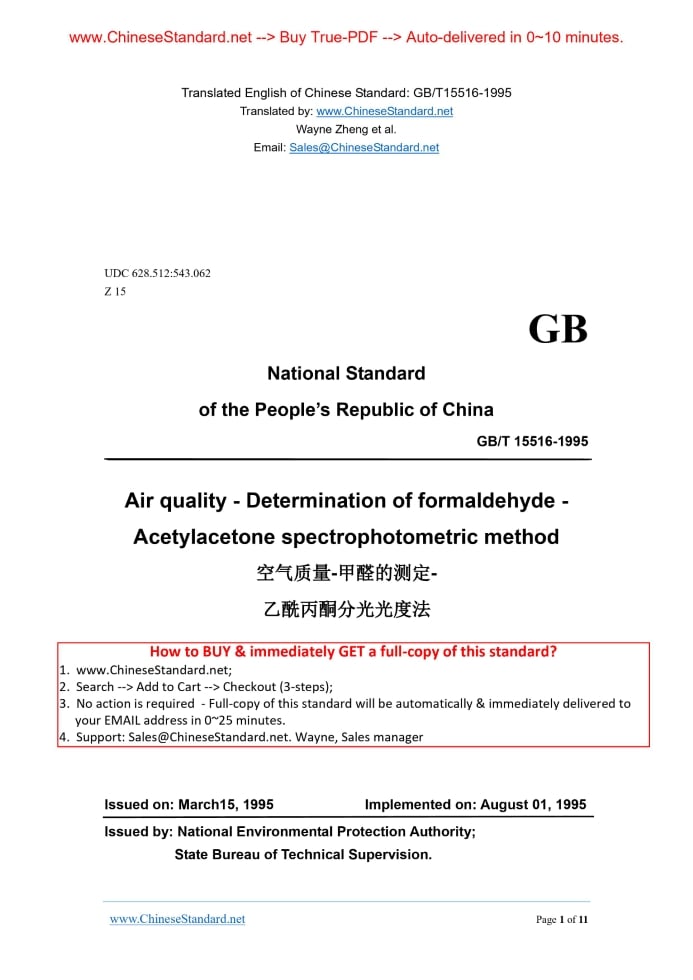
UDC 628.512.543.062 Z 15 GB National Standard of the People’s Republic of China Air quality - Determination of formaldehyde - Acetylacetone spectrophotometric method Issued on. MARCH15, 1995 Implemented on. AUGUST 01, 1995 Issued by. National Environmental Protection Authority; State Bureau of Technical Supervision.
Table of Contents
1 Subject content and application scope... 3 2 Principle... 3 3 Reagents... 4 4 Instruments... 6 5 Samples... 7 6 Steps... 8 7 Results and expression... 9 8 Precautions... 10 Additional Note... 11 Air quality - Determination of formaldehyde – Acetylacetone spectrophotometric method1 Subject content and application scope
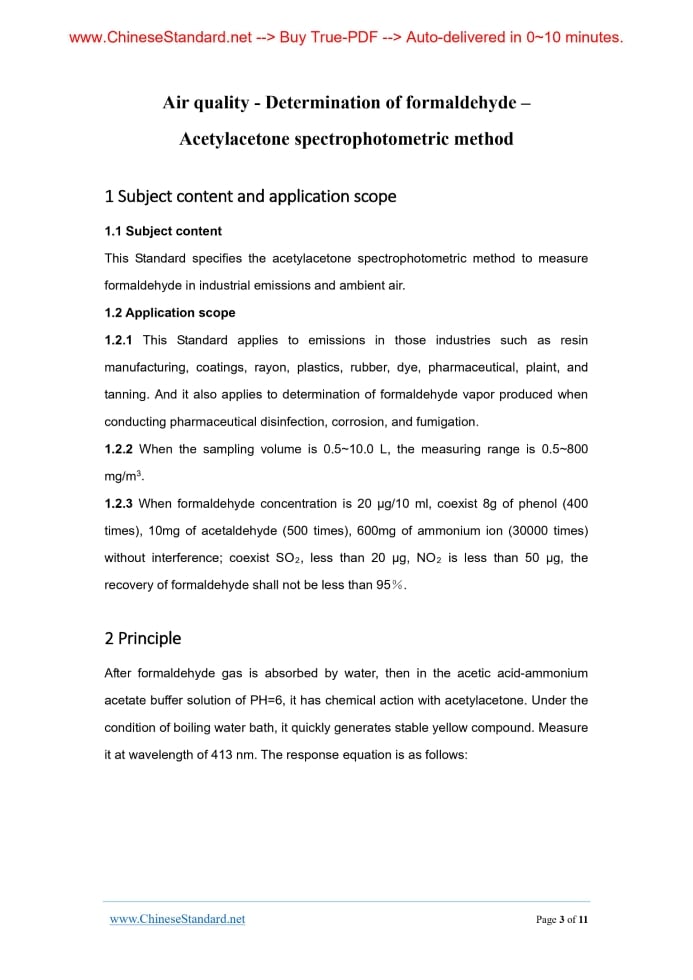
1.1 Subject content This Standard specifies the acetylacetone spectrophotometric method to measure formaldehyde in industrial emissions and ambient air. 1.2 Application scope 1.2.1 This Standard applies to emissions in those industries such as resin manufacturing, coatings, rayon, plastics, rubber, dye, pharmaceutical, plaint, and tanning. And it also applies to determination of formaldehyde vapor produced when conducting pharmaceutical disinfection, corrosion, and fumigation. 1.2.2 When the sampling volume is 0.5~10.0 L, the measuring range is 0.5~800 mg/m3. 1.2.3 When formaldehyde concentration is 20 µg/10 ml, coexist 8g of phenol (400 times), 10mg of acetaldehyde (500 times), 600mg of ammonium ion (30000 times) without interference; coexist SO2, less than 20 µg, NO2 is less than 50 µg, the recovery of formaldehyde shall not be less than 95%.2 Principle
After formaldehyde gas is absorbed by water, then in the acetic acid-ammonium acetate buffer solution of PH=6, it has chemical action with acetylacetone. Under the condition of boiling water bath, it quickly generates stable yellow compound. Measure it at wavelength of 413 nm. The response equation is as follows.3 Reagents
Unless otherwise specified, when analyzing, it shall use the analytical pure reagents which comply with national standard and the water prepared according to 3.1. 3.1 Organic-free distilled water. Add a small mount of alkaline solution of potassium permanganate into water. Then distill it (Water shall always be red throughout the whole distillation process, or potassium permanganate shall be added at any time). 3.2 Absorbing liquid. The organic-free double distilled water (3.1). 3.3 Ammonium acetate (NH4CH3COO). 3.4 Glacial acetic acid (CH3COOH). ρ=1.055. 3.5 Acetylacetone (C5H8O2). ρ=0.975. 3.6 Hydrochloric acid (HCl) solution. ρ=1.19 (1+5). 3.7 Sodium hydroxide (NaOH) solution. 30g/100ml. 3.8 Iodine (I2). 3.9 Potassium iodide (KI). 3.10 Potassium iodate (KIO3) solution c(1/6KIO3)=0.1000 mol/L. Weigh 3.567g of potassium iodate which has been dried at 110°C for 2h. Dissolve into water. Dilute to constant volume in the 1000ml flask. 3.11 Starch solution. 1g/100ml. Weigh 1g of starch. Mix them into paste with water. Pour it into 100ml of boiling water. It is transparent solution. It shall be prepared before using. 3.12 Sodium thiosulfate solution. c(Na2S2O3)=0.1 mol/L. Weigh 25g of sodium thiosulfate solution (Na2S2O3•5H2O) and 2g of sodium (Na2CO3) to dissolve into 1000ml of water that has been freshly boiled and cooled. Store in the brown reagent bottle. Filter after placing for 1 week. And mark the concentration.4 Instruments
4.1 Sampler. Air sampler. The flow range is 0.2~1.0L/min (with flow measurement device). 4.2 Soap film flowmeter. 4.6 Standard Pitot tube. With correction factor. 4.7 Inclined micro-manometer. 4.8 Sampling lead pipe. Teflon tube. Inner diameter is 6~7mm, with glass fiber filter in front of the lead pipe. 4.9 Aneroid barometer. 4.10 Mercury thermometers. 0~100°C. 4.11 pH acidity.5 Samples
5.1 Sample collection Sampling system is in-series consisted of sampling lead pipe (4.8), sampling absorption tube (4.3), and air sampler (4.1). 5.2 Sample storage Collected sample shall be stored up at 2~5°C. Complete the analysis in 2 days, so as to prevent formaldehyde from oxidation. 5.3 Calibration of sample volume6 Steps
6.1 Drawing of calibration curve Take 7 piece of 25ml colorimetric tube with stopper. Prepare the standard color columns according to following table. 6.2 Sample determination Transfer the after-absorbing sample solution into 50ml or 100ml flask. Use water to dilute to constant volume. Take less than 10ml of sample (the drawn amount is determined by sample concentration). In 25ml colorimetric tube (4.4), use water to fix constant volume to 10.0ml scale. 6.3 Blank test Use the absorbing liquid of blank absorption tube which does not sample on the spot to perform blank determination according to (6.1).7 Results and expression
7.1 Calculation formula Calculate the formaldehyde absorbance y in the test sample with formula (6). 7.2 Precision and accuracy Analyzed by 6 laboratories, the 2 samples containing 2.96mg/L and 3.55mg/L of formaldehyde are consistent.8 Precautions
Formaldehyde will be oxidized under the sunshine. Therefore, when sampling, it shall use brown absorption tube. In the transport and storage process of sample, it shall adopt the measures to avoid light. ......Source: Above contents are excerpted from the full-copy PDF -- translated/reviewed by: www.ChineseStandard.net / Wayne Zheng et al.