GB/T 13883-2023 PDF English
Price & Delivery
US$230.00 · In stock · Download in 9 secondsGB/T 13883-2023: Determination of selenium in feeds
Delivery: 9 seconds. True-PDF full-copy in English & invoice will be downloaded + auto-delivered via email. See step-by-step procedure
Status: Valid
GB/T 13883: Historical versions
| Standard ID | USD | BUY PDF | Delivery | Standard Title (Description) | Status |
| GB/T 13883-2023 | 230 | Add to Cart | Auto, 9 seconds. | Determination of selenium in feeds | Valid |
| GB/T 13883-2008 | 85 | Add to Cart | Auto, 9 seconds. | Determination of selenium in feeds | Obsolete |
| GB/T 13883-1992 | 199 | Add to Cart | 2 days | Method for the determination of selenium in feedstuffs. (DAN) fluorometrt | Obsolete |
Click to Preview this PDF
Similar standards
GB/T 13883-2023: Determination of selenium in feeds
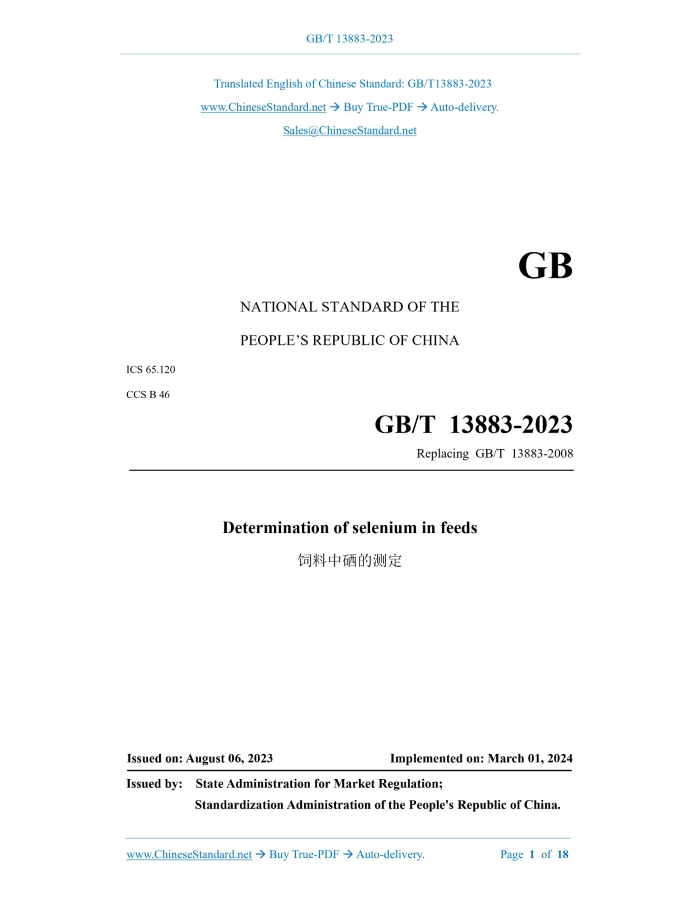
---This is an excerpt. Full copy of true-PDF in English version (including equations, symbols, images, flow-chart, tables, and figures etc.), auto-downloaded/delivered in 9 seconds, can be purchased online: https://www.ChineseStandard.net/PDF.aspx/GBT13883-2023GB NATIONAL STANDARD OF THE PEOPLE’S REPUBLIC OF CHINA ICS 65.120 CCS B 46 Replacing GB/T 13883-2008 Determination of selenium in feeds Issued on. AUGUST 06, 2023 Implemented on. MARCH 01, 2024 Issued by. State Administration for Market Regulation; Standardization Administration of the People's Republic of China.
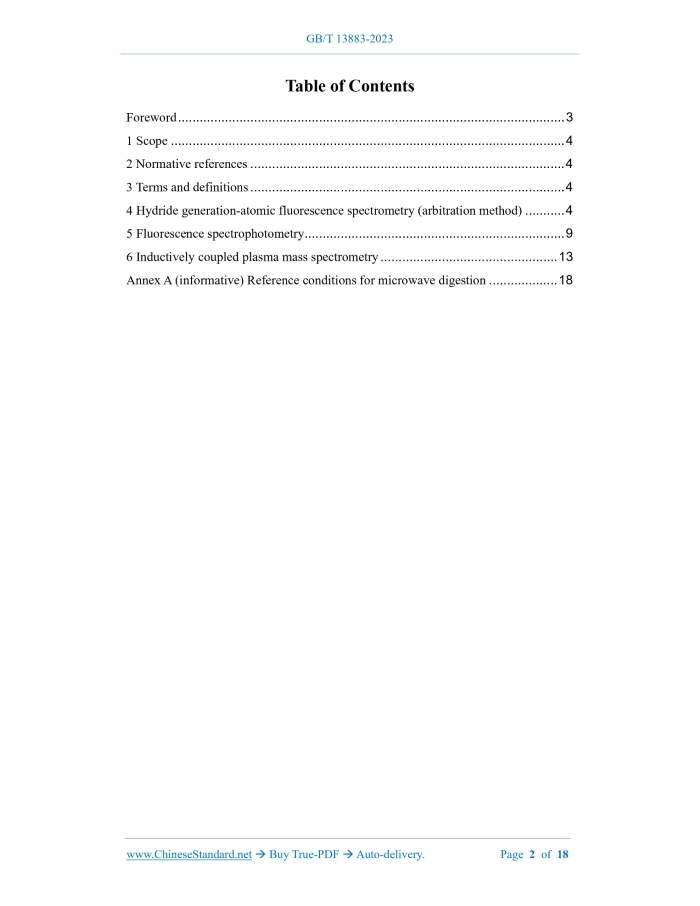
Table of Contents
Foreword... 3 1 Scope... 4 2 Normative references... 4 3 Terms and definitions... 4 4 Hydride generation-atomic fluorescence spectrometry (arbitration method)... 4 5 Fluorescence spectrophotometry... 9 6 Inductively coupled plasma mass spectrometry... 13 Annex A (informative) Reference conditions for microwave digestion... 181 Scope
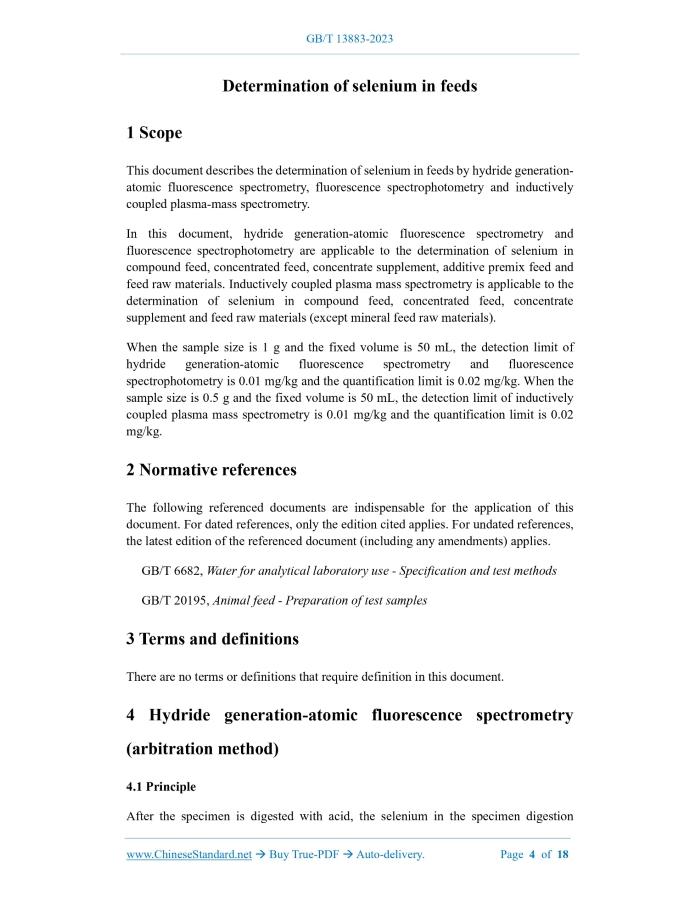
This document describes the determination of selenium in feeds by hydride generation- atomic fluorescence spectrometry, fluorescence spectrophotometry and inductively coupled plasma-mass spectrometry. In this document, hydride generation-atomic fluorescence spectrometry and fluorescence spectrophotometry are applicable to the determination of selenium in compound feed, concentrated feed, concentrate supplement, additive premix feed and feed raw materials. Inductively coupled plasma mass spectrometry is applicable to the determination of selenium in compound feed, concentrated feed, concentrate supplement and feed raw materials (except mineral feed raw materials). When the sample size is 1 g and the fixed volume is 50 mL, the detection limit of hydride generation-atomic fluorescence spectrometry and fluorescence spectrophotometry is 0.01 mg/kg and the quantification limit is 0.02 mg/kg. When the sample size is 0.5 g and the fixed volume is 50 mL, the detection limit of inductively coupled plasma mass spectrometry is 0.01 mg/kg and the quantification limit is 0.02 mg/kg.2 Normative references
The following referenced documents are indispensable for the application of this document. For dated references, only the edition cited applies. For undated references, the latest edition of the referenced document (including any amendments) applies. GB/T 6682, Water for analytical laboratory use - Specification and test methods GB/T 20195, Animal feed - Preparation of test samples3 Terms and definitions
There are no terms or definitions that require definition in this document.4 Hydride generation-atomic fluorescence spectrometry (arbitration method)
4.1 Principle After the specimen is digested with acid, the selenium in the specimen digestion solution is reduced to tetravalent selenium in the hydrochloric acid medium. Potassium borohydride is used as a reducing agent to reduce tetravalent selenium to hydrogen selenide in the hydrochloric acid medium. 4.2 Reagents or materials Warning -- All strong acids shall be handled with caution. Dilution and use shall be carried out in a fume hood. When using perchloric acid, be careful not to burn it dry. Be careful of explosion. 4.2.17 Argon. the purity is not less than 99.995%. 4.3 Instruments and equipment 4.4 Sample Prepare the specimen according to GB/T 20195, at least 200 g. Crush the compound feed, concentrated feed, concentrate supplement and feed raw materials so that they all pass through a 0.425 mm analysis sieve. Crush the additive premix feed so that they all pass through a 0.25 mm analysis sieve. Mix well. Put into a sealed container and set aside. 4.5 Test steps 4.5.1 Preparation of specimen solution 4.5.4 Determination Adjust the instrument to the best working state. Start the measurement after stabilizing for 15 min~20 min. Use hydrochloric acid solution II (4.2.10) as the carrier and potassium borohydride solution (4.2.12) as the reducing agent. Use the carrier solution for continuous injection. 4.6 Test data processing The selenium content w1 in the specimen is expressed as mass fraction. The value is expressed in milligrams per kilogram (mg/kg), calculated according to formula (1). 4.7 Precision The ratio of the absolute difference between two independent determination results obtained under repeatability conditions and their arithmetic mean to the arithmetic mean shall meet the requirements of Table 1.5 Fluorescence spectrophotometry
5.1 Principle The specimen is digested with mixed acid, and selenium (Se4+) and 2,3- diaminonaphthalene (DAN) generate 4,5-phenylbenzoselenadiazole in a slightly acidic solution. The resulting complex is extracted with cyclohexane. 5.2 Reagents or materials Warning -- All strong acids shall be handled with caution. Dilution and use shall be carried out in a fume hood. When using perchloric acid, be careful not to burn it dry. Be careful of explosion. 5.2.1 Water. GB/T 6682, Grade II. 5.2.2 Perchloric acid. guaranteed reagent. Selenium content/(mg/kg) Relative deviation/% 5.2.3 Nitric acid. guaranteed reagent. 5.3 Instruments and equipment 5.4 Sample Same as 4.4. 5.5 Test steps 5.5.1 Preparation of specimen solution 5.5.1.1 Wet digestion 5.5.2 Extraction Add 2 drops of cresol red indicator (5.2.12) to the sample digestion solution. Adjust with ammonia solution (5.2.7) until the solution turns yellow. Adjust with hydrochloric acid solution III (5.2.8) until the solution turns orange (pH 1.5~2), then add 3 mL of hydroxylamine hydrochloride-ethylenediaminetetraacetic acid disodium solution (5.2.10). Shake well. Add 2 mL of 2,3-diaminonaphthalene solution (5.2.11). 5.6 Test data processing The selenium content w2 in the specimen is expressed as mass fraction. The value is expressed in milligrams per kilogram (mg/kg), calculated according to formula (2).6 Inductively coupled plasma mass spectrometry
6.1 Principle The specimen is digested with acid to dissolve selenium. Under certain acidic conditions, it is introduced into an inductively coupled plasma mass spectrometer for determination. 6.2 Reagents or materials Selenium content/(mg/kg) Relative deviation/% Warning -- All strong acids shall be handled with caution. Dilution and use shall be done in a fume hood. When using perchloric acid, be careful not to burn it dry. Be careful of explosion. 6.2.5 Hydrogen peroxide. 6.2.6 Nitric acid solution I. Take 5 mL of nitric acid (6.2.3) and add it to 95 mL of water. Mix well. 6.2.7 Nitric acid solution II. Measure 30 mL of nitric acid (6.2.3) and add it to 70 mL of water. Mix well. 6.4 Sample Same as 4.4. 6.5 Test steps 6.5.1 Preparation of specimen solution Perform two tests in parallel. Weigh 0.5 g of the specimen (accurate to 0.0001 g) into a digestion tank. Add 8 mL of nitric acid (6.2.3). Soak for 10 min. Add 2 mL of hydrogen peroxide (6.2.5). 6.5.2 Instrument reference conditions The instrument reference conditions are as follows. 6.5.3 Determination Adjust the instrument to the best working state. Calibrate with rhodium (103Rh) as internal standard. Add rhodium internal standard element working solution (6.2.13) online. 6.6 Test data processing The selenium content w3 in the specimen is expressed as mass fraction, in milligrams per kilogram (mg/kg), and is calculated according to formula (3). ......Source: Above contents are excerpted from the full-copy PDF -- translated/reviewed by: www.ChineseStandard.net / Wayne Zheng et al.