MHT6084-2012 English PDF
Price & Delivery
US$250.00 · In stock · Download in 9 secondsMHT6084-2012: Specification for aero and aero-derived gas turbine engine lubricants
Delivery: 9 seconds. True-PDF full-copy in English & invoice will be downloaded + auto-delivered via email. See step-by-step procedure
Status: Valid
| Standard ID | USD | BUY PDF | Delivery | Standard Title (Description) | Status |
| MH/T 6084-2012 | 250 | Add to Cart | Auto, 9 seconds. | Specification for aero and aero-derived gas turbine engine lubricants | Valid |
Click to Preview this PDF
Similar standards
MHT6084-2012: Specification for aero and aero-derived gas turbine engine lubricants
---This is an excerpt. Full copy of true-PDF in English version (including equations, symbols, images, flow-chart, tables, and figures etc.), auto-downloaded/delivered in 9 seconds, can be purchased online: https://www.ChineseStandard.net/PDF.aspx/MHT6084-2012MH CIVIL AVIATION INDUSTRY STANDARD ICS 75.100 E 34 Specification for aero and aero-derived gas turbine engine lubricants Issued on: JUNE 29, 2012 Implemented on: NOVEMBER 01, 2012 Issued by. Civil Aviation Administration of China
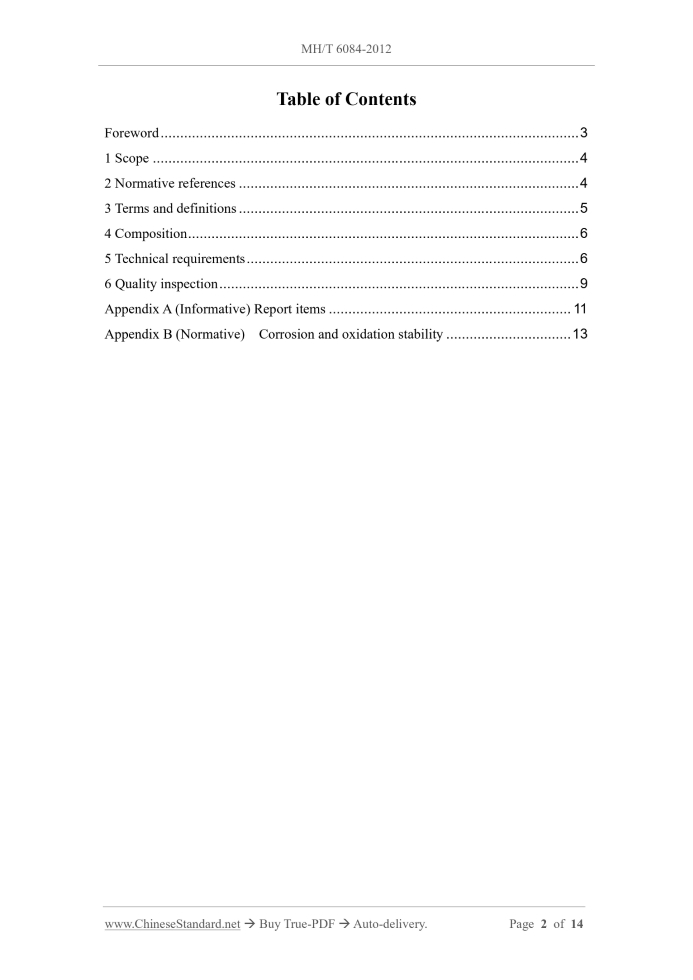
Table of Contents
Foreword... 3 1 Scope... 4 2 Normative references... 4 3 Terms and definitions... 5 4 Composition... 6 5 Technical requirements... 6 6 Quality inspection... 9 Appendix A (Informative) Report items... 11 Appendix B (Normative) Corrosion and oxidation stability... 13Foreword
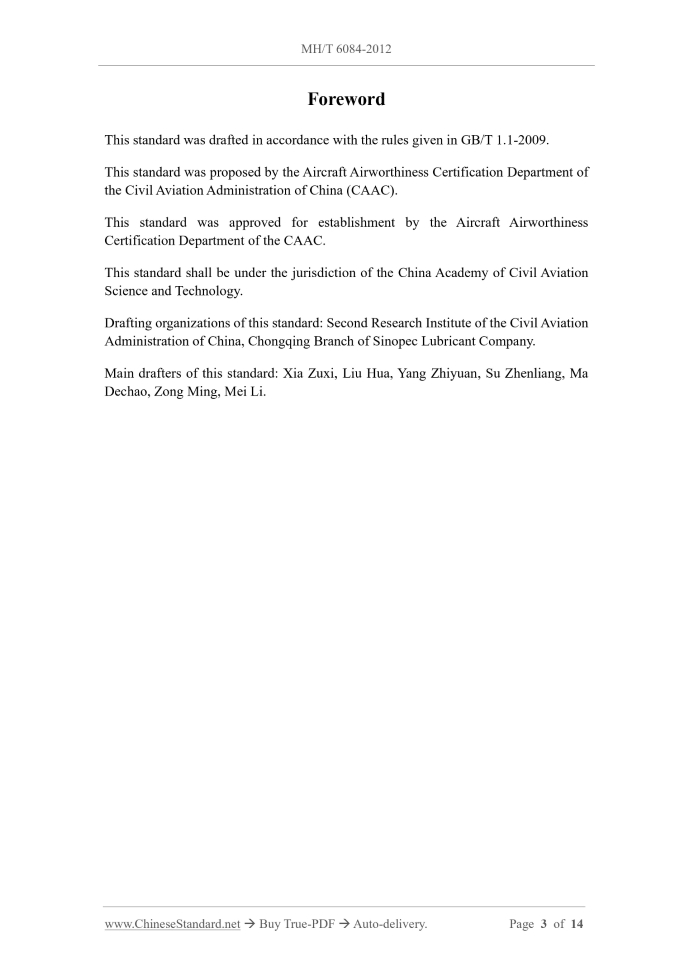
This standard was drafted in accordance with the rules given in GB/T 1.1-2009. This standard was proposed by the Aircraft Airworthiness Certification Department of the Civil Aviation Administration of China (CAAC). This standard was approved for establishment by the Aircraft Airworthiness Certification Department of the CAAC. This standard shall be under the jurisdiction of the China Academy of Civil Aviation Science and Technology. Drafting organizations of this standard. Second Research Institute of the Civil Aviation Administration of China, Chongqing Branch of Sinopec Lubricant Company. Main drafters of this standard. Xia Zuxi, Liu Hua, Yang Zhiyuan, Su Zhenliang, Ma Dechao, Zong Ming, Mei Li. Specification for aero and aero-derived gas turbine engine lubricants1 Scope
This standard specifies the composition, technical requirements, and quality inspection requirements for aero and aero-derived gas turbine engine lubricants (5 centistokes grade) (hereinafter referred to as turbine engine lubricant). This standard applies to the production of aero and aero-derived gas turbine engine lubricants.2 Normative references
The following documents are essential to the application of this document. For the dated documents, only the versions with the dates indicated are applicable to this document; for the undated documents, only the latest version (including all the amendments) is applicable to this standard. ASTM D 92 Standard test method for flash and fire points by Cleveland open cup tester ASTM D 97 Standard test method for pour point of petroleum products ASTM D 445 Standard test method for kinematic viscosity of transparent and opaque liquids (and calculation of dynamic viscosity) ASTM D 892 Standard test method for foaming characteristics of lubricating oils ASTM D 972 Standard test method for evaporation loss of lubricating greases and oils ASTM D 2532 Standard test method for viscosity and viscosity change after standing at low temperature of aircraft turbine lubricants ASTM D 2603 Standard test method for sonic shear stability of polymer-containing oils Def Stan 05-50 Part 61.Method 9.Protection against oxidation stability Def Stan 05-50 Part 61.Method 22.Method for evaluating the compatibility of gas turbine engine lubricants with elastomers Def Stan 05-50 Part 61.Method 24.Evaluation of the compatibility of mixtures of base oils, additives, etc. in gas turbine engine lubricants FED-STD-791 Method 3010 Solid particle contamination in aircraft turbine engine lubricants (Gravimetric procedure) FED-STD-791 Method 3410 High-temperature deposition and degradation properties of aircraft turbine engine fuel FED-STD-791 Method 3411 Thermal stability and corrosion resistance of aircraft turbine engine lubricants FED-STD-791 Method 3604 Swelling properties of synthetic rubber using aircraft turbine engine lubricants FED-STD-791 Method 5308 Corrosion resistance and oxidation stability of light oils (Metal cube) FED-STD-791 Method 6508 Load-carrying capacity of lubricants (Ryder gearbox) SAE AIR 4978 Temporary methods for assessing the load carrying capacity of aircraft propulsion system lubricating oils SAE ARP 5088 Test method for the determination of total acidity in polyol ester and diester gas turbine lubricants by automatic potentiometric titration SAE ARP 5996 Evaluation of coking propensity of aviation lubricants using the single phase flow technique3 Terms and definitions
The following terms and definitions apply to this document. 3.1 Standard performance capability class SPC A type of lubricant that meets general usage requirements. 3.2 High performance capability class HPC A type of lubricant that meets engine operating conditions and/or service life requirements, which is suitable for higher temperatures. 3.3 Batch A group of base oils, additives, or finished lubricants that have undergone final analysis and testing.4 Composition
Turbine engine lubricants shall use polyol ester compounds as base oil and shall not contain barium or titanium-based organic compounds. If tricresyl phosphate (TCP) additives are used, the mass fraction of ortho-isomers shall not exceed 0.2%. All chemical components of turbine engine lubricants shall comply with the laws, regulations, environmental and toxicological requirements of the country of production and sale; it shall have a Material Safety Data Sheet (MSDS) or other relevant documentation to cover these requirements.5 Technical requirements
The physical, chemical, stability, deposition, tribological properties of the turbine engine lubricant shall meet the requirements of Tables 1 ~ 5, respectively. The items listed in Appendix A can be included in the report. ......Source: Above contents are excerpted from the full-copy PDF -- translated/reviewed by: www.ChineseStandard.net / Wayne Zheng et al.