GB 5009.270-2023 PDF English
GB 5009.270: Historical versions
| Standard ID | USD | BUY PDF | Delivery | Standard Title (Description) | Status |
| GB 5009.270-2023 | 260 | Add to Cart | Auto, 9 seconds. | National food safety standard - Determination of inositol in foods | Valid |
| GB 5009.270-2016 | 85 | Add to Cart | Auto, 9 seconds. | National Food Safety Standard -- Determination of Inositol in Foods | Obsolete |
Similar standards
GB 5009.270-2023: National food safety standard - Determination of inositol in foods
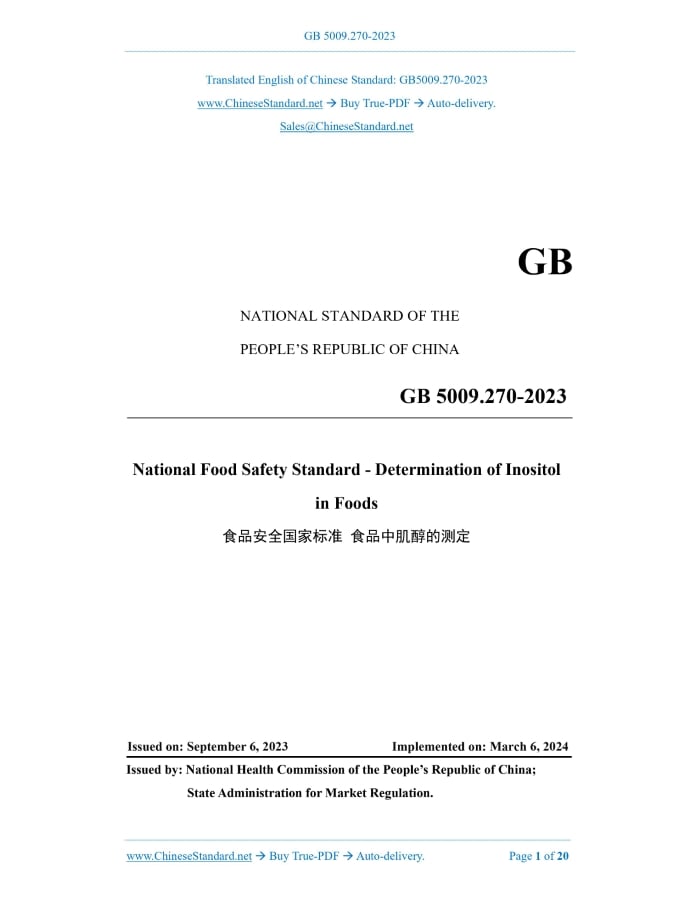
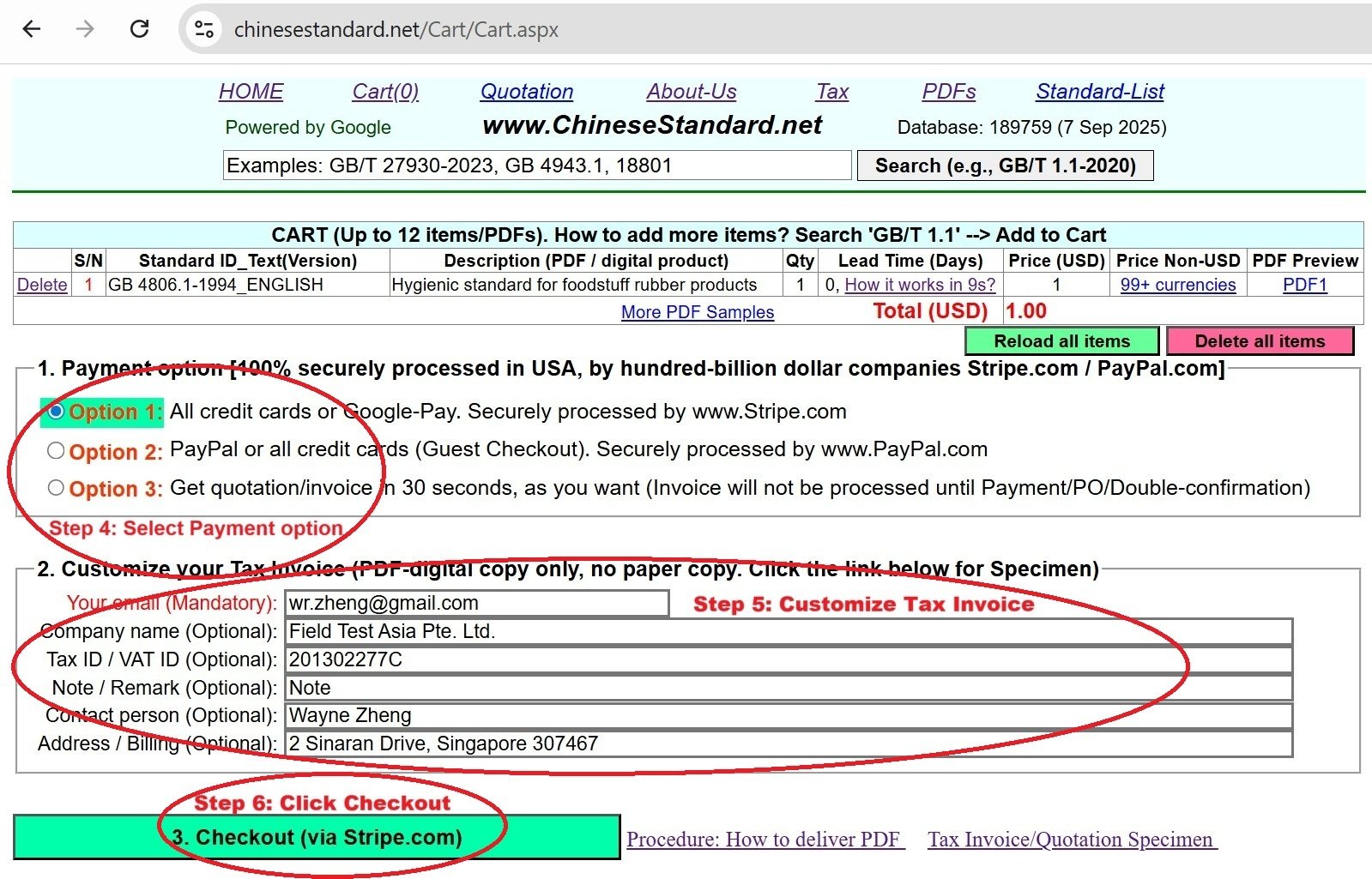
---This is an excerpt. Full copy of true-PDF in English version (including equations, symbols, images, flow-chart, tables, and figures etc.), auto-downloaded/delivered in 9 seconds, can be purchased online: https://www.ChineseStandard.net/PDF.aspx/GB5009.270-2023GB NATIONAL STANDARD OF THE PEOPLE’S REPUBLIC OF CHINA National Food Safety Standard - Determination of Inositol in Foods Issued on. SEPTEMBER 6, 2023 Implemented on. MARCH 6, 2024 Issued by. National Health Commission of the People’s Republic of China; State Administration for Market Regulation.
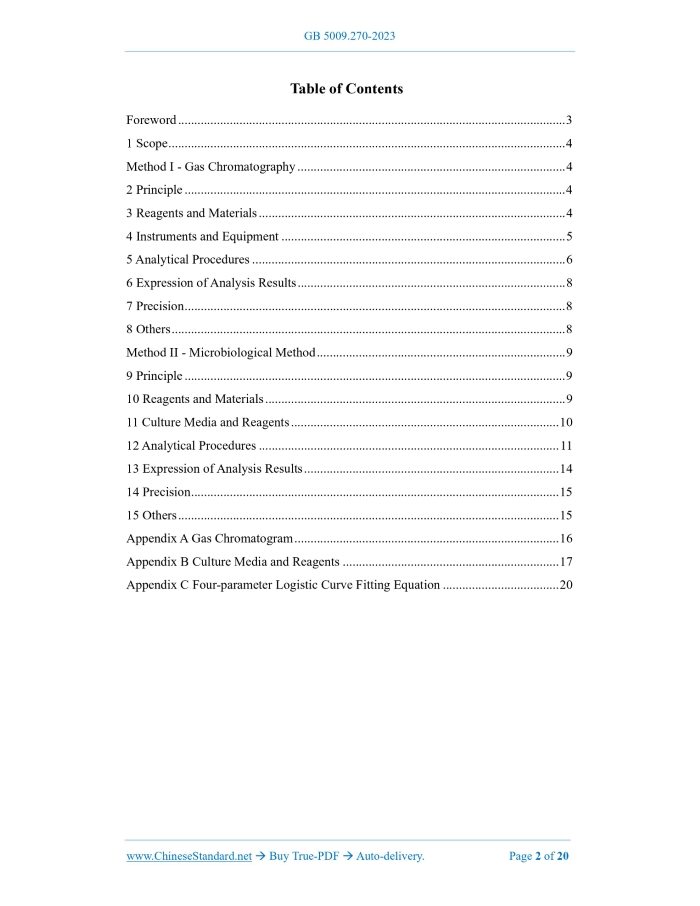
Table of Contents
Foreword... 3 1 Scope... 4 Method I - Gas Chromatography... 4 2 Principle... 4 3 Reagents and Materials... 4 4 Instruments and Equipment... 5 5 Analytical Procedures... 6 6 Expression of Analysis Results... 8 7 Precision... 8 8 Others... 8 Method II - Microbiological Method... 9 9 Principle... 9 10 Reagents and Materials... 9 11 Culture Media and Reagents... 10 12 Analytical Procedures... 11 13 Expression of Analysis Results... 14 14 Precision... 15 15 Others... 15 Appendix A Gas Chromatogram... 16 Appendix B Culture Media and Reagents... 17 Appendix C Four-parameter Logistic Curve Fitting Equation... 20Foreword
This Standard serves as a replacement of GB 5009.270-2016 National Food Safety Standard - Determination of Inositol in Foods. In comparison with GB 5009.270-2016, the main changes are as follows. ---“Gas Chromatography” is adjusted to Method 1, and “Microbiological Method” is adjusted to Method 2; ---Appendix B and Appendix C are added; ---The scope of application of gas chromatography, silanization reagents, sample pre- treatment methods and instrument reference conditions are modified; ---The expression of the principle of the microbiological method, the name and preparation method of bacterial strain, equipment, materials and test procedures are modified. National Food Safety Standard - Determination of Inositol in Foods1 Scope
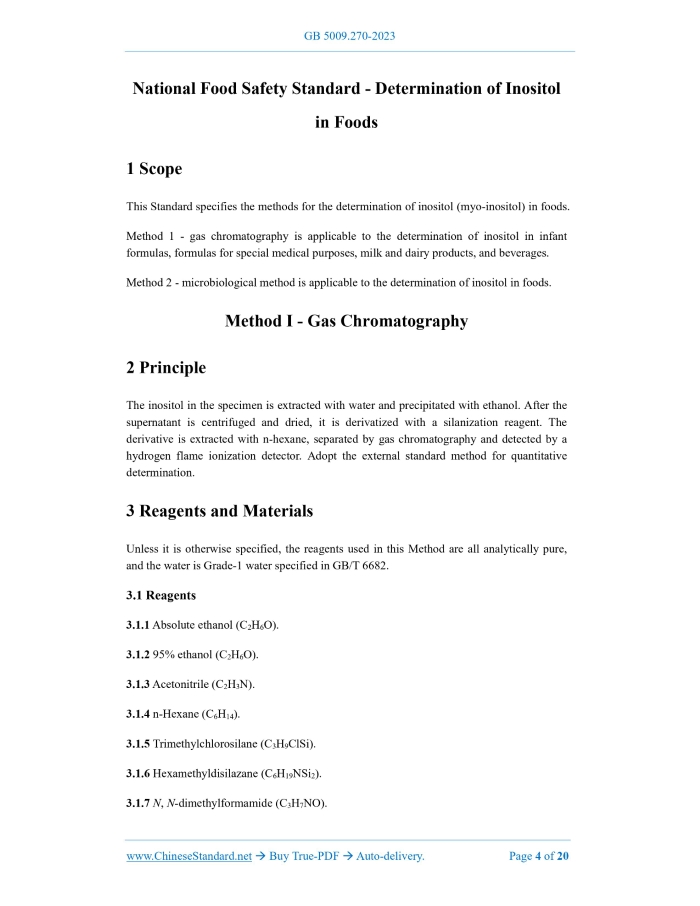
This Standard specifies the methods for the determination of inositol (myo-inositol) in foods. Method 1 - gas chromatography is applicable to the determination of inositol in infant formulas, formulas for special medical purposes, milk and dairy products, and beverages. Method 2 - microbiological method is applicable to the determination of inositol in foods. Method I - Gas Chromatography2 Principle
The inositol in the specimen is extracted with water and precipitated with ethanol. After the supernatant is centrifuged and dried, it is derivatized with a silanization reagent.3 Reagents and Materials
Unless it is otherwise specified, the reagents used in this Method are all analytically pure, and the water is Grade-1 water specified in GB/T 6682. 3.1 Reagents 3.1.1 Absolute ethanol (C2H6O). 3.2 Preparation of Reagents 3.2.1 70% ethanol. measure-take 700 mL of absolute ethanol, use water to reach a constant volume of 1,000 mL, and evenly mix it. 3.2.2 Silanization reagent. respectively draw-take trimethylchlorosilane, hexamethyldisilazane and N, N-dimethylformamide, mix them in a volume ratio of 1.2.8, and conduct ultrasonic mixing. Prepare it right before use. 3.3 Reference Material Inositol reference material (C6H12O6, CAS. 87-89-8). purity 99%, or a standard substance certified by the state and awarded a reference material certificate. 3.4 Preparation of Standard Solutions4 Instruments and Equipment
4.1 Gas chromatograph. equipped with a hydrogen flame ionization detector. 4.2 Analytical balance. with a division value of 0.1 mg and 1 mg. 4.5 Constant-temperature water bath. with a temperature accuracy of 2 C. 4.6 Rotary evaporator. 4.7 Vortex oscillator. 4.8 Ultrasonoscope. 4.9 Nitrogen blower.5 Analytical Procedures
5.1 Specimen Preparation 5.3 Reference Conditions of Instrument The reference conditions of the instrument are as follows. 5.4 Drawing of Standard Curve Respectively inject the inositol standard determination solutions into the gas chromatograph, take the mass of inositol in the inositol standard determination solutions as the x-coordinate and the measured peak area as the y-coordinate to draw a standard curve. 5.5 Determination of Specimen Solution Inject the specimen determination solution into the gas chromatograph to measure the retention time and peak area.6 Expression of Analysis Results
The content of inositol in the specimen is calculated in accordance with Formula (1).7 Precision
The absolute difference between the results of two independent determinations obtained under repeatability conditions shall not exceed 10% of the arithmetic mean.8 Others
For solid samples, when the sampling size is 1 g and the constant volume is 50 mL, the detection limit is 1.0 mg/100 g, and the quantitation limit is 3.0 mg/100 g.9 Principle
Inositol is an essential nutrient for the growth of Saccharomyces cerevisiae. Under certain conditions, there is a corresponding relation between the growth of Saccharomyces cerevisiae and the inositol content. Taking the standard working curve as a reference, in accordance with the absorbance value of the solution to be tested, the inositol content in the specimen to be tested can be calculated.10 Reagents and Materials
10.1 Equipment 10.1.1 Balance. with a division value of 0.1 mg, 1 mg and 0.1 g. 10.1.10 Vortex oscillator. 10.1.11 Homogenizer. 10.2 Materials 10.2.1 Glass beads. with a diameter of about 5 mm. 10.2.3 Sterile pipette. 10 mL (with a scale of 0.1 mL) or 10 mL micropipette and tip. 10.2.4 Conical flask. 200 mL or 250 mL. 10.2.5 Volumetric flask (Type A). 50 mL, 100 mL and 250 mL. 10.2.6 Funnel. with a diameter of 90 mm.11 Culture Media and Reagents
Unless it is otherwise specified, the reagents used in this Method are all analytically pure, and the water is Grade-2 water specified in GB/T 6682. 11.1 Culture Media 11.2 Reagents and Strain 11.2.1 Sodium chloride (NaCl). 11.2.2 Sodium hydroxide (NaOH). 11.2.3 Hydrochloric acid (HCl). 11.3 Preparation of Reagents 11.5 Preparation of Standard Solutions12 Analytical Procedures
12.1 Preparation of Strain 12.2 Preparation and Extraction of Specimens Solid specimens, for example, cereals, need to be crushed, ground and sieved (the sieve plate has an aperture of 0.3 mm ~ 0.5 mm); for specimens such as meat and meat products, use a homogenizer to make them into chyme; specimens such as fruits and vegetables need to be homogenized and evenly mixed; for liquid specimens, shake and mix them before determination. Specimens are prepared right before use. 12.3 Preparation of Standard Solution In accordance with Table 2, respectively add water, inositol standard working solution and inositol determination culture medium into the culture tubes. Prepare 3 portions of each tube in parallel. 12.4 Preparation of Test Solution In accordance with Table 3, respectively add water, specimen extracting solution and inositol determination culture medium into the culture tubes. Prepare 3 portions of each tube in parallel. ......Source: Above contents are excerpted from the full-copy PDF -- translated/reviewed by: www.ChineseStandard.net / Wayne Zheng et al.