GB 5009.123-2023 PDF English
GB 5009.123: Historical versions
| Standard ID | USD | BUY PDF | Delivery | Standard Title (Description) | Status |
| GB 5009.123-2023 | 140 | Add to Cart | Auto, 9 seconds. | National food safety standard - Determination of chromium in foods | Valid |
| GB 5009.123-2014 | 115 | Add to Cart | Auto, 9 seconds. | National Food Safety Standard- Determination of chromium in foods | Obsolete |
| GB/T 5009.123-2003 | 70 | Add to Cart | Auto, 9 seconds. | Determination of chromium in foods | Obsolete |
Similar standards
GB 5009.123-2023: National food safety standard - Determination of chromium in foods
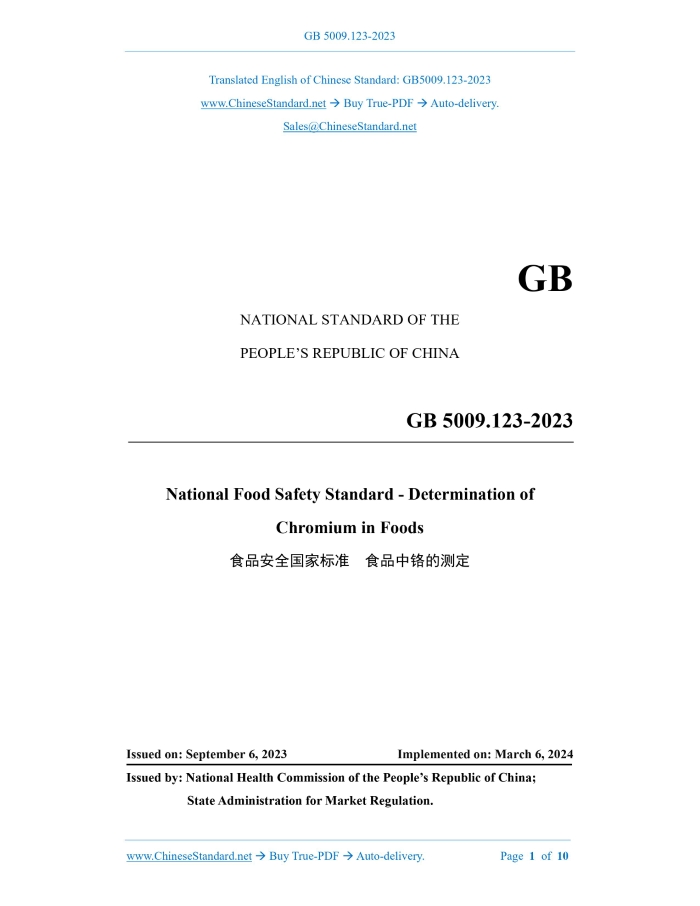
---This is an excerpt. Full copy of true-PDF in English version (including equations, symbols, images, flow-chart, tables, and figures etc.), auto-downloaded/delivered in 9 seconds, can be purchased online: https://www.ChineseStandard.net/PDF.aspx/GB5009.123-2023GB NATIONAL STANDARD OF THE PEOPLE’S REPUBLIC OF CHINA National Food Safety Standard - Determination of Chromium in Foods Issued on. SEPTEMBER 6, 2023 Implemented on. MARCH 6, 2024 Issued by. National Health Commission of the People’s Republic of China; State Administration for Market Regulation.
Table of Contents
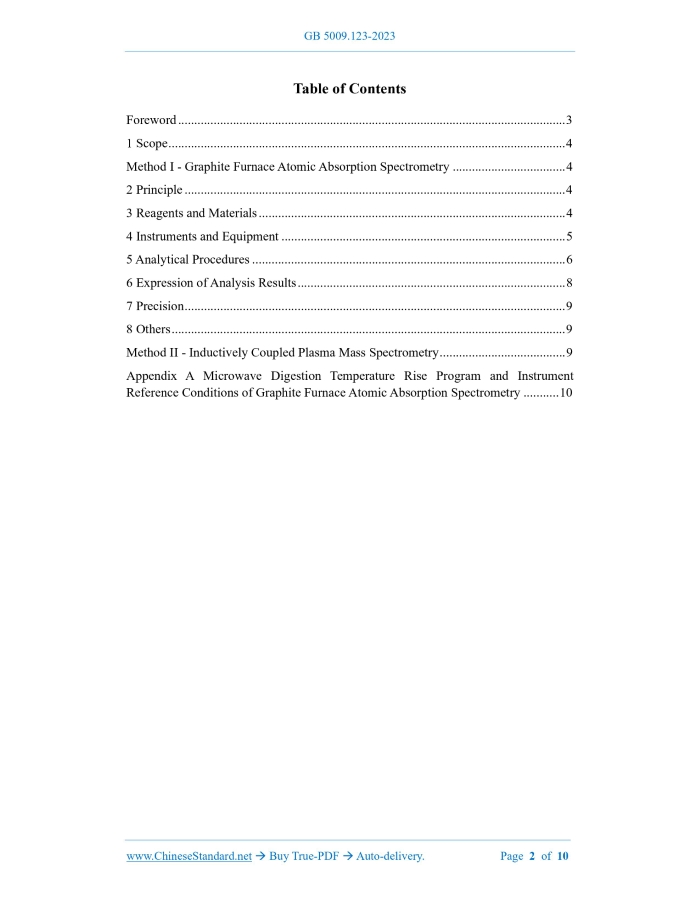
Foreword... 3 1 Scope... 4 Method I - Graphite Furnace Atomic Absorption Spectrometry... 4 2 Principle... 4 3 Reagents and Materials... 4 4 Instruments and Equipment... 5 5 Analytical Procedures... 6 6 Expression of Analysis Results... 8 7 Precision... 9 8 Others... 9 Method II - Inductively Coupled Plasma Mass Spectrometry... 9 Appendix A Microwave Digestion Temperature Rise Program and Instrument Reference Conditions of Graphite Furnace Atomic Absorption Spectrometry... 10Foreword
This Standard serves as a replacement of GB 5009.123-2014 National Food Safety Standard - Determination of Chromium in Foods. In comparison with GB 5009.123-2014, the main changes are as follows. ---The second method “inductively coupled plasma mass spectrometry” is added; ---Specimen preparation is modified; ---The wet digestion method, pressure tank digestion method, microwave digestion method and dry digestion method are modified. National Food Safety Standard - Determination of Chromium in Foods1 Scope
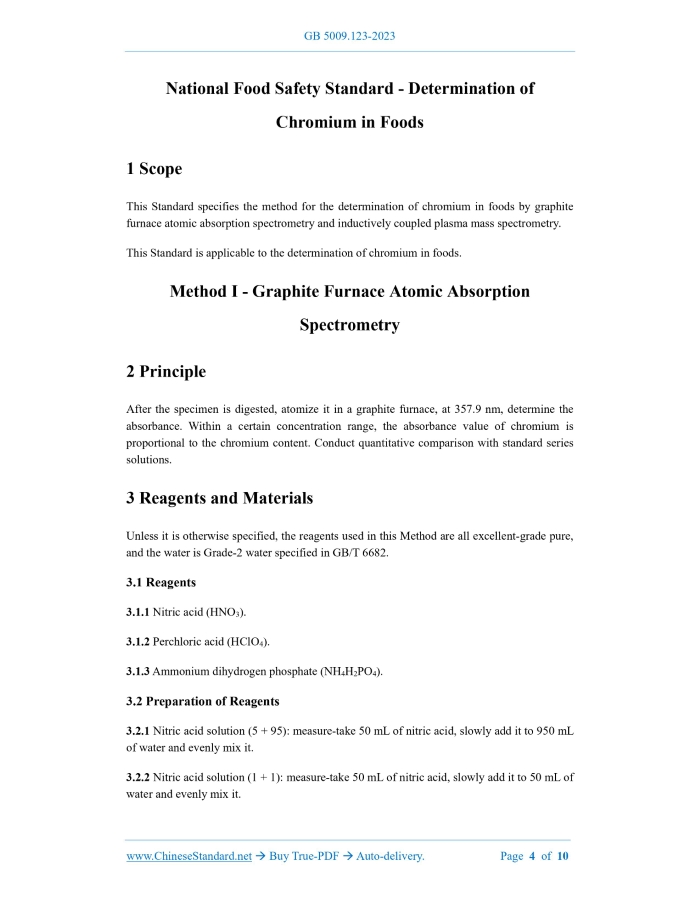
This Standard specifies the method for the determination of chromium in foods by graphite furnace atomic absorption spectrometry and inductively coupled plasma mass spectrometry. This Standard is applicable to the determination of chromium in foods. Method I - Graphite Furnace Atomic Absorption Spectrometry2 Principle
After the specimen is digested, atomize it in a graphite furnace, at 357.9 nm, determine the absorbance. Within a certain concentration range, the absorbance value of chromium is proportional to the chromium content. Conduct quantitative comparison with standard series solutions.3 Reagents and Materials
Unless it is otherwise specified, the reagents used in this Method are all excellent-grade pure, and the water is Grade-2 water specified in GB/T 6682. 3.1 Reagents 3.1.1 Nitric acid (HNO3). 3.1.2 Perchloric acid (HClO4). 3.1.3 Ammonium dihydrogen phosphate (NH4H2PO4). 3.2 Preparation of Reagents 3.3 Reference Material Potassium dichromate (K2Cr2O7, CAS No.. 7778-50-9). purity > 99.99%, or a standard substance certified by the state and awarded a reference material certificate. 3.4 Preparation of Standard Solutions 3.4.1 Chromium standard stock solution (1,000 mg/L). accurately weigh-take 0.2829 g of potassium dichromate (110 C, bake for 2 h), dissolve it in water, then, transfer into a 100 mL volumetric flask. Use nitric acid solution (5 + 95) to dilute it to the scale and evenly mix it. The mass concentration of chromium in this solution is 1,000 mg/L.4 Instruments and Equipment
NOTE. all glassware and polytetrafluoroethylene digestion inner tanks need to be soaked in nitric acid solution (1 + 5) overnight, repeatedly rinsed with tap water, and finally, thoroughly rinsed with water. 4.1 Atomic absorption spectrometer. equipped with graphite furnace atomizer and chromium hollow cathode lamp. 4.2 Electronic balance. with a division value of 0.1 mg and 1 mg. 4.3 Adjustable electric heating plate or adjustable electric stove. 4.6 Constant-temperature drying oven. 4.7 Muffle furnace.5 Analytical Procedures
5.1 Specimen Preparation 5.1.1 Solid-state samples 5.1.1.1 Dry samples For samples with low-water content, such as. beans, grains, fungi, tea, dried fruits and baked goods, etc., take the edible part, when necessary, use a high-speed pulverizer to evenly crush it. For powdery samples that are uniform in shape, such as. solid dairy products, protein powder and flour, etc., evenly shake them. 5.1.2 Liquid samples For samples, such as. soft drinks and condiments, etc., evenly shake them. 5.1.3 Semi-solid samples Evenly mix them. 5.2 Test Conditions of the Method 5.2.1 Specimen pre-treatment 5.2.1.1 Wet digestion method For solid specimens, weigh-take 0.2 g ~ 3 g (accurate to 0.001 g). For liquid specimens, accurately transfer-take or weigh-take 0.500 mL (g) ~ 5.00 mL (g) (accurate to 0.001 g) into a digestion tube with scale. 5.2.1.2 Microwave digestion method For solid specimens, weigh-take 0.2 g ~ 0.5 g (accurate to 0.001 g; for samples containing relatively high-water content, the sampling size can be appropriately increased to 1 g). For liquid specimens, accurately transfer-take or weigh-take 0.500 mL (g) ~ 3.00 mL (g) (accurate to 0.001 g) into a microwave digestion tank. For samples containing ethanol or carbon dioxide, firstly heat them at a low temperature to remove ethanol or carbon dioxide, add 5 mL ~ 10 mL of nitric acid, in accordance with the operation procedures of microwave digestion, digest the specimen. 5.2.1.4 Dry digestion method For solid specimens, weigh-take 0.5 g ~ 5 g (accurate to 0.001 g); for liquid specimens, accurately transfer-take or weigh-take 2.00 mL (g) ~ 10.0 mL (g) (accurate to 0.001 g) into a crucible, and heat it over low heat; carbonize it, until it becomes smokeless. Then, transfer it into a muffle furnace, at 550 C, ash it for 3 h ~ 4 h. 5.3 Reference Conditions of Instruments See Table A.2 for instrument operating conditions. 5.4 Drawing of Standard Curve In accordance with the mass concentration from low to high, respectively take 10 L of the standard series of solutions and 5 L of the ammonium dihydrogen phosphate solution (select the optimal sample injection volume in accordance with the instrument used), meanwhile, inject it into the graphite tube. After atomization, determine the absorbance value, and by taking the mass concentration as the x-coordinate and the absorbance value as the y-coordinate, draw a standard curve.6 Expression of Analysis Results
The content of chromium in the specimen is calculated in accordance with Formula (1).7 Precision
When the chromium content in the specimen is > 1 mg/kg (mg/L), the absolute difference between the results of two independent determinations obtained under repeatability conditions shall not exceed 10% of the arithmetic mean.8 Others
When the sampling size is 0.5 g or 2 mL and the constant volume is 10 mL, the detection limit of this Method is 0.01 mg/kg or 0.003 mg/L, and the quantitation limit is 0.03 mg/kg or 0.008 mg/L.Appendix A
Microwave Digestion Temperature Rise Program and Instrument Reference Conditions of Graphite Furnace Atomic Absorption Spectrometry A.1 The microwave digestion temperature rise program is shown in Table A.1. Table A.1 -- Microwave Digestion Temperature Rise Program A.2 The instrument reference conditions of graphite furnace atomic absorption spectrometry are shown in Table A.2. ......Source: Above contents are excerpted from the full-copy PDF -- translated/reviewed by: www.ChineseStandard.net / Wayne Zheng et al.