GB 31604.47-2023 PDF English
GB 31604.47: Historical versions
| Standard ID | USD | BUY PDF | Delivery | Standard Title (Description) | Status |
| GB 31604.47-2023 | 140 | Add to Cart | Auto, 9 seconds. | National food safety standard - Food contact materials and products - Determination of fluorescent substances in paper, paperboard and paper products | Valid |
| GB 31604.47-2016 | 70 | Add to Cart | Auto, 9 seconds. | Food contact materials for export -- Paper and paper products -- Determination of fluorescent brightener -- Liquid chromatography | Obsolete |
Similar standards
GB 31604.47-2023: National food safety standard - Food contact materials and products - Determination of fluorescent substances in paper, paperboard and paper products
---This is an excerpt. Full copy of true-PDF in English version (including equations, symbols, images, flow-chart, tables, and figures etc.), auto-downloaded/delivered in 9 seconds, can be purchased online: https://www.ChineseStandard.net/PDF.aspx/GB31604.47-2023
GB NATIONAL STANDARD OF THE PEOPLE'S REPUBLIC OF CHINA National food safety standard - Food contact materials and products - Determination of fluorescent substances in paper, cardboard and paper products Issued on. SEPTEMBER 6, 2023 Implemented on. MARCH 6, 2024 Issued by. National Health Commission of the People's Republic of China; State Administration for Market Regulation.
Table of Contents
Foreword... 3 1 Scope... 4 2 Principle... 4 3 Reagents and materials... 4 4 Instruments and equipment... 5 5 Analysis steps... 6Foreword
This standard replaces GB 31604.47-2016 National food safety standard - Food contact materials and products - Determination of fluorescent substances in paper, cardboard and paper products. Compared with GB 31604.47-2016, the main changes in this standard are as follows. -- The name of the standard is modified to "National food safety standard - Food contact materials and products - Determination of fluorescent substances in paper, cardboard and paper products"; -- The detection wavelength of 254 nm is added; -- The description of the function of standard control gauze is added; -- The presentation of result determination is modified. National food safety standard - Food contact materials and products - Determination of fluorescent substances in paper, cardboard and paper products1 Scope
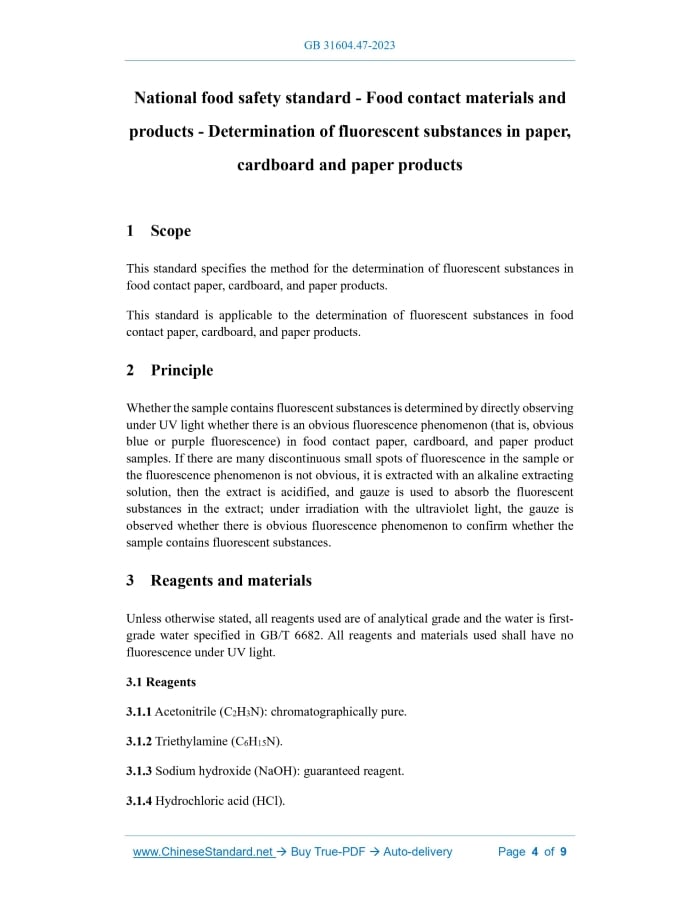
This standard specifies the method for the determination of fluorescent substances in food contact paper, cardboard, and paper products. This standard is applicable to the determination of fluorescent substances in food contact paper, cardboard, and paper products.2 Principle
Whether the sample contains fluorescent substances is determined by directly observing under UV light whether there is an obvious fluorescence phenomenon (that is, obvious blue or purple fluorescence) in food contact paper, cardboard, and paper product samples. If there are many discontinuous small spots of fluorescence in the sample or the fluorescence phenomenon is not obvious, it is extracted with an alkaline extracting solution, then the extract is acidified, and gauze is used to absorb the fluorescent substances in the extract; under irradiation with the ultraviolet light, the gauze is observed whether there is obvious fluorescence phenomenon to confirm whether the sample contains fluorescent substances.3 Reagents and materials
Unless otherwise stated, all reagents used are of analytical grade and the water is first- grade water specified in GB/T 6682.All reagents and materials used shall have no fluorescence under UV light. 3.1 Reagents 3.2 Reagent preparation 3.2.1 Hydrochloric acid solution (1+9). Mix hydrochloric acid and water in a volume ratio of 1.9. 3.3 Standard products Fluorescent whitening agent 220 (C40H40N12O16S4Na4, referred to as C.I.220, CAS number. 16470-24-9). the purity of ≥95%, or a standard product with national certification and a Reference Material Certificate. 3.4 Preparation of standard solution 3.5 Materials 3.5.1 Gauze. 3.5.2 Glass wool.4 Instruments and equipment
All instruments and equipment that are in direct contact with the sample shall have no fluorescence under ultraviolet light. 4.1 UV lamp. The wavelength is 365 nm and 254 nm. 4.2 Scissors. 4.3 Right-angled triangle. 4.4 Ultrasonic cleaner. 4.9 Analytical balance. The sensitivity is 1 mg and 0.1 mg, respectively. 4.10 Chicken heart bottle. 250 mL. 4.11 Erlenmeyer flask with stopper. 250 mL. 4.12 Glass funnel. 4.13 Glass watch glass. 4.14 Tray. 4.15 Centrifuge. The rotating speed is ≥3500 r/min.5 Analysis steps
5.1 Sample preparation 5.1.1 Sample preparation for direct measurement of fluorescent substances For food contact paper and cardboard, such as food packaging paper, candy paper, and popsicle paper, use scissors and a right-angled triangle to cut it into a size of 10 cm×10 cm or 100 cm2.If the sample area is less than 100 cm2, then cut the samples of the same batch at the same position so that the total area reaches 100 cm2.According to the above operation, randomly sample from this batch of products and cut out 5 samples with an area of 100 cm2 to be tested. 5.1.2 Sample preparation when confirmation of fluorescent substances is required For samples that require confirmation testing, weigh 10 g (accurate to 1 mg) of the sample, cut into paper scraps of approximately 5 mm×5 mm, and then crush them into cotton wool with a high-speed pulverizer for later use. 5.2 Direct measurement of fluorescent substances and judgment of results In a darkroom or dark box, place the 100 cm2 sample cut according to 5.1.1 about 20 cm below the UV light source, turn on the power switch of the UV lamp, select the detection wavelengths of 254 nm and 365 nm respectively, and directly observe whether fluorescence phenomenon appears on the sample. 5.3 Confirmation of fluorescent substances 5.3.1 Preparation of non-fluorescent gauze Use scissors and a right-angled triangle to cut out several pieces of gauze about 5 cm×5 cm in size. 5.3.2 Preparation of standard control gauze Weigh 2.0 g of the uniformly crushed blank sample prepared according to 5.1.2 (accurate to 1 mg) into a 250 mL Erlenmeyer flask, add 0.5 mL of standard working solution (40.0 mg/L), then place in a dark place (the illumination is required to be less than 20 lx), add 100 mL of alkaline extracting solution, and conduct ultrasonic extraction at 50 °C for 40 minutes. 5.3.5 Confirmatory test for fluorescent substances In a darkroom or dark box, place the watch glass containing the standard control gauze, blank sample gauze, and two parallel sample gauze about 20 cm below the UV light source, turn on the power switch of the UV lamp, then select the detection wavelength of 254 nm and 365 nm respectively, and observe directly. 5.3.6 Determination of confirmation test results of fluorescent substances At the two wavelengths of 254 nm and 365 nm, if there is no obvious fluorescence phenomenon in the two parallel sample gauze (that is, no obvious blue or purple fluorescence), the fluorescent substance in the sample is judged to be negative; if two parallel sample gauze both have obvious fluorescence phenomenon, the fluorescent substance in the sample is judged to be positive; if only one parallel sample gauze has obvious fluorescence phenomenon, it is necessary to carry out the parallel test of two samples again. ......Source: Above contents are excerpted from the full-copy PDF -- translated/reviewed by: www.ChineseStandard.net / Wayne Zheng et al.