GB 1886.332-2021 English PDF
Price & Delivery
US$125.00 · In stock · Download in 9 secondsGB 1886.332-2021: National food safety standard - Food additives - Calcium phosphate tribasic
Delivery: 9 seconds. True-PDF full-copy in English & invoice will be downloaded + auto-delivered via email. See step-by-step procedure
Status: Valid
| Standard ID | USD | BUY PDF | Delivery | Standard Title (Description) | Status |
| GB 1886.332-2021 | 125 | Add to Cart | Auto, 9 seconds. | National food safety standard - Food additives - Calcium phosphate tribasic | Valid |
Click to Preview this PDF
Similar standards
GB 1886.332-2021: National food safety standard - Food additives - Calcium phosphate tribasic
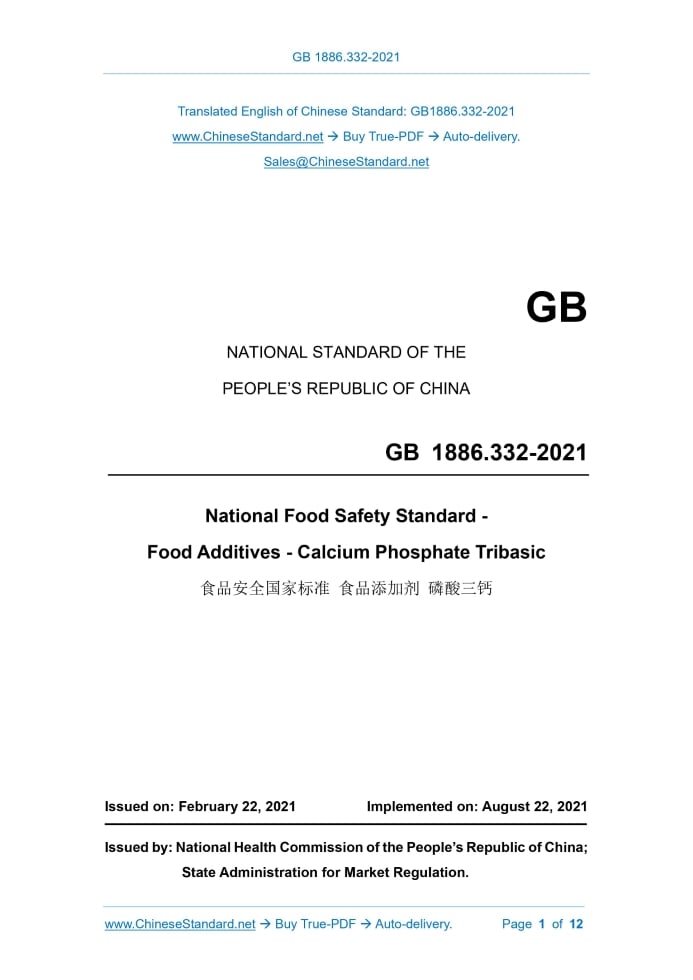
---This is an excerpt. Full copy of true-PDF in English version (including equations, symbols, images, flow-chart, tables, and figures etc.), auto-downloaded/delivered in 9 seconds, can be purchased online: https://www.ChineseStandard.net/PDF.aspx/GB1886.332-2021GB NATIONAL STANDARD OF THE PEOPLE’S REPUBLIC OF CHINA National Food Safety Standard - Food Additives - Calcium Phosphate Tribasic ISSUED ON: FEBRUARY 22, 2021 IMPLEMENTED ON: AUGUST 22, 2021 Issued by: National Health Commission of the People’s Republic of China; State Administration for Market Regulation.
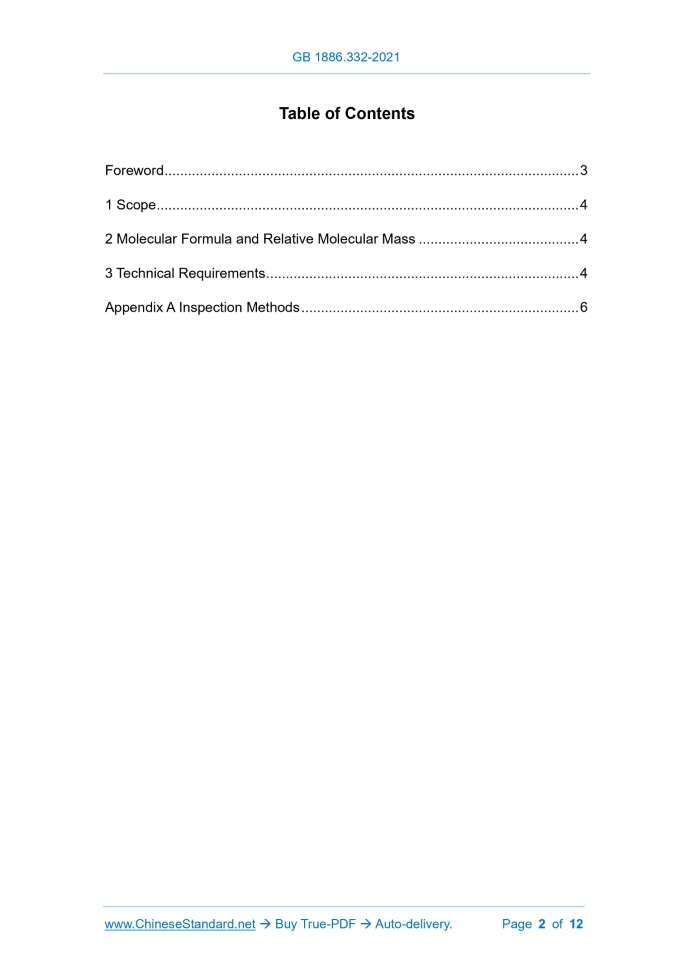
Table of Contents
Foreword ... 3 1 Scope ... 4 2 Molecular Formula and Relative Molecular Mass ... 4 3 Technical Requirements ... 4 Appendix A Inspection Methods ... 6 National Food Safety Standard - Food Additives - Calcium Phosphate Tribasic1 Scope
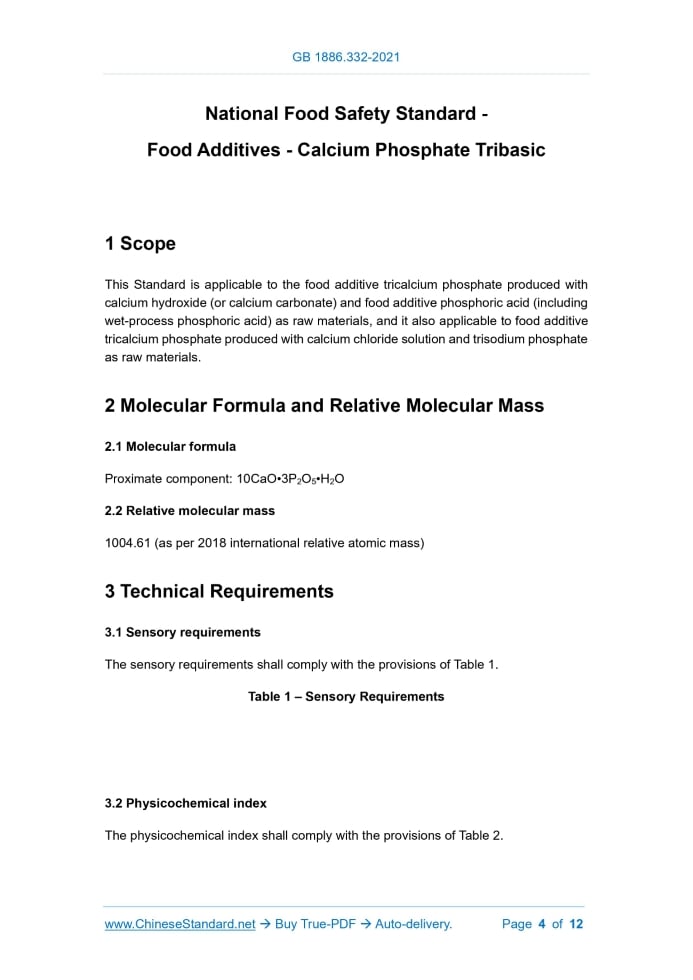
This Standard is applicable to the food additive tricalcium phosphate produced with calcium hydroxide (or calcium carbonate) and food additive phosphoric acid (including wet-process phosphoric acid) as raw materials, and it also applicable to food additive tricalcium phosphate produced with calcium chloride solution and trisodium phosphate as raw materials.2 Molecular Formula and Relative Molecular Mass
2.1 Molecular formula Proximate component: 10CaO•3P2O5•H2O 2.2 Relative molecular mass 1004.61 (as per 2018 international relative atomic mass)3 Technical Requirements
3.1 Sensory requirements The sensory requirements shall comply with the provisions of Table 1. Table 1 – Sensory Requirements 3.2 Physicochemical index The physicochemical index shall comply with the provisions of Table 2.Appendix A
Inspection Methods Caution: Some reagents used in this test method are toxic or corrosive, so please be careful when operating! If necessary, perform it in a fume hood. If it splashes on the skin, it shall be rinsed with water immediately, and the severe cases shall be treated immediately. A.1 General provisions If no other requirements are specified, all the reagents and water used in this Standard refer to the analytical reagents and Class-III water specified in GB/T 6682. If no other requirements are specified, all the standard solution used in the test, standard solution for determining the impurity, preparation and product shall be prepared according to the provisions of GB/T 601, GB/T 602, GB/T 603.The solution used in the test refers to the aqueous solution when the solvent is not specified. A.2 Identification test A.2.1 Reagents and materials A.2.1.1 Nitric acid solution: 1+1. A.2.1.2 Hydrochloric acid solution: 1+3. A.2.1.3 Ammonia solution: 1+1. A.2.1.4 Ammonium oxalate solution: 35g/L. A.2.1.5 Ammonium molybdate solution: 60g/L, take 6g of ammonium molybdate [(NH4)6MO7O24·4H2O] and dissolve it in 50mL water; slowly add 50mL nitric acid solution while stirring; and store in a brown reagent bottle. A.2.2 Identification method A.2.2.1 Identification of calcium ions Weigh about 0.1g of specimen; add 5mL of hydrochloric acid solution, 5mL of water; heat to 40°C ~ 50°C. Add 1mL of ammonia solution while stirring; add 5mL of ammonium oxalate solution; and a white precipitate is produced. A.2.2.2 Identification of phosphate radical Weigh about 0.1g of specimen; add nitric acid solution dropwise to dissolve the specimen; then take 1mL of excessive nitric acid solution; heat to 40°C ~ 50°C; add solution shall be 12.3~12.5. Continue to titrate with ethylenediaminetetraacetic acid disodium salt (EDTA) standard titration solution until the solution appears clear blue and keep it unchanged for 60s. At the same time, a blank test is performed. Except for the blank test without adding the specimen, the other operations and the types and amounts of the added reagents (except the standard titration solution) are the same as the determination test. A.3.1.5 Calculation of results The mass fraction w1 of the trisodium phosphate (by Ca) shall be calculated as per Formula (A.1). Where: V1 – volume of ethylenediaminetetraacetic acid disodium salt (EDTA) standard titration solution consumed for titrating the specimen solution, in mL; V0 – volume of ethylenediaminetetraacetic acid disodium salt (EDTA) standard titration solution consumed for the blank test, in mL; 1000 – conversion factor; c1 – concentration of ethylenediaminetetraacetic acid disodium salt (EDTA) standard titration solution, in mol/L; M1 – molar mass of the calcium (Ca), in g/mol [M1 =40.078]; m1 – mass of the specimen, in g. The test results are based on the arithmetic mean of the parallel determination results. The absolute difference between two independent determination results obtained under repeatability conditions is no more than 0.2%. A.3.2 Zinc sulfate back titration method (Method-II) A.3.2.1 Method summary In the specimen solution, add excessive ethylenediaminetetraacetic acid disodium salt (EDTA) standard titration solution; complex with calcium ions; and use the KB mixture as an indicator to titrate the excessive ethylenediaminetetraacetic acid disodium salt (EDTA) standard titration solution by zinc sulfate standard titration solution. A.3.2.2 Reagents and materials Take about 0.5g of the specimen, accurate to 0.0002g; place it in a 100mL beaker; moisten it with a small amount of water; and add 5mL of hydrochloric acid solution to dissolve the sample completely. Transfer all to a 250mL volumetric flask; dilute to the mark with water; and shake well. If necessary, dry filter, discard the first 20mL of filtrate. Pipette 25.00mL of the above specimen solution; place it in a 500mL conical flask; then use another pipette to transfer 25.00mL of ethylenediaminetetraacetic acid disodium salt (EDTA) standard titration solution; add 50mL of water, 10mL of ammonia- ammonium chloride buffer solution (A); shake well and stand for 5min. Add 2~3 drops of KB indicator solution; titrate with zinc sulfate standard titration solution until the solution changes from blue to blue-purple; and keep it for 30s without fading, which is the end point. At the same time, a blank test is carried out. Except for the blank test without adding the specimen, the other operations and the types and amounts of reagents added (except the standard titration solution) are the same as the determination test. A.3.2.4 Calculation of results The mass fraction w1 of tricalcium phosphate (by Ca) shall be calculated according to Formula (A.3). Where: V5 - volume of zinc sulfate standard titration solution consumed by the blank test, in mL; V6 - volume of zinc sulfate standard titration solution consumed by titrating the specimen solution, in mL; 1000 – conversion factor; c4 – concentration of zinc sulfate standard titration solution, in mol/L; M2 – molar mass of the calcium (Ca), in g/mol [M2=40.078] m2 – mass of the specimen, in g; 25 – volume of pipetting the specimen solution, in mL; 250 – constant volume of specimen solution, in mL. The test results are based on the arithmetic mean of the parallel determination results. The absolute difference between two independent determination results obtained ......Source: Above contents are excerpted from the full-copy PDF -- translated/reviewed by: www.ChineseStandard.net / Wayne Zheng et al.