GB/T 12265-2021 PDF English
Price & Delivery
US$185.00 · In stock · Download in 9 secondsGB/T 12265-2021: Safety of machinery - Minimum gaps to avoid crushing of parts of the human body
Delivery: 9 seconds. True-PDF full-copy in English & invoice will be downloaded + auto-delivered via email. See step-by-step procedure
Status: Valid
GB/T 12265: Historical versions
| Standard ID | USD | BUY PDF | Delivery | Standard Title (Description) | Status |
| GB/T 12265-2021 | 185 | Add to Cart | Auto, 9 seconds. | Safety of machinery - Minimum gaps to avoid crushing of parts of the human body | Valid |
| GB 12265.1-1997 | 479 | Add to Cart | 4 days | Safety of machinery--Safety distances to prevent danger zones being reached by the uppar limbs | Obsolete |
| GB 12265-1990 | RFQ | ASK | 3 days | Safe distances between operator and hazardous positions of machinery | Obsolete |
Click to Preview this PDF
Similar standards
GB/T 12265-2021: Safety of machinery - Minimum gaps to avoid crushing of parts of the human body
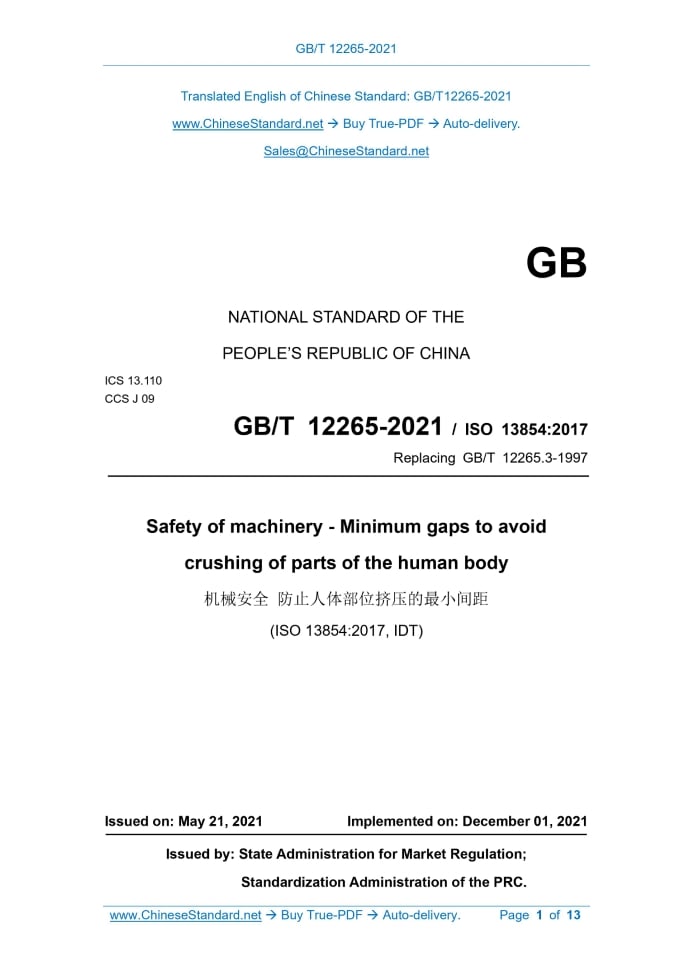
---This is an excerpt. Full copy of true-PDF in English version (including equations, symbols, images, flow-chart, tables, and figures etc.), auto-downloaded/delivered in 9 seconds, can be purchased online: https://www.ChineseStandard.net/PDF.aspx/GBT12265-2021GB NATIONAL STANDARD OF THE PEOPLE’S REPUBLIC OF CHINA ICS 13.110 CCS J 09 GB/T 12265-2021 / ISO 13854:2017 Replacing GB/T 12265.3-1997 Safety of machinery - Minimum gaps to avoid crushing of parts of the human body (ISO 13854:2017, IDT) ISSUED ON: MAY 21, 2021 IMPLEMENTED ON: DECEMBER 01, 2021 Issued by: State Administration for Market Regulation; Standardization Administration of the PRC.
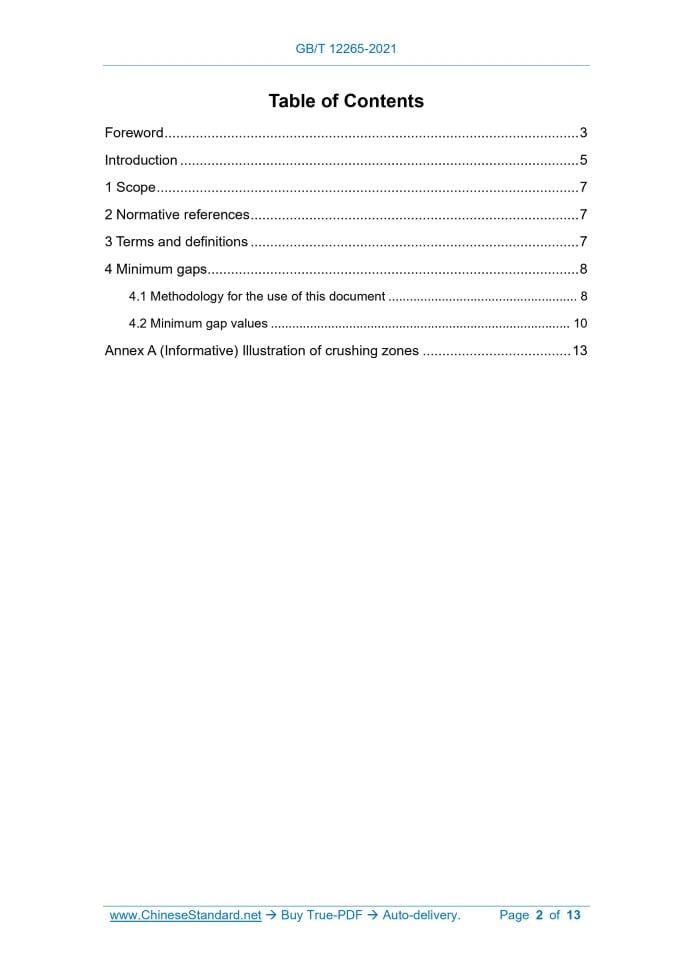
Table of Contents
Foreword ... 3 Introduction ... 5 1 Scope ... 7 2 Normative references ... 7 3 Terms and definitions ... 7 4 Minimum gaps ... 8 4.1 Methodology for the use of this document ... 8 4.2 Minimum gap values ... 10 Annex A (Informative) Illustration of crushing zones ... 13 Safety of machinery - Minimum gaps to avoid crushing of parts of the human body1 Scope
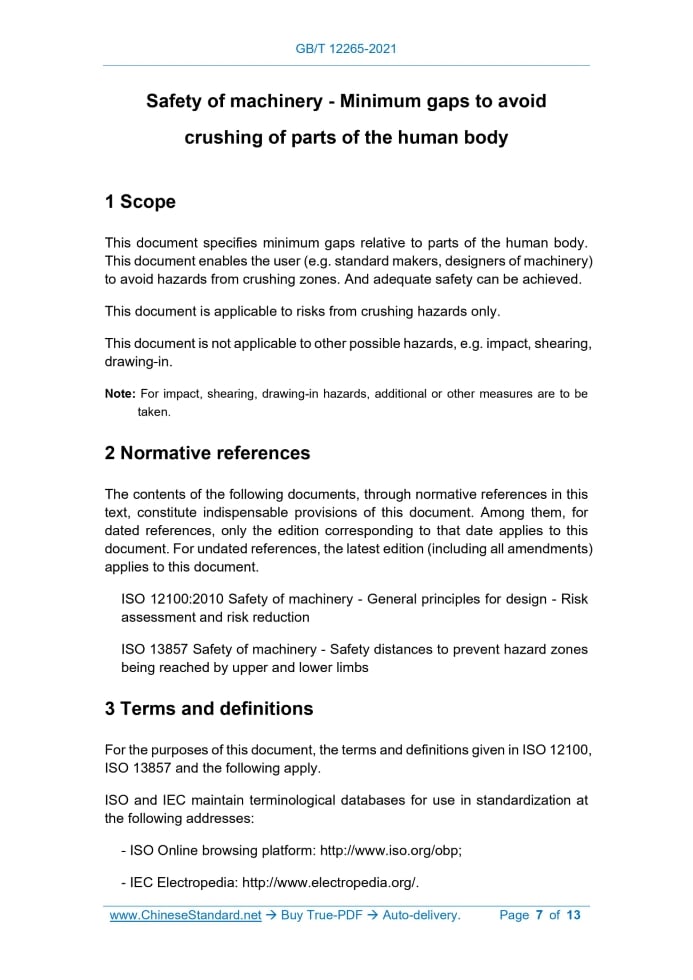
This document specifies minimum gaps relative to parts of the human body. This document enables the user (e.g. standard makers, designers of machinery) to avoid hazards from crushing zones. And adequate safety can be achieved. This document is applicable to risks from crushing hazards only. This document is not applicable to other possible hazards, e.g. impact, shearing, drawing-in. Note: For impact, shearing, drawing-in hazards, additional or other measures are to be taken.2 Normative references
The contents of the following documents, through normative references in this text, constitute indispensable provisions of this document. Among them, for dated references, only the edition corresponding to that date applies to this document. For undated references, the latest edition (including all amendments) applies to this document. ISO 12100:2010 Safety of machinery - General principles for design - Risk assessment and risk reduction ISO 13857 Safety of machinery - Safety distances to prevent hazard zones being reached by upper and lower limbs3 Terms and definitions
For the purposes of this document, the terms and definitions given in ISO 12100, ISO 13857 and the following apply. ISO and IEC maintain terminological databases for use in standardization at the following addresses: - ISO Online browsing platform: http://www.iso.org/obp; - IEC Electropedia: http://www.electropedia.org/. 3.1 Crushing zone Zone in which the human body or parts of the human body are exposed to a crushing hazard. Note: This hazard will be generated if - two movable parts are moving towards one another, or - one movable part is moving towards a fixed part. See also Annex A.4 Minimum gaps
4.1 Methodology for the use of this document The method of using this document shall form part of the iterative safety strategy outlined in ISO 12100:2010, Clause 4. The user of this document shall a) identify the crushing hazards, b) assess the risks from these hazards in accordance with ISO 12100, paying particular attention to the following: - where it is foreseeable that the risk from a crushing hazard involves different parts of the body, the minimum gap in Table 1 relating to the largest of these parts shall be applied [see also d)]; - the unpredictable behaviour of children and their body dimensions if children are included in the population at risk; - whether parts of the body can enter the crushing zone in a configuration other than those indicated in Table 1; - whether thick or bulky clothing (e.g. protective clothing for extreme temperatures) or tools have to be taken into account; - whether machinery will be used by persons wearing thick soled footwear (e.g. clogs), which will increase the effective dimension of the foot; c) select from Table 1 the appropriate minimum gap relating to the body part at risk (see also Annex A), and ......Source: Above contents are excerpted from the full-copy PDF -- translated/reviewed by: www.ChineseStandard.net / Wayne Zheng et al.