YY 0954-2015 English PDF
Price & Delivery
US$140.00 · In stock · Download in 9 secondsYY 0954-2015: Nonactive surgical implants - Type I collagen implants - Specific requirements
Delivery: 9 seconds. True-PDF full-copy in English & invoice will be downloaded + auto-delivered via email. See step-by-step procedure
Status: Obsolete
YY 0954: Historical versions
| Standard ID | USD | BUY PDF | Delivery | Standard Title (Description) | Status |
| YY 0954-2015 | 140 | Add to Cart | Auto, 9 seconds. | Nonactive surgical implants - Type I collagen implants - Specific requirements | Obsolete |
| YY/T 0954-2015 | 399 | Add to Cart | 4 days | Nonactive surgical implants--Type Ⅰ collagen implants--Specific requirements | Valid |
Click to Preview this PDF
Similar standards
YY 0954-2015: Nonactive surgical implants - Type I collagen implants - Specific requirements
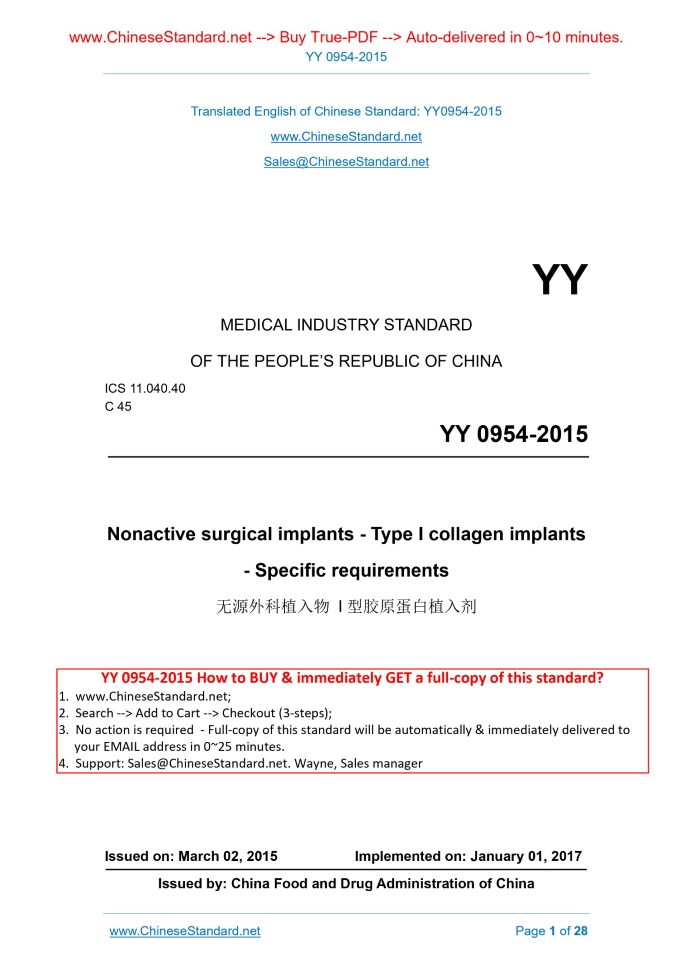
---This is an excerpt. Full copy of true-PDF in English version (including equations, symbols, images, flow-chart, tables, and figures etc.), auto-downloaded/delivered in 9 seconds, can be purchased online: https://www.ChineseStandard.net/PDF.aspx/YY0954-2015YY MEDICAL INDUSTRY STANDARD ICS 11.040.40 C 45 Nonactive surgical implants - Type I collagen implants - Specific requirements Issued on. MARCH 02, 2015 Implemented on. JANUARY 01, 2017 Issued by. China Food and Drug Administration of China
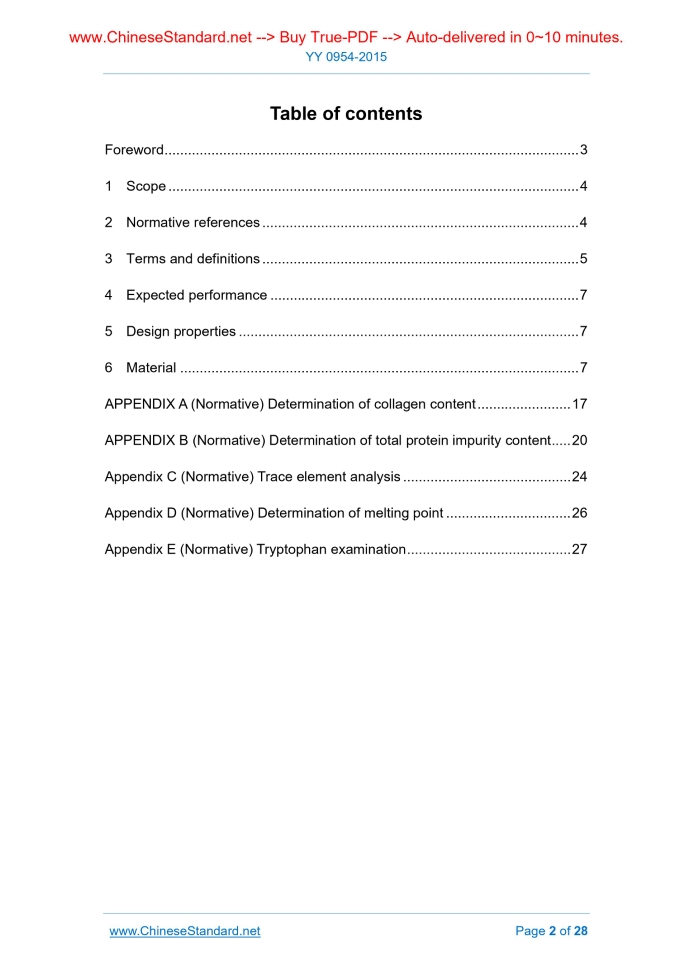
Table of Contents
Foreword... 3 1 Scope... 4 2 Normative references... 4 3 Terms and definitions... 5 4 Expected performance... 7 5 Design properties... 7 6 Material... 7 APPENDIX A (Normative) Determination of collagen content... 17 APPENDIX B (Normative) Determination of total protein impurity content... 20 Appendix C (Normative) Trace element analysis... 24 Appendix D (Normative) Determination of melting point... 26 Appendix E (Normative) Tryptophan examination... 27Foreword
This standard was drafted in accordance with the rules given in GB/T 1.1-2009. Some of the contents of this standard may be related to patents. The issuer of this document is not responsible for identifying such patents. This standard was proposed by China Food and Drug Administration of China. This standard shall be under the jurisdiction of the National Technical Committee for Standardization of Surgical Implants and Orthopedic Devices (SAC/TC 110). The drafting organizations of this standard. China Food and Drug Research Institute. The main drafters of this standard. Ke Linnan, Fu Bufang, Wang Jian, Tang Jinglong, Chen Dandan, Feng Xiaoming, Wang Chunren. Nonactive surgical implants - Type I collagen implants - Specific requirements1 Scope
This standard specifies the specific requirements for injectable collagen implants (abbreviated as implants) which are prepared from purified (non- cross-linked) type I collagen as a starting material. This standard specifies the implant technical requirements and testing methods. It also specifies the expected performance, design properties, materials, design evaluation, test methods, clinical evaluation, post-marketing surveillance, manufacturing, packaging, and information provided by the manufacturer, taking into account the safety factors of implant. The implants as specified in this standard are suitable for use in dermal layers and/or subcutaneous injections for clinical use, in order to eliminate or reduce facial wrinkles and depressions caused by various reasons.2 Normative references
The following documents are essential to the application of this document. For the dated documents, only the versions with the dates indicated are applicable to this document; for the undated documents, only the latest version (including all the amendments) are applicable to this Standard. GB/T 16886.1 Biological evaluation of medical devices - Part 1.Evaluation and testing within a risk management process GB/T 16886.3 Biological evaluation of medical devices Part 3.Test for genotoxicity carcinogenicity and reproductive toxicity GB/T 16886.4 Biological evaluation of medical devices - Part 4.Selection of tests for interactions with blood GB/T 16886.5 Biological evaluation of medical devices - Part 5.Test for vitro cytotoxicity GB/T 16886.6 Biological evaluation of medical devices - Part 6.Tests for local effects after implantation GB/T 16886.10 Biological evaluation of medical devices - Part 10.Tests for irritation and delayed-type hypersensitivity GB/T 16886.11 Biological evaluation of medical devices - Part 11.Tests for systemic toxicity GB/T 16886.12 Biological evaluation of medical devices - Part 12.Sample preparation and reference materials GB/T 16886.17 Biological evaluation of medical devices - Part 17. Establishment of allowable limits for leachable substances GB/T 16886.18 Biological evaluation of medical devices - Part 18.Chemical characterization of materials3 Terms and definitions
The following terms and definitions apply to this document. 3.1 Type I collagen The most abundant collagen in mammalian tissues expressed by encoding α chain COL1A1 gene and COL1A2 gene, which belongs to fibrin type collagen. 3.2 Type I collagen implant It refers to, under sterile conditions, the products produced by homogenously dispersing the purified (non-cross-linked) type I collagen material into phosphate buffer to prepare collagen suspensions of different concentrations AND filling it in the prefilled syringes. 3.3 Protein impurity It refers to other proteins other than type I collagen that remain after the collagen purification process. It mainly includes (but not limited to) elastin, improperly arranged collagen molecules, host cell contaminants, cell culture contaminants, enzyme preparations, and the like. The type III collagen which may be accompanied with type I collagen is not considered as protein impurity.4 Expected performance
The requirements in Chapter 4 of YY/T 0640-2008 are applicable.5 Design properties
The requirements in Chapter 5 of YY/T 0640-2008 are applicable. In order to achieve the desired performance requirements, the design properties shall take into account the effects due to material degradation.6 Material
6.1 The requirements in Chapter 6 of YY/T 0640-2008 are applicable. 6.2 The collagen material used shall comply with the requirements of ASTM F 2212-2009.Taking into account that the raw material comes from animals and/or human body, it has the risk of carrying the virus, so it shall conduct management in accordance with YY/T 0771.1, YY/T 0771.2, and YY/T 0771.3. 7 Design evaluation 7.1 General principles for design evaluation 7.1.1 The requirements in Chapter 7 of YY/T 0640-2008 are applicable. 7.1.2 In designing and manufacturing collagen implants, it shall pay attention to the following. 7.2 Preclinical evaluation 7.2.1 General preclinical for preclinical evaluation The preclinical evaluation of collagen implants shall comply with the requirements in 7.2 of YY/T 0640-2008. In accordance with the requirements of the experiment, all test samples shall be the finally sterilized equipment or components. The number of samples shall be chosen in accordance with the requirements of this standard. 7.3 Chemical characteristics 7.3.1 Type I collagen identification After the SDS-polyacrylamide gel electrophoresis analysis, COMPARE the electrophoretic bands of the samples and the type I collagen reference product, AND the electrophoretic bands shall be consistent. 7.3.2 Collagen content It shall be 80% ~ 120% of the indicated amount. 7.3.6 Total heavy metals and trace elements 7.3.6.1 Total amount of heavy metals (calculated as Pb) The total amount of heavy metal (calculated as lead Pb) in the implant shall not exceed 10 μg/g (mass fraction). 7.3.6.2 Trace elements The total amount of arsenic shall not exceed 1 μg/g; AND the total amount of chromium, cadmium, copper, iron, mercury, nickel, lead and molybdenum shall not be more than 50 μg/g (mass fraction). 7.3.7 Melting point The melting point of the implant shall be within the indicated range. 7.4 Biological properties 7.4.1 Sterility Type I collagen implants shall be sterile. 7.4.2 Biological evaluation 7.4.2.1 General principles of biological evaluation It shall, in accordance with the requirements of ISO/IEC 6188 6.1, conduct biological evaluation against the implants. 8 Test methods 8.1 Appearance Vertically PLACE the type I collagen implant under the umbrella canopy light, with the illumination of 1000 lx; arbitrarily ROTATE it and OBSERVE from the horizontal direction, it shall comply with the provisions of 7.2.2. 8.2 Loading capacity FOLLOW the provisions of Appendix X F of the Pharmacopoeia of the People's Republic of China (volume II) (2010 version), AND it shall comply with the provisions of 7.2.3. 8.3 Dynamic viscosity 8.5 Collagen content FOLLOW the method of Appendix A, AND the results shall comply with the provisions of 7.3.2. 8.6 Protein impurity analysis FOLLOW the method of Appendix B, AND the results shall comply with the provisions of 7.3.3. 8.9 Total heavy metals and trace elements 8.9.1 Total amount of heavy metals (calculated as Pb) The residues left under the residues on ignition shall follow the 2nd method of Appendix VIII H of the Pharmacopoeia of the People's Republic of China (volume II) (2010 version), AND the results shall comply with the provisions of 7.3.6.1. 8.9.2 Trace elements FOLLOW the methods as specified in Appendix C; AND the results shall comply with the provisions of 7.3.6.2. 8.10 Melting point FOLLOW the method as specified in Appendix D, AND the results shall comply with the provisions of 7.3.7. 8.11 Acid hydrolyzate FOLLOW the methods as specified in A.1 to prepare the sample acid hydrolyzate test solution; USE the amino acid analyzer to determine the amino acid composition of the acid hydrolyzate of the implants. The results shall comply with the provisions of 7.3.8. 8.12 Tryptophan inspection FOLLOW the method as specified in Appendix E, AND the results shall comply with the provisions of 7.3.9. 9 Clinical evaluation The requirements in 7.3 of YY/T 0640-2008 apply. The requirements in ISO 14155-1 and ISO 14155-2 are applicable to clinical studies. ......Source: Above contents are excerpted from the full-copy PDF -- translated/reviewed by: www.ChineseStandard.net / Wayne Zheng et al.