US$209.00 · In stock
Delivery: <= 3 days. True-PDF full-copy in English will be manually translated and delivered via email.
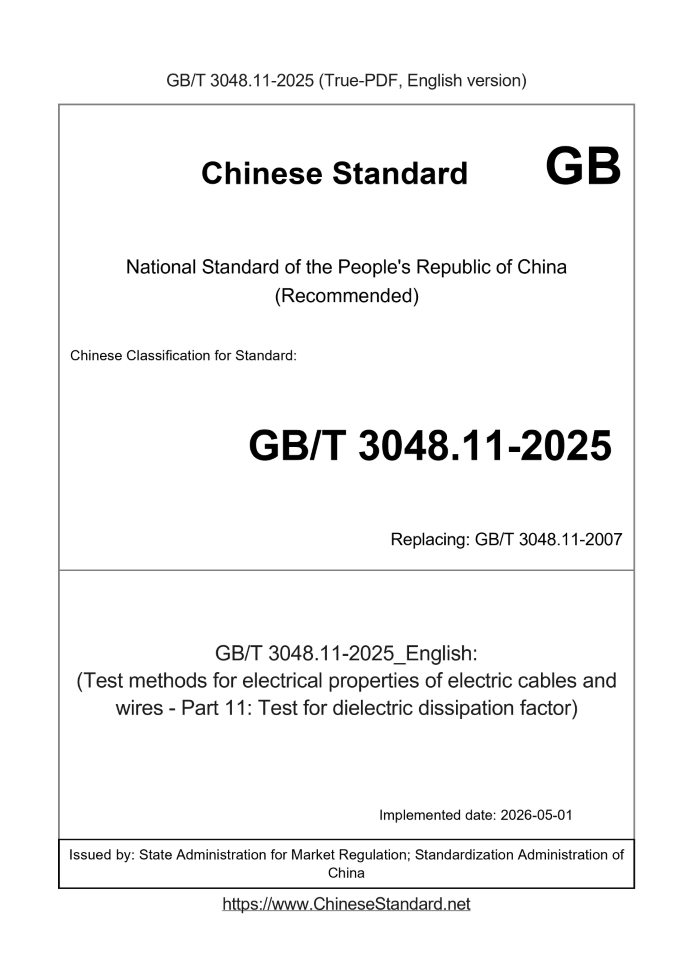
GB/T 3048.11-2025: Test methods for electrical properties of electric cables and wires - Part 11: Test for dielectric dissipation factor
Status: Valid
GB/T 3048.11: Historical versions
| Standard ID | USD | BUY PDF | Lead-Days | Standard Title (Description) | Status |
| GB/T 3048.11-2025 | 209 |
Add to Cart
|
3 days
|
Test methods for electrical properties of electric cables and wires - Part 11: Test for dielectric dissipation factor
| Valid |
| GB/T 3048.11-2007 | 209 |
Add to Cart
|
3 days
|
Test methods for electrical properties of electric cables and wires -- Part 11: Test for dielectric dissipation factor
| Valid |
| GB/T 3048.11-1994 | 199 |
Add to Cart
|
2 days
|
Test methods for determining electrical properties of electric cables and wires. Dielectric dissipation factor measurement
| Obsolete |
| GB 3048.11-1983 | 199 |
Add to Cart
|
2 days
|
Electric wires and cables--Test methods for dielectric dissipation factor measurement
| Obsolete |
Basic data
Standard ID: GB/T 3048.11-2025 (GB/T3048.11-2025)
Description (Translated English): Test methods for electrical properties of electric cables and wires - Part 11: Test for dielectric dissipation factor
Sector / Industry: National Standard (Recommended)
Classification of Chinese Standard: K10
Classification of International Standard: 29.060.20
Word Count Estimation: 10,126
Date of Issue: 2025-10-05
Date of Implementation: 2026-05-01
Older Standard (superseded by this standard): GB/T 3048.11-2007
Issuing agency(ies): State Administration for Market Regulation and Standardization Administration of China
GB/T 3048.11-2025: Test methods for electrical properties of electric cables and wires - Part 11: Test for dielectric dissipation factor
---This is a DRAFT version for illustration, not a final translation. Full copy of true-PDF in English version (including equations, symbols, images, flow-chart, tables, and figures etc.) will be manually/carefully translated upon your order.
ICS 29.060.20
CCSK13
National Standards of the People's Republic of China
Replaces GB/T 3048.11-2007
Electrical performance test methods for wires and cables
Part 11.Dielectric Loss Tangent Test
Published on 2025-10-05
Implemented on May 1, 2026
State Administration for Market Regulation
The State Administration for Standardization issued a statement.
Table of contents
Preface III
Introduction IV
1.Scope 1
2 Normative References 1
3.Terms and Definitions 1
4.Test Equipment 1
5.Sample Preparation 2
6.Experimental Procedure 2
7.Experimental Results and Calculations 3
8.Test Safety 3
9.Experimental Records 3
Foreword
This document complies with the provisions of GB/T 1.1-2020 "Standardization Work Guidelines Part 1.Structure and Drafting Rules of Standardization Documents".
Drafting.
This document is Part 11 of GB/T 3048 "Test Methods for Electrical Properties of Wires and Cables". GB/T 3048 has published the following...
part.
---Part 1.General Provisions;
---Part 2.Resistivity Testing of Metallic Materials;
---Part 3.Volume Resistivity Tests for Semiconducting Rubber and Plastic Materials;
---Part 4.Conductor DC Resistance Test;
---Part 5.Insulation Resistance Test;
---Part 7.Tracking Resistance Test;
---Part 8.AC Voltage Test;
---Part 9.Spark Test of Insulated Wire Cores;
---Part 10.Spark Test for Extruded Sheaths;
---Part 11.Dielectric Loss Tangent Test;
---Part 12.Partial Discharge Tests;
---Part 13.Impulse Voltage Test;
---Part 14.DC Voltage Test;
---Part 16.Surface Resistance Test.
This document replaces GB/T 3048.11-2007 "Test Methods for Electrical Properties of Wires and Cables - Part 11.Dielectric Loss Tangent Test".
Compared with GB/T 3048.11-2007, the main technical changes in the "Test" are as follows, except for structural adjustments and editorial modifications.
---The frequency of the test power supply was changed (see 4.1.2,.2007 version 4.1.2);
---The ratio of peak to RMS test voltage has been changed (see 4.1.2,.2007 version 4.1.2);
---The measurement range and accuracy of tanδ have been changed (see 4.2.1,.2007 version 4.2.1);
---Grounding resistance has been increased for different voltage levels (see 8.2).
Please note that some content in this document may involve patents. The issuing organization of this document assumes no responsibility for identifying patents.
This document was proposed by the China Electrical Equipment Industry Association.
This document is under the jurisdiction of the National Technical Committee on Standardization of Wires and Cables (SAC/TC213).
This document was drafted by. Shanghai Guolan Testing Co., Ltd., Shanghai Cable Research Institute Co., Ltd., and State Grid Shanghai Electric Power Company.
Cable Branch Company, Jiangsu Shangshang Cable Group Co., Ltd., Hainan Weite Electric Group Co., Ltd., Huizhou Jinlongyu Cable Industry Development Co., Ltd.
company.
The main drafters of this document are. Li Chuang, Yan Xiaohan, Xia Junfeng, Zhou Hong, Ling Guozhen, Li Ju, Liu Songdong, and Li Chungang.
The release history of this document and the document it replaces is as follows.
---First published in 1965 as GB 767-1965, first revised in 1983 as GB 3048.11-1983, and revised again in.1994.
Revised to GB/T 3048.11-1994, and revised for the third time in.2007 to GB/T 3048.11-2007;
---This is the fourth revision.
Introduction
Wires and cables are widely used in power transmission and signal transmission, and various types of products are available depending on the application scenario. Electrical performance is a key evaluation criterion.
GB/T 3048 is an important general indicator of the performance of electrical wires and cables, and is of great significance for ensuring the design and use objectives of electrical wires and cables.
GB/T 3048 establishes universal fundamental test methods applicable to the electrical performance testing of different types of wires and cables. It is proposed that these methods be developed by the following 14 departments.
Composition.
---Part 1.General Provisions. This document aims to define the terminology, definitions, and general provisions for testing the electrical properties of wires and cables.
---Part 2.Resistivity Testing of Metallic Materials. The purpose is to specify the testing methods and requirements for the resistivity of metallic materials in wires and cables.
---Part 3.Volume Resistivity Test for Semiconducting Rubber and Plastic Materials. The purpose is to determine the volume resistivity of semiconducting rubber and plastic materials used in wires and cables.
Test methods and requirements for resistivity.
---Part 4.DC Resistance Test for Conductors. The purpose is to specify the test methods and requirements for the DC resistance of conductors in wires and cables.
---Part 5.Insulation Resistance Test. The purpose is to specify the test methods and requirements for the insulation resistance of wires and cables.
---Part 7.Tracking Resistance Test. The purpose is to specify the test methods and requirements for the tracking resistance of wires and cables.
---Part 8.AC Voltage Test. The purpose is to specify the test methods and requirements for AC voltage of wires and cables.
---Part 9.Spark Test of Insulated Cores. The purpose is to specify the test methods and requirements for spark testing of insulated cores in electrical wires and cables.
---Part 10.Spark Test for Extruded Sheaths. The purpose is to specify the test method and procedures for the spark test when extruding the corrosion-resistant sheath of wires and cables.
Require.
---Part 11.Dielectric Loss Tangent Test. The purpose is to specify the test method for the dielectric loss tangent of wires and cables.
Require.
---Part 12.Partial Discharge Tests. The purpose is to specify the test methods and requirements for partial discharge in wires and cables.
---Part 13.Impulse Voltage Test. The purpose is to specify the test methods and requirements for impulse voltage of wires and cables.
---Part 14.DC Voltage Test. The purpose is to specify the test methods and requirements for DC voltage of wires and cables.
---Part 16.Surface Resistance Test. The purpose is to specify the test methods and requirements for the surface resistance of wires and cables.
Note. The original GB/T 3048 standard system had 16 parts, but GB/T 3048.5-2007 replaced GB/T 3048.5-1994 and GB/T 3048.6-
GB/T 3048.9-2007 replaced GB/T 3048.9-1994 and GB/T 3048.15-1994, therefore the current GB/T 3048 standard system has fewer standards.
Parts 6 and 15.
Electrical performance test methods for wires and cables
Part 11.Dielectric Loss Tangent Test
1 Scope
This document describes the test method for the dielectric loss tangent of wires and cables, including test equipment, sample preparation, test procedure, and test results.
Results and calculations, test safety, and test records.
This document is applicable to measuring the dielectric loss tangent (tanδ) and capacitance of cables under power frequency AC voltage.
This document does not apply to the measurement of winding wire products.
2 Normative references
The contents of the following documents, through normative references within the text, constitute essential provisions of this document. Dated citations are not included.
For references to documents, only the version corresponding to that date applies to this document; for undated references, the latest version (including all amendments) applies.
This document.
GB/T 2900.19 Electrical Terminology. High Voltage Testing Techniques and Insulation Coordination
GB/T 3048.1 Test methods for electrical properties of wires and cables - Part 1.General principles
GB/T 3048.8-2025 Electrical Performance Test Methods for Wires and Cables - Part 8.AC Voltage Test
3 Terms and Definitions
The terms and definitions defined in GB/T 2900.19 and GB/T 3048.1, as well as the following terms and definitions, apply to this document.
3.1
tanδ
A parameter characterizing the energy loss of cable insulation under an alternating electric field is the phase angle between the applied sinusoidal voltage and the current passing through the sample.
Complementary angle tangent.
4.Test Equipment
4.1 Test Power Supply
4.1.1 It is advisable to use a test transformer to generate the required test voltage, or a series resonant circuit to generate the test voltage. The test power supply should meet the following requirements.
Requirements for test voltage and capacitor current.
4.1.2 The test power supply should be an AC voltage with a frequency of 45Hz to 55Hz, and the voltage waveform should be close to a sine wave, with the two half-waves basically in phase.
Similarly, the ratio of the peak value to the root mean square (effective) value is 2 ± 0.05.
4.1.3 The voltage of the test power supply shall be measured in accordance with the provisions of 4.3 in GB/T 3048.8-2025.
4.2 Measuring Instruments
4.2.1 It is advisable to use the Schering bridge and standard capacitor to measure the dielectric loss tangent (tanδ) of the cable.
......
Tips & Frequently Asked Questions:
Question 1: How long will the true-PDF of GB/T 3048.11-2025_English be delivered?
Answer: Upon your order, we will start to translate GB/T 3048.11-2025_English as soon as possible, and keep you informed of the progress. The lead time is typically 1 ~ 3 working days. The lengthier the document the longer the lead time.
Question 2: Can I share the purchased PDF of GB/T 3048.11-2025_English with my colleagues?
Answer: Yes. The purchased PDF of GB/T 3048.11-2025_English will be deemed to be sold to your employer/organization who actually pays for it, including your colleagues and your employer's intranet.
Question 3: Does the price include tax/VAT?
Answer: Yes. Our tax invoice, downloaded/delivered in 9 seconds, includes all tax/VAT and complies with 100+ countries' tax regulations (tax exempted in 100+ countries) -- See Avoidance of Double Taxation Agreements (DTAs):
List of DTAs signed between Singapore and 100+ countriesQuestion 4: Do you accept my currency other than USD?
Answer: Yes. If you need your currency to be printed on the invoice, please write an email to Sales@ChineseStandard.net. In 2 working-hours, we will create a special link for you to pay in any currencies. Otherwise, follow the normal steps: Add to Cart -- Checkout -- Select your currency to pay.
Question 5: Should I purchase the latest version GB/T 3048.11-2025?
Answer: Yes. Unless special scenarios such as technical constraints or academic study, you should always prioritize to purchase the latest version GB/T 3048.11-2025 even if the enforcement date is in future. Complying with the latest version means that, by default, it also complies with all the earlier versions, technically.