GB 5009.242-2017 PDF English
| Standard ID | USD | BUY PDF | Delivery | Standard Title (Description) | Status |
| GB 5009.242-2017 | 70 | Add to Cart | Auto, 9 seconds. | National food safety standard - Determination of Manganese in Food | Valid |
Similar standards
GB 5009.242-2017: National food safety standard - Determination of Manganese in Food
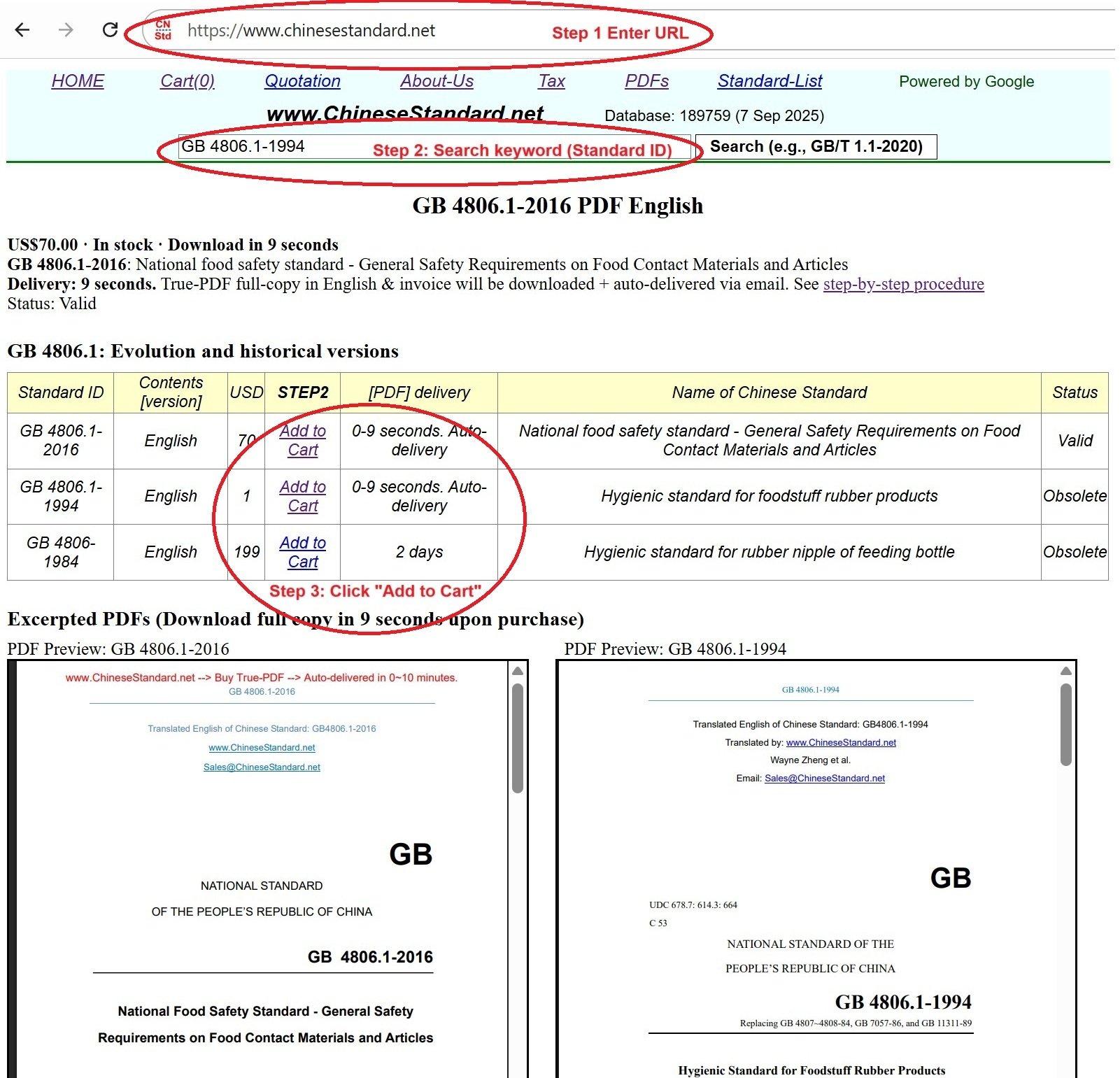
---This is an excerpt. Full copy of true-PDF in English version (including equations, symbols, images, flow-chart, tables, and figures etc.), auto-downloaded/delivered in 9 seconds, can be purchased online: https://www.ChineseStandard.net/PDF.aspx/GB5009.242-2017GB NATIONAL STANDARD OF THE PEOPLE’S REPUBLIC OF CHINA National Food Safety Standard - Determination of Manganese in Food Issued on. APRIL 06, 2017 Implemented on. OCTOBER 06, 2017 Issued by. National Health and Family Planning Commission of PRC; China Food and Drug Administration.
Table of Contents
Foreword... 3 1 Scope... 4 2 Principle... 4 3 Reagents and Materials... 4 4 Apparatus... 5 5 Analytical Procedures... 6 6 Expression of Analytical Results... 8 7 Precision... 8 8 Others... 8 Appendix A Specimen Digestion Reference Conditions... 10Foreword
This Standard replaced the determination parts of magnesium in the following standards such as GB/T 5009.90-2003 Determination of iron, Magnesium and Manganese in Foods, GB 5413.21-2010 National Food Safety Standard Determination of Calcium, Iron, Zinc, Sodium, Potassium, Magnesium, Copper and Manganese in Foods for Infants and Young Children, Milk and Milk Products, GB/T 14609-2008 Inspection of Grain and Oils - Determination of Copper, Iron, Manganese, Zinc, Calcium, Magnesium in Cereals and Derived Products by Atomic Absorption and Flame Spectrophotometry, GB/T 23545-2009 Determination of Manganese in White Wine - Inductively Coupled Plasma Atomic Emission Spectrometry, GB/T 18932.11- 2002 Method for Determination of Potassium, Phosphorus, Iron, Calcium, Zinc, Aluminum, Sodium, Magnesium, Boron, Manganese, Copper, Barium, Titanium, Vanadium, Nickel, Cobalt and Chromium in Honey – Inductively Coupled Plasma Atomic Emission Spectrometry (ICP-AES), GB/T 18932.12-2002 Method for the Determination of Potassium, Sodium, Calcium, Magnesium, Zine, Iron, Copper, Manganese, Chromium, Lead, Cadmium Contents in Honey - Atomic Absorption Spectrometry, and NY/T 1653-2008 Determination for Mineral Elements In Vegetables, Fruits and Derived Products by ICP - AES Method. Compared with the above-mentioned standards, this Standard has the major changes as follows. --- Modified the standard name into “National Food Safety Standard – Determination of Manganese in Food”; --- Modified the contents in the specimen preparation part; --- Modified the contents in the specimen digestion part; --- Modified the inductively coupled plasma emission spectrometry as Method 2, the inductively coupled plasma mass spectrometry as Method 3. --- Added the method’s limit of detection and quantification limit; --- Added the appendix. National Food Safety Standard - Determination of Manganese in Food1 Scope
This Standard specifies three determination methods for manganese in food, namely, flame atomic absorption spectrometry, inductively coupled plasma emission spectrometry, and inductively coupled plasma mass spectrometry. This Standard is applicable to the determination of manganese in food. Method 1 -- Flame Atomic Absorption Spectrometry2 Principle
After the digestion treatment, inject the specimen into the atomic absorption spectrometer; after flame atomization, the manganese absorbs 279.5nm resonance line; under certain concentration range, its absorbance value is proportional to the manganese content; then quantify through comparison with the standard series.3 Reagents and Materials
Unless otherwise is specified, the reagents used in this method shall be guarantee reagent; while water used in this method shall be Class-II water stipulated in GB/T 6682. 3.1 Reagents 3.1.1 Nitric acid (HNO3). 3.1.2 Perchloric acid (HClO4). 3.2 Reagents preparation 3.3 Standard substance Metal manganese standard substance (Mn). purity > 99.99%. 3.4 Preparation of standard solution 3.4.1 Manganese standard stock solution (1000mg/L). accurately take 1g (accurate to 0.0001g) of metal manganese; add nitric acid to dissolve; transfer into 1000mL volumetric flask; add nitric acid solution to the scale; mix evenly; store into the polyethylene bottle at 4°C; or use the standard solution certified by the state, awarded standard substance certificate. 3.4.2 Manganese standard working solution (10.0mg/L). accurately pipette 1.0mL of manganese standard stock solution into the 100mL volumetric flask; use the nitric acid solution to dilute to the scale; store into the polyethylene bottle at 4°C.4 Apparatus
4.1 Atomic absorption spectrometer, equipped with flame atomizer, manganese hollow cathode lamp. 4.2 Analytical balance. sensitivity is 0.1mg and 1.0mg. 4.6 Adjustable temperature-control electric hot plate. 4.7 Adjustable temperature-control electric hot furnace. 4.8 Microwave digestion instrument, equipped with Teflon digestion inner tank. 4.9 Constant-temperature drying oven. 4.10 Pressure digestion tank, equipped with Teflon digestion inner tank.5 Analytical Procedures
5.1 Specimen preparation 5.1.1 Solid sample 5.1.2 Liquid sample Shake evenly the soft drinks, spices and the like samples. 5.1.3 Semi-solid sample Stir evenly. 5.2 Sample digestion 5.2.1 Microwave digestion method Take 0.2g~0.5g (accurate to 0.001g) of specimen into the microwave digestion inner tank; firstly, heat the sample contained ethanol or carbon dioxide at low temperature on the electric hot plate to remove ethanol or carbon dioxide; add 5mL~10mL of nitric acid; cover it to stand for 1h or stay overnight; tighten the outer tank; 5.2.2 Digestion method of pressure tank Take 0.3g~1g (accurate to 0.001g) of specimen into the Teflon pressure digestion inner tank; firstly, heat the sample contained ethanol or carbon dioxide at low temperature on the electric hot plat to remove the ethanol or carbon dioxide; add 5mL of nitric acid; cover it to stand for 1h or stay overnight; tighten the outer tank; 5.2.3 Wet digestion method Take 0.5g~5g (accurate to 0.001g) of specimen into the glass vessel or Teflon digestion vessel; firstly, heat the sample contained ethanol or carbon dioxide at low temperature on the electric hot plate to remove the ethanol or carbon dioxide; add 10mL of mixed acid; cover it to stand for 1h or stay overnight; place it on the adjustable temperature- control electric hot plate or electric hot furnace for digestion; 5.3 Instrument reference conditions Optimize the instrument to the best conditions; major reference conditions. absorption wavelength 279.5nm, slit width 0.2mm, lamp current 9mA, gas flow rate 1.0L/min. 5.4 Drawing of standard curve Separately inject the standard series working solutions into the atomic absorption spectrometer; measure their absorbance values; draw standard curve with concentration of standard working solution as abscissa, while the absorbance value as ordinate. 5.5 Determination of sample solution Under the same experimental conditions for determination of the standard cure working solution, inject the blank solution and specimen solution into the atomic absorption spectrometer; measure the absorbance value of manganese; the manganese concentration of the to-be-tested solution can be obtained from the standard curve.6 Expression of Analytical Results
The manganese content in the specimen shall be calculated by Formula (1).7 Precision
The absolute difference between two independent test results obtained under repeatability conditions shall not exceed 10% of the arithmetic mean.8 Others
If the sample quantity is 0.5g, constant volume is 25mL, this method’s limit of detection for manganese is 0.2mg/kg; while the quantification limit is 0.5mg/kg.Appendix A
Specimen Digestion Reference Conditions The reference conditions for microwave digestion and pressure tank digestion can refer to Table A.1. ......Source: Above contents are excerpted from the full-copy PDF -- translated/reviewed by: www.ChineseStandard.net / Wayne Zheng et al.