GB/T 3048.4-2025 PDF English
US$215.00 · In stock · Download in 9 seconds
GB/T 3048.4-2025: Test methods for electrical properties of electric cables and wires - Part 4: Test of DC resistance of conductors
Delivery: 9 seconds. True-PDF full-copy in English & invoice will be downloaded + auto-delivered via email. See step-by-step procedure
Status: Valid
GB/T 3048.4-2025: Test methods for electrical properties of electric cables and wires - Part 4: Test of DC resistance of conductors
Delivery: 9 seconds. True-PDF full-copy in English & invoice will be downloaded + auto-delivered via email. See step-by-step procedure
Status: Valid
GB/T 3048.4: Historical versions
| Standard ID | USD | BUY PDF | Delivery | Standard Title (Description) | Status |
| GB/T 3048.4-2025 | 215 | Add to Cart | Auto, 9 seconds. | Test methods for electrical properties of electric cables and wires - Part 4: Test of DC resistance of conductors | Valid |
| GB/T 3048.4-2007 | 70 | Add to Cart | Auto, 9 seconds. | Test methods for electrical properties of electric cables and wires -- Part 4: Test of DC resistance of conductors | Valid |
| GB/T 3048.4-1994 | 199 | Add to Cart | 2 days | Test methods for determining electrical properties of electric cables and wires. Measurement of D. C. resistance of conductors | Obsolete |
| GB 3048.4-1983 | 199 | Add to Cart | 2 days | Electric wires and cables--Test methods for measurement of D. C. resistance of conductors | Obsolete |
Similar standards
GB/T 3048.4-2025: Test methods for electrical properties of electric cables and wires - Part 4: Test of DC resistance of conductors
---This is an excerpt. Full copy of true-PDF in English version (including equations, symbols, images, flow-chart, tables, and figures etc.), auto-downloaded/delivered in 9 seconds, can be purchased online: https://www.ChineseStandard.net/PDF.aspx/GBT3048.4-2025
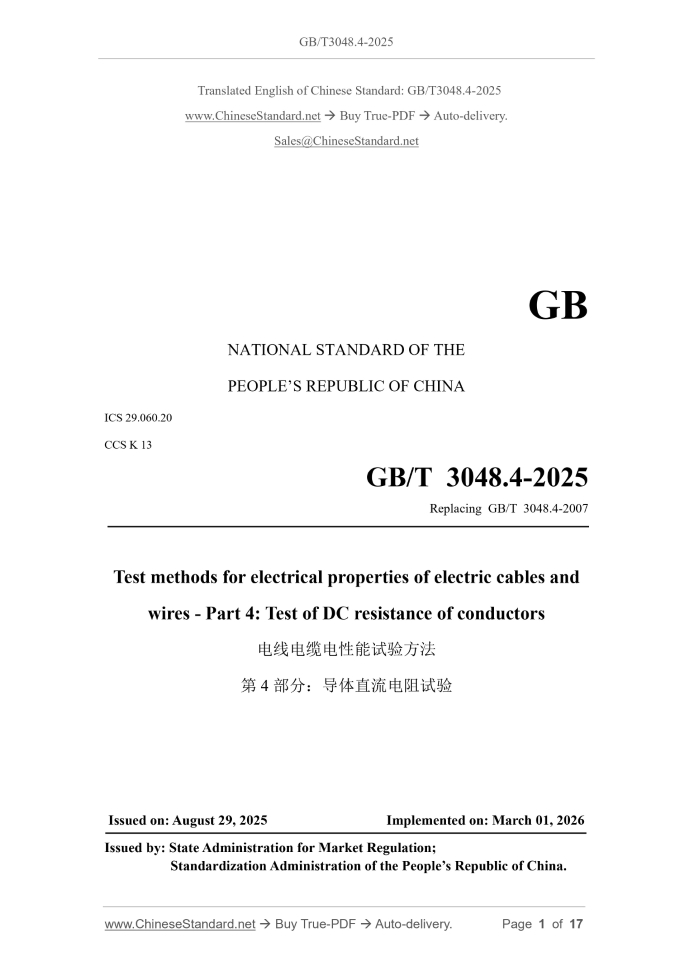
GB NATIONAL STANDARD OF THE PEOPLE’S REPUBLIC OF CHINA ICS 29.060.20 CCS K 13 GB/T 3048.4-2025 Replacing GB/T 3048.4-2007 Test methods for electrical properties of electric cables and wires - Part 4.Test of DC resistance of conductors Issued on: AUGUST 29, 2025 Implemented on: MARCH 01, 2026 Issued by. State Administration for Market Regulation; Standardization Administration of the People’s Republic of China.
Table of Contents
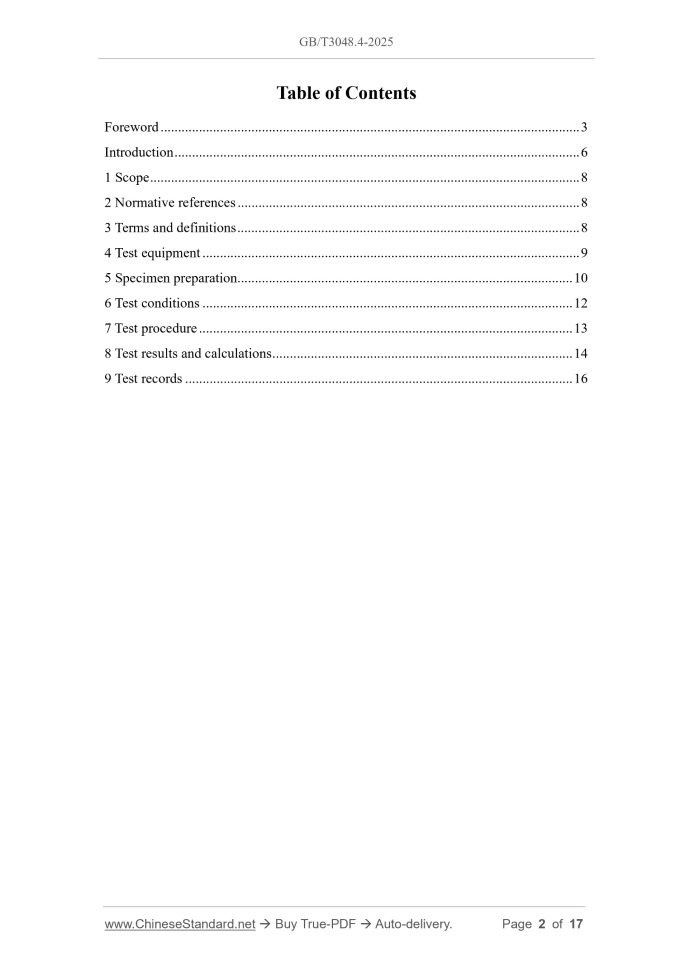
Foreword... 3 Introduction... 6 1 Scope... 8 2 Normative references... 8 3 Terms and definitions... 8 4 Test equipment... 9 5 Specimen preparation... 10 6 Test conditions... 12 7 Test procedure... 13 8 Test results and calculations... 14 9 Test records... 16 Test methods for electrical properties of electric cables and wires - Part 4.Test of DC resistance of conductors1 Scope
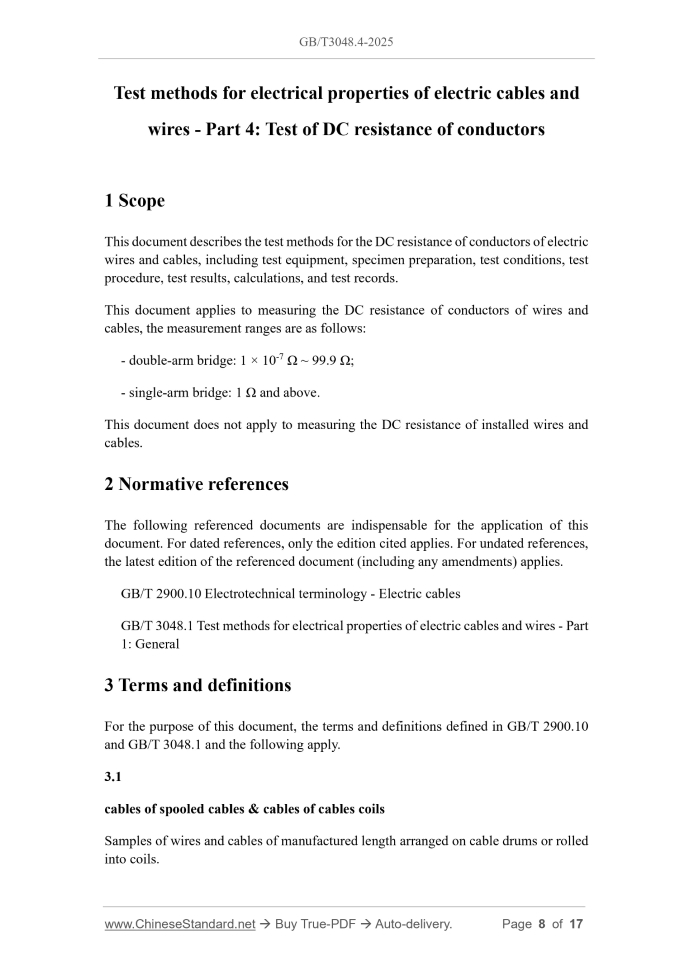
This document describes the test methods for the DC resistance of conductors of electric wires and cables, including test equipment, specimen preparation, test conditions, test procedure, test results, calculations, and test records. This document applies to measuring the DC resistance of conductors of wires and cables, the measurement ranges are as follows. - double-arm bridge. 1 × 10⁻⁷ Ω ~ 99.9 Ω; - single-arm bridge. 1 Ω and above. This document does not apply to measuring the DC resistance of installed wires and cables.2 Normative references
The following referenced documents are indispensable for the application of this document. For dated references, only the edition cited applies. For undated references, the latest edition of the referenced document (including any amendments) applies. GB/T 2900.10 Electrotechnical terminology - Electric cables GB/T 3048.1 Test methods for electrical properties of electric cables and wires - Part 1.General3 Terms and definitions
For the purpose of this document, the terms and definitions defined in GB/T 2900.10 and GB/T 3048.1 and the following apply. 3.1 cables of spooled cables & cables of cables coils Samples of wires and cables of manufactured length arranged on cable drums or rolled into coils.4 Test equipment
4.1 The schematic diagram of the single-arm bridge is shown in Figure 1, and the schematic diagram of the double-arm bridge is shown in Figure 2. 4.2 Resistance measurements should be made using a portable bridge or a laboratory- specific fixed bridge, or a digital DC resistance tester. Laboratory-specific fixed bridges and accessories shall be wired and installed according to the instrument’s technical manual. 4.3 When the resistance being measured is less than 1 Ω, a four-terminal measuring fixture should be used for wiring. The outer pair of electrodes of the four-terminal fixture are current electrodes, and the inner pair are potential electrodes. Potential electrodes shall consist of metal electrodes with sharp edges or sharp needle electrodes, and a pair of potential electrodes shall be parallel to each other and perpendicular to the specimen. The distance between each potential contact and the corresponding current contact shall be no less than 1.5 times the circumference of the specimen cross section.5 Specimen preparation
5.1 General specimen preparation method 5.1.1 Specimen cutting and preparation In addition to the provisions of this document, other requirements for specimen preparation shall comply with the provisions of GB/T 3048.1. A specimen of the length required for the test is cut from the tested wire or cable, the effective length between the potential electrodes shall not be less than 1 m. If the product standard specifies a sample length does not meet the effective length between the potential electrodes, the distance between the potential electrodes may be appropriately shortened, provided that the measurement error meets the requirements. The result is converted to the conductor resistance value at 1 m. Alternatively, cables of spooled cable or cables of cables coil can be used as the specimen. When removing insulation, protective sheaths, and other coverings (if any) from the conductor, damage to the conductor shall be avoided. For multi-core stranded cable specimens, the conductor covering shall be retained as much as possible along the effective length between the potential electrodes. For stranded conductor specimens, only the covering at the ends where they connect to the measurement system should be removed, exposing the conductor. For stranded bare conductors, measures shall be taken to prevent the conductor from loosening during sampling. 5.1.2 Specimen straightening If straightening or alignment of the specimen is necessary, there shall be no distortion or damage that would alter the cross-section of the specimen conductor, nor shall the specimen conductor be stretched. 5.1.3 Specimen preparation Before connecting the specimen to the measurement system, the conductor surface at the connection point shall be cleaned to remove any debris, dirt, and grease. All insulation between individual wires of the conductor at the connection point (such as oxide layers, insulating varnish, or water-blocking materials) shall be removed. If reagents are used, they shall be thoroughly cleaned with a volatile solvent such as water or alcohol to remove any residual reagents. 5.2 Preparation method for specimens of stranded aluminum conductors (including aluminum alloy conductors) 5.2.1 General Except as specified in this subclause, other preparation methods shall be carried out in accordance with 5.1. 5.2.2 Specimen length The effective length of the specimen between the potential electrodes should be. 3 m for conductors with a nominal cross-sectional area of 185 mm² or less, and 5 m for conductors with a nominal cross-sectional area greater than 185 mm². In case of dispute, 5 m for conductors with a nominal cross-sectional area of 185 mm² or less, and 10 m for conductors with a nominal cross-sectional area greater than 185 mm². 5.3 Preparation method for specimens of split conductors 5.3.1 General Except as specified in this subclause, other preparation methods shall be carried out in accordance with 5.1. 5.3.2 Specimen preparation The cross-section of the split conductor shall be flat. Remove the insulating paper and water-blocking material (if any) between the current electrode and potential electrode strands. For bare conductors, use appropriate means (such as strong clamps) to secure the conductors. For finished cables, remove all coverings except the insulated cores, and covering materials other than the conductor on both sides of the potential electrode shall also be removed, exposing the conductors. In case of dispute, the insulation layer between the current electrode and potential electrode should be retained.6 Test conditions
6.1 Test temperature 6.1.1 During type tests, the specimen shall be placed in a test environment with a temperature of (20 ± 5) °C and an air humidity of no more than 85 % for a minimum of 12 h, or as specified in the applicable product standard. During specimen placement and testing, the ambient temperature shall not fluctuate by more than ±1 °C. Ambient temperature shall be measured with a thermometer with a graduation of 0.1 °C, to the nearest 0.1 °C. The thermometer shall not be less than 1 m from the ground, not be less than 10 cm from the wall, not more than 1 meter from the specimen, and the two shall be approximately at the same height and shall be protected from the influence of thermal radiation and air convection. 6.1.2 During routine tests, the specimen shall be placed in a test environment with a temperature of (20 ± 15) °C for a sufficient period of time to allow temperature equilibrium to occur. In case of dispute, the placement time should not be less than 24 h. Ambient temperature shall be measured with a thermometer with a graduation of 1 °C, accurate to the nearest 1 °C. The thermometer shall not be less than 1 m from the ground, not more than 1 meter from the specimen, and be protected from the influence of thermal radiation and air convection. 6.2 Measurement error ......Source: Above contents are excerpted from the full-copy PDF -- translated/reviewed by: www.ChineseStandard.net / Wayne Zheng et al.
Tips & Frequently Asked Questions:
Question 1: How long will the true-PDF of English version of GB/T 3048.4-2025 be delivered?
Answer: The full copy PDF of English version of GB/T 3048.4-2025 can be downloaded in 9 seconds, and it will also be emailed to you in 9 seconds (double mechanisms to ensure the delivery reliably), with PDF-invoice.Question 2: Can I share the purchased PDF of GB/T 3048.4-2025_English with my colleagues?
Answer: Yes. The purchased PDF of GB/T 3048.4-2025_English will be deemed to be sold to your employer/organization who actually paid for it, including your colleagues and your employer's intranet.Question 3: Does the price include tax/VAT?
Answer: Yes. Our tax invoice, downloaded/delivered in 9 seconds, includes all tax/VAT and complies with 100+ countries' tax regulations (tax exempted in 100+ countries) -- See Avoidance of Double Taxation Agreements (DTAs): List of DTAs signed between Singapore and 100+ countriesQuestion 4: Do you accept my currency other than USD?
Answer: Yes. www.ChineseStandard.us -- GB/T 3048.4-2025 -- Click this link and select your country/currency to pay, the exact amount in your currency will be printed on the invoice. Full PDF will also be downloaded/emailed in 9 seconds.Question 5: Should I purchase the latest version GB/T 3048.4-2025?
Answer: Yes. Unless special scenarios such as technical constraints or academic study, you should always prioritize to purchase the latest version GB/T 3048.4-2025 even if the enforcement date is in future. Complying with the latest version means that, by default, it also complies with all the earlier versions, technically.How to buy and download a true PDF of English version of GB/T 3048.4-2025?
A step-by-step guide to download PDF of GB/T 3048.4-2025_English
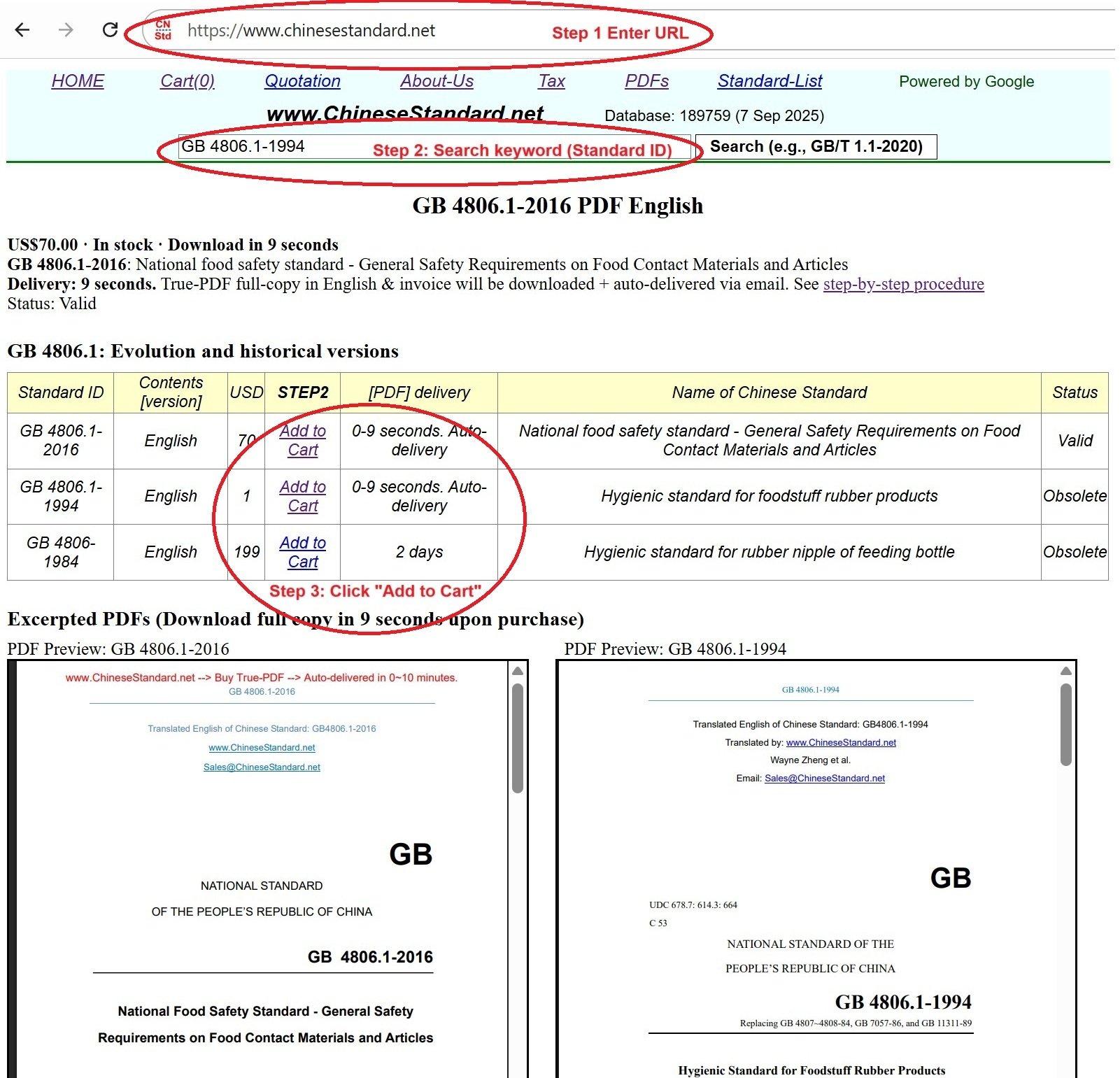
Step 1: Visit website https://www.ChineseStandard.net (Pay in USD), or https://www.ChineseStandard.us (Pay in any currencies such as Euro, KRW, JPY, AUD).Step 2: Search keyword "GB/T 3048.4-2025".
Step 3: Click "Add to Cart". If multiple PDFs are required, repeat steps 2 and 3 to add up to 12 PDFs to cart.
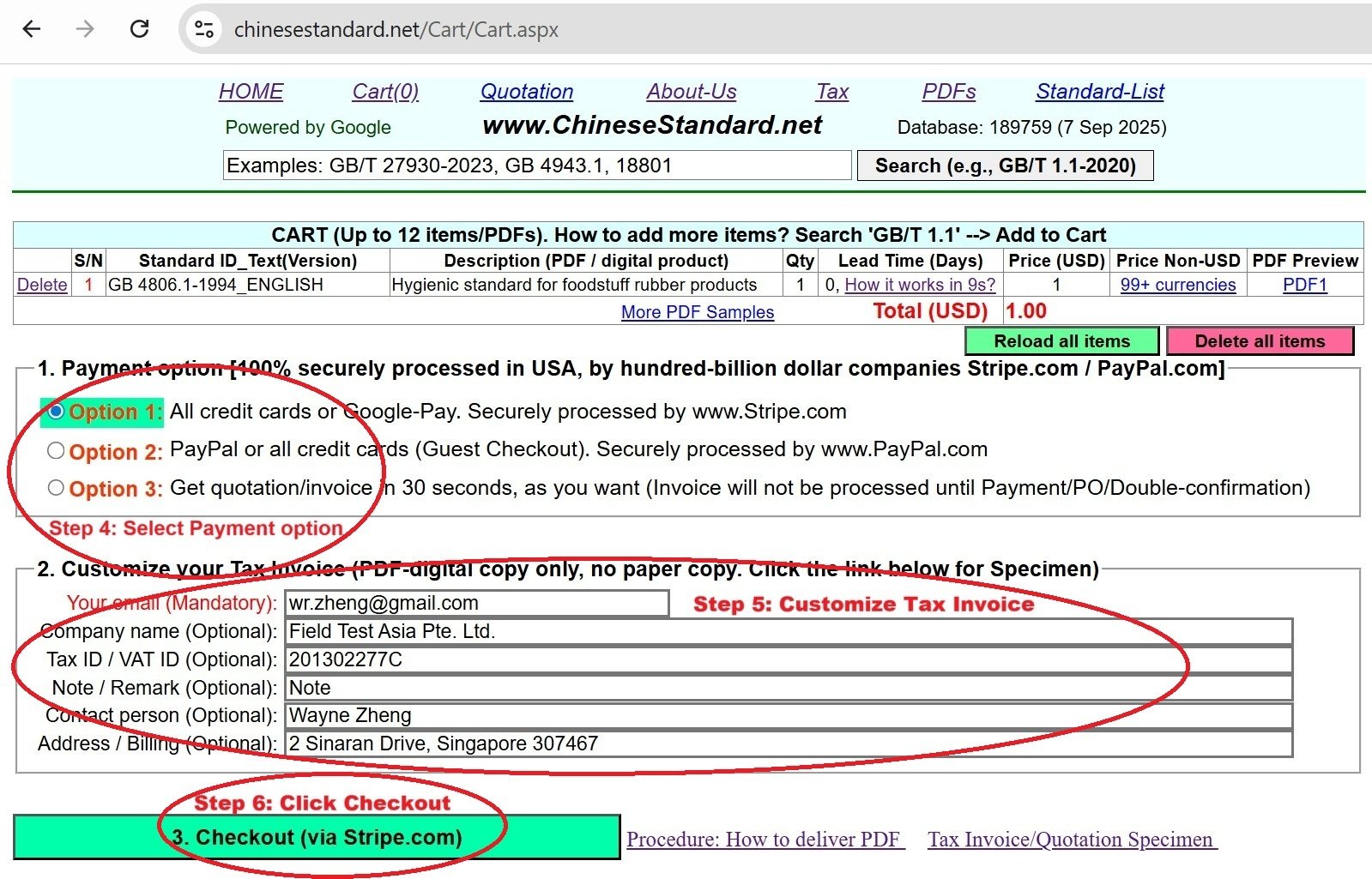
Step 4: Select payment option (Via payment agents Stripe or PayPal).
Step 5: Customize Tax Invoice -- Fill up your email etc.
Step 6: Click "Checkout".
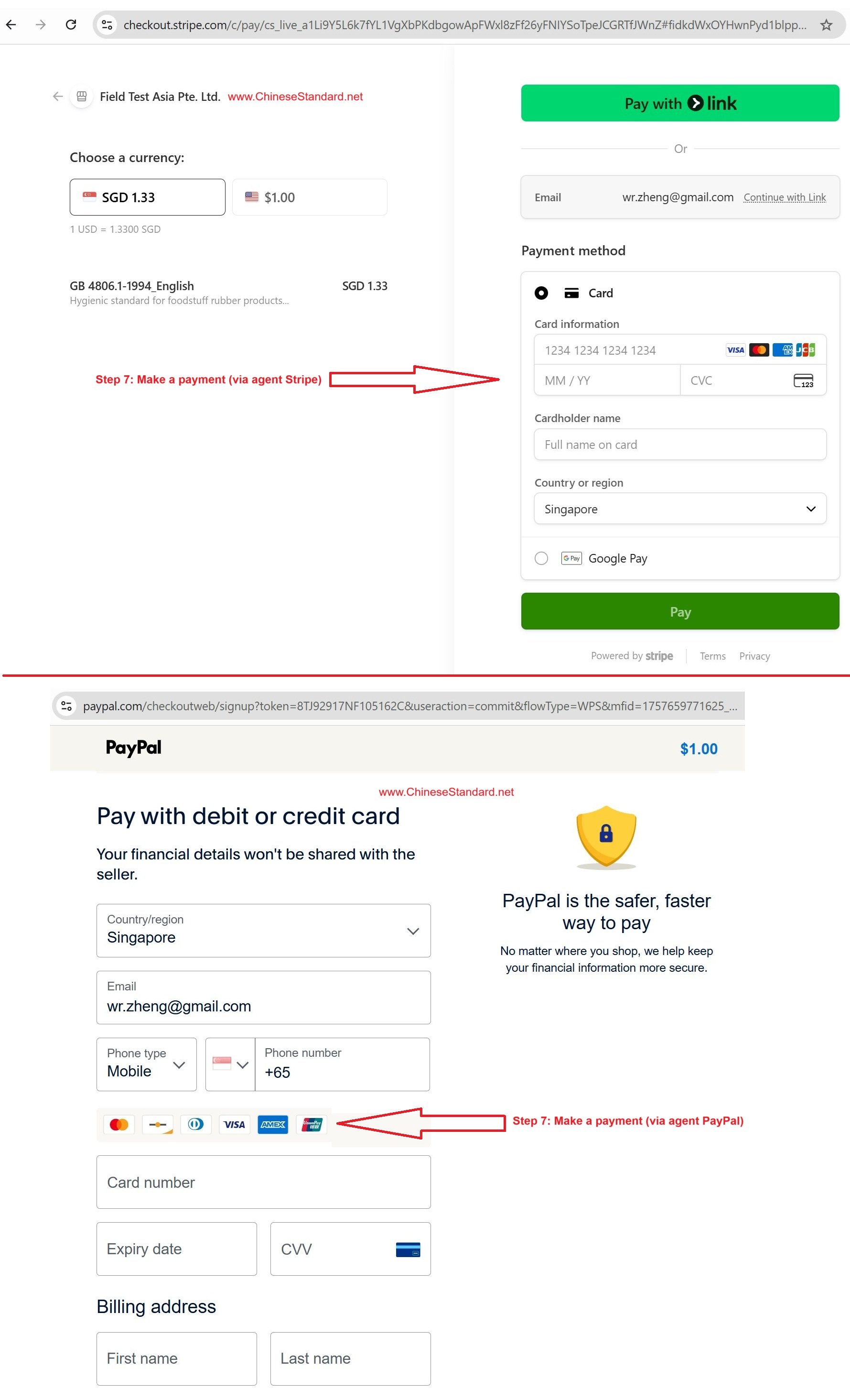
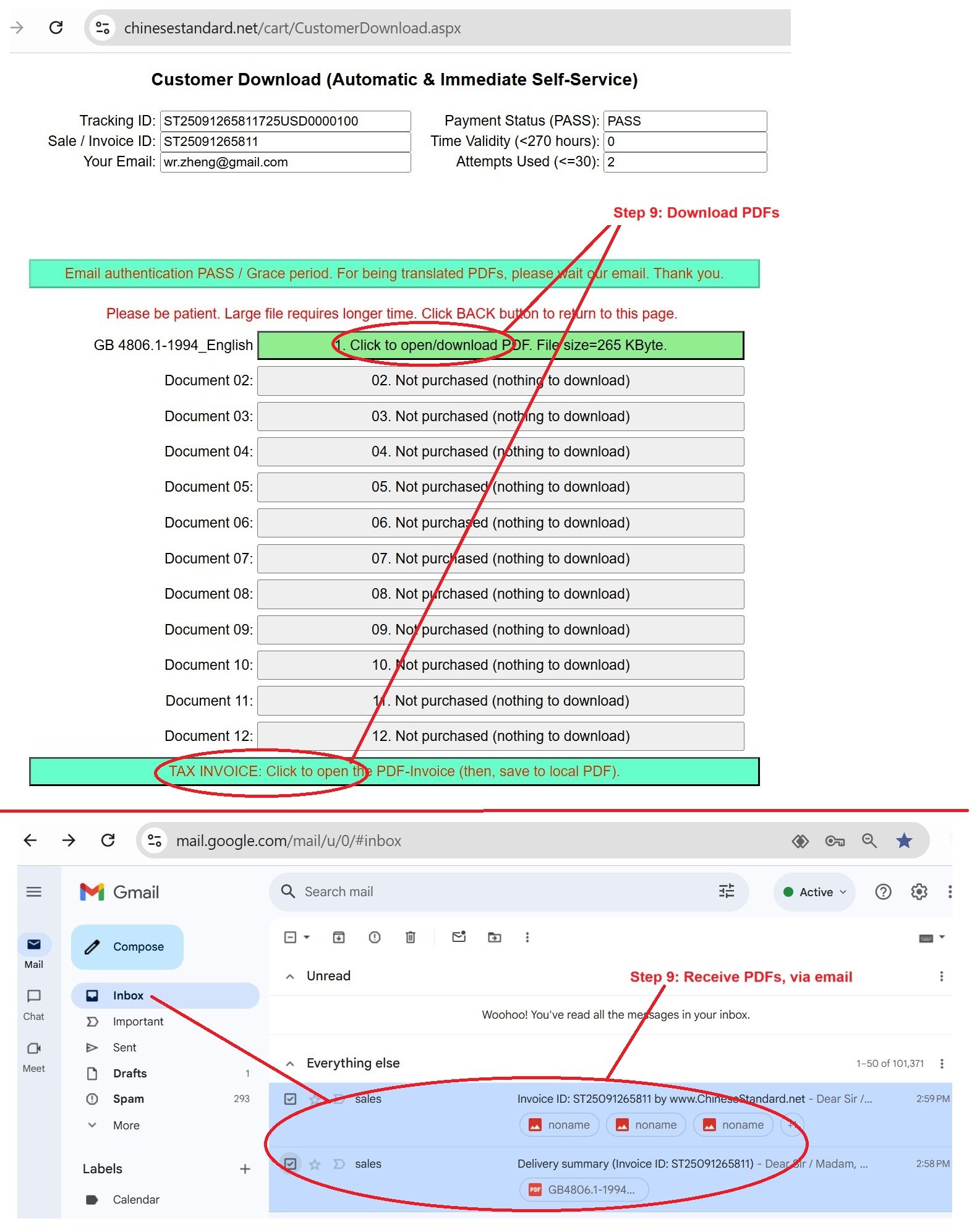
Step 7: Make payment by credit card, PayPal, Google Pay etc. After the payment is completed and in 9 seconds, you will receive 2 emails attached with the purchased PDFs and PDF-invoice, respectively.
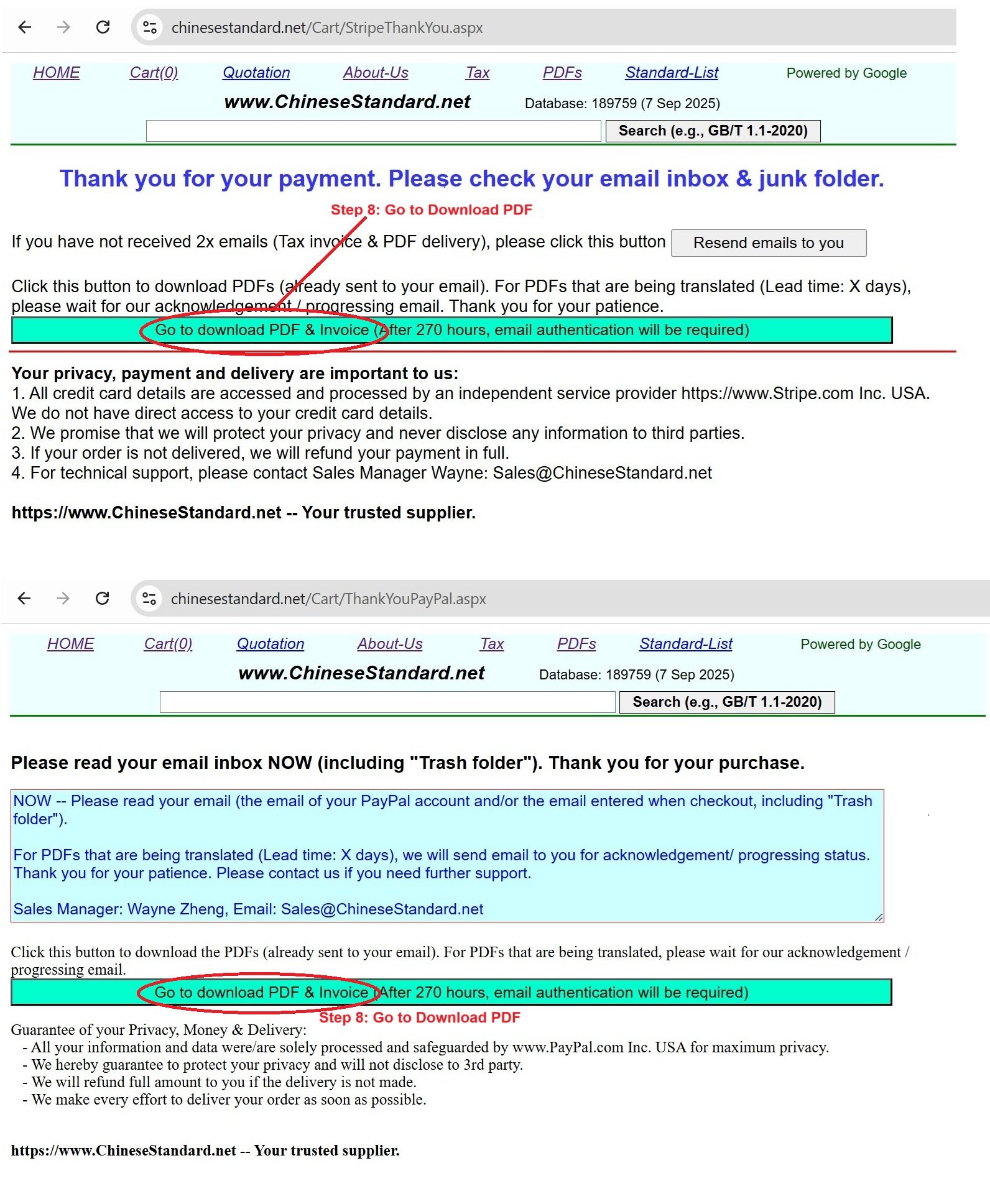
Step 8: Optional -- Go to download PDF.
Step 9: Optional -- Click Open/Download PDF to download PDFs and invoice.
See screenshots for above steps: Steps 1~3 Steps 4~6 Step 7 Step 8 Step 9