| Standard ID | USD | BUY PDF | Lead-Days | Standard Title (Description) | Status |
| GB 28527-2012 | RFQ |
ASK
|
13 days
|
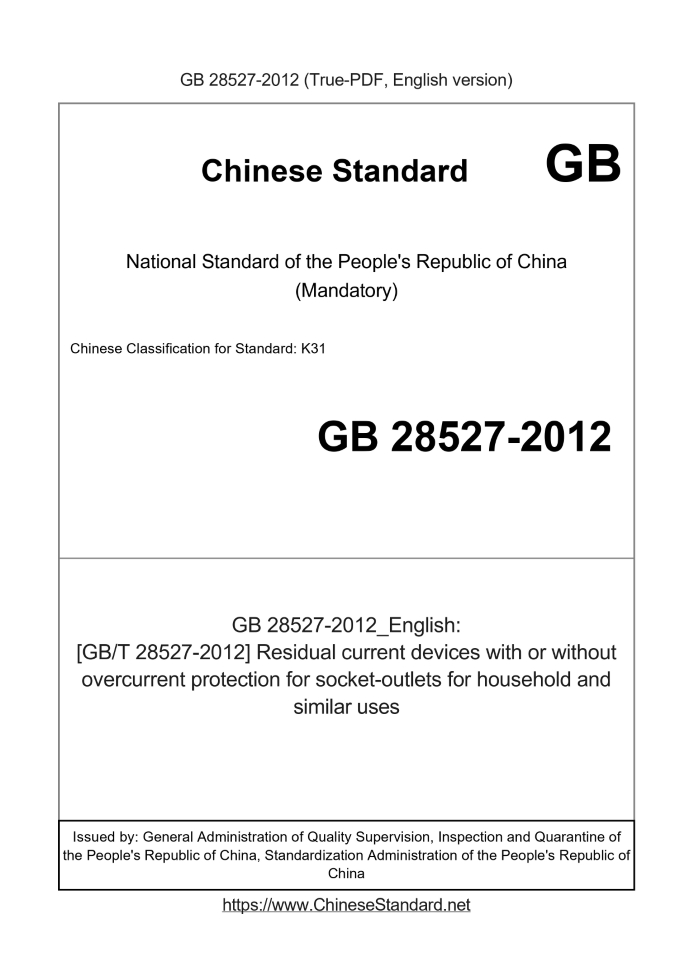
[GB/T 28527-2012] Residual current devices with or without overcurrent protection for socket-outlets for household and similar uses
| Valid |
Basic data
Standard ID: GB 28527-2012 (GB28527-2012)
Description (Translated English): [GB/T 28527-2012] Residual current devices with or without overcurrent protection for socket-outlets for household and similar uses
Sector / Industry: National Standard
Classification of Chinese Standard: K31
Classification of International Standard: 29.120.50
Word Count Estimation: 108,168
Quoted Standard: GB 2099.1; GB/T 2423.4; GB/T 2424.2; GB 4208; GB/T 5169.10; GB/T 5169.11; GB 8898; GB/T 14472; GB/T 16842; GB 16916.1; GB 16917.1; GB/T 16935.3; GB 17466.1; GB 17466.24; GB 18499; GB/T 19215.1; GB 4343.1-2009; IEC 61008-1-2008; IEC 61009-1-2008; IEC 61534
Adopted Standard: IEC 62640-2011, MOD
Regulation (derived from): National Standards Bulletin No. 13 of 2012
Issuing agency(ies): General Administration of Quality Supervision, Inspection and Quarantine of the People's Republic of China, Standardization Administration of the People's Republic of China
Summary: This Chinese standard specifies the residual current electrical energy, including detection of residual current, the current value of the remaining residual operating current compared to the value of the function, and when the residual current exceeds thi
GB 28527-2012: [GB/T 28527-2012] Residual current devices with or without overcurrent protection for socket-outlets for household and similar uses
---This is a DRAFT version for illustration, not a final translation. Full copy of true-PDF in English version (including equations, symbols, images, flow-chart, tables, and figures etc.) will be manually/carefully translated upon your order.
Residual current devices with or without overcurrent protection for socket-outlets for household and similar uses
ICS 29.120.50
K31
National Standards of People's Republic of China
Household and similar uses or without overcurrent protection
Residual current collector receptacle (SRCD)
(IEC 62640.2011, MOD)
Published 2012-06-29
2013-05-01 implementation
Administration of Quality Supervision, Inspection and Quarantine of People's Republic of China
Standardization Administration of China issued
Table of Contents
Preface Ⅶ
Introduction Ⅷ
1 Scope 1
2 Normative References 1
2 3 Definitions
3.1 the definition of the earth current flowing from the charging member 3
3.2 Definitions excitation residual current device 3
3.3 Residual current collector define actions and functions 3
3.4 definitions related to the magnitude and the excitation range 5
For definitions of 3.5 and influence the magnitude and scope 7
3.6 Operating Conditions 7
3.7 Test 8
3.8 associated with the defined residual current protector 8
Category 4 9
4.1 The operating conditions during power failure classification 9
4.2 Design based on classification 9
4.3 Classification 9 operating conditions when the DC component
4.4 The ground facilities classified 9
The cover structure classified 9 4.5
Classified according to the way 4.6 9
10 4.7 Classification of environmental conditions
4.8 The terminal type classification 10
4.9 The overcurrent protection classification 10
4.10 based on whether the protective door Category 10
Characteristics of 5 SRCD 11
Features Overview 11 5.1
11 5.2 General characteristics of all SRCD
5.3 overcurrent protection SRCD having unique characteristics (see 4.9) 12
5.4 Priority or standard values 13
5.5 4.9c) 2) SRCD overcurrent instantaneous tripping of the standard range of 14
6 logos and other product data 14
6.1 General principles 14
Notation 6.2 screwless terminals 16
Notation 6.3 with 16 FE connected SRCD
7 and using the standard operating conditions of the installation 16
The structure and operation of the claims 8 17
8.1 Overview 17
8.2 Information and sign 17
Electrical design and mechanical design 8.3 17
8.4 21 operating characteristics
Characteristics of the wiring 21 is directly fed with 8.5 wrong terminal SRCD
21 8.6 Test apparatus
8.7 Temperature Rise 22
Humidity resistance 22 8.8
8.9 Dielectric properties 22
8.10 EMC compliance and misuse release 22
8.11 SRCD overcurrent condition in the operation characteristics 23
8.12 Impulse Insulation Performance 24
Mechanical and electrical durability 8.13 24
Resistance to mechanical shock resistance 24 8.14
8.15 Reliability 24
8.16 SRCD protection against electric shock and degree of protection IP 24
8.17 heat resistance 25
Abnormal heat and fire resistant 8.18 25
8.19 Working conditions within the ambient temperature range of 26 SRCD
Temporary overvoltage resistance 26 8.20
9 Test 26
9.1 Overview 26
Durability Test 9.2 logo and sign 28
9.3 verify the trip-free mechanism 28
9.4 verify clearances and creepage distances alternative test 28
9.5 Requirements particular resistor and a capacitor and an inductor 29
9.6 a screw, and the current-carrying member 31 connected to reliability tests
9.7 Screw-type and screw terminal 31
9.8 AC-type and A-type verification operation characteristics SRCD 40
9.9 verification by 4.2.1b) classified SRCD working conditions in the mis-wiring of 43
9.10 verification test apparatus 44
Verify temperature rise limit 9.11 44
45 9.12 humidity resistance
Dielectric properties test 45 9.13
9.14 EMC compliance and nuisance tripping 47
9.15 verification SRCD working conditions under overcurrent conditions 47
9.16 verification SRCD clearances impact resistance voltage test 52
Mechanical and electrical durability 9.17 53
Resistance to mechanical vibration 55 9.18
9.19 Reliability 58
9.20 SRCD shock protection and IP rating 59
9.21 heat resistance 60
Abnormal heat and fire resistant 9.22 - Glow wire test 61
9.23 overcurrent protection SRCD 62
9.24 63 verifies the electronic component aging
9.25 SRCD verify the performance of the temporary overvoltage at 64
9.26 verification FE/PE steady state current limit 64
Number of test procedures 89 Annex A (normative) certification tests and test
A.1 Summary 89
A.2 Test Procedure 89
Number A.3 submit all test procedures of the test 91
When the number of samples of the same fundamental design A.4 SRCD submit a test series, simplifying the test procedure 92
Annex B (normative) determining the clearance and creepage distances 94
Correspondence between the Annex C (normative) in units of mm2 in cross-sectional area and size, AWG 96
Annex D (normative) routine experimentation 97
D.1 General principles 97
D.2 relay test 97
D.3 dielectric strength test 97
Performance test apparatus 97 D.4
The method of Annex E (normative) determining short-circuit power factor of 98
E.1 Overview 98
E.2 Method Ⅰ. 98 is determined based on the DC component
E.3 Method Ⅱ. determining with an auxiliary generator 98
Reference 99
FIG 65 refers to a standard test
Usually the test circuit 66 in FIG. 2
FIG 3 the minimum climb relationship between the electrical voltage and electrical clearance distance 67 peak
68 the relationship between the distance and the clearances 4 to peak operating voltage minimum creepage
Terminal 69 FIG 5 column
6 and FIG screw terminal screw terminal 70
7 of saddle terminals 71
Bell-type terminal 71 of FIG. 8
The extent of the damage the wire inspection apparatus 72 in FIG. 9
FIG 10 a schematic view of a bending test 73
The test circuit 11 independent current source and voltage source 74 of FIG example
Low-temperature test Test period 12 in FIG. 74
Measuring the steady-state current 13 FE/PE 75
FIG 14 SRCD test circuit for testing the correct operation of the residual pulsating direct current at 76
FIG 15 SRCD test circuit for testing the correct operation when residual pulsating direct current superimposition smoothed DC 77
FIG 16 0.5us/100kHz ring wave current 78
Test circuit example of FIG. 17 under the action of the inrush current surge voltage generated verification preventing nuisance tripping SRCD 78
FIG 18 is turned on and the test circuit to verify the rated breaking capacity and coordination capacity 79
19 Verify SRCD I2t tolerated and the minimum value of the test apparatus of FIG Ip (9.15.2.1a)) 80
FIG 20 checks the charging member 81 is not touching of the probe with
Impact test apparatus 82 in FIG. 21
FIG 22 is a detail hammer 83
FIG 23 the mounting bracket 84 of the test
FIG 24 is flush-mounted with the mounting block 84 SRCD
25 85 reliability test cycle
Ball pressure test device 26 of FIG. 86
Table 27 shown in FIG. 86 a schematic view of the impact and application
8828 9.22 illustrates the FIG.
The test circuit (9.25) 88 29 verified withstand temporary overvoltage (the TOV) of
FIG B.1 ~ B.10 FIG 94 illustrates an application creepage distance
Table 1 SRCD AC residual current maximum breaking time standard value 14
Table 2 SRCD pulsating DC residual current maximum breaking time standard value 14
Table 3 Standard overcurrent instantaneous tripping range of 14
Table 4 position mark 15
Table 5 Effect of the amount of value 17
Table 6 Minimum clearance and creepage distances 18
Table 7 tripping current limit 21
Table 8 temperature rise 22
TABLE 9 Time - 23 overload operating characteristics
Table 10 Characteristics of 23 snap action
Table 11 temporary overvoltage tolerance values and tolerance time 26
Table 12 Test copper conductor 26 corresponds to the nominal current
Table 13 Table 27 Test Type
Table 14 maximum permissible temperature under abnormal conditions 30
Table 15 thread diameter 31 and torque is applied
Table 16 rated current and can be connected to the corresponding copper wire nominal cross-sectional area 31
Values in Table 17 copper wire bent in the mechanical loading test of 33
Tensile test values in Table 18 of the screw-type terminal 33
Conducting wire 34 Table 19
Table 20 to verify the mechanical strength of a terminal screw tightening torque 35
Table 21 Relationship between the screwless terminal rated current and the cross-sectional area of copper conductors 36 may be connected
Table 22 screwless terminals 37 tensile test value
Values in Table 23 copper wire bending under mechanical load test 38
Table 24 Experimental verification screwless terminals electrical current and thermal stresses in normal use 38
Table hard copper conductors 25 screwless terminals for bending test nominal cross-sectional area 39
Table 26 force the bending test 40
Table 27 In the case of pulsating direct current, SRCD tripping current range 43
Table 28 EMC tests employed 47
Table 29 Test 47 SRCD verification work under conditions of over current condition
Power factor from the test circuit 49 Table 30
Table 31 verification test voltage between the electrodes 53 of the impulse withstand voltage
Table 32 Experimental verification voltage impulse withstand voltage of the metal stent 53
Table 33 test conductor cross-sectional area 54
Table 34 Impact test drop height 56
Torque test values in Table 35 of the gland 57
Table A.1 Test Procedure 89
The number of samples in Table A.2 full test program 91
Table A.3 number of samples to simplify the test procedure 92
Foreword
All technical contents of this standard is mandatory.
This standard was drafted in accordance with rules GB/T 1.1-2009 given.
This Standard is a modified IEC 62640.2011 is electrically socket residual current "household and similar purposes with or without overcurrent protection
Device "(in English).
This standard and IEC 62640.2011 The main differences are as follows.
--- applicability of the flat pin type socket. Considering the plug of the home system is a flat pin, 8.3.1 and increase of Home
Single phase plug and socket type similar purposes, the basic parameters and dimensions of the content, an increase of 9.2 dedicated check the contents.
--- Note on the process. IEC 62640.2011 in all of the note, who did not tally with our country or our country do not apply to the situation in
This standard are to be deleting and properly treated.
--- an increase of 4.10 based on content classification unprotected door.
--- SRCD for overcurrent protection, the overcurrent trip increase in Annex D test routine experiments.
--- "earth leakage current" to "fault current to ground." Since the fault current can cause a fire.
--- a note in Table 6 of "9.13.2" to "9.16." Because only in line with the impulse voltage test of 9.16, among the electric 8.3.2
The gap can be reduced.
--- 9.19.2 of "21h at the end of the last power-on period, the measurement terminals with thin thermocouple temperature, which temperature should not exceed
50K "to" 21h at the end of the last power-on period, with the temperature measuring terminals of fine wire thermocouples, the temperature should not exceed
60K ". This is consistent with the requirements in Table 8.
The standard proposed by China Electrical Equipment Industrial Association.
This low-voltage electrical standard by the National Standardization Technical Committee (SAC/TC189).
This standard is drafted. Shanghai Electric Apparatus Research Institute.
Participated in the drafting of this standard. Shanghai Electric Division Electrical Technology Co., Ltd. Zhejiang Chint electrical construction, through leading technology group, benefits
The benefit (Group) Co., Ltd., Nanjing tripod Electric Co., Ltd. brand, Goodwin Electronics Co., Ltd. Yuyao City, Zhejiang Chint Electric Co. shares
The company, Shi Naide Electric (China) Investment Co., Ltd., Shanghai electrical equipment testing by the Zhejiang People Electric Co., Ltd.
The main drafters of this standard. Liu Jinyan, Zhou Gang plot.
Participate drafters of this standard. Chen Yu, Fang Fengshu, Yu Fang, Li Cheng force, Zunyi Zhu, Qian added Chan, Zhang Ping, Zhu Jia, Kai package tree.
Introduction
GB 16916 and GB 16917 series of standards having one to four residual current electric poles suitable for installation in any part of the electrical device
Device. The collector may be mounted at the end of the entire electrical device into the line, the front end or one or more fixed electrical circuit means, or to a power supply
One or several outlets of the front end circuit. These appliances may be assembled with the receptacle in the same housing.
The RCD is possible to provide fault protection (indirect contact), additional protection (protection against direct contact) (if rated residual current is equal to
Or less than 30mA), and a fire hazard due to the fault current and the overcurrent protection is not provided due to the persistence of
protection. Satisfies GB GB 16917 or 16916 series of standards to ensure isolation of the RCD, and similar household can withstand high
The level of electromagnetic disturbances, and the electrical device can be used safely.
Although GB 16916 and GB 16917 series of standards applicable to the "combination in the socket of the RCD", but we know that due to the socket
The particular use and mounting portion, the boundary fixed electrical installations, close to the front end of the electrical device taken through the electrical plug into the socket, these
RCD requirements of different characteristics.
RCD socket usually installed by skilled or trained person can operate several times a day. Since it is considered the plug from the plug
Block has been pulled provide effective isolation, it does not require isolation. Outlet end of the RCD is not permanently connected and long wire has
Limit the number of electrical appliances to prove that it is reasonable to reduce the level of EMC. This standard includes the additional SRCD expected only for direct contact
protection. Taking into account these unique characteristics, it is necessary to draw up a SRCD standards.
Household and similar uses or without overcurrent protection
Residual current collector receptacle (SRCD)
1 Scope
This standard specifies the residual current collector comprises a function of detecting residual current, the residual current value and the residual operating current value is compared
Function, and a function when the residual current exceeds this value, the disconnection of the protected circuit.
Maximum rated residual current is 30mA.
Does not exceed the rated voltage of 250V AC SRCD, which is the maximum rated current. 16A; not exceed the rated voltage of AC 130V
The SRCD, its maximum rated current is 20A.
Remaining power for use with the present standard applies to the special assembly or the use of household and similar with or without ground contacts pole sockets
For electrical flow (SRCD. residual current electrical socket). SRCD meet this standard by the phase - neutral power, phase - phase supply or
Phase - the intermediate power supply conductor to ground.
SRCD only provides additional protection to the outlet end thereof. SRCD intended for use in the front stage it has to ensure fault protection (indirect access
Contact protection) circuits.
NOTE 1. For example, fault protection (indirect contact) provided by the following means.
-TT system, using the former stage of GB 16916.1 and GB 16917.1 RCCB or RCBO compliance.
-TN system, the first stage may be employed overcurrent protection device.
SRCD can not provide isolation, it can not be used in IT systems.
Note 2. Isolation provides protection for the intended function or malfunction, or SRCD the IT system should be used and GB 16916.1 and GB 16917.1
GB 2099.1 as with the applicable standards.
Note 3. Technical requirements and test intended for use in IT systems SRCD under consideration.
SRCD distribution board should not be used, they are not a complete circuit of the terminal to protect the distribution circuit or complete. These products
Subject GB prospective mounting the mounting box 17466.1; or in compliance with GB/T 19215.1 cable trunking and ducting systems; or in compliance with IEC 61534
Supply piping system; or near the outlet box and meet one of the above standard installation box. These products are not intended for use in accord
GB 7251 GB 17466.24 or family housing.
RCD household and similar purposes not covered by this standard, including in GB 16916 or GB 16917. By a battery, or in addition to
The power to other load circuits other than the power SRCD not included within the scope of this standard.
This standard is also applicable to SRCD with overload or over-current protection.
This standard is also applicable to the assembly of a residual current wiring electrical components, the residual current collector is only used for a single wire assembly adjacent
Fixing electrical equipment (example. hand dryer, water coolers, etc.) to provide protection.
Note 4. SRCD designed to be operated by non-professional and does not require maintenance.
This standard applies to the technical requirements and environmental conditions of normal temperature. Used under more severe environmental conditions you may need to fill SRCD
Charge technical requirements.
SRCD socket portion meets the requirements of GB 2099.1-2008.
2 Normative references
The following documents for the application of this document is essential. For dated references, only applies to the version dated paper
Pieces. For undated references, the latest edition (including any amendments) applies to this document.
GB 2099.1 household and similar purposes plug and socket - Part 1. General requirements (GB 2099.1-2008, IEC 60884-1.
2006, E3.1, MOD)
GB/T 2423.4 electric and electronic products Environmental testing - Part 2. Test Db Test Method. Damp heat, cyclic (12h 12h cycle
Ring) (GB/T 2423.4-2008, IEC 60068-2-30.2005, IDT)
GB/T 2424.2 electric and electronic products environmental testing damp heat tests (GB/T 2424.2-2005, IEC 60068-3-4.
2001, IDT)
GB/T 2900 (all parts) Electrotechnical term (GB/T 2900, IEC 60050 series, EQV)
GB 4208 shell protection (IP code) (GB 4208-2008, IEC 60529.2001, IDT)
GB/T 5169.10 fire hazard testing for electric and electronic products - Part 10. hot wire/hot wire based test methods Glow-wire apparatus
Test apparatus and general methods (GB/T 5169.10-2006, IEC 60695-2-10.2000, IDT)
GB/T 5169.11 fire hazard testing for electric and electronic products - Part 11. hot wire/hot wire based test methods finished burning
Hot wire flammability test method (GB/T 5169.11-2006, IEC 60695-2-11.2000, IDT)
GB 8898 Audio, video and similar electronic apparatus - Safety requirements (IEC 60065.2005, EQV)
GB/T 14472 electronic equipment part 14 is fixed capacitors. electromagnetic interference suppression specification Fixed capacitors
(GB/T 14472-1998, IEC 384-14.1993, IDT)
GB/T 16842 and the housing of the protective equipment used in testing with test (GB/T 16842-2008, IEC 61032.1997, IDT)
Residual current operated circuit breaker (the RCCB) without a GB 16916.1 household and similar uses overcurrent protection Part 1. a
General rule (GB 16916.1-2003, IEC 61008-1.1996, MOD)
GB 16917.1 with household and similar uses overcurrent protection residual current operated circuit breaker (the RCBO) - Part 1. General
Rules (GB 16917.1-2003, IEC 61009-1.1996, MOD)
GB/T 16935.3 insulation device with the low pressure system Part 3. the use of a coating, potting or molding for protection against po......
Tips & Frequently Asked Questions:
Question 1: How long will the true-PDF of GB 28527-2012_English be delivered?
Answer: Upon your order, we will start to translate GB 28527-2012_English as soon as possible, and keep you informed of the progress. The lead time is typically 9 ~ 13 working days. The lengthier the document the longer the lead time.
Question 2: Can I share the purchased PDF of GB 28527-2012_English with my colleagues?
Answer: Yes. The purchased PDF of GB 28527-2012_English will be deemed to be sold to your employer/organization who actually pays for it, including your colleagues and your employer's intranet.
Question 3: Does the price include tax/VAT?
Answer: Yes. Our tax invoice, downloaded/delivered in 9 seconds, includes all tax/VAT and complies with 100+ countries' tax regulations (tax exempted in 100+ countries) -- See Avoidance of Double Taxation Agreements (DTAs):
List of DTAs signed between Singapore and 100+ countriesQuestion 4: Do you accept my currency other than USD?
Answer: Yes. If you need your currency to be printed on the invoice, please write an email to Sales@ChineseStandard.net. In 2 working-hours, we will create a special link for you to pay in any currencies. Otherwise, follow the normal steps: Add to Cart -- Checkout -- Select your currency to pay.