GB 25576-2020 PDF English
GB 25576: Historical versions
| Standard ID | USD | BUY PDF | Delivery | Standard Title (Description) | Status |
| GB 25576-2020 | 110 | Add to Cart | Auto, 9 seconds. | National food safety standard - Food additives - Silicon dioxide | Valid |
| GB 25576-2010 | 85 | Add to Cart | Auto, 9 seconds. | National food safety standards of food additives silica | Obsolete |
GB 25576-2020: National food safety standard - Food additives - Silicon dioxide
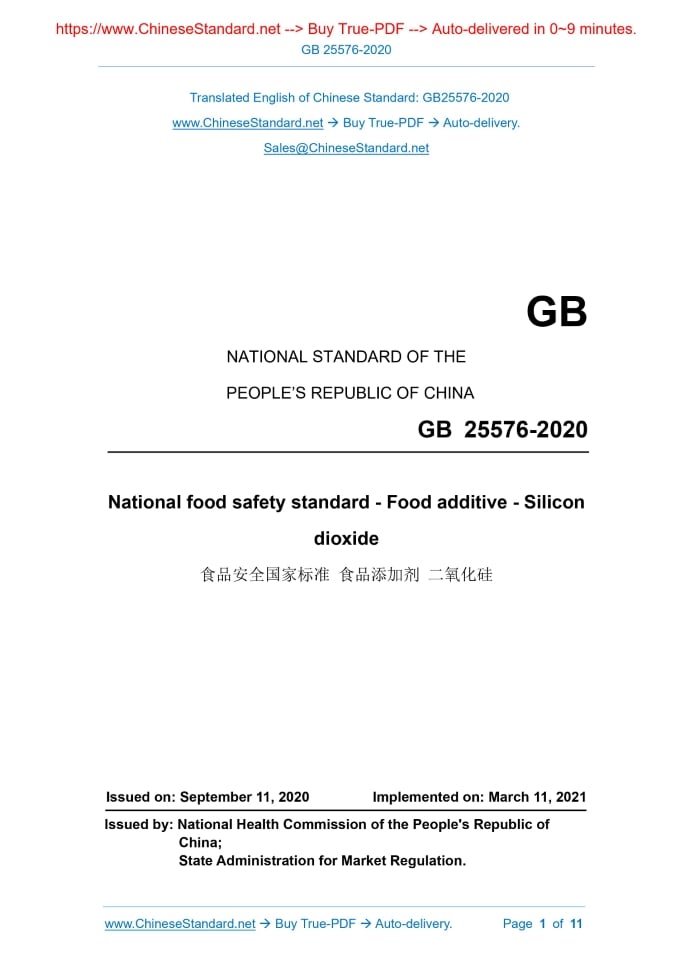
---This is an excerpt. Full copy of true-PDF in English version (including equations, symbols, images, flow-chart, tables, and figures etc.), auto-downloaded/delivered in 9 seconds, can be purchased online: https://www.ChineseStandard.net/PDF.aspx/GB25576-2020GB NATIONAL STANDARD OF THE PEOPLE’S REPUBLIC OF CHINA National food safety standard - Food additive - Silicon dioxide Issued on. SEPTEMBER 11, 2020 Implemented on. MARCH 11, 2021 Issued by. National Health Commission of the People's Republic of China; State Administration for Market Regulation.
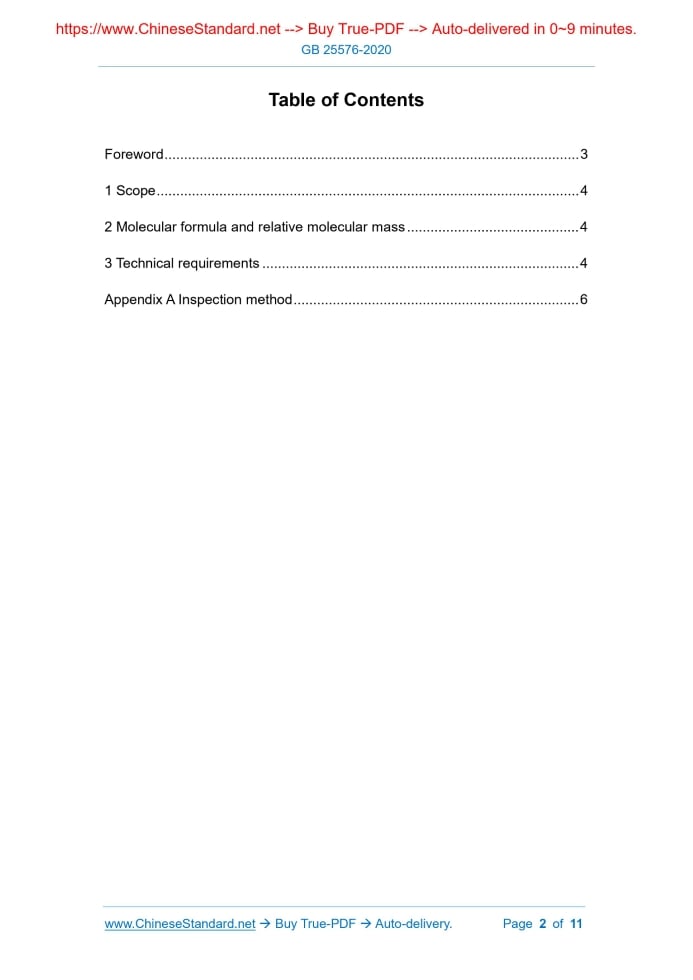
Table of Contents
Foreword... 3 1 Scope... 4 2 Molecular formula and relative molecular mass... 4 3 Technical requirements... 4 Appendix A Inspection method... 6Foreword
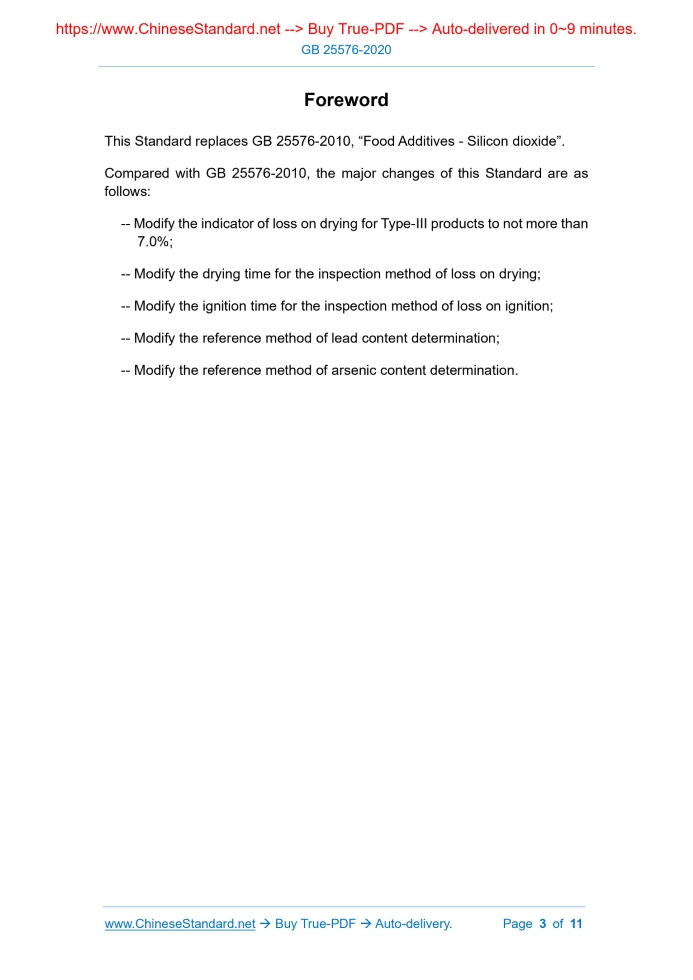
This Standard replaces GB 25576-2010, “Food Additives - Silicon dioxide”. Compared with GB 25576-2010, the major changes of this Standard are as follows. -- Modify the indicator of loss on drying for Type-III products to not more than 7.0%; -- Modify the drying time for the inspection method of loss on drying; -- Modify the ignition time for the inspection method of loss on ignition; -- Modify the reference method of lead content determination; -- Modify the reference method of arsenic content determination. National food safety standard - Food additive - Silicon dioxide1 Scope
This Standard applies to fumed silica that is produced by the gas phase method (chlorosilane is hydrolyzed in the oxygen-hydrogen flame), silica gel and hydrated silica gel that are produced by the gel method (reaction of sodium silicate solution and acid), and precipitated silicon dioxide that is produced by the precipitation method (reaction of sodium silicate solution and acid).2 Molecular formula and relative molecular mass
2.1 Molecular formula SiO2 2.2 Relative molecular mass 60.08 (according to the international relative atomic mass in 2016)3 Technical requirements
3.1 Sensory requirements Sensory requirements shall be in accordance with Table 1. and silica gel. 3.2 Physical and chemical indicators Physical and chemical indicators shall be in accordance with Table 2.Appendix A
Inspection method A.1 Warning Some reagents that are used in the test method of this Standard are toxic or corrosive. The operator must be cautious! If splashed on the skin, use water to rinse immediately. In severe cases, treat immediately. A.2 General provisions The reagents and water that are used in this Standard, when no other requirements are specified, refer to analytical reagents and grade-III water which is specified in GB/T 6682.The impurity standard solutions, preparations and products, which are used in the test, shall be prepared according to the provisions of GB/T 602 and GB/T 603 when no other requirements are specified. The used solution, if not indicated which solvent is used, refers to aqueous solution. A.3 Identification test A.3.1 Reagents and materials A.3.1.1 Anhydrous potassium carbonate. A.3.1.2 Ammonia. A.3.1.3 Nitric acid. A.3.1.6 O-tolidine glacial acetic acid saturated solution. A.3.2 Identification method A.3.2.1 Weigh about 5 mg of the sample in a platinum crucible; add 200 mg of anhydrous potassium carbonate to mix; burn for about 10 minutes at 500 °C ~ 600 °C; cool; add 2 mL of water to dissolve. If necessary, heat up; then, slowly add 2 mL of ammonium molybdate solution, to produce a dark yellow color. A.3.2.2 Drop 1 drop of the dissolved sample in A.3.2.1 onto the filter paper; evaporate the solution; add 1 drop of o-tolidine glacial acetic acid saturated solution; then, put the filter paper on the ammonia; there shall be green spots. A.4 Determination of silicon dioxide content A.4.1 Method summary After the sample is burned at 950 °C ± 50 °C, heat excess hydrofluoric acid to decompose the silicon dioxide, to react and produce fluorosilicic acid, which escapes. Weigh after ignition; the lost mass is the silicon dioxide content. A.4.2 Reagents and materials A.4.3 Instruments and apparatuses A.4.3.1 High temperature furnace. Control the temperature at 950 °C ± 50 °C. A.4.3.2 Platinum crucible. 50 mL. A.4.4 Analysis steps Use a platinum crucible that is fired to a constant mass at 950 °C ± 50 °C to weigh about 1 g of sample B (see A.6.2), accurate to 0.0002 g. Use an appropriate amount of ethanol (about 2 mL) to wet the sample; add 5 ~ 6 drops of sulfuric acid; add 10 mL of hydrofluoric acid to submerge the sample. Place it on an electric furnace to evaporate until a large amount of white smoke appears; cool it; add 5 mL of hydrofluoric acid; carefully reverberate the crucible to rinse the inner wall; then, evaporate to dryness. Burn at 950 °C ± 50 °C for 60 min ± 5 min. Take it out; cool it in a desiccator; weigh it. A.5 Determination of loss on drying A.5.1 Instruments and apparatuses A.5.1.1 Electrothermal constant-temperature drying oven. Control the temperature at 105 °C ± 2 °C. A.5.1.2 Weighing bottle. ϕ60 mm × 30 mm. A.5.2 Analysis steps Use a weighing bottle that is dried at 105 °C ± 2 °C to weigh 2 g ~ 3 g of the sample (for Type-II, weigh 8 g ~ 10 g), accurate to 0.000 2 g. Transfer it into the electrothermal constant-temperature drying oven; dry at 105 °C ± 2 °C for 120 min ± 5 min; cool in a desiccator; weigh. Keep this dried sample as sample A, for use in the determination of loss on ignition in A.6. A.5.3 Result calculation Calculate the mass fraction w2 of loss on drying according to Formula (A.2). Where. A.6 Determination of loss on ignition A.6.1 Instruments and apparatuses A.6.2 Analysis steps Weigh 1 g ~ 2 g of sample A (see A.5.2), accurate to 0.000 2 g; place it in a porcelain crucible that is fired to a constant mass at 950 °C ± 50 °C; burn it at 950 °C ± 50 °C for 60 min ± 5 min; cool in a desiccator; weigh. Keep this burnt sample as sample B, for use in the determination of silicon dioxide content in A.4. ......Source: Above contents are excerpted from the full-copy PDF -- translated/reviewed by: www.ChineseStandard.net / Wayne Zheng et al.