US$359.00 · In stock
Delivery: <= 4 days. True-PDF full-copy in English will be manually translated and delivered via email.
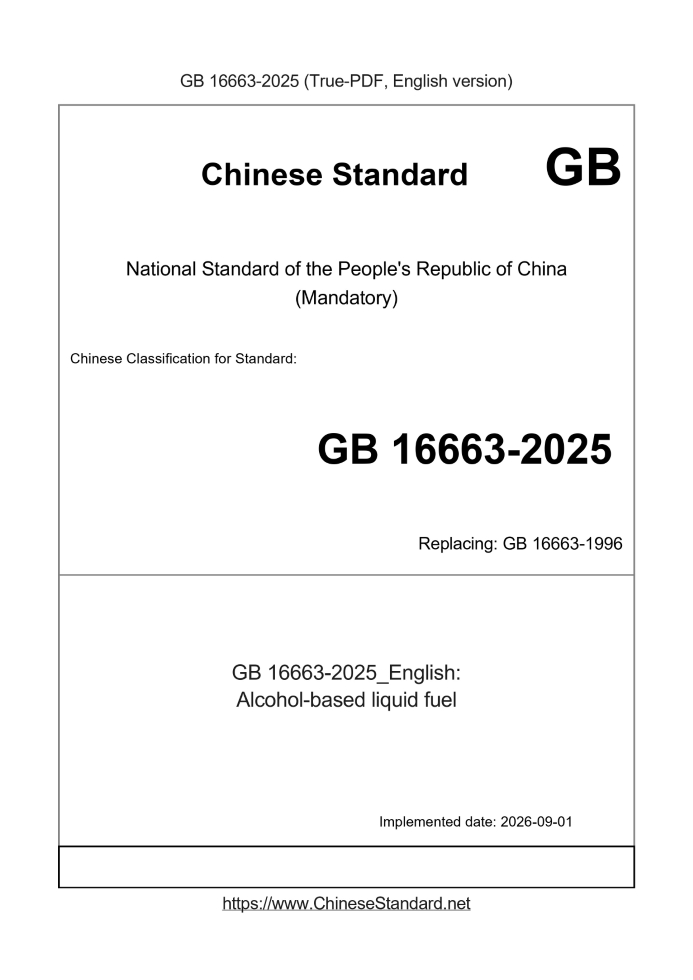
GB 16663-2025: Alcohol-based liquid fuel
Status: Valid
GB 16663: Historical versions
| Standard ID | USD | BUY PDF | Lead-Days | Standard Title (Description) | Status |
| GB 16663-2025 | 359 |
Add to Cart
|
4 days
|
Alcohol-based liquid fuel
| Valid |
| GB 16663-1996 | 209 |
Add to Cart
|
3 days
|
Alcohol base liquid fuel
| |
Basic data
Standard ID: GB 16663-2025 (GB16663-2025)
Description (Translated English): Alcohol-based liquid fuel
Sector / Industry: National Standard
Classification of Chinese Standard: F19
Classification of International Standard: 75.160.20
Word Count Estimation: 18,170
Date of Issue: 2025-08-29
Date of Implementation: 2026-09-01
Older Standard (superseded by this standard): GB 16663-1996
Issuing agency(ies): State Administration for Market Regulation; Standardization Administration of China
GB 16663-2025: Alcohol-based liquid fuel
---This is an excerpt. Full copy of true-PDF in English version (including equations, symbols, images, flow-chart, tables, and figures etc.), auto-downloaded/delivered in 9 seconds, can be purchased online: https://www.ChineseStandard.net/PDF.aspx/GB16663-2025
ICS 75.160.20
CCSF19
National Standards of the People's Republic of China
Replaces GB 16663-1996
Alcohol-based liquid fuels
Published on 2025-08-29
Implemented on 2026-09-01
State Administration for Market Regulation
The State Administration for Standardization issued a statement.
Table of Contents
Preface III
1.Scope 1
2 Normative References 1
3.Terms and Definitions 2
4.Product Variety and Marking 2
5 Requirements and Test Methods 3
6.Inspection Rules 3
7.Signage and accompanying documents 4
8 Packaging, storage and road transport 4
9 Safety 4
Appendix A (Normative) Determination of Methanol Content in Alcohol-Based Liquid Fuels by Gas Chromatography 6
Appendix B (Normative) Determination of Formaldehyde Content in Alcohol-Based Liquid Fuels. Spectrophotometric Method 8
Appendix C (Informative) Precautions for Mobile Containers of Alcohol-Based Liquid Fuels 10
Appendix D (Informative) Precautions for Stationary Containers of Alcohol-Based Liquid Fuels 11
Appendix E (Informative) Safety Instructions 12
Reference 13
Foreword
This document complies with the provisions of GB/T 1.1-2020 "Standardization Work Guidelines Part 1.Structure and Drafting Rules of Standardization Documents".
Drafting.
This document replaces GB 16663-1996 "Alcohol-based Liquid Fuels". Compared with GB 16663-1996, the main differences are structural adjustments and editorial changes.
In addition, the main technological changes are as follows.
a) The scope has been changed (see Chapter 1, Chapter 1 of the.1996 edition);
b) A new chapter on terms and definitions has been added (see Chapter 3);
c) A new chapter on product types and markings has been added, and the product types have been changed to three levels. AF-80, AF-90, and AF-95 (see Chapter 4).
Table 1 (1996 edition)
d) Added "Appearance" technical requirements (see Table 1);
e) The term "alcohol content" was changed to "methanol content," and the test method was modified; (see Table 1, Appendix A, Table 1, 4.2 of the.1996 edition);
f) The technical requirements and test methods for "water content" have been added, and the requirement for the sum of the mass fractions of methanol and water content has been added (see Table 1);
g) The technical requirements and test methods for “density” have been changed (see Table 1, Table 1 of the.1996 edition);
h) The "Mechanical impurities" item has been removed (see Table 1 in the.1996 edition);
i) The "Pour Point" item has been removed (see Table 1 in the.1996 edition);
j) The test method for "ignition temperature" has been modified (see Table 1, 4.6 of the.1996 edition);
k) The "50% distillation temperature" item has been removed (see Table 1 in the.1996 edition);
l) The technical requirements and test methods for "sulfur content" have been revised (see Table 1, Table 1.4.9 of the.1996 edition);
m) The term "low calorific value" was changed to "net calorific value," and the technical requirements were revised (see Table 1,.1996 edition).
n) The term "formaldehyde test" was changed to "formaldehyde content," and the test method was also changed (see Table 1, Appendix B, Table 1, 4.12 of the.1996 edition);
o) Added technical requirements and test methods for "ash content" (see Table 1);
p) The "Stability" item has been removed (see Table 1 in the.1996 edition);
q) The technical requirements for raw materials have been increased (see 5.2);
r) Increased technical requirements for colorants (see 5.3);
s) The technical requirements for the formulation have been changed (see 5.4, 3.3 of the.1996 edition);
t) The chapter on inspection rules has been amended (see Chapter 6, Chapter 5 of the.1996 edition);
u) The chapter on logos and accompanying documents has been changed (see Chapter 7, Chapter 6 of the.1996 edition);
v) The chapter on packaging, storage, and road transport has been amended (see Chapter 8, Chapter 6 of the.1996 edition);
w) A chapter on security has been added (see Chapter 8).
Please note that some content in this document may involve patents. The issuing organization of this document assumes no responsibility for identifying patents.
This document was proposed and is under the jurisdiction of the National Energy Administration.
This document was first published in.1996, and this is its first revision.
Alcohol-based liquid fuels
Hazardous---Alcohol-based liquid fuels are classified as Class 2 flammable liquids. Methanol has an acute oral toxicity level of Class 3 and an acute skin toxicity level of Class 3.
Inhalation toxicity is classified as Class 3, and specific target organ system toxicity (eyes, central nervous system) is classified as Class 1.Without appropriate precautions, this...
The product described in this document may pose hazards during its production, storage, transportation, and use. This document is not intended to address all safety issues related to this product.
The question proposes recommendations. Operators and users have a responsibility to take appropriate personal safety and health measures and ensure compliance with relevant national laws and regulations.
According to the regulations.
1.Scope
This document specifies the product types, labeling requirements, and testing for alcohol-based liquid fuels that are primarily methanol-based, with added water and a blue colorant.
Methods, inspection rules, marking and accompanying documents, packaging, storage and road transport and safety.
This document applies to civilian alcohol-based liquid fuels used in gas appliances; industrial alcohol-based liquid fuels should refer to this document for implementation.
2 Normative references
The contents of the following documents, through normative references within the text, constitute essential provisions of this document. Dated citations are not included.
For references to documents, only the version corresponding to that date applies to this document; for undated references, the latest version (including all amendments) applies.
This document.
GB 190 Packaging Marks for Dangerous Goods
GB/T 338 Industrial Methanol
GB/T 384 Determination of calorific value of petroleum products
GB/T 508 Determination of Ash Content in Petroleum Products
GB/T 511 Petroleum and Petroleum Products and Additives - Determination of Mechanical Impurities
GB/T 601 Preparation of Standard Titration Solutions for Chemical Reagents
GB/T 611 General Method for Determination of Density of Chemical Reagents
GB/T 4472 Determination of density and relative density of chemical products
GB/T 5332 Test method for ignition temperature of flammable liquids and gases
GB 5749 Standard for Drinking Water Quality
GB/T 6283 Determination of Moisture Content in Chemical Products - Karl Fischer Method (General Method)
GB/T 6678 General Rules for Sampling of Chemical Products
GB/T 6680 General Rules for Sampling of Liquid Chemical Products
GB/T 6682-2008 Specifications and test methods for water used in analytical laboratories
GB/T 9722 General Rules for Gas Chromatography of Chemical Reagents
GB/T 9724 General Rules for the Determination of pH Value of Chemical Reagents
GB/T 11140 Determination of Sulfur Content in Petroleum Products - Wavelength Dispersive X-ray Fluorescence Spectrometry
GB 12463 General Technical Requirements for Transport Packaging of Dangerous Goods
GB 15258 Regulations for Writing Safety Labels for Chemicals
GB 18564.1 Tank Vehicles for Road Transport of Liquid Dangerous Goods - Part 1.Technical Requirements for Metal Atmospheric Pressure Tanks
GB 30000.1 Standard for Classification and Labelling of Chemicals Part 1.General Rules
GB 30000.7 Chemical Classification and Labelling Standards Part 7.Flammable Liquids
GB 30000.18 Chemical Classification and Labelling Specifications Part 18.Acute Toxicity
GB/T 30000.31 Chemical Classification and Labelling Specifications Part 31.Warning Signs in Chemical Workplaces
GB/T 34100 Determination of total sulfur content in light hydrocarbons, engine fuels and other petroleum products by ultraviolet fluorescence method
GB 36220 Safety Technical Conditions for Oil Tankers and Refueling Vehicles
HG/T 6277-2024 Methanol to Olefins (MTO) Grade
JT/T 617.1 Rules for Road Transport of Dangerous Goods Part 1.General Rules
JT/T 617.2 Rules for Road Transport of Dangerous Goods Part 2.Classification
JT/T 617.3 Road Transport Rules for Dangerous Goods Part 3.Index of Commodity Names and Transport Requirements
JT/T 617.4 Road Transport Rules for Dangerous Goods Part 4.Requirements for Transport Packaging
JT/T 617.5 Road Transport Rules for Dangerous Goods Part 5.Consignment Requirements
JT/T 617.6 Road Transport Rules for Dangerous Goods Part 6.Loading and Unloading Conditions and Operational Requirements
JT/T 617.7 Road Transport Rules for Dangerous Goods Part 7.Transport Conditions and Operational Requirements
JT/T 1046 Explosion-proof safety requirements for fuel tanks and liquid fuel transport containers of road transport vehicles
JT/T 1285 Safety Technical Conditions for Road Transport Vehicles Carrying Dangerous Goods
NB/SH/T 0164 Rules for Packaging, Storage, Transportation and Delivery Acceptance of Petroleum and Related Products
NB/SH/T 0253 Determination of Total Sulfur Content in Light Petroleum Products by Coulomb Method
NB/T 47003.1 Steel Welded Atmospheric Pressure Vessels
SH/T 0604 Determination of density of crude oil and petroleum products (U-tube method)
SH/T 0689 Determination of Total Sulfur Content in Light Hydrocarbons, Engine Fuels, and Other Petroleum Products (Ultraviolet Fluorescence Method)
3.Terms and Definitions
The following terms and definitions apply to this document.
3.1
Combustion appliance
Appliances that use gaseous or liquid fuels as energy sources and generate heat through combustion to serve purposes such as cooking, heating, and hot water supply.
4.Product variety and labeling
4.1 Product Variety
Alcohol-based liquid fuels include civilian alcohol-based liquid fuels and industrial alcohol-based liquid fuels. Civilian alcohol-based liquid fuels are primarily composed of methanol.
A blue liquid fuel formulated with water and coloring agents, intended for residential and commercial (public building) appliances. Industrial alcohol-based liquid fuel is...
Liquid fuels, composed of mixtures of alcohols, hydrocarbons, and water, are supplied to industrial enterprises for use as fuel in production.
Civilian alcohol-based liquid fuels are classified into three grades based on their methanol content. AF-80, AF-90, and AF-95.Among them, AF-80 alcohol-based liquid fuel...
It can be used by users who do not require high calorific value, such as those who simmer food over low heat. AF-90 alcohol-based liquid fuel can be used with most kitchen cookware.
AF-95 alcohol-based liquid fuel can be used in non-special equipment such as boilers and domestic water heaters.
4.2 Product Marking
Alcohol-based liquid fuel products are marked as. Product Code and Product Name.
Example. An alcohol-based liquid fuel product with a methanol content (mass fraction) of 90% is labeled as follows.
AF-90 alcohol-based liquid fuel.
......
Tips & Frequently Asked Questions:
Question 1: How long will the true-PDF of GB 16663-2025_English be delivered?
Answer: Upon your order, we will start to translate GB 16663-2025_English as soon as possible, and keep you informed of the progress. The lead time is typically 2 ~ 4 working days. The lengthier the document the longer the lead time.
Question 2: Can I share the purchased PDF of GB 16663-2025_English with my colleagues?
Answer: Yes. The purchased PDF of GB 16663-2025_English will be deemed to be sold to your employer/organization who actually pays for it, including your colleagues and your employer's intranet.
Question 3: Does the price include tax/VAT?
Answer: Yes. Our tax invoice, downloaded/delivered in 9 seconds, includes all tax/VAT and complies with 100+ countries' tax regulations (tax exempted in 100+ countries) -- See Avoidance of Double Taxation Agreements (DTAs):
List of DTAs signed between Singapore and 100+ countriesQuestion 4: Do you accept my currency other than USD?
Answer: Yes. If you need your currency to be printed on the invoice, please write an email to Sales@ChineseStandard.net. In 2 working-hours, we will create a special link for you to pay in any currencies. Otherwise, follow the normal steps: Add to Cart -- Checkout -- Select your currency to pay.
Question 5: Should I purchase the latest version GB 16663-2025?
Answer: Yes. Unless special scenarios such as technical constraints or academic study, you should always prioritize to purchase the latest version GB 16663-2025 even if the enforcement date is in future. Complying with the latest version means that, by default, it also complies with all the earlier versions, technically.