GB 1351-2023 PDF English
GB 1351: Historical versions
| Standard ID | USD | BUY PDF | Delivery | Standard Title (Description) | Status |
| GB 1351-2023 | 155 | Add to Cart | Auto, 9 seconds. | Wheat | Valid |
| GB 1351-2008 | 135 | Add to Cart | Auto, 9 seconds. | Wheat | Obsolete |
| GB 1351-1999 | 199 | Add to Cart | 2 days | Wheat | Obsolete |
| GB 1351-1986 | RFQ | ASK | 3 days | Wheat | Obsolete |
GB 1351-2023: Wheat
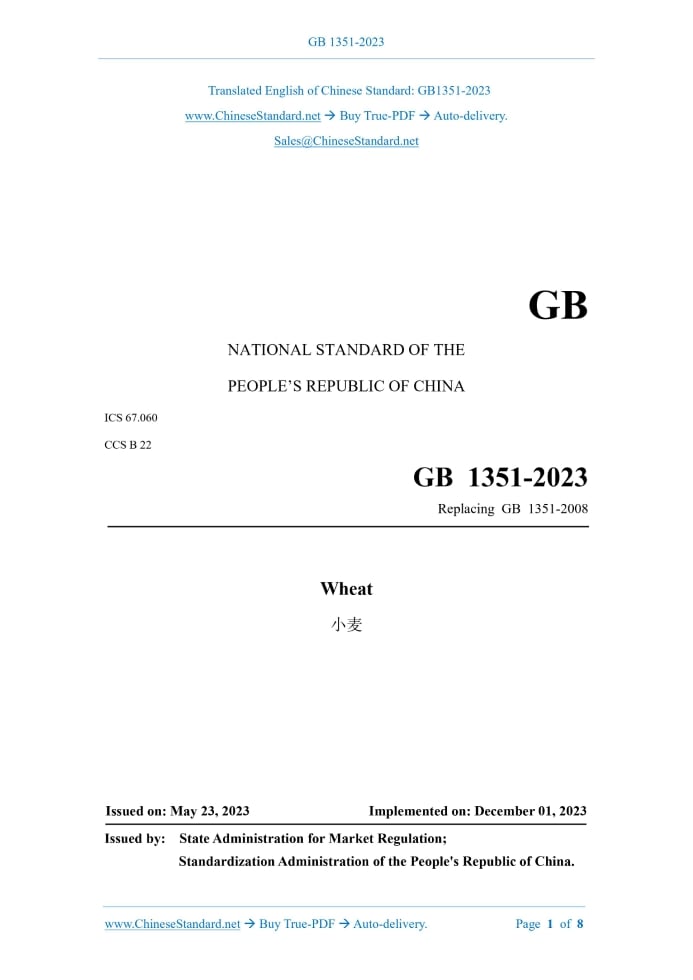
---This is an excerpt. Full copy of true-PDF in English version (including equations, symbols, images, flow-chart, tables, and figures etc.), auto-downloaded/delivered in 9 seconds, can be purchased online: https://www.ChineseStandard.net/PDF.aspx/GB1351-2023GB NATIONAL STANDARD OF THE PEOPLE’S REPUBLIC OF CHINA ICS 67.060 CCS B 22 Replacing GB 1351-2008 Wheat ISSUED ON: MAY 23, 2023 IMPLEMENTED ON: DECEMBER 01, 2023 Issued by: State Administration for Market Regulation; Standardization Administration of the People's Republic of China.
Table of Contents
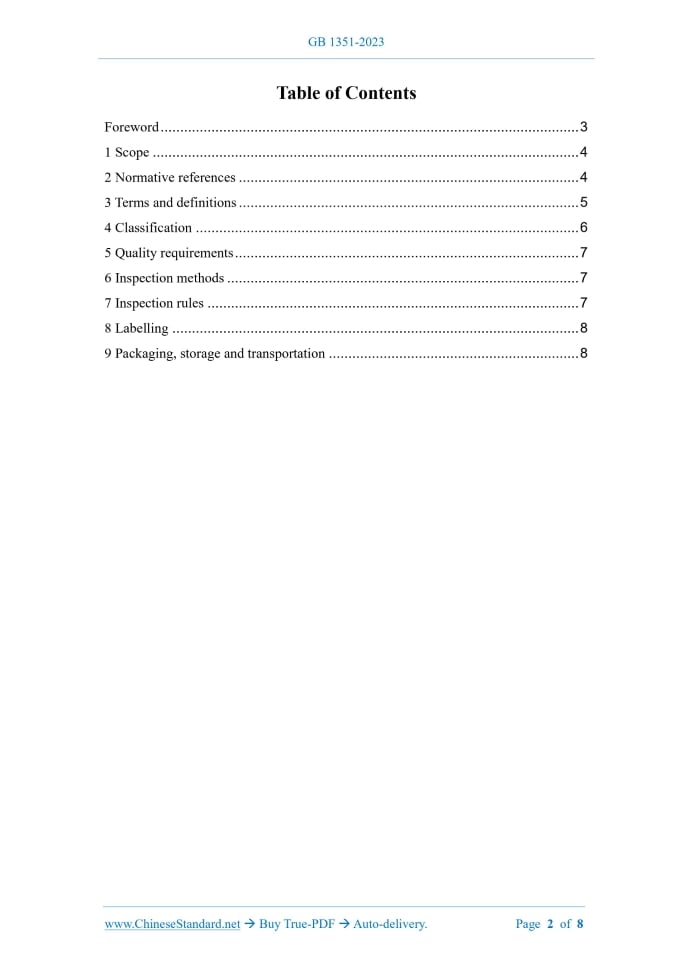
Foreword ... 3 1 Scope ... 4 2 Normative references ... 4 3 Terms and definitions ... 5 4 Classification ... 6 5 Quality requirements ... 7 6 Inspection methods ... 7 7 Inspection rules ... 7 8 Labelling ... 8 9 Packaging, storage and transportation ... 8 Wheat1 Scope
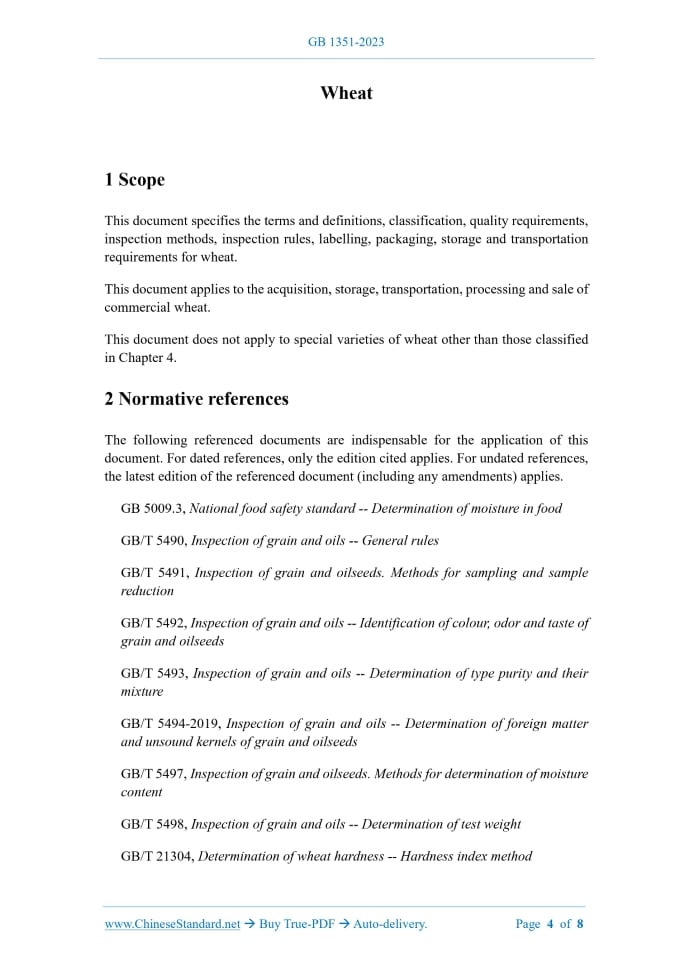
This document specifies the terms and definitions, classification, quality requirements, inspection methods, inspection rules, labelling, packaging, storage and transportation requirements for wheat. This document applies to the acquisition, storage, transportation, processing and sale of commercial wheat. This document does not apply to special varieties of wheat other than those classified in Chapter 4.2 Normative references
The following referenced documents are indispensable for the application of this document. For dated references, only the edition cited applies. For undated references, the latest edition of the referenced document (including any amendments) applies. GB 5009.3, National food safety standard -- Determination of moisture in food GB/T 5490, Inspection of grain and oils -- General rules GB/T 5491, Inspection of grain and oilseeds. Methods for sampling and sample reduction GB/T 5492, Inspection of grain and oils -- Identification of colour, odor and taste of grain and oilseeds GB/T 5493, Inspection of grain and oils -- Determination of type purity and their mixture GB/T 5494-2019, Inspection of grain and oils -- Determination of foreign matter and unsound kernels of grain and oilseeds GB/T 5497, Inspection of grain and oilseeds. Methods for determination of moisture content GB/T 5498, Inspection of grain and oils -- Determination of test weight GB/T 21304, Determination of wheat hardness -- Hardness index method3 Terms and definitions
For the purposes of this document, the following terms and definitions apply. 3.1 test weight The mass of wheat grains per unit volume. NOTE: Expressed in grams per liter (g/L). 3.2 defected kernel Wheat kernels that are damaged but still usable. NOTE 1: Including insect-bored kernels, diseased kernels, heat-damaged kernels, broken kernels, sprouted kernels and moldy kernels. NOTE 2: Insect-bored kernels are kernels that have been damaged by insects, with the embryo or endosperm damaged. NOTE 3: Diseased kernels (mottled kernels) refer to kernels with disease spots on the surface, which damage the embryo or endosperm; diseased kernels include black point kernels and fusarium damaged kernels. Black point kernels refer to kernels with obvious dark brown or black seed coats in the embryo or other parts, which damage the embryo or endosperm. Fusarium damaged kernels refer to kernels that are wrinkled, dull white, or have purple kernels, or have obvious pink moldy substances, with black ascocarps in between. NOTE 4: Heat-damaged kernels refer to kernels that have changed their normal color or been damaged due to heat generation or heat exposure caused by microorganisms or other reasons. NOTE 5: Broken kernels are kernels that are crushed, broken, or have damaged embryo or endosperm. NOTE 6: Sprouted kernels are kernels whose seed coat has ruptured at the embryonic part although the bud or rootlet has not yet broken through the seed coat, or whose bud or rootlet has broken through the seed coat but does not exceed the length of the kernel itself. NOTE 7: Mouldy kernels refer to kernels that are moldy. 3.3 impurities; useless material Other materials other than wheat, and wheat of no use value. NOTE 1: Including screenings, inorganic impurities and organic impurities. NOTE 2: Screenings refer to the material that passes through a sieve with a round hole of 1.5 mm in diameter. NOTE 3: Inorganic impurities refer to soil, sand, gravel, bricks and tiles and other inorganic substances. NOTE 4: Organic impurities refer to foreign grains, wheat of no use value and other organic substances other than wheat. NOTE 5: Wheat with no use value refers to grains that cannot be used as wheat raw materials, including: wheat that has completely changed color and deteriorated, wheat with sprouts longer than the length of the grain, wheat with nematode disease, wheat with bunt disease, etc. 3.4 color and brightness The colour and luster of a batch of wheat under specified conditions. 3.5 odor The smell of a batch of wheat under specified conditions. 3.6 wheat hardness The ability of wheat kernels to resist deformation and breakage under external forces. 3.7 wheat hardness index The wheat sample is crushed under specified conditions. The wheat hardness index refers to the mass fraction of the sample retained on the sieve. NOTE: Expressed by HI.4 Classification
Wheat is classified by kernel hardness and seed coat color as follows: a) Hard white wheat: wheat with a seed coat of not less than 90% white or yellowish- white and a wheat hardness index of not less than 60; b) Hard red wheat: wheat with a seed coat of not less than 90% dark red or reddish brown and a wheat hardness index of not less than 60; c) Soft white wheat: wheat with a seed coat of not less than 90% white or yellowish- white, and a wheat hardness index of not more than 45; d) Soft red wheat: wheat with a seed coat of not less than 90% dark red or reddish brown and a wheat hardness index of not more than 45; e) Mixed wheat: wheat that does not meet the requirements of a) to d). NOTE: Wheat with seed coats of purple, black, and other colors is a special variety of wheat. ......Source: Above contents are excerpted from the full-copy PDF -- translated/reviewed by: www.ChineseStandard.net / Wayne Zheng et al.