YY/T 0031-2008 English PDF
Price & Delivery
US$70.00 · In stock · Download in 9 secondsYY/T 0031-2008: Silicone tubes and elastomeric parts for infusion and transfusion
Delivery: 9 seconds. True-PDF full-copy in English & invoice will be downloaded + auto-delivered via email. See step-by-step procedure
YY/T 0031: Historical versions
| Standard ID | USD | BUY PDF | Delivery | Standard Title (Description) | Status |
| YY/T 0031-2008 | 70 | Add to Cart | Auto, 9 seconds. | Silicone tubes and elastomeric parts for infusion and transfusion | |
| YY/T 0031-1990 | RFQ | ASK | 3 days | (Silicone rubber infusion (blood) Tube) | Obsolete |
Click to Preview this PDF
Similar standards
YY/T 0031-2008: Silicone tubes and elastomeric parts for infusion and transfusion
---This is an excerpt. Full copy of true-PDF in English version (including equations, symbols, images, flow-chart, tables, and figures etc.), auto-downloaded/delivered in 9 seconds, can be purchased online: https://www.ChineseStandard.net/PDF.aspx/YYT0031-2008NATIONAL STANDARD OF THE PEOPLE’S REPUBLIC OF CHINA ICS 11.040.20 C 31 Replacing YY/T 0031-1990 Silicone tubes and elastomeric parts for infusion and transfusion ISSUED ON: OCTOBER 17, 2008 IMPLEMENTED ON: JANUARY 01, 2010 Issued by: China Food and Drug Administration
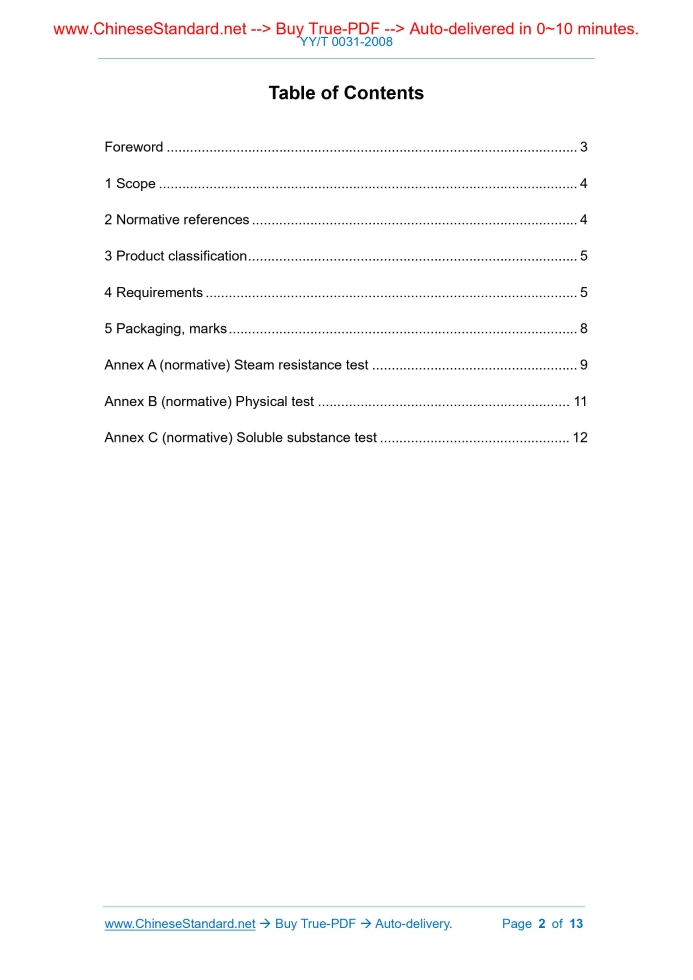
Table of Contents
Foreword ... 3 1 Scope ... 4 2 Normative references ... 4 3 Product classification ... 5 4 Requirements ... 5 5 Packaging, marks ... 8 Annex A (normative) Steam resistance test ... 9 Annex B (normative) Physical test ... 11 Annex C (normative) Soluble substance test ... 12 Silicone tubes and elastomeric parts for infusion and transfusion1 Scope
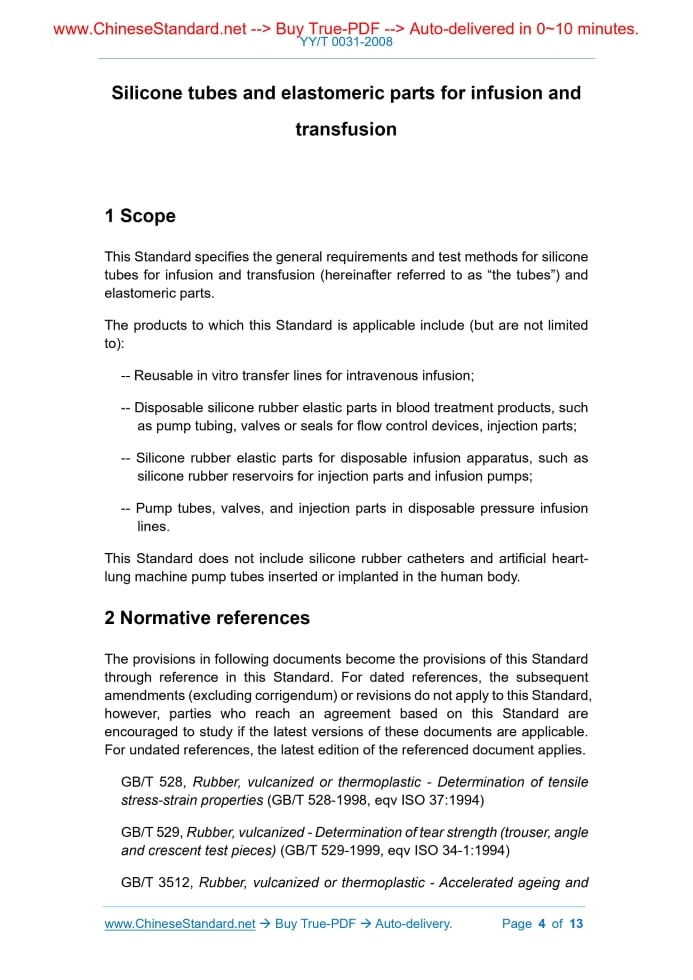
This Standard specifies the general requirements and test methods for silicone tubes for infusion and transfusion (hereinafter referred to as “the tubes”) and elastomeric parts. The products to which this Standard is applicable include (but are not limited to): -- Reusable in vitro transfer lines for intravenous infusion; -- Disposable silicone rubber elastic parts in blood treatment products, such as pump tubing, valves or seals for flow control devices, injection parts; -- Silicone rubber elastic parts for disposable infusion apparatus, such as silicone rubber reservoirs for injection parts and infusion pumps; -- Pump tubes, valves, and injection parts in disposable pressure infusion lines. This Standard does not include silicone rubber catheters and artificial heart- lung machine pump tubes inserted or implanted in the human body.2 Normative references
The provisions in following documents become the provisions of this Standard through reference in this Standard. For dated references, the subsequent amendments (excluding corrigendum) or revisions do not apply to this Standard, however, parties who reach an agreement based on this Standard are encouraged to study if the latest versions of these documents are applicable. For undated references, the latest edition of the referenced document applies. GB/T 528, Rubber, vulcanized or thermoplastic - Determination of tensile stress-strain properties (GB/T 528-1998, eqv ISO 37:1994) GB/T 529, Rubber, vulcanized - Determination of tear strength (trouser, angle and crescent test pieces) (GB/T 529-1999, eqv ISO 34-1:1994) GB/T 3512, Rubber, vulcanized or thermoplastic - Accelerated ageing andAnnex A
(normative) Steam resistance test A.1 Principle For silicone rubber products that are expected to undergo steam sterilization, use a specimen that is obtained with same production process and is in accordance with GB/T 528, after subjecting to the saturated steam at specified temperature to the specified time, to determine the reduction rate of physical properties before and after this process. A.2 Test instruments Pressure steam sterilizer (temperature control accuracy is within ±2°C). A.3 Steps A.3.1 Conduct the breaking strength test and the break elongation test to the specimen according to the provisions of GB/T 528. A.3.2 Use 100°C water to inject into the pressure steam sterilizer. Then hang the unstretched specimen in the sterilizer to make the specimen spacing not less than 5cm, the distance between the specimen and the wall not less than 10cm. Quickly heat to 121°C and remain the constant temperature for 2h. After the specified time, when it is immediately cooled to 100°C, take out the specimen. Hang at room temperature for 4h±0.5h. Then conduct the breaking strength test and the break elongation test to the specimen according to the provisions of GB/T 528. A.4 Result expression Calculate the percent reduction of the performance according to the following formula: Where, η - The percent reduction of the performance; A - The determined value of specimen performance after hot steam treatment;Annex C
(normative) Soluble substance test C.1 Preparation of inspection solution C.1.1 Pipeline Take 8g of pipeline. Cut it into 10mm pieces. Use distilled water to wash at least 3 times. Place the specimen into a ground bottle. Add 100mL of distilled water to make the specimen immersed in the distilled water. Then put it into the pressure steam sterilizer at 121°C±2°C for 1h. Then take it out. Cool to room temperature. Use the distilled water of same batch after the same treatment as the blank control solution. C.1.2 Elastomeric parts C.1.2.1 When the expected use time of the elastomeric parts exceeds 24h, take 8g of pipeline. Cut into 10mm pieces. Use distilled water to wash 3 times. Place the specimen into a ground bottle. Add 100mL of distilled water to make the specimen immersed in the distilled water. Then soak it at 70°C±2°C for 24h and take it out. Cool to room temperature. Use the distilled water of same batch after the same treatment as the blank control solution. C.1.2.2 When the expected use time of the elastomeric parts does not exceed 24h, take 8g of elastomeric parts. Cut into 10mm pieces. Use distilled water to wash 3 times. Place the specimen in a ground bottle. Add 100mL of distilled water to make the specimen immersed in the distilled water. Then soak it at 37°C±2°C for 24h and take it out. Cool to room temperature. Use the distilled water of same batch after the same treatment as the blank control solution. C.2 Color Take inspection solution in a colorimetric tube. Visually observe if the solution is colorless and transparent. C.3 pH value Take inspection solution and blank control solution. Use a PH meter to respectively test pH values to confirm whether the difference between those two complies with the provisions of Table 3. C.4 Evaporation residues ......Source: Above contents are excerpted from the full-copy PDF -- translated/reviewed by: www.ChineseStandard.net / Wayne Zheng et al.