YS/T 630-2016 English PDF
Price & Delivery
US$145.00 · In stock · Download in 9 secondsYS/T 630-2016: Chemical analysis method of alumina - Determination of impurities in alumina - ICP-AES analytical method
Delivery: 9 seconds. True-PDF full-copy in English & invoice will be downloaded + auto-delivered via email. See step-by-step procedure
Status: Valid
YS/T 630: Historical versions
| Standard ID | USD | BUY PDF | Delivery | Standard Title (Description) | Status |
| YS/T 630-2016 | 145 | Add to Cart | Auto, 9 seconds. | Chemical analysis method of alumina - Determination of impurities in alumina - ICP-AES analytical method | Valid |
| YS/T 630-2007 | 319 | Add to Cart | 3 days | Chemical analysis methods of alumina. Determination of impurities in alumina. Inductively coupled plasma atomic emission spectrometric method | Obsolete |
Click to Preview this PDF
Similar standards
YS/T 630-2016: Chemical analysis method of alumina - Determination of impurities in alumina - ICP-AES analytical method
---This is an excerpt. Full copy of true-PDF in English version (including equations, symbols, images, flow-chart, tables, and figures etc.), auto-downloaded/delivered in 9 seconds, can be purchased online: https://www.ChineseStandard.net/PDF.aspx/YST630-2016
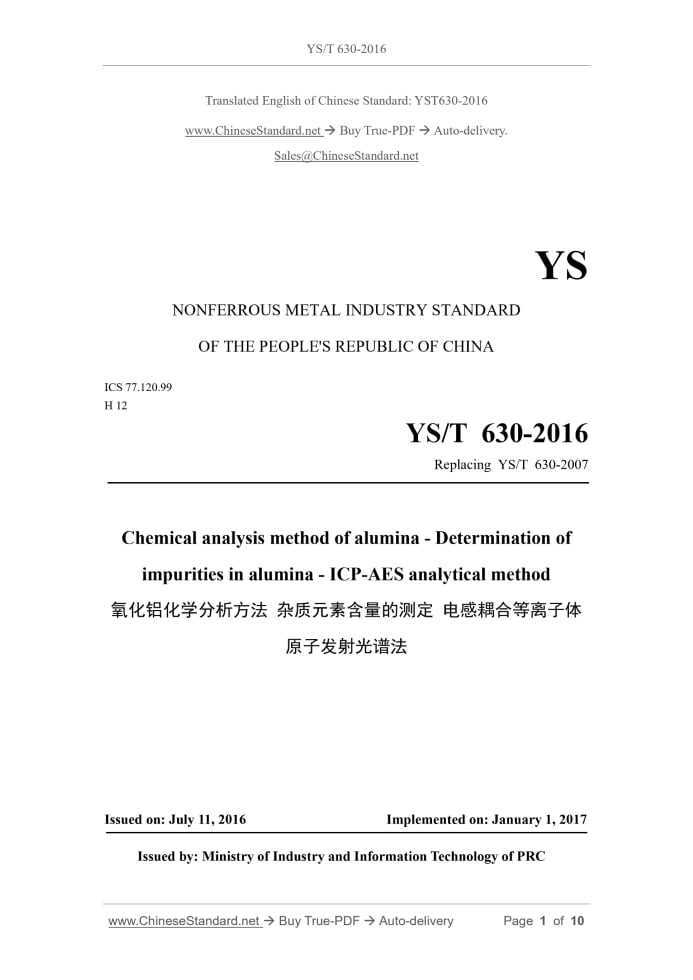
YS NONFERROUS METAL INDUSTRY STANDARD OF THE PEOPLE'S REPUBLIC OF CHINA ICS 77.120.99 H 12 Replacing YS/T 630-2007 Chemical analysis method of alumina - Determination of impurities in alumina - ICP-AES analytical method Issued on: JULY 11, 2016 Implemented on: JANUARY 1, 2017 Issued by. Ministry of Industry and Information Technology of PRC
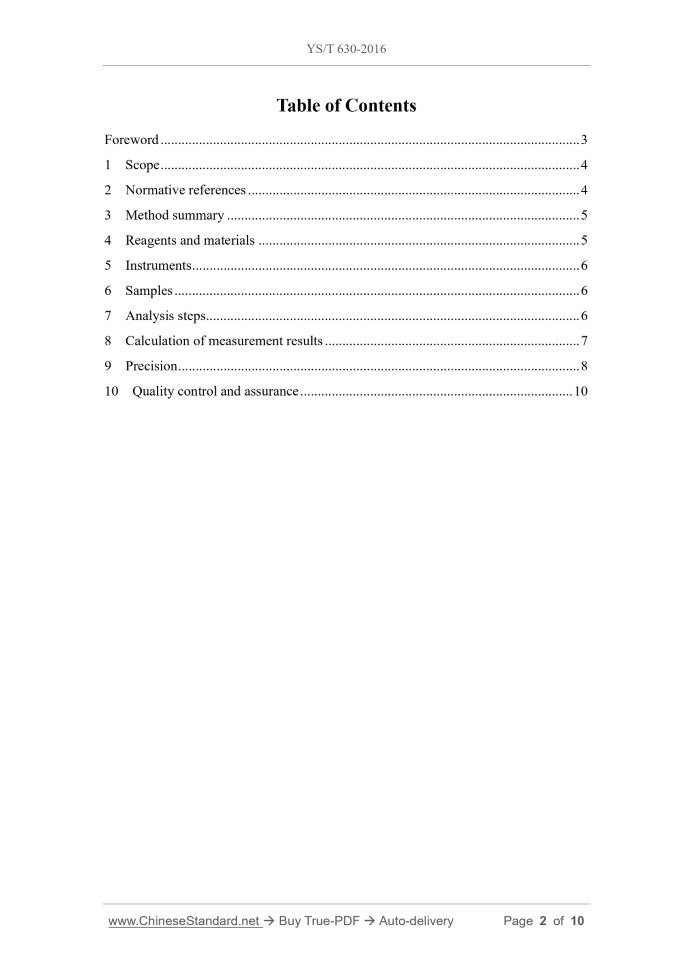
Table of Contents
Foreword... 3 1 Scope... 4 2 Normative references... 4 3 Method summary... 5 4 Reagents and materials... 5 5 Instruments... 6 6 Samples... 6 7 Analysis steps... 6 8 Calculation of measurement results... 7 9 Precision... 8 10 Quality control and assurance... 10 Chemical analysis method of alumina - Determination of impurities in alumina - ICP-AES analytical method1 Scope
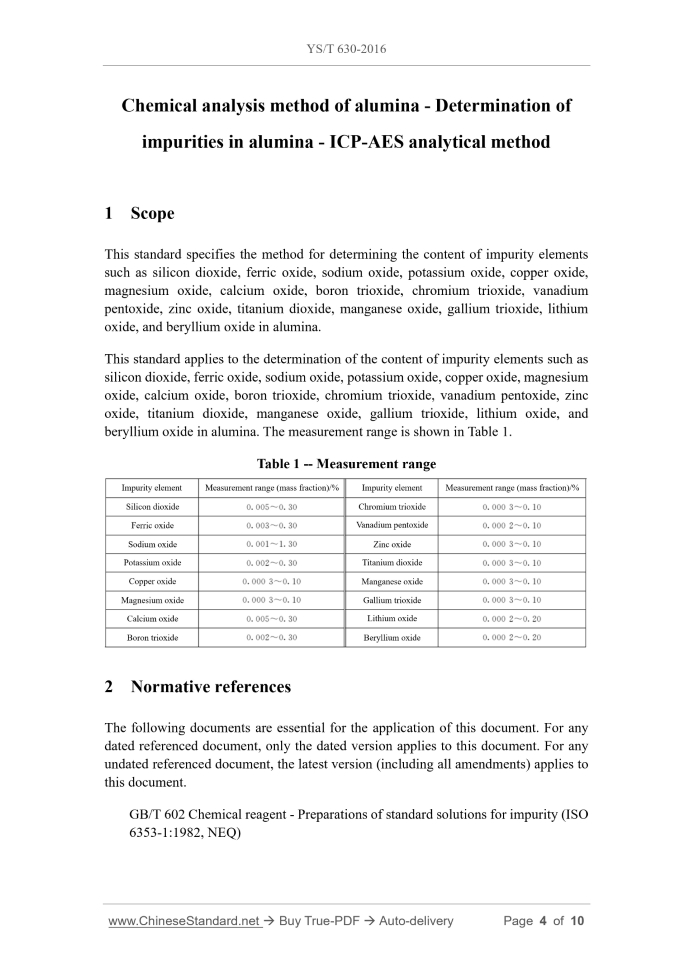
This standard specifies the method for determining the content of impurity elements such as silicon dioxide, ferric oxide, sodium oxide, potassium oxide, copper oxide, magnesium oxide, calcium oxide, boron trioxide, chromium trioxide, vanadium pentoxide, zinc oxide, titanium dioxide, manganese oxide, gallium trioxide, lithium oxide, and beryllium oxide in alumina. This standard applies to the determination of the content of impurity elements such as silicon dioxide, ferric oxide, sodium oxide, potassium oxide, copper oxide, magnesium oxide, calcium oxide, boron trioxide, chromium trioxide, vanadium pentoxide, zinc oxide, titanium dioxide, manganese oxide, gallium trioxide, lithium oxide, and beryllium oxide in alumina. The measurement range is shown in Table 1. Table 1 -- Measurement range2 Normative references
The following documents are essential for the application of this document. For any dated referenced document, only the dated version applies to this document. For any undated referenced document, the latest version (including all amendments) applies to this document. GB/T 602 Chemical reagent - Preparations of standard solutions for impurity (ISO 6353-1.1982, NEQ) Impurity element Measurement range (mass fraction)/% Vanadium pentoxide Impurity element Measurement range (mass fraction)/% Silicon dioxide Ferric oxide Sodium oxide Potassium oxide Copper oxide Magnesium oxide Calcium oxide Boron trioxide Chromium trioxide Zinc oxide Titanium dioxide Manganese oxide Gallium trioxide Lithium oxide Beryllium oxide3 Method summary
Under the action of a microwave digestion system, the test specimen is digested with sulfuric acid at high temperature and high pressure, and the test solution is introduced into argon plasma. Under the selected optimal operating conditions, the impurity element content is determined by an inductively coupled plasma spectrometer, and the matrix matching method is used to correct the influence of the matrix on the determination.4 Reagents and materials
4.1 Argon (with a purity of ≥99.99%). 4.2 Sulfuric acid (1+2). Guaranteed or UP grade. 4.3 Sulfuric acid (1+1). Guaranteed or UP grade. 4.4 High-purity aluminum (≥99.999%). 4.5 Deionized water or ultrapure water. 4.6 Aluminum matrix solution (20 mg/mL). Weigh 5.2873 g of high-purity aluminum (4.4) into a 1000 mL beaker; add 400 mL of sulfuric acid (4.3), place the beaker on an electric stove, and slowly heat until completely dissolved. Cool, transfer the solution to a 500 mL volumetric flask, dilute to the mark with water, mix thoroughly, and store in a polyethylene bottle. 1 mL of this solution contains 20 mg of aluminum oxide. 4.7 Standard storage solution 4.7.1 Prepare standard solutions of silicon, iron, sodium, potassium, copper, magnesium, calcium, chromium, vanadium, zinc, titanium, manganese, gallium, lithium, beryllium, and boron according to GB/T 602, with the concentrations of silicon, potassium, vanadium, and titanium at 100 μg/mL and those of iron, sodium, copper, magnesium, calcium, chromium, zinc, manganese, gallium, lithium, beryllium, and boron at 1000 μg/mL. 4.8 Mixed standard solution. Pipette 10.00 mL each of the iron and calcium standard solutions (4.7), 50.00 mL of the sodium standard solution (4.7), 5.00 mL each of the copper, magnesium, chromium, zinc, manganese, gallium, lithium, beryllium, and boron standard solutions (4.7), and 50.00 mL each of the vanadium and titanium standard solutions (4.7) into a 250 mL volumetric flask, dilute to the mark with water, mix thoroughly, and transfer to a polyethylene bottle for storage. This solution contains 40 μg/mL each of iron and calcium, 200 μg/mL of sodium, and 20 μg/mL each of copper, magnesium, chromium, vanadium, zinc, titanium, manganese, gallium, lithium, beryllium and boron.5 Instruments
5.1 Inductively Coupled Plasma-Atomic Emission Spectrometer (ICP-AES). 5.2 Dryer. New activated alumina is used as the desiccant. 5.3 Microwave digestion apparatus. with a rated temperature of 300 °C, and a digestion vessel volume of 100 mL. 5.4 Polytetrafluoroethylene sealed sample dissolver (autoclave). 5.5 Electronic balance. The sensitivity is 0.0001 g. 5.6 Oven. 300 °C±10 °C.6 Samples
6.1 The sample shall pass through a sieve with an aperture of 0.125 mm. 6.2 The sample shall be dried in an oven (5.6) at 300 ℃±10 ℃ for 2 hours and placed in a desiccator (5.2) to cool to room temperature.7 Analysis steps
7.1 Test specimen Weigh 0.2 g of the sample (Chapter 6) to the nearest 0.0001 g. 7.2 Number of measurements Two measurements shall be performed independently, and the average value shall be taken. 7.3 Blank test A blank test shall be performed along with the specimen test. 7.4 Preparation of analytical solution 7.4.1 Place the specimen (7.1) in a polytetrafluoroethylene digestion vessel, add 12.0 mL of sulfuric acid (4.2), and digest in a microwave digester (5.3) until the sample is completely dissolved. Remove the digestion vessel, cool to room temperature, transfer the solution to a 100 mL volumetric flask, dilute to the mark with water, and mix thoroughly. 7.4.2 Place the specimen (7.1) in a polytetrafluoroethylene reaction cup, add 12.0 mL of sulfuric acid (4.2), and cover tightly. Place the reaction cup in a sample dissolver and cover tightly. Heat the dissolver to 240 °C±2 °C in an oven, maintain for 6 hours, remove the dissolver, and allow it to cool naturally to room temperature. Remove the reaction cup, transfer the solution to a 100 mL volumetric flask, dilute to the mark with water, and mix thoroughly. 7.5 Preparation of standard series solutions 7.5.1 Pipette 0 mL, 1.00 mL, 3.00 mL, 5.00 mL, 8.00 mL, and 10.00 mL of the silicon standard solution (4.7) into a set of 100 mL volumetric flasks. Add 10.00 mL of the aluminum matrix solution (4.6) to each flask. Dilute to the mark with water, mix thoroughly, and store in polyethylene bottles. 7.5.2 Pipette 0 mL, 1.00 mL, 3.00 mL, 5.00 mL, 8.00 mL, and 10.00 mL of potassium standard solution (4.7) into a set of 100 mL volumetric flasks. Add 10.00 mL of aluminum matrix solution (4.6) to each flask. Dilute to the mark with water, mix well, and store in polyethylene bottles. 7.6 Determination Under the selected instrument's optimal working conditions, measure the standard series solutions (7.5) and the analytical solution (7.4).8 Calculation of measurement results
The contents of the standard series solutions are directly input into the corresponding computer software system. Based on the strength values of the standard series solutions and the analytical solution, the computer calculates, corrects, and outputs the concentration (μg/mL) of the element to be measured in the analytical solution. The mass fraction of each element to be measured is calculated according to formula (1). ......Source: Above contents are excerpted from the full-copy PDF -- translated/reviewed by: www.ChineseStandard.net / Wayne Zheng et al.