GB/T 7999-2015 English PDF
Price & Delivery
US$85.00 · In stock · Download in 9 secondsGB/T 7999-2015: Optical Emission Spectrometric Analysis Method of Aluminum and Aluminum Alloys
Delivery: 9 seconds. True-PDF full-copy in English & invoice will be downloaded + auto-delivered via email. See step-by-step procedure
Status: Valid
GB/T 7999: Historical versions
| Standard ID | USD | BUY PDF | Delivery | Standard Title (Description) | Status |
| GB/T 7999-2015 | 85 | Add to Cart | Auto, 9 seconds. | Optical Emission Spectrometric Analysis Method of Aluminum and Aluminum Alloys | Valid |
| GB/T 7999-2007 | 319 | Add to Cart | 3 days | Optical emission spectrometric analysis method of aluminum and aluminum alloys | Obsolete |
| GB/T 7999-2000 | 319 | Add to Cart | 3 days | Standard method for direct reading spectromertric analysis of aluminum and its alloys | Obsolete |
| GB/T 7999-1987 | RFQ | ASK | 3 days | Standard method for direct reading spectrometric analysis of aluminum and its alloys | Obsolete |
Click to Preview this PDF
Similar standards
GB/T 7999-2015: Optical Emission Spectrometric Analysis Method of Aluminum and Aluminum Alloys
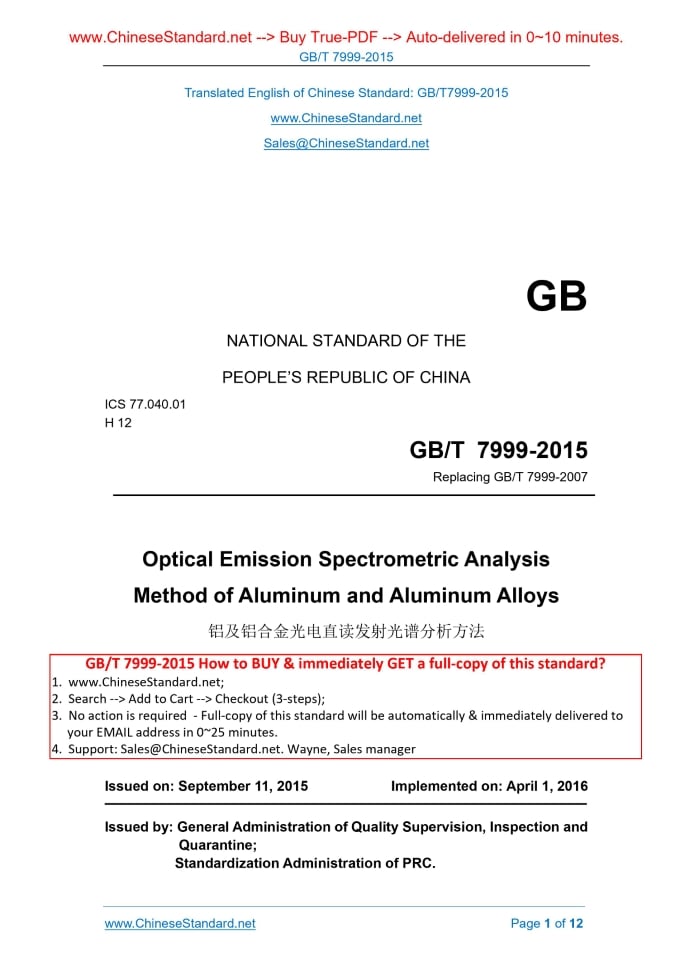
---This is an excerpt. Full copy of true-PDF in English version (including equations, symbols, images, flow-chart, tables, and figures etc.), auto-downloaded/delivered in 9 seconds, can be purchased online: https://www.ChineseStandard.net/PDF.aspx/GBT7999-2015GB NATIONAL STANDARD OF THE PEOPLE’S REPUBLIC OF CHINA ICS 77.040.01 H 12 Replacing GB/T 7999-2007 Optical Emission Spectrometric Analysis Method of Aluminum and Aluminum Alloys Issued on. SEPTEMBER 11, 2015 Implemented on. APRIL 1, 2016 Issued by. General Administration of Quality Supervision, Inspection and Quarantine; Standardization Administration of PRC.
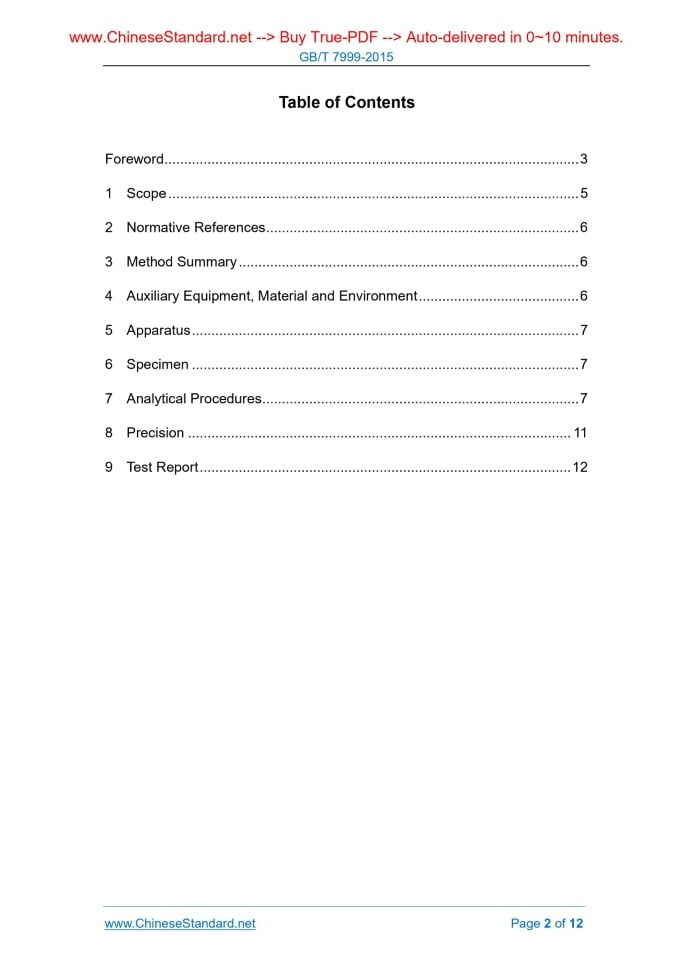
Table of Contents
Foreword... 3 1 Scope... 5 2 Normative References... 6 3 Method Summary... 6 4 Auxiliary Equipment, Material and Environment... 6 5 Apparatus... 7 6 Specimen... 7 7 Analytical Procedures... 7 8 Precision... 11 9 Test Report... 12Foreword
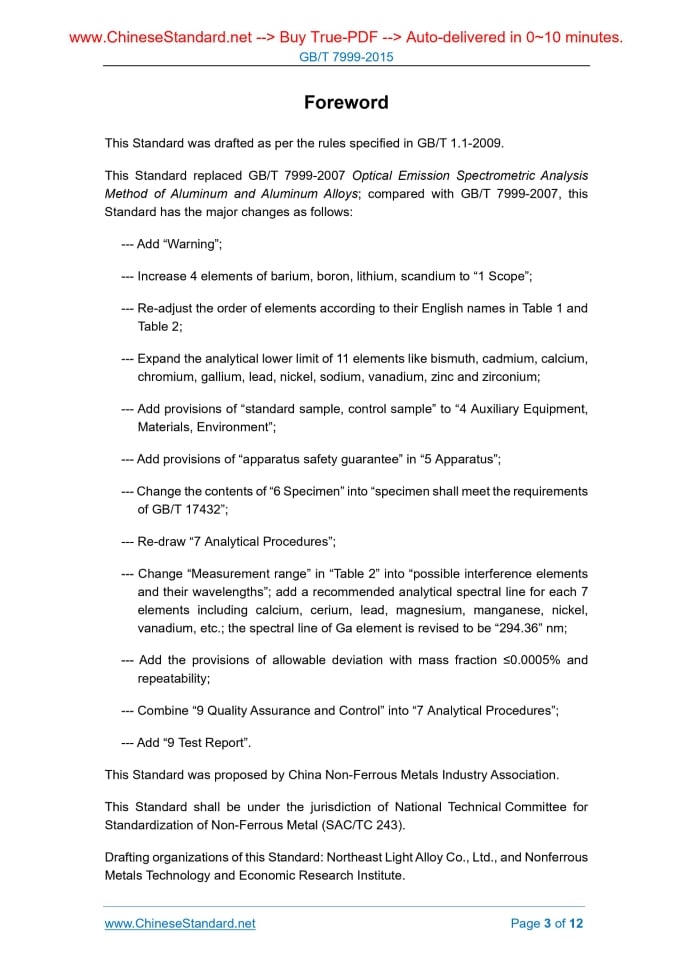
This Standard was drafted as per the rules specified in GB/T 1.1-2009. This Standard replaced GB/T 7999-2007 Optical Emission Spectrometric Analysis Method of Aluminum and Aluminum Alloys; compared with GB/T 7999-2007, this Standard has the major changes as follows. --- Add “Warning”; --- Increase 4 elements of barium, boron, lithium, scandium to “1 Scope”; --- Re-adjust the order of elements according to their English names in Table 1 and Table 2; --- Expand the analytical lower limit of 11 elements like bismuth, cadmium, calcium, chromium, gallium, lead, nickel, sodium, vanadium, zinc and zirconium; --- Add provisions of “standard sample, control sample” to “4 Auxiliary Equipment, Materials, Environment”; --- Add provisions of “apparatus safety guarantee” in “5 Apparatus”; --- Change the contents of “6 Specimen” into “specimen shall meet the requirements of GB/T 17432”; --- Re-draw “7 Analytical Procedures”; --- Change “Measurement range” in “Table 2” into “possible interference elements and their wavelengths”; add a recommended analytical spectral line for each 7 elements including calcium, cerium, lead, magnesium, manganese, nickel, vanadium, etc.; the spectral line of Ga element is revised to be “294.36” nm; --- Add the provisions of allowable deviation with mass fraction ≤0.0005% and repeatability; --- Combine “9 Quality Assurance and Control” into “7 Analytical Procedures”; --- Add “9 Test Report”. This Standard was proposed by China Non-Ferrous Metals Industry Association. This Standard shall be under the jurisdiction of National Technical Committee for Standardization of Non-Ferrous Metal (SAC/TC 243). Drafting organizations of this Standard. Northeast Light Alloy Co., Ltd., and Nonferrous Metals Technology and Economic Research Institute. Participating drafting organizations of this Standard. Xinjiang Join World Company Limited, Kunming Metallurgy Research Institute, Guizhou Research Center of Physico- Chemical Test & Analysis, Guangzhou Research Institute of Non-Ferrous Metals, Suzhou Research Institute for Nonferrous Metals, Hebi Quality Technology Supervision, Inspection and Test Center, Fushun Aluminum Co., Ltd., Baotou Aluminum Co., Ltd., Zhenzhou Research Institute of Aluminum Corporation of China Limited, Southwest Aluminum (Group) Co., Ltd., Chalco Ruimin Co., Ltd., Fujian Nanping Aluminum Co., Ltd., Aluminum Corporation of China Limited Northwest Aluminum Fabrication Branch, Zhenjiang Dingsheng Aluminum Co., Ltd., Aluminum Corporation of China Limited Guizhou Branch, and Jinzhou Entry-Exit Inspection and Quarantine Bureau. Chief drafting staffs of this Standard. Zhou Bing, Liu Xin, Yao Jia, Xi Huan, Wu Bin, Liu Yingbo, Zhang Jidong, Li Fujiang, Xiao Limei, Zhao Shizhuo, Luo Shun, Sun Hongying, Cui Shuang, Wu Jingmin, Zhang Ying, Song Yuping, Zeng Ping, Lu XinYu, Liu Shuangqing, Li Weijie, Zheng Feng, Lan Zheng, Wang Caoyu, Chen Xiaoming, and Feng Dongsheng. The historical editions replaced by this Standard are as follows. --- GB/T 7999-1987, GB/T 7999-2000, GB/T 7999-2007. Optical Emission Spectrometric Analysis Method of Aluminum and Aluminum Alloys Warning -- Personnel using this Standard shall have practical working experience in the formal laboratory. This Standard doesn’t address all possible security issues. The users are responsible to take appropriate safety and health measures; and guarantee to conform to the specified conditions of relevant national regulations.1 Scope
This Standard specifies the optical emission spectrometric analysis method of aluminum, aluminum alloys and impurities. This Standard is applicable to measure 28 elements at the same time in the aluminum and aluminum alloy like antimony, arsenic, barium, beryllium, bismuth, boron, cadmium, calcium, cerium, chromium, copper, gallium, iron, lead, lithium, magnesium, manganese, nickel, phosphorus, scandium, silicon, sodium, strontium, tin, titanium, vanadium, zinc, and zirconium; the measuring scope can see Table 1.2 Normative References
The following documents are essential to the application of this document. For the dated documents, only the versions with the dates indicated are applicable to this document; for the undated documents, only the latest version (including all the amendments) are applicable to this document. GB/T 8170 Rules of Rounding off for Numerical Values & Expression and Judgment of Limiting Values GB/T 17432 Methods of Sampling for Analyzing the Chemical Composition of Wrought Aluminum and Aluminum Alloys3 Method Summary
In the argon atmosphere, place the specimen processed as per requirements onto the excitation station, and act as an electrode; the energy generated by light source generator vaporize, atomize the analyte, as well as excite and emit the characteristic spectral line of the to-be-measured elements;4 Auxiliary Equipment, Material and Environment
4.1 Equipment for processing specimen Lathe or miller. 4.2 Excite gap to protect gas Argon (purity≥99.995%); recommend to use argon purifier. 4.3 Environmental conditions of optical emission spectrometer The optical emission spectrometer shall be placed in the lab where it is anti- electromagnetic interference, anti-shock, and gas-corrosion-free; the environmental temperature and humidity shall be controlled as per the requirements of optical emission spectrometer. 4.5 Standardized sample The standardized sample shall have very homogeneous and appropriate content; can be selected from the standard sample used for establishing working curve; also can be self-made; the self-made one shall ensure the sample is uniform, stable, and good reproducibility. 4.6 Control sample The control sample shall have an accurate fixed value, its chemical composition, metallurgical processing, organizing state shall be basically consistent with the specimen.5 Apparatus
5.1 Optical emission spectrometer. 5.2 Optical emission spectrometer shall be equipped with power restrictions using safety interlocks.6 Specimen
The specimen shall meet the requirements of GB/T 17432.7 Analytical Procedures
7.1 Working state control of optical emission spectrometer 7.2 Analytical parameters 7.2.1 Optimization of analytical parameters Different instrument has different exciting conditions; according to the instructions and condition test of optical emission spectrometer; select the appropriate exciting conditions, analytical lines, and other working parameters. 7.2.2 Spectral interference inspection Try to select the spectral lines that won’t interfere each other; if necessary, apply the interference correction function of the instrument to perform the interference correction. 7.2.3 Analytical spectral line The recommended internal marking line, analytical spectral line in this Standard list the interference elements and their wavelengths at the same time; see Table 2. 7.4 Calibration of working curve 7.4.1 Standardization Use standardized sample to calibrate the instrument regularly; the drift of working curve caused by calibration due to the following factors changes like electronic system, optical system, temperature, humidity, etc.; so that ensure the accuracy of the analysis. The standardized time interval depends on the stability of the instrument. 7.5 Specimen analysis In the selected working conditions, place the specimen (Chapter 6) onto the excitation station of the optical emission spectrometer; the exciting point shall be 5mm~6mm away from the sample edge; the specimen shall be excited for twice or above; take the average value as the analytical results. 7.6 Data processing The analytical results shall be expressed by the mass fraction; round off the analytical results to be the specified digits stipulated in the corresponding product standard according to the number rounding off rules stipulated in GB/T 8170.8 Precision
8.1 Repeatability Under the repeatability conditions, obtain the determination value of 11 independent test results; in the given measuring range below, the relative standard deviation of these 11 independent test results shall not exceed the provisions of Table 3. 8.2 Allowable deviation Contents of To-Be-Measured Elements / % Relative Standard Deviation / % The relative error of analytical results among laboratories shall not exceed the allowable deviation in Table 4.9 Test Report
The contents of test report specified in this Chapter shall include the following items at least. ......Source: Above contents are excerpted from the full-copy PDF -- translated/reviewed by: www.ChineseStandard.net / Wayne Zheng et al.