SN/T 3644-2013 English PDF
Price & Delivery
US$205.00 · In stock · Download in 9 secondsSN/T 3644-2013: Determination of Sialic acid in cubilose and its products for export
Delivery: 9 seconds. True-PDF full-copy in English & invoice will be downloaded + auto-delivered via email. See step-by-step procedure
Status: Valid
| Standard ID | USD | BUY PDF | Delivery | Standard Title (Description) | Status |
| SN/T 3644-2013 | 205 | Add to Cart | Auto, 9 seconds. | Determination of Sialic acid in cubilose and its products for export | Valid |
Click to Preview this PDF
Similar standards
SN/T 3644-2013: Determination of Sialic acid in cubilose and its products for export
---This is an excerpt. Full copy of true-PDF in English version (including equations, symbols, images, flow-chart, tables, and figures etc.), auto-downloaded/delivered in 9 seconds, can be purchased online: https://www.ChineseStandard.net/PDF.aspx/SNT3644-2013SN ENTRY-EXIT INSPECTION AND QUARANTINE STANDARD Determination of Sialic acid in cubilose and its products for export Issued on: AUGUST 30, 2013 Implemented on: MARCH 01, 2014 Issued by. General Administration of Quality Supervision, Inspection and Quarantine of the People's Republic of China
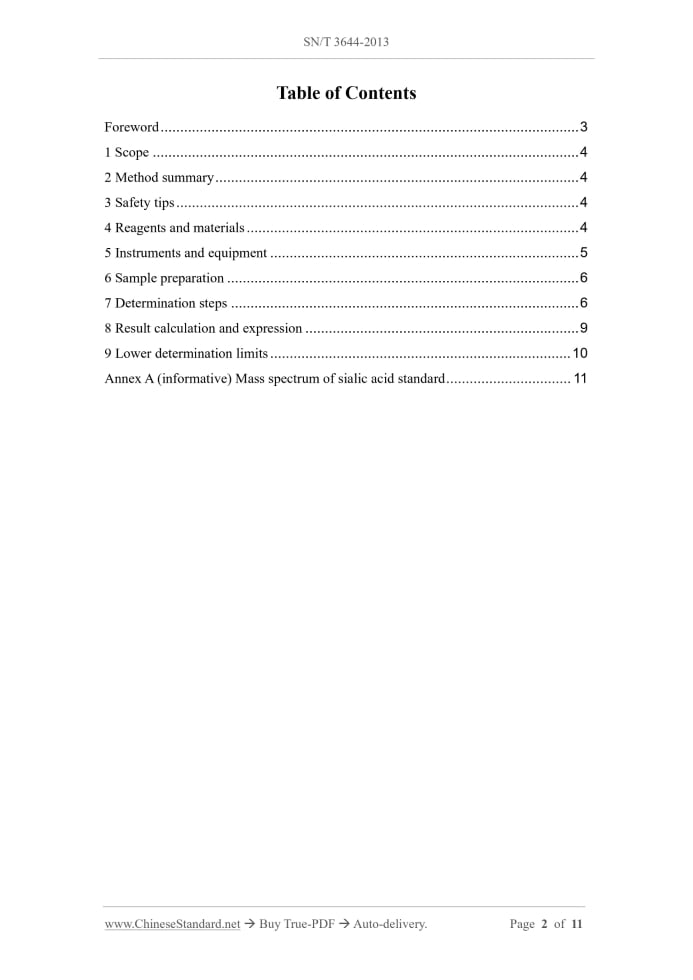
Table of Contents
Foreword... 3 1 Scope... 4 2 Method summary... 4 3 Safety tips... 4 4 Reagents and materials... 4 5 Instruments and equipment... 5 6 Sample preparation... 6 7 Determination steps... 6 8 Result calculation and expression... 9 9 Lower determination limits... 10 Annex A (informative) Mass spectrum of sialic acid standard... 11 Determination of Sialic acid in cubilose and its products for export1 Scope
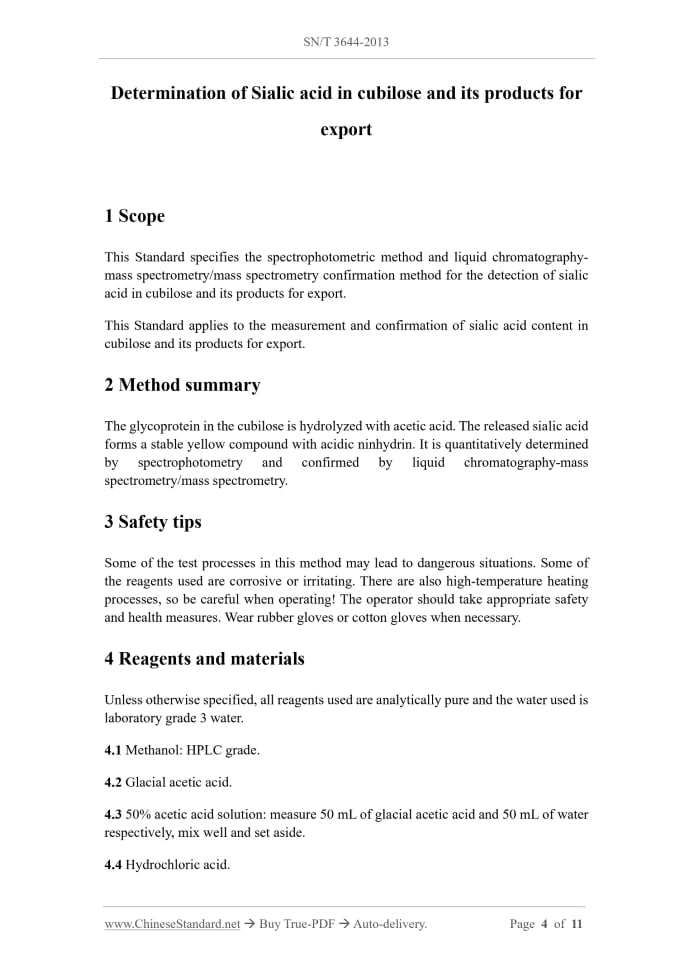
This Standard specifies the spectrophotometric method and liquid chromatography- mass spectrometry/mass spectrometry confirmation method for the detection of sialic acid in cubilose and its products for export. This Standard applies to the measurement and confirmation of sialic acid content in cubilose and its products for export.2 Method summary
The glycoprotein in the cubilose is hydrolyzed with acetic acid. The released sialic acid forms a stable yellow compound with acidic ninhydrin. It is quantitatively determined by spectrophotometry and confirmed by liquid chromatography-mass spectrometry/mass spectrometry.3 Safety tips
Some of the test processes in this method may lead to dangerous situations. Some of the reagents used are corrosive or irritating. There are also high-temperature heating processes, so be careful when operating! The operator should take appropriate safety and health measures. Wear rubber gloves or cotton gloves when necessary.4 Reagents and materials
Unless otherwise specified, all reagents used are analytically pure and the water used is laboratory grade 3 water. 4.1 Methanol. HPLC grade. 4.2 Glacial acetic acid. 4.3 50% acetic acid solution. measure 50 mL of glacial acetic acid and 50 mL of water respectively, mix well and set aside. 4.4 Hydrochloric acid. 4.5 Ammonium sulfate. 4.6 Ninhydrin. 4.7 Ninhydrin indicator. add 60 mL of glacial acetic acid and 40 mL of hydrochloric acid to 2.5 g of ninhydrin, stir and dissolve. 4.8 Dialysis bag. molecular weight cutoff is 14000. 4.9 Sialic acid standard substance (N-Acetylneuraminic acid, CAS No. is 131-48-6). Purity ≥ 99%, stored at -18°C. 4.10 Sialic acid standard solution (200 μL/mL). accurately weigh an appropriate amount of sialic acid standard substance and prepare a sialic acid standard solution with a concentration of 200 μg/mL with water. Prepare the solution when needed. 4.11 Zeolite.5 Instruments and equipment
5.1 Visible spectrophotometer. 5.2 Liquid chromatography-mass spectrometry/mass spectrometry. equipped with electrospray ion source. 5.3 Oven. 102°C~105°C. 5.4 Mortar. 5.5 Sieve. 100 mesh. 5.6 Electronic balance. sensitivity is 0.01 mg and 0.001 g. 5.7 Frosted mouth triangle bottle. 250 mL. 5.8 Heating equipment. flat electric furnace. 5.9 Condensation reflux device. 5.10 Centrifuge tube. 50 mL, polypropylene (PP). 5.11 Centrifuge. 3000 r/min, 12000 r/min. 5.12 Colorimetric tube. 10 mL, glass. 5.13 Cuvette. 1 cm, quartz. 5.14 Container. 100 mL, glass. 5.15 Pipette gun. 2 mL, 10 mL.6 Sample preparation
6.1 Preparation of solid cubilose Take the cubilose sample and dry it in a 105°C oven. Grind it after cooling in a dryer. Pass it through a 100-mesh sieve and put it into a clean container. Seal it for later use. 6.2 Preparation of cubilose products For liquid cubilose products, use a pulper to make samples. Let stand and wait for the foam and sample liquid to separate, then decant the foam (or use a centrifuge to separate). Take an appropriate amount of the supernatant and put it into a dialysis bag (4.8). Dialyze in running water for 24 h. Put the dialyzed sample liquid into a clean container. Seal it for later use.7 Determination steps
7.1 Sialic acid extraction 7.1.1 Extraction of solid sialic acid Weigh 0.1 g (accurate to 0.001 g) of sample powder (6.1) into a frosted conical flask. Add 20.0 mL of 50% acetic acid solution (4.3). Add a few zeolites. Place on a heating plate. Install the condenser reflux tube and heat to boiling. Time for 10 min. Remove the conical flask. The flask wall can be quickly cooled with running water. After the hydrolyzate cools to room temperature, transfer it to a 100 mL volumetric flask through a funnel. Wash the conical flask twice with an appropriate amount of water. Finally, make up to the volume with distilled water. After shaking well, pour 10.0 mL into a centrifuge tube with 1.2 g of ammonium sulfate. Stir well with a glass rod. Dissolve the ammonium sulfate. Tighten the lid. Place in a centrifuge. Centrifuge at 3000 r/min for 10 min. Set aside the supernatant. 7.1.2 Extraction of sialic acid from liquid cubilose products Weigh 10 g (accurate to 0.001 g) of sample solution (6.2) into a frosted conical flask. Add 10.0 mL of glacial acetic acid and a few zeolites. Place on a heating plate. Install a condenser reflux tube. Heat to boiling. Time for 10 min. Remove the conical flask. The flask wall can be quickly cooled with running water. After the hydrolyzate has cooled to room temperature, transfer it to a 100 mL volumetric flask through a funnel. Wash the conical flask twice with an appropriate amount of water. Finally, make up to the volume with distilled water. After shaking well, pour 10.0 mL into a centrifuge tube with 1.2 g of ammonium sulfate. Stir well with a glass rod to dissolve the ammonium sulfate. Tighten the lid. Place in a centrifuge. Centrifuge at 3000 r/min for 10 min. Set aside the supernatant. If the cubilose product is very thick and easily burns when heated and hydrolyzed, weigh 5 g (accurate to 0.001 g) and add 15.0 mL of 50% acetic acid solution. Follow the same steps as above. 7.2 Determination of sialic acid content 7.2.1 Determination by spectrophotometry Take 2.0 mL of the supernatant (7.1) and place it in a 10 mL colorimetric tube. Then add 2.0 mL of ninhydrin indicator (4.7) and 2.0 mL of glacial acetic acid. Shake well. Develop the color in a 100°C water bath for 10 min. Take out the test tube and cool it quickly in running water. Then pour it into a 1 cm colorimetric dish. Measure the absorbance at a wavelength of 470 nm. Adjust the zero point with a reagent blank tube. If the absorbance exceeds the measurement range of the spectrophotometer, dilute the test solution (7.1). Blank test. Substitute distilled water as the specimen. Proceed according to the above measurement steps. Standard curve. Dilute the sialic acid standard solution (4.10) stepwise to 100 μg/mL, 50 μg/mL, 20 μg/mL, 10 μg/mL, and 5 μg/mL. Take 2.0 mL of each standard dilution into a 10 mL colorimetric tube. Add 2.0 mL of ninhydrin indicator (4.7) and 2.0 mL of glacial acetic acid. Shake well. Develop the color in a 100°C water bath for 10 min. Take out the test tube and cool it quickly in running water. Then use a 1 cm colorimetric dish to measure the absorbance at a wavelength of 470 nm. Prepare a standard working curve based on the concentration and absorbance of the standard solution. 7.2.2 Determination by liquid chromatography-mass spectrometry/mass spectrometry 7.2.2.1 Determination steps When identifying cubilose samples, liquid chromatography-mass spectrometry/mass spectrometry can be used for confirmation based on spectrophotometric analysis. Perform hydrolysis pretreatment on the cubilose sample to be confirmed according to 6.1.Take 50 μL of the obtained supernatant. Add 900 μL of methanol. Mix well. Centrifuge at 12000 r/min for 10 min. Take 50 μL of the supernatant again. Add 900 μL of mobile phase. Mix well. Filter. Apply to the machine. 7.2.2.2 Liquid chromatography conditions The liquid chromatography conditions are as follows. a) Chromatographic column. C18, 150×2.1 mm, 3 μm; or other chromatographic columns with equivalent performance; ......Source: Above contents are excerpted from the full-copy PDF -- translated/reviewed by: www.ChineseStandard.net / Wayne Zheng et al.