QC/T 944-2013 English PDF
Price & Delivery
US$125.00 · In stock · Download in 9 secondsQC/T 944-2013: The methods of polybrominated biphenyls and polybrominated diphenyl ethers in automotive materials
Delivery: 9 seconds. True-PDF full-copy in English & invoice will be downloaded + auto-delivered via email. See step-by-step procedure
Status: Valid
| Standard ID | USD | BUY PDF | Delivery | Standard Title (Description) | Status |
| QC/T 944-2013 | 125 | Add to Cart | Auto, 9 seconds. | The methods of polybrominated biphenyls and polybrominated diphenyl ethers in automotive materials | Valid |
Click to Preview this PDF
QC/T 944-2013: The methods of polybrominated biphenyls and polybrominated diphenyl ethers in automotive materials
---This is an excerpt. Full copy of true-PDF in English version (including equations, symbols, images, flow-chart, tables, and figures etc.), auto-downloaded/delivered in 9 seconds, can be purchased online: https://www.ChineseStandard.net/PDF.aspx/QCT944-2013
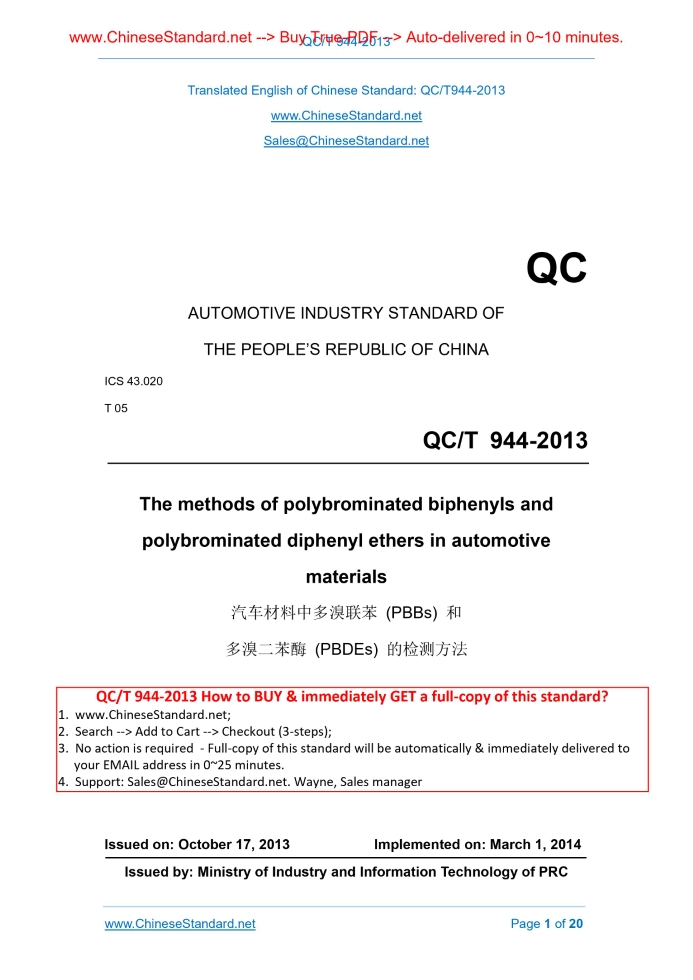
QC AUTOMOTIVE INDUSTRY STANDARD OF THE PEOPLE’S REPUBLIC OF CHINA ICS 43.020 T 05 The methods of polybrominated biphenyls and polybrominated diphenyl ethers in automotive materials Issued on. OCTOBER 17, 2013 Implemented on. MARCH 1, 2014 Issued by. Ministry of Industry and Information Technology of PRC
1 Scope
This Standard specifies the detection methods for PBBs and PBDEs in automotive materials. "X-ray fluorescence spectrometry" is for X-ray fluorescence spectroscopy screening and rapid determination of bromine content in automotive materials. The GC-MS method is applicable for the determination of PBBs and PBDEs in automotive materials by gas chromatography-mass spectrometry.2 Normative references
The following referenced documents are indispensable for the application of this document. For dated references, only the edition cited applies. For undated references, the latest edition of the referenced document (including any amendments) applies. GB/T 8170, Rules of rounding off for numerical values & expression and judgement of limiting values GB/T 30512-2014, Requirements for Prohibited Substances on Automobiles GB/Z 21276-2007, Determination of restricted substances - Polybrominated biphenyls and polybrominated diphenyl ethers in electrical and electronic equipment 3 X-ray fluorescence spectrometry 3.1 Principle Place the prepared sample in a sample chamber of an X-ray fluorescence spectrometer. Analyze the sample according to the selected test mode. Determine whether the content of bromine in the sample is qualified according to the screening limits of different samples, and whether it is necessary to carry out accurate determination. 3.2 Reagents and materials 3.3.4 Grinding machine. with tungsten carbide (WC) abrasives 3.3.5 Tableting machine. working pressure of not less than 20 MPa 3.3.6 Melting machine. working temperature of not less than 1150°C 3.4 Sample preparation 3.4.1 Sample preparation principle 3.4.1.1 The sample used for the test must cover the measurement window of the spectrometer. 3.4.1.2 The irradiated surface of the sample should be representative of the sample as a whole. 3.4.1.3 Pay attention to pollution prevention during sample preparation process. 3.4.2 Sample preparation method 3.6.2 Screening of bromine In accordance with Requirements for Prohibited Substances on Automobiles of which the mass fractions of the limits of polybrominated biphenyls (PBBs) and polybrominated diphenyl ethers (PBDEs) are 0.1% (1000 mg/kg), the screening limits for bromine in automotive materials are shown in Table 1.Screen the bromine in automotive materials based on screening limits. There are two cases in results. Pass (P) - if the test results are less than the set minimum, the result shall be acceptable; Uncertain (X) - if the test results are greater than the set minimum, the result shall be uncertain and a further test shall be carried out in accordance with Method 2. 3.6.3 Report of test results Take the arithmetic mean of the test results as report results, in milligrams/kilograms (mg/kg). 4 Gas chromatography-mass spectrometry (GC-MS) 4.1 Principle Samples are extracted with toluene as solvent. After the extracted volume to the appropriate volume, use Gas Chromatography-Mass Spectrometry (GC- MS) Full Scan Mode (SCAN) and select Ion monitoring mode (SIM) to qualitatively and quantitatively determine the polybrominated biphenyls and polybrominated diphenyl ethers in extracts. Then calculate their content in automotive materials. 4.2 Reagents and materials 4.2.1 Solvents. toluene, chromatography pure; or acetone, cyclohexane, n- hexane, methanol, dichloromethane, isooctane, nonane, etc. 4.2.3 Standard stock solution. Respectively take the right amount of polybrominated biphenyls and polybrominated diphenyl ether standard sample (4.2.2). Use toluene (4.2.1) to prepare 1 µg/mL mixed standard stock solution. 4.2.9 Glass wool 4.2.10 Micro-liter syringe or automatic pipette 4.2.11 Liquid nitrogen. industrial grade 4.3 Apparatus and equipment 4.3.1 Gas chromatography - mass spectrometry. equipped with mass selective detector (MSD), of mass range (100-1000) amu. 4.3.2 Soxhlet extractor with condenser 4.3.3 Rotary evaporator 4.3.4 Grinding device. including cutting machine or scissors, grinder, grinding machine and other devices, mainly for sample crushing 4.3.5 Balance. a sense of 0.0001 g 4.5 Analysis steps 4.5.1 Soxhlet extraction 4.5.1.1 Add 70 mL of toluene (4.2.1) into the Soxhlet extractor. Extract 2h to clean the Soxhlet extractor, discard the extract. 4.5.2 Determination 4.5.2.1 Refer to gas chromatography - mass spectrometry conditions. Gas chromatography-mass spectrometry parameters should be set to ensure that chromatographic determination of the measured components and other components can be effectively separated. 4.5.2.2 Calibration curve plotting. Different concentrations of calibrated standard solution (4.2.5) are injected into the gas chromatography-mass spectrometer in turn. Take calibrated standard solution concentration as abscissa, calibrated standard solution of the peak area as the vertical coordinate to build up the calibration curve. 4.7.2 Recovery rate The recovery rate of polybrominated biphenyls (PBBs) and polybrominated diphenyl ethers (PBDEs) in automotive materials is between 70% and 130%. 4.7.3 Precision Under repeatability conditions, the absolute difference between the two independent test results obtained is not more than 20% of the arithmetic mean of the two measured values. It is premised that the ratio is not more than 5% of the case of 20% of the arithmetic mean of the two measured values.5 Test report
The test report should include the following content. ......Source: Above contents are excerpted from the full-copy PDF -- translated/reviewed by: www.ChineseStandard.net / Wayne Zheng et al.