QB/T 4671-2014 English PDF
Price & Delivery
US$70.00 · In stock · Download in 9 secondsQB/T 4671-2014: Test method for synthetic leather/artificial leather. Resistance to hydrolysis
Delivery: 9 seconds. True-PDF full-copy in English & invoice will be downloaded + auto-delivered via email. See step-by-step procedure
Status: Valid
| Standard ID | USD | BUY PDF | Delivery | Standard Title (Description) | Status |
| QB/T 4671-2014 | 70 | Add to Cart | Auto, 9 seconds. | Test method for synthetic leather/artificial leather. Resistance to hydrolysis | Valid |
Click to Preview this PDF
QB/T 4671-2014: Test method for synthetic leather/artificial leather. Resistance to hydrolysis
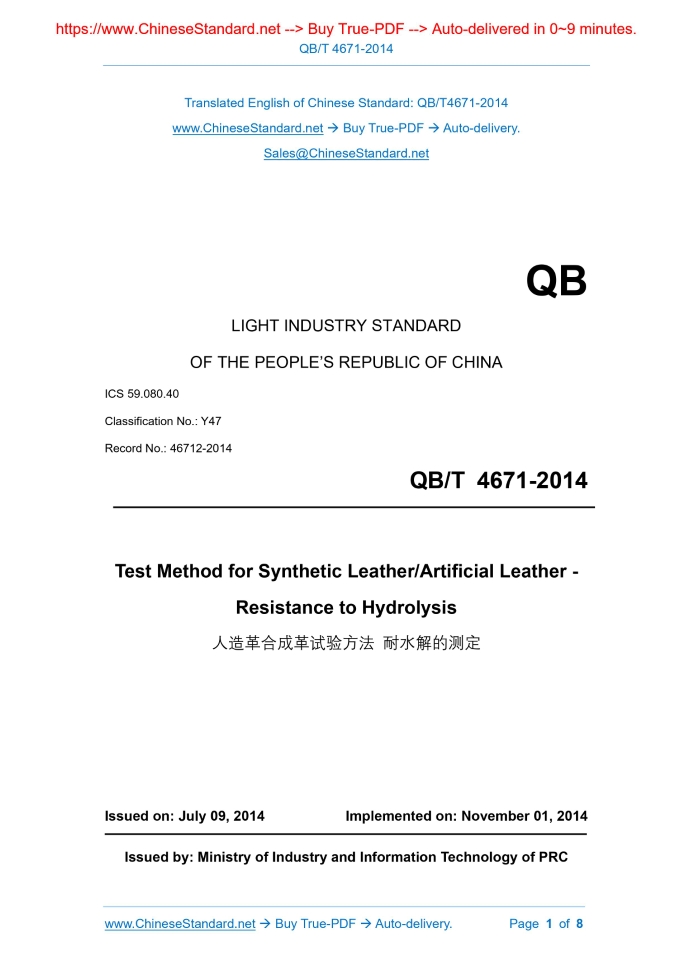
---This is an excerpt. Full copy of true-PDF in English version (including equations, symbols, images, flow-chart, tables, and figures etc.), auto-downloaded/delivered in 9 seconds, can be purchased online: https://www.ChineseStandard.net/PDF.aspx/QBT4671-2014QB LIGHT INDUSTRY STANDARD ICS 59.080.40 Classification No.. Y47 Record No.. 46712-2014 Test Method for Synthetic Leather/Artificial Leather - Resistance to Hydrolysis Issued on. JULY 09, 2014 Implemented on. NOVEMBER 01, 2014 Issued by. Ministry of Industry and Information Technology of PRC
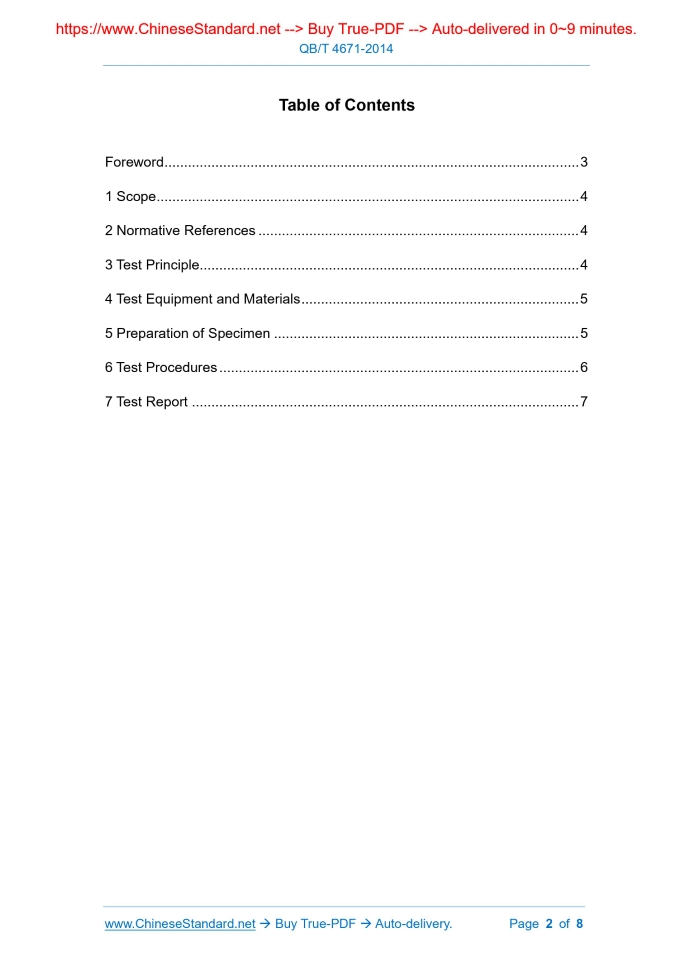
Table of Contents
Foreword... 3 1 Scope... 4 2 Normative References... 4 3 Test Principle... 4 4 Test Equipment and Materials... 5 5 Preparation of Specimen... 5 6 Test Procedures... 6 7 Test Report... 7Foreword
This Standard was drafted as per the rules specified in GB/T 1.1-2009. This Standard was proposed by China Light Industry Council. This Standard shall be under the jurisdiction of National Technical Committee for Standardization of Plastic Products (SAC/TC 48). Chief drafting organization of this Standard. Anan (China) Co., Ltd. Participating drafting organizations of this Standard. Anta (China) Co., Ltd.; Jinjiang Xiangda Industry & Trade Co., Ltd.; 361 Degrees (China) Co., Ltd.; Zhejiang Huafon Synthetic Resin Co., Ltd.; Anhui Anli Artificial Leather Co., Ltd.; Zhejiang Hexin Ind Grp Co., Ltd.; Zhejiang Sunlight Textile Technology Co., Ltd.; Suzhou Sunmun Technology Co., Ltd.; and Hefei Ketian Chemical Industry Co., Ltd. Chief drafting staffs of this Standard. Lin Tiansong, Chen Yuan, Fu Qingshui, Chen Rongying, Zhang Yong, Jiang Sulian, Zhao Chune, Gu Yuting, Shi Yilei, and Jin Meijin. Test Method for Synthetic Leather/Artificial Leather - Resistance to Hydrolysis1 Scope
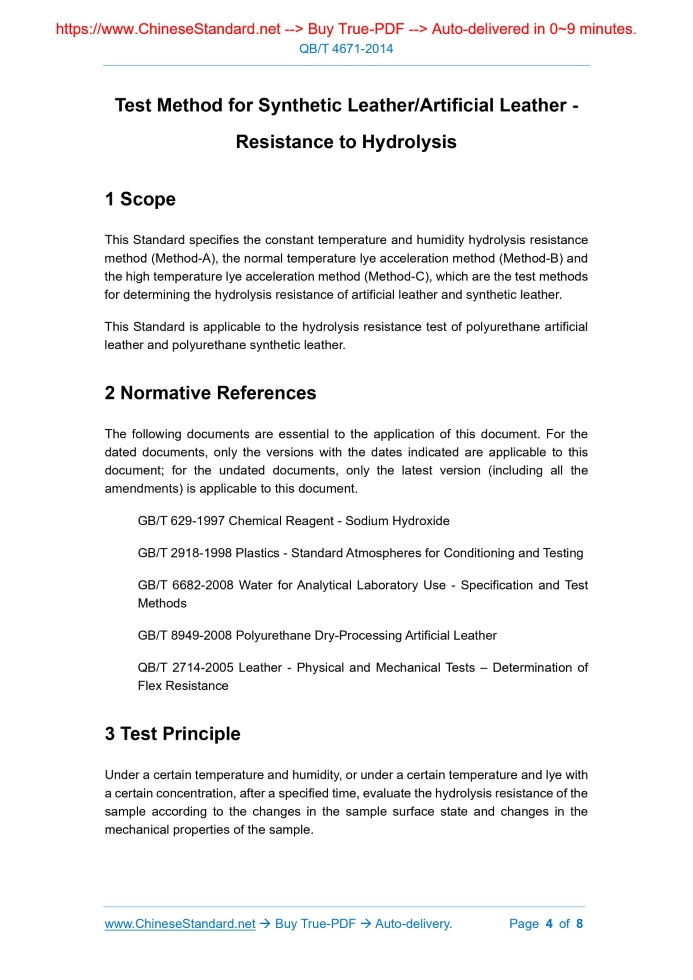
This Standard specifies the constant temperature and humidity hydrolysis resistance method (Method-A), the normal temperature lye acceleration method (Method-B) and the high temperature lye acceleration method (Method-C), which are the test methods for determining the hydrolysis resistance of artificial leather and synthetic leather. This Standard is applicable to the hydrolysis resistance test of polyurethane artificial leather and polyurethane synthetic leather.2 Normative References
The following documents are essential to the application of this document. For the dated documents, only the versions with the dates indicated are applicable to this document; for the undated documents, only the latest version (including all the amendments) is applicable to this document. GB/T 629-1997 Chemical Reagent - Sodium Hydroxide GB/T 2918-1998 Plastics - Standard Atmospheres for Conditioning and Testing GB/T 6682-2008 Water for Analytical Laboratory Use - Specification and Test Methods3 Test Principle
Under a certain temperature and humidity, or under a certain temperature and lye with a certain concentration, after a specified time, evaluate the hydrolysis resistance of the sample according to the changes in the sample surface state and changes in the mechanical properties of the sample.4 Test Equipment and Materials
4.1 Test equipment 4.2 Test Materials 4.2.1 Analytically-pure NaOH reagent It shall comply with the provisions of GB/T 629-1997. 4.2.4 100°C high temperature resisting container without lid Beaker, weighing paper, measuring cylinder, glass rod.5 Preparation of Specimen
5.1 Specimen size. respectively cut 2 specimens along the warp/longitudinal and weft/transverse directions about more than 100 mm from the edge of the sample. The specimen size is (220±2) mm long × (150±2) mm wide; when cutting the defects such as spots, damage marks, stains and the like shall be avoided.6 Test Procedures
Artificial leather/synthetic leather hydrolysis resistance test methods are divided into constant temperature and humidity hydrolysis resistance method (Method-A), normal temperature lye acceleration method (Method-B), and high temperature lye acceleration method (Method-C), of which the normal temperature lye acceleration method (Method-B) is the arbitration method. 6.1 Constant temperature and humidity hydrolysis resistance method (Method- A) 6.2 Normal temperature lye acceleration method (Method-B) 6.2.1 Place the analytically-pure NaOH reagent in a beaker; add distilled water to prepare a 10% NaOH solution; stir evenly by a glass rod; and let it stand. After it is completely dissolved and cooled to 23°C, move it into a high-temperature resisting container. 6.3 High temperature lye acceleration method (Method-C) 6.3.1 Place the analytically-pure NaOH reagent in a beaker; add distilled water to prepare a 10% NaOH solution; stir evenly by a glass rod; let it stand. After it is completely dissolved, transfer it to a high temperature resisting container containing the NaOH solution. 6.3.2 Seal the high temperature resisting container containing 100mL of 10% NaOH solution and place it in a constant temperature water bath and heat it to 70°C. 6.3.3 The ratio of the number of milliliters of NaOH solution to the number of grams of sample mass shall be no less than 20.1. 6.4 Test Results and Evaluation 6.4.1 Observe whether there is obvious lubrication, color changes, cracks, delamination and other phenomena on the surface of the specimen. 6.4.2 According to the provisions of 5.9 in GB/T 8949-2008, test the peeling load of the specimen. 6.4.3 According to the provisions of QB/T 2714-2005, test the fold fastness of the specimen.7 Test Report
The test report shall include at least the following contents. QB/T 4671-2014 QB LIGHT INDUSTRY STANDARD ICS 59.080.40 Classification No.. Y47 Record No.. 46712-2014 Test Method for Synthetic Leather/Artificial Leather - Resistance to Hydrolysis Issued on. JULY 09, 2014 Implemented on. NOVEMBER 01, 2014 Issued by. Ministry of Industry and Information Technology of PRCTable of Contents
Foreword... 3 1 Scope... 4 2 Normative References... 4 3 Test Principle... 4 4 Test Equipment and Materials... 5 5 Preparation of Specimen... 5 6 Test Procedures... 6 7 Test Report... 7Foreword
This Standard was drafted as per the rules specified in GB/T 1.1-2009. This Standard was proposed by China Light Industry Council. This Standard shall be under the jurisdiction of National Technical Committee for Standardization of Plastic Products (SAC/TC 48). Chief drafting organization of this Standard. Anan (China) Co., Ltd. Participating drafting organizations of this Standard. Anta (China) Co., Ltd.; Jinjiang Xiangda Industry & Trade Co., Ltd.; 361 Degrees (China) Co., Ltd.; Zhejiang Huafon Synthetic Resin Co., Ltd.; Anhui Anli Artificial Leather Co., Ltd.; Zhejiang Hexin Ind Grp Co., Ltd.; Zhejiang Sunlight Textile Technology Co., Ltd.; Suzhou Sunmun Technology Co., Ltd.; and Hefei Ketian Chemical Industry Co., Ltd. Chief drafting staffs of this Standard. Lin Tiansong, Chen Yuan, Fu Qingshui, Chen Rongying, Zhang Yong, Jiang Sulian, Zhao Chune, Gu Yuting, Shi Yilei, and Jin Meijin. Test Method for Synthetic Leather/Artificial Leather - Resistance to Hydrolysis1 Scope
This Standard specifies the constant temperature and humidity hydrolysis resistance method (Method-A), the normal temperature lye acceleration method (Method-B) and the high temperature lye acceleration method (Method-C), which are the test methods for determining the hydrolysis resistance of artificial leather and synthetic leather. This Standard is applicable to the hydrolysis resistance test of polyurethane artificial leather and polyurethane synthetic leather.2 Normative References
The following documents are essential to the application of this document. For the dated documents, only the versions with the dates indicated are applicable to this document; for the undated documents, only the latest version (including all the amendments) is applicable to this document. GB/T 629-1997 Chemical Reagent - Sodium Hydroxide GB/T 2918-1998 Plastics - Standard Atmospheres for Conditioning and Testing GB/T 6682-2008 Water for Analytical Laboratory Use - Specification and Test Methods3 Test Principle
Under a certain temperature and humidity, or under a certain temperature and lye with a certain concentration, after a specified time, evaluate the hydrolysis resistance of the sample according to the changes in the sample surface state and changes in the mechanical properties of the sample.4 Test Equipment and Materials
4.1 Test equipment 4.2 Test Materials 4.2.1 Analytically-pure NaOH reagent It shall comply with the provisions of GB/T 629-1997. 4.2.4 100°C high temperature resisting container without lid Beaker, weighing paper, measuring cylinder, glass rod.5 Preparation of Specimen
5.1 Specimen size. respectively cut 2 specimens along the warp/longitudinal and weft/transverse directions about more than 100 mm from the edge of the sample. The specimen size is (220±2) mm long × (150±2) mm wide; when cutting the defects such as spots, damage marks, stains and the like shall be avoided.6 Test Procedures
Artificial leather/synthetic leather hydrolysis resistance test methods are divided into constant temperature and humidity hydrolysis resistance method (Method-A), normal temperature lye acceleration method (Method-B), and high temperature lye acceleration method (Method-C), of which the normal temperature lye acceleration method (Method-B) is the arbitration method. 6.1 Constant temperature and humidity hydrolysis resistance method (Method- A) 6.2 Normal temperature lye acceleration method (Method-B) 6.2.1 Place the analytically-pure NaOH reagent in a beaker; add distilled water to prepare a 10% NaOH solution; stir evenly by a glass rod; and let it stand. After it is completely dissolved and cooled to 23°C, move it into a high-temperature resisting container. 6.3 High temperature lye acceleration method (Method-C) 6.3.1 Place the analytically-pure NaOH reagent in a beaker; add distilled water to prepare a 10% NaOH solution; stir evenly by a glass rod; let it stand. After it is completely dissolved, transfer it to a high temperature resisting container containing the NaOH solution. 6.3.2 Seal the high temperature resisting container containing 100mL of 10% NaOH solution and place it in a constant temperature water bath and heat it to 70°C. 6.3.3 The ratio of the number of milliliters of NaOH solution to the number of grams of sample mass shall be no less than 20.1. 6.4 Test Results and Evaluation 6.4.1 Observe whether there is obvious lubrication, color changes, cracks, delamination and other phenomena on the surface of the specimen. 6.4.2 According to the provisions of 5.9 in GB/T 8949-2008, test the peeling load of the specimen. 6.4.3 According to the provisions of QB/T 2714-2005, test the fold fastness of the specimen.7 Test Report
The test report shall include at least the following contents. ......Source: Above contents are excerpted from the full-copy PDF -- translated/reviewed by: www.ChineseStandard.net / Wayne Zheng et al.