GB/T 8647.4-2006 English PDF
Price & Delivery
US$130.00 · In stock · Download in 9 secondsGB/T 8647.4-2006: The methods for chemical analysis of nickel -- Determination of phosphorous content -- Molybdenum blue spectrophotometric method
Delivery: 9 seconds. True-PDF full-copy in English & invoice will be downloaded + auto-delivered via email. See step-by-step procedure
Status: Valid
GB/T 8647.4: Historical versions
| Standard ID | USD | BUY PDF | Delivery | Standard Title (Description) | Status |
| GB/T 8647.4-2006 | 130 | Add to Cart | Auto, 9 seconds. | The methods for chemical analysis of nickel -- Determination of phosphorous content -- Molybdenum blue spectrophotometric method | Valid |
| GB/T 8647.4-1988 | 199 | Add to Cart | 2 days | Nickel--Determination of phosphorus content--Molybdenum blue spectrophotometric method | Obsolete |
Click to Preview this PDF
Similar standards
GB/T 8647.4-2006: The methods for chemical analysis of nickel -- Determination of phosphorous content -- Molybdenum blue spectrophotometric method
---This is an excerpt. Full copy of true-PDF in English version (including equations, symbols, images, flow-chart, tables, and figures etc.), auto-downloaded/delivered in 9 seconds, can be purchased online: https://www.ChineseStandard.net/PDF.aspx/GBT8647.4-2006
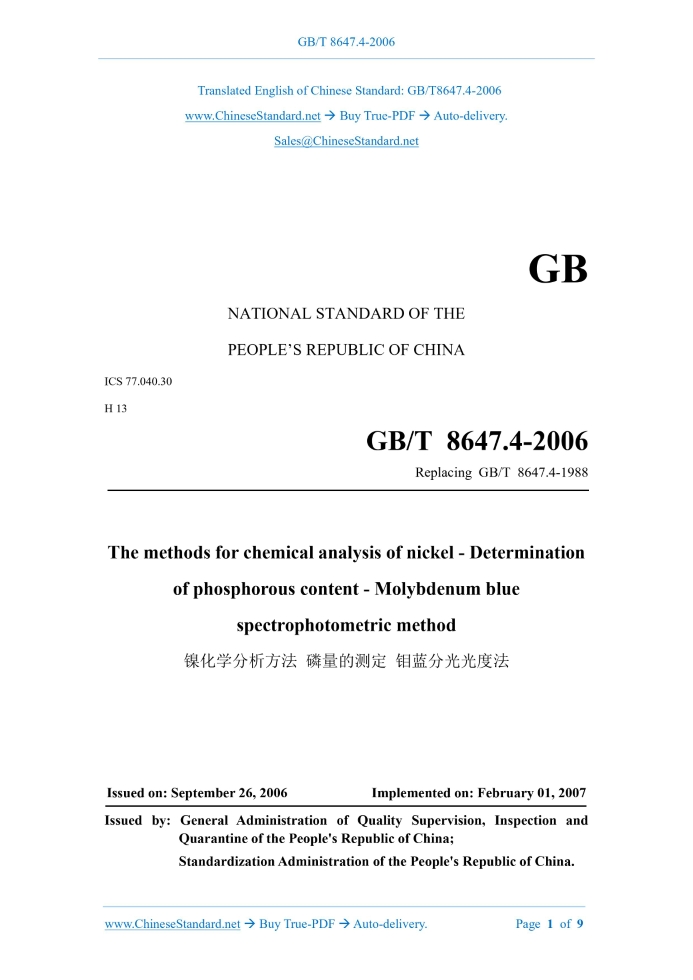
GB NATIONAL STANDARD OF THE PEOPLE’S REPUBLIC OF CHINA ICS 77.040.30 H 13 Replacing GB/T 8647.4-1988 The methods for chemical analysis of nickel - Determination of phosphorous content - Molybdenum blue spectrophotometric method ISSUED ON: SEPTEMBER 26, 2006 IMPLEMENTED ON: FEBRUARY 01, 2007 Issued by: General Administration of Quality Supervision, Inspection and Quarantine of the People's Republic of China; Standardization Administration of the People's Republic of China.
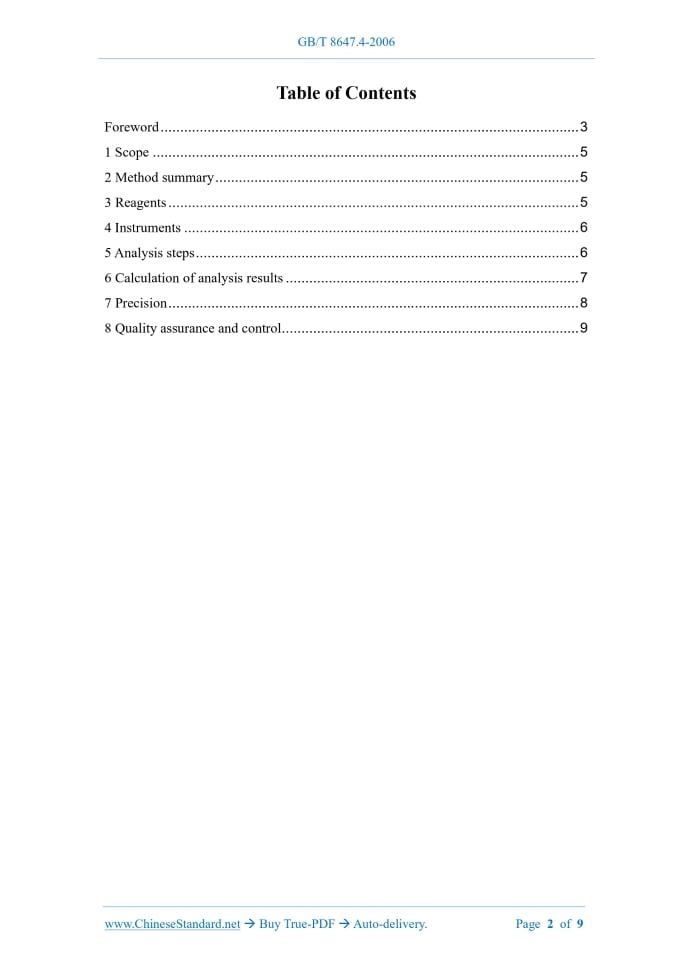
Table of Contents
Foreword ... 3 1 Scope ... 5 2 Method summary ... 5 3 Reagents ... 5 4 Instruments ... 6 5 Analysis steps ... 6 6 Calculation of analysis results ... 7 7 Precision ... 8 8 Quality assurance and control ... 9Foreword
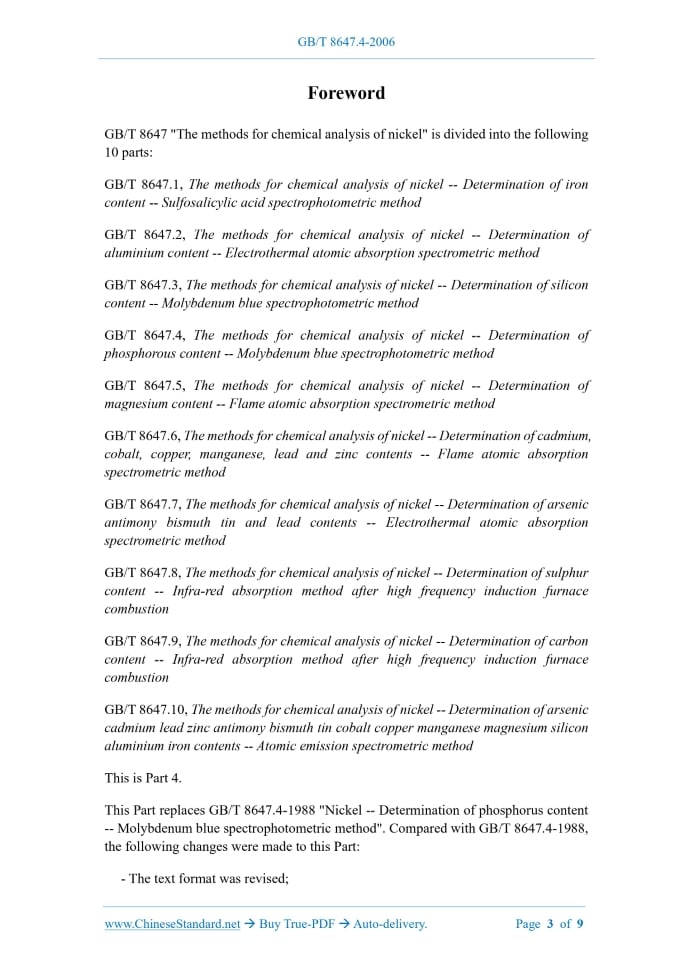
GB/T 8647 "The methods for chemical analysis of nickel" is divided into the following 10 parts: GB/T 8647.1, The methods for chemical analysis of nickel -- Determination of iron content -- Sulfosalicylic acid spectrophotometric method GB/T 8647.2, The methods for chemical analysis of nickel -- Determination of aluminium content -- Electrothermal atomic absorption spectrometric method GB/T 8647.3, The methods for chemical analysis of nickel -- Determination of silicon content -- Molybdenum blue spectrophotometric method GB/T 8647.4, The methods for chemical analysis of nickel -- Determination of phosphorous content -- Molybdenum blue spectrophotometric method GB/T 8647.5, The methods for chemical analysis of nickel -- Determination of magnesium content -- Flame atomic absorption spectrometric method GB/T 8647.6, The methods for chemical analysis of nickel -- Determination of cadmium, cobalt, copper, manganese, lead and zinc contents -- Flame atomic absorption spectrometric method GB/T 8647.7, The methods for chemical analysis of nickel -- Determination of arsenic antimony bismuth tin and lead contents -- Electrothermal atomic absorption spectrometric method GB/T 8647.8, The methods for chemical analysis of nickel -- Determination of sulphur content -- Infra-red absorption method after high frequency induction furnace combustion GB/T 8647.9, The methods for chemical analysis of nickel -- Determination of carbon content -- Infra-red absorption method after high frequency induction furnace combustion GB/T 8647.10, The methods for chemical analysis of nickel -- Determination of arsenic cadmium lead zinc antimony bismuth tin cobalt copper manganese magnesium silicon aluminium iron contents -- Atomic emission spectrometric method This is Part 4. This Part replaces GB/T 8647.4-1988 "Nickel -- Determination of phosphorus content -- Molybdenum blue spectrophotometric method". Compared with GB/T 8647.4-1988, the following changes were made to this Part: - The text format was revised; The methods for chemical analysis of nickel - Determination of phosphorous content - Molybdenum blue spectrophotometric method1 Scope
This Part specifies the method for the determination of phosphorus content in nickel. This Part is applicable to the determination of phosphorus content in nickel. Determination range: 0.0005%~0.03%.2 Method summary
The test material is dissolved in nitric acid. Phosphorus is oxidized with potassium permanganate. In an acidic solution, the phosphomolybdic acid heteropoly acid complex formed by phosphorus (V) and ammonium molybdate is extracted with a mixed solvent of n-butanol-chloroform. It is reduced to phosphomolybdic blue with stannous chloride. Its absorbance is measured at a wavelength of 620 nm on a spectrophotometer.3 Reagents
3.1 Nitric acid (ρ1.42 g/mL): guaranteed reagent. 3.2 Nitric acid (1+1). 3.3 Hydrochloric acid (ρ1.19 g/mL): guaranteed reagent. 3.4 Perchloric acid (ρ1.66 g/mL): guaranteed reagent. 3.5 Perchloric acid (1+1). 3.6 Perchloric acid (1+9). 3.7 n-Butanol. 3.8 Chloroform. 3.9 Mixed extractant: three parts of chloroform and one part of n-butanol are mixed. 3.10 Ammonium molybdate solution (100 g/L): Weigh 10 g of ammonium molybdate 5.3 Determination 5.3.1 Place the test material (5.1) in a 250 mL beaker. Slowly add 15 mL of nitric acid (3.2) and 2~4 drops of potassium permanganate solution (3.12). Slightly heat until the test material is completely dissolved. NOTE: Add 1 drop of potassium permanganate solution (3.12) to the blank test material. 5.3.2 After the solution has cooled, add 10 mL of perchloric acid (3.5). Heat and evaporate until thick white perchloric acid smoke emerges. Cool. Add 30 mL of water. Stir to dissolve the salts. 5.3.3 Transfer the solution into a 125 mL separatory funnel. Add water to 50 mL. For specimens with phosphorus content greater than 0.006%, dilute the test solution according to Table 1 and place it in a 125 mL separatory funnel. Add perchloric acid (3.6) to 50 mL. 5.3.4 Add 3 mL of ammonium molybdate solution (3.10) to the separatory funnel. Shake well. Let stand for 10 min. 5.3.5 Add 2 mL of n-butanol (3.7). Oscillate for 1 min. Add 15 mL of mixed extractant (3.9). Oscillate for 2 min. After standing for stratification, place the organic phase in a 50 mL volumetric flask. Add another 15 mL of mixed extractant (3.9) to the aqueous phase. Oscillate for 2 min. After standing for stratification, combine the organic phases in a volumetric flask. 5.3.6 Add 3 mL~4 mL of n-butanol (3.7) to the volumetric flask. Add 4 drops of stannous chloride solution (3.11). Dilute to volume with n-butanol (3.7). Mix well. Let stand for 15 min~20 min. Transfer part of the solution to a dry 2 cm cuvette. 5.3.7 Use the blank experimental solution as a reference. Measure its absorbance at a wavelength of 620 nm on a spectrophotometer. Find the corresponding phosphorus content from the working curve. 5.4 Working curve Take 0 mL, 2.00 mL, 4.00 mL, 6.00 mL, 8.00 mL, 10.00 mL of phosphorus standard solution (3.14) and place them in a set of 125 mL separatory funnels. Add perchloric acid (3.6) to 50 mL. Follow 5.3.4~5.3.6. Use the reagent blank solution as a reference. Measure its absorbance at a wavelength of 620 nm on a spectrophotometer. Draw a working curve with phosphorus content as the horizontal axis and absorbance as the vertical axis.6 Calculation of analysis results
The mass fraction of phosphorus w(P) is calculated as follows, with the value expressed ......Source: Above contents are excerpted from the full-copy PDF -- translated/reviewed by: www.ChineseStandard.net / Wayne Zheng et al.