GB/T 5451-2001 English PDF
Price & Delivery
US$95.00 · In stock · Download in 9 secondsGB/T 5451-2001: Testing method for the wettability of dispersible powders of pesticides
Delivery: 9 seconds. True-PDF full-copy in English & invoice will be downloaded + auto-delivered via email. See step-by-step procedure
Status: Valid
GB/T 5451: Historical versions
| Standard ID | USD | BUY PDF | Delivery | Standard Title (Description) | Status |
| GB/T 5451-2001 | 95 | Add to Cart | Auto, 9 seconds. | Testing method for the wettability of dispersible powders of pesticides | Valid |
| GB/T 5451-1985 | RFQ | ASK | 3 days | Testing method for the wettability of dispersible powders of pesticides | Obsolete |
Click to Preview this PDF
GB/T 5451-2001: Testing method for the wettability of dispersible powders of pesticides
---This is an excerpt. Full copy of true-PDF in English version (including equations, symbols, images, flow-chart, tables, and figures etc.), auto-downloaded/delivered in 9 seconds, can be purchased online: https://www.ChineseStandard.net/PDF.aspx/GBT5451-2001GB NATIONAL STANDARD OF THE PEOPLE’S REPUBLIC OF CHINA ICS 65.100;71.040.40 G 23 Replacing GB/T 5451-1985 Testing method for the wettability of dispersible powders of pesticides ISSUED ON: JULY 13, 2001 IMPLEMENTED ON: FEBRUARY 01, 2002 Issued by: General Administration of Quality Supervision, Inspection and Quarantine of the People's Republic of China.
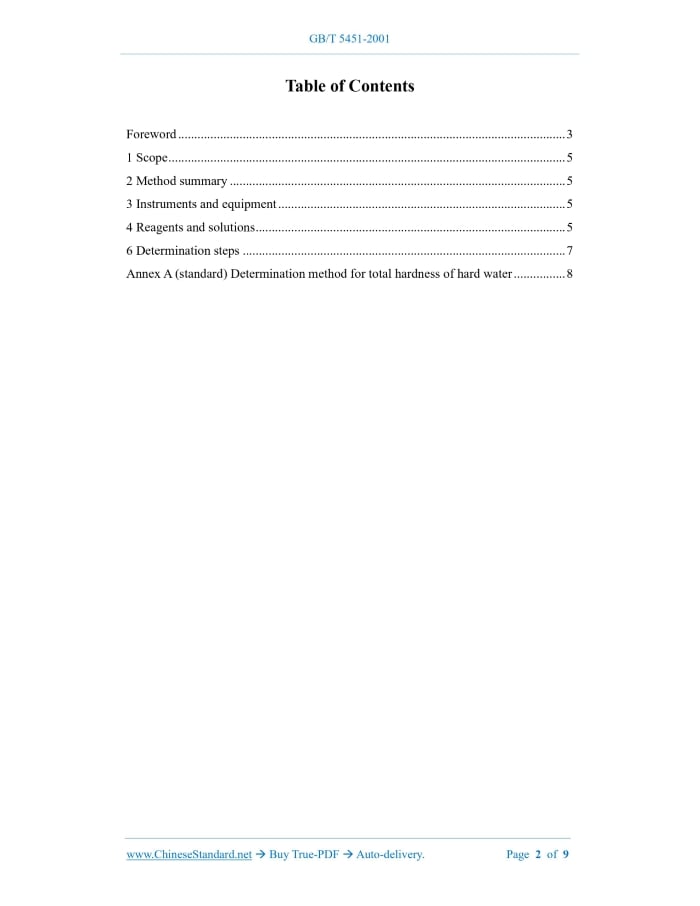
Table of Contents
Foreword ... 3 1 Scope ... 5 2 Method summary ... 5 3 Instruments and equipment ... 5 4 Reagents and solutions ... 5 6 Determination steps ... 7 Annex A (standard) Determination method for total hardness of hard water ... 8 Testing method for the wettability of dispersible powders of pesticides1 Scope
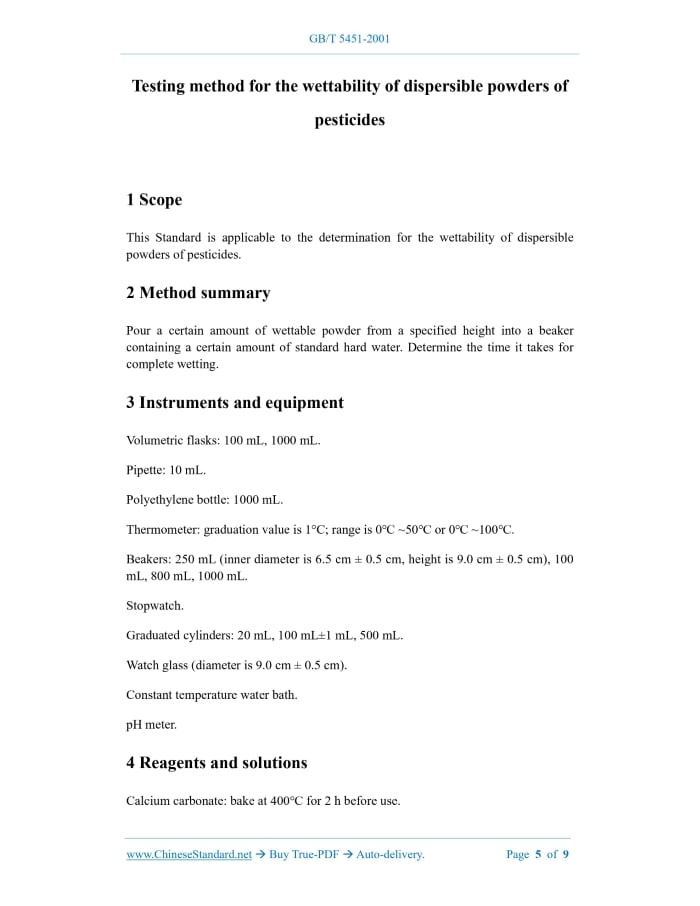
This Standard is applicable to the determination for the wettability of dispersible powders of pesticides.2 Method summary
Pour a certain amount of wettable powder from a specified height into a beaker containing a certain amount of standard hard water. Determine the time it takes for complete wetting.3 Instruments and equipment
Volumetric flasks: 100 mL, 1000 mL. Pipette: 10 mL. Polyethylene bottle: 1000 mL. Thermometer: graduation value is 1°C; range is 0℃ ~50℃ or 0℃ ~100℃. Beakers: 250 mL (inner diameter is 6.5 cm ± 0.5 cm, height is 9.0 cm ± 0.5 cm), 100 mL, 800 mL, 1000 mL. Stopwatch. Graduated cylinders: 20 mL, 100 mL±1 mL, 500 mL. Watch glass (diameter is 9.0 cm ± 0.5 cm). Constant temperature water bath. pH meter.4 Reagents and solutions
Calcium carbonate: bake at 400℃ for 2 h before use. Magnesium oxide: bake at 105℃ for 2 h before use. Anhydrous calcium chloride. Magnesium chloride with crystal water (MgCl2 • 6H2O). Ammonia: c(NH3 • H2O)=1 mol/L solution. Hydrochloric acid: c(HCl)=2 mol/L solution, c(HCl)=1.0 mol/L solution and c(HCl)=0.1 mol/L solution. Methyl red: ρ(methyl red)=5 g/L solution. Sodium hydroxide: c(NaOH)=0.1 mol/L solution. 5 Preparation of standard hard water [ρ(Ca2+ + Mg2+)=342 mg/L] The following three methods are optional. 5.1 Preparation method one 5.1.1 Preparation of stock solution 5.1.1.1 Solution A -- Preparation of c(Ca2+) = 0.04 mol/L solution Accurately weigh 4.000 g of calcium carbonate and place it in an 800 mL beaker. Add a little water to moisten. Then slowly add 82 mL of 1.0 mol/L hydrochloric acid. Stir thoroughly to combine. After all the calcium carbonate is dissolved, add 400 mL of water. Boil to remove carbon dioxide. After cooling to room temperature, add 2 drops of methyl red indicator solution. Neutralize with 1 mol/L ammonia until orange. Transfer this solution to a 1000 mL volumetric flask. Bring to the volume with water. Shake well. Store in polyethylene bottles until later use. 5.1.1.2 Solution B -- Preparation of c(Mg2+) = 0.04 mol/L solution Accurately weigh 1.613 g of magnesium oxide and place it in an 800 mL beaker. Add a little water to moisten. Then slowly add 82 mL of 1.0 mol/L hydrochloric acid. Stir well to combine and heat gently. After all the magnesium oxide is dissolved, add 400 mL of water. Boil to remove carbon dioxide. After cooling to room temperature, add 2 drops of methyl red indicator solution. Neutralize with 1 mol/L ammonia until orange. Transfer this solution to a 1000 mL volumetric flask. Bring to the volume with water. Shake well. Store in polyethylene bottles until later use. 5.1.2 Preparation of standard hard water Pipette 68.5 mL of solution A and 17.0 mL of solution B into a 1000 mL beaker. AddAnnex A
(standard) Determination method for total hardness of hard water A1 Reagents and solutions Ammonium chloride. Concentrated ammonia. Buffer solution (pH=10): Weigh 67.5 g of ammonium chloride and 570 mL of concentrated ammonia water. Dilute to 1 L with distilled water. Mix well. Acid chrome blue R. Naphthol green. Potassium sulfate. Calcium magnesium mixed indicator: Weigh 1.0 g of acid chromium blue R, 2.0 g of naphthol green and 100.0 g of potassium sulfate. Place them in an agate mortar. Grind finely and mix well. Store in brown bottles to prevent water absorption and light. EDTA disodium. Pure zinc (or zinc oxide). Concentrated hydrochloric acid. Methyl orange. Preparation of EDTA disodium standard titration solution: Weigh 7.44 g of disodium EDTA. Dissolve in distilled water and dilute to 1000 mL. Calibration of EDTA disodium standard titration solution: Weigh approximately 0.016 g of pure zinc (or 0.024 g of zinc oxide), accurate to 0.00002 g. Add concentrated hydrochloric acid to dissolve. Use methyl orange as indicator. Neutralize with concentrated ammonia to neutrality. Add 1 mL of buffer solution. Add about 0.1 g of calcium and magnesium mixed indicator. Titrate with EDTA disodium solution to a greenish color. Do a blank test under the same conditions. The concentration c (EDTA disodium) of the EDTA disodium standard titration solution is calculated according to formula (A1) or formula (A2): ......Source: Above contents are excerpted from the full-copy PDF -- translated/reviewed by: www.ChineseStandard.net / Wayne Zheng et al.