GB/T 3850-2015 English PDF
Price & Delivery
US$90.00 · In stock · Download in 9 secondsGB/T 3850-2015: Impermeable sintered metal materials and hard metals -- Determination of density
Delivery: 9 seconds. True-PDF full-copy in English & invoice will be downloaded + auto-delivered via email. See step-by-step procedure
Status: Valid
GB/T 3850: Historical versions
| Standard ID | USD | BUY PDF | Delivery | Standard Title (Description) | Status |
| GB/T 3850-2015 | 90 | Add to Cart | Auto, 9 seconds. | Impermeable sintered metal materials and hard metals -- Determination of density | Valid |
| GB/T 3850-1983 | 199 | Add to Cart | 3 days | Impermeable sintered metal materials and hardmetals. Determination of density | Obsolete |
Click to Preview this PDF
Similar standards
GB/T 3850-2015: Impermeable sintered metal materials and hard metals -- Determination of density
---This is an excerpt. Full copy of true-PDF in English version (including equations, symbols, images, flow-chart, tables, and figures etc.), auto-downloaded/delivered in 9 seconds, can be purchased online: https://www.ChineseStandard.net/PDF.aspx/GBT3850-2015GB NATIONAL STANDARD OF THE PEOPLE’S REPUBLIC OF CHINA ICS 77.160 H 16 GB/T 3850-2015 / ISO 3369:2006 Replacing GB/T 3850-1983 Impermeable Sintered Metal Materials and Hardmetals – Determination of Density (ISO 3369:2006, IDT) ISSUED ON: DECEMBER 10, 2015 IMPLEMENTED ON: JULY 01, 2016 Issued by: General Administration of Quality Supervision, Inspection and Quarantine; Standardization Administration of PRC.
Table of Contents
Foreword ... 3 1 Scope ... 4 2 Normative References ... 4 3 Principle ... 4 4 Apparatus and Materials ... 4 5 Specimen ... 5 6 Procedures ... 5 7 Expression of Results ... 6 8 Test Report ... 7 9 Precision ... 7 Impermeable Sintered Metal Materials and Hardmetals – Determination of Density1 Scope
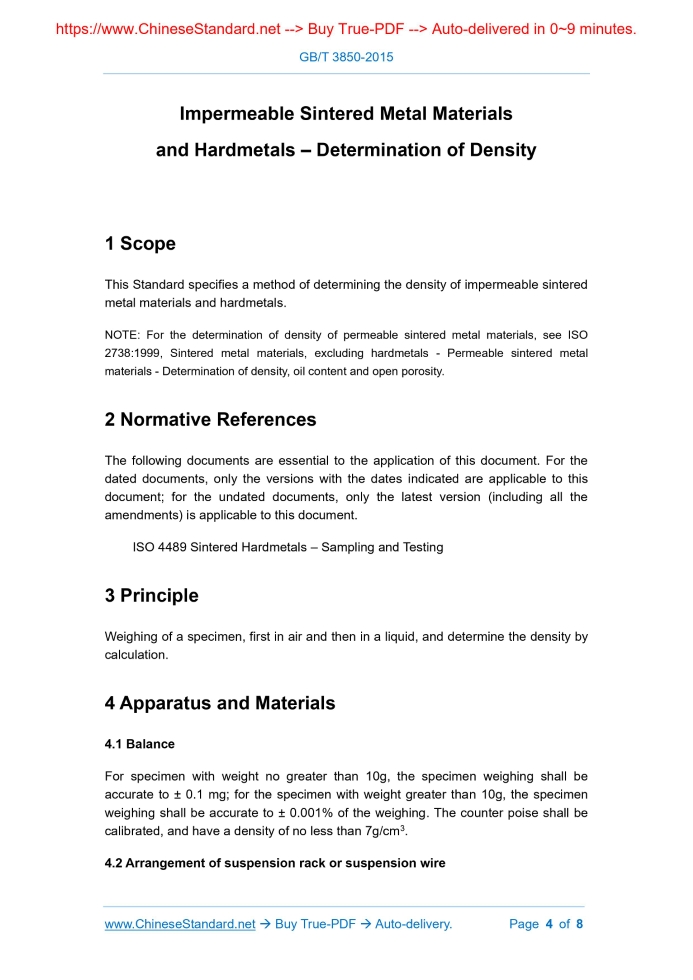
This Standard specifies a method of determining the density of impermeable sintered metal materials and hardmetals. NOTE: For the determination of density of permeable sintered metal materials, see ISO 2738:1999, Sintered metal materials, excluding hardmetals - Permeable sintered metal materials - Determination of density, oil content and open porosity.2 Normative References
The following documents are essential to the application of this document. For the dated documents, only the versions with the dates indicated are applicable to this document; for the undated documents, only the latest version (including all the amendments) is applicable to this document. ISO 4489 Sintered Hardmetals – Sampling and Testing3 Principle
Weighing of a specimen, first in air and then in a liquid, and determine the density by calculation.4 Apparatus and Materials
4.1 Balance For specimen with weight no greater than 10g, the specimen weighing shall be accurate to ± 0.1 mg; for the specimen with weight greater than 10g, the specimen weighing shall be accurate to ± 0.001% of the weighing. The counter poise shall be calibrated, and have a density of no less than 7g/cm3. 4.2 Arrangement of suspension rack or suspension wire The measuring device shall refer to Figures 1 and 2. In general case, the suspension wire shall have a maximum diameter of 0.25 mm. A thicker suspension wire shall only be used if this is necessary to support the heavy specimen. 4.3 Vessel The size of the vessel shall be appropriate, which shall be such that when placing the specimen with volume less than 10cm3 into the liquid, the rise in liquid level shall be no greater than 2.5 mm. 4.4 Liquid The liquid may use the distilled or deionized water, and preferably use degassed water; to which 1 or 2 drops of a wetting agent have been added.5 Specimen
5.1 Sampling shall be carried out according to the provisions of ISO 4489. 5.2 The volume of the specimen shall be no less than 0.5 cm3. When the volume of the specimen is less than 0.5cm3, several specimens may be combined together for testing; however, the volume of each specimen shall be no less than 0.05cm3. 5.3 The surface of the specimen shall be thoroughly cleaned from adhering foreign material, such as dirt, grease and oil.6 Procedures
6.1 Place the specimen in the upper suspension rack (Figure 1) or suspension pan (Figure 2). The lower suspension rack shall be completely immersed into the liquid, and the suspension wire shall be hanging freely from the suspension pan and partially immersed in the liquid. Remove all air bubbles and weigh the specimen (m1). 6.2 Place the test piece on the lower suspension rack (Figure 1) or tie it by means of the metal wire (Figure 2). Then transfer into the vessel containing liquid; only the suspension wire is allowed to exposed out of the liquid level. Remove all air bubbles and weigh. 6.3 For specimen with wight no greater than 10g, read to 0.1mg; for specimen with weight greater than 10g, read to 0.001% of the weighing. 6.4 The specimen, liquid and surrounding air shall be at the same temperature when weighing is carried out. The temperature of the liquid shall be determined. When distilled water is used, its density shall be taken from Table 1. ......Source: Above contents are excerpted from the full-copy PDF -- translated/reviewed by: www.ChineseStandard.net / Wayne Zheng et al.