GB/T 37322-2026 (GB/T 37322-2019) English PDF
Price & Delivery
US$265.00 · In stock · Download in 9 secondsGB/T 37322-2019: Test method for evaluating gasoline cleanliness - Simulation test of intake valve deposit (IVD) of gasoline engine
Delivery: 9 seconds. True-PDF full-copy in English & invoice will be downloaded + auto-delivered via email. See step-by-step procedure
Status: Valid
GB/T 37322: Historical versions
| Standard ID | USD | BUY PDF | Delivery | Standard Title (Description) | Status |
| GB/T 37322-2026 | RFQ | ASK | 3 days | Evaluation of gasoline cleanliness - Simulation test method for intake valve deposit (IVD) on gasoline engine | Valid |
| GB/T 37322-2019 | 265 | Add to Cart | Auto, 9 seconds. | Test method for evaluating gasoline cleanliness - Simulation test of intake valve deposit (IVD) of gasoline engine | Valid |
Click to Preview this PDF
Similar standards
GB/T 37322-2019: Test method for evaluating gasoline cleanliness - Simulation test of intake valve deposit (IVD) of gasoline engine
---This is an excerpt. Full copy of true-PDF in English version (including equations, symbols, images, flow-chart, tables, and figures etc.), auto-downloaded/delivered in 9 seconds, can be purchased online: https://www.ChineseStandard.net/PDF.aspx/GBT37322-2019
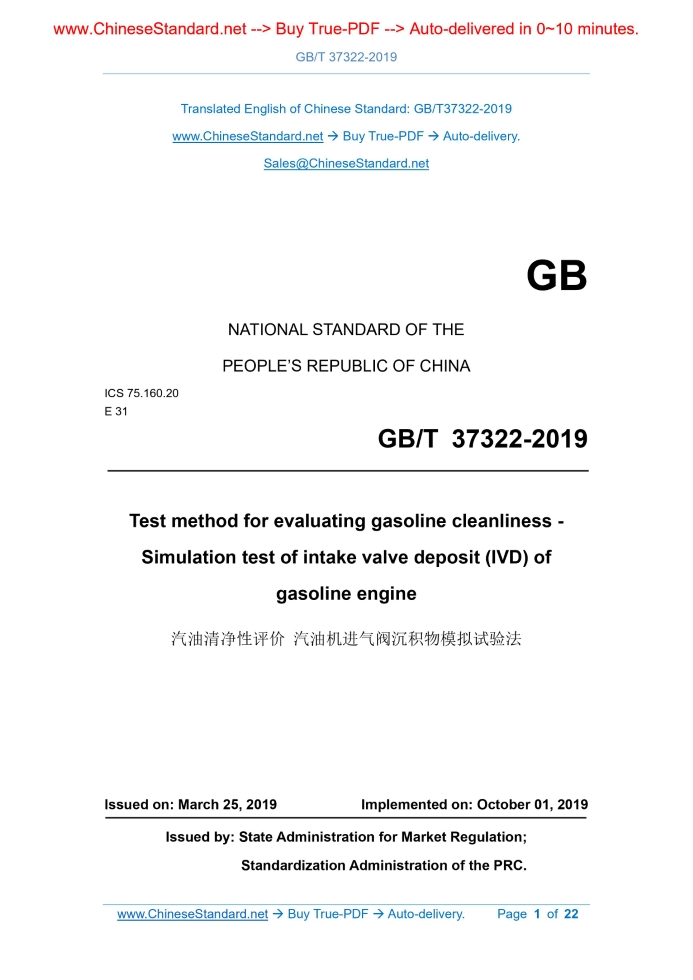
NATIONAL STANDARD OF THE PEOPLE’S REPUBLIC OF CHINA ICS 75.160.20 E 31 Test method for evaluating gasoline cleanliness - Simulation test of intake valve deposit (IVD) of gasoline engine Issued on. MARCH 25, 2019 Implemented on. OCTOBER 01, 2019 Issued by. State Administration for Market Regulation; Standardization Administration of the PRC.
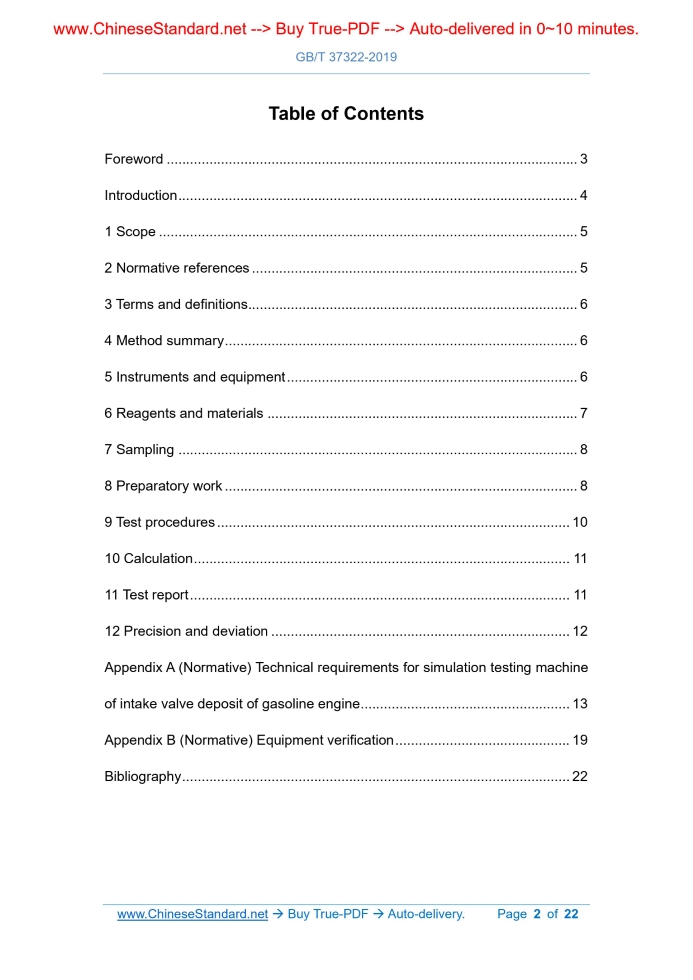
Table of Contents
Foreword... 3 Introduction... 4 1 Scope... 5 2 Normative references... 5 3 Terms and definitions... 6 4 Method summary... 6 5 Instruments and equipment... 6 6 Reagents and materials... 7 7 Sampling... 8 8 Preparatory work... 8 9 Test procedures... 10 10 Calculation... 11 11 Test report... 11 12 Precision and deviation... 12 Appendix A (Normative) Technical requirements for simulation testing machine of intake valve deposit of gasoline engine... 13 Appendix B (Normative) Equipment verification... 19 Bibliography... 22Foreword
This Standard is drafted in accordance with the rules given in GB/T 1.1-2009. This Standard was proposed by and shall be under the jurisdiction of National Technical Committee 280 on Petroleum Products and Lubricants of Standardization Administration of China (SAC/TC 280). Responsible drafting organization of this Standard. SINOPEC Research Institute of Petroleum Processing. Participating drafting organizations of this Standard. Lanzhou Weike Petrochemical Instrument Co., Ltd., Shenzhen Academy of Metrology & Quality Inspection, Shandong Chambroad Petrochemicals Co., Ltd., Shenzhen Jimmy Chemical Technology Co., Ltd., Guangdong (Huizhou) Quality Supervision & Testing Centre for Petroleum Products, Lubrizol Additives (Zhuhai) Co., Ltd., Beijing Petroleum Product Quality Supervision and Inspection Center, Tianjin Yuetai Petrochemical Technology Co., Ltd., Zhuhai Laikeli Environmental Protection Technology Co., Ltd. Main drafters of this Standard. Zhang Xin, Chen Yumeng, Zhang Demin, Zhao Yan, Wang Jiqin, Li Ruibo, Wen Huan, Dai Song, Wang Shoucheng, Zhong Liang, Dong Shuangjian, Zhang Jia, Huang Weilin.1 Scope
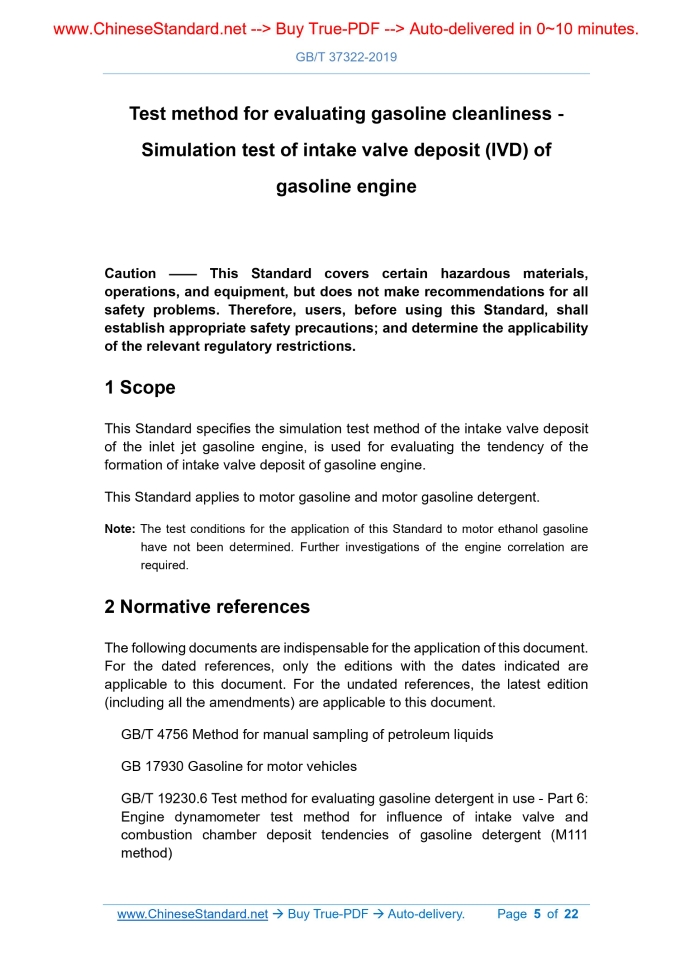
This Standard specifies the simulation test method of the intake valve deposit of the inlet jet gasoline engine, is used for evaluating the tendency of the formation of intake valve deposit of gasoline engine. This Standard applies to motor gasoline and motor gasoline detergent. Note. The test conditions for the application of this Standard to motor ethanol gasoline have not been determined. Further investigations of the engine correlation are required.2 Normative references
The following documents are indispensable for the application of this document. For the dated references, only the editions with the dates indicated are applicable to this document. For the undated references, the latest edition (including all the amendments) are applicable to this document. GB/T 4756 Method for manual sampling of petroleum liquids GB 17930 Gasoline for motor vehicles GB/T 19230.6 Test method for evaluating gasoline detergent in use - Part 6. Engine dynamometer test method for influence of intake valve and combustion chamber deposit tendencies of gasoline detergent (M111 method)3 Terms and definitions
The following terms and definitions apply to this document. 3.1 Intake valve deposit Any substance deposited on the surface of intake valve which is generated by fuel, lubricating oil, and additives or which is drawn in from the outside. 3.2 Calibration reference fuel A stable fuel with gasoline characteristics for calibrating the simulation testing machine of intake valve deposit of gasoline engine. 3.4 Deposit accelerant The substance which, in a high-temperature and oxygen environment, causes metal surfaces to rapidly generate deposits on the intake valve similar to those after long-term operation of engine.4 Method summary
Under the specified test conditions, the quantitative sample is mixed with air through a nozzle and sprayed onto a deposit collector which has been weighed and heated to the test temperature, to simulate the formation of intake valve deposit of gasoline engine.5 Instruments and equipment
5.1 Test equipment Simulation testing machine of intake valve deposit of gasoline engine. See Appendix A for technical requirements. 5.2 Test instruments 5.2.4 Micro sample injector. 1000 μL, 250 μL. 5.2.5 Volumetric flask. 300 mL. 5.2.6 Tweezers. 5.2.7 Balance gloves. 5.2.8 Digital camera. no less than 8 million pixels.6 Reagents and materials
6.1 Reagents 6.1.1 N-heptane. analytically pure. 6.1.6 Anhydrous ethanol. analytically pure. 6.1.7 Isopropanol. analytically pure. 6.2 Materials 6.2.1 Scouring pad. particle size 240~280. 6.2.2 Water sandpaper. 62 μm. 6.2.3 Deposit accelerant. See the requirements of B.2.1 in Appendix B. 6.2.4 Iron naphthenate diluent. See B.2.2. 6.2.5 Calibration reference fuel. The composition requirements are shown in Table B.1. 6.2.8 Detergent. commercially available detergent. 6.2.9 Paper stick. It is rolled from filter paper and has a diameter of 1.5 mm. 6.2.10 Sponge. 35D.7 Sampling
7.1 In accordance with GB/T 4756, a representative gasoline sample is taken. Samples shall be taken and stored in opaque containers, such as dark brown glass bottles and metal cans, to avoid exposure to sunlight or ultraviolet light. 7.2 Before the test, samples shall be placed indoors until being close to room temperature.8 Preparatory work
8.1 Preparation of deposit collector 8.1.1 The deposit collector is sanded using a scouring pad dipped in water and a detergent along the length of the collector plate. For used collectors with heavier deposits, USE water sandpaper dipped in water to grind; then USE the scouring pad dipped in water and the detergent to polish, until the surface of test plates is bright and unstained. 8.1.4 The collector is taken out from the dryer for weighing; and then placed back into the dryer; and after 10 s, is weighed again. If the difference between the two consecutive readings of weighing balance is no more than 0.1 mg, it can be used as a stand-by. If the difference is greater than 0.1 mg, the collector is placed back into the dryer. After 30 min, it is re-weighed, until the difference between the two consecutive readings is no more than 0.1 mg. 8.2 Preparation of test equipment 8.2.1 The test time of the instrument is set to 85 min. The oil injection time is set to 75 min. The test temperature is set to 175 °C (When the room temperature is ≤20 °C, the temperature is set to 174 °C). The temperature control accuracy is ±1 °C. TURN on the air source; adjust the air pressure to 80 kPa±1 kPa, and the air flow rate to 700 L/h±20 L/h. 8.2.4 TURN on the power switch of the equipment. USE the cleaning mode to quickly spray the solution in the sample cup through the oil inlet hose and nozzle to the solvent recovery box, until the spray is completed. 8.3 Equipment verification According to Appendix B, the simulation testing machine of intake valve deposit of gasoline engine is verified.9 Test procedures
9.1 Test environmental conditions Laboratory temperature. 16 °C~32 °C. TEST in a fume hood, forced ventilation. 9.2 Preparation of samples 9.3 Sample determination 9.3.1 LOAD in the weighed deposit collector and clamp it; PLUG in the temperature thermocouple; and LOCK the oil inlet. 9.3.2 START the test, so that the deposit collector temperature reaches the set temperature. 9.3.3 Adjust the air pressure to 80 kPa±1 kPa. The air flow rate is stabilized at 700 L/h±20 L/h. 9.4 Collector processing 9.4.1 USE tweezers to take out the deposit collector. After cooling to room temperature, it is placed in a container containing n-heptane and allowed to stand for 6 min, and then taken out. 9.4.2 The collector is immersed in a container containing petroleum ether (60 °C~90 °C), left to stand for 1 min; and then taken out. INSERT the paper stick into the thermometer hole of the collector, to absorb the reagent in the hole. 9.4.3 After the collector is placed in an oven at 100 °C for 15 min, it is taken out into a dryer. The dryer is placed near the balance; and cooled to room temperature. the difference between the two consecutive readings is no more than 0.1 mg. 9.5 Photograph PHOTOGRAPH the deposit collector after the test.10 Calculation
The simulated intake valve deposit mass of the sample shall be calculated according to formula (1).11 Test report
The report shall include the following. ......Source: Above contents are excerpted from the full-copy PDF -- translated/reviewed by: www.ChineseStandard.net / Wayne Zheng et al.