GB/T 33948.1-2017 English PDF
Price & Delivery
US$90.00 · In stock · Download in 9 secondsGB/T 33948.1-2017: Method for chemical analysis of copper-steel composite metal -- Part 1: Determination of copper content -- Iodine titration method
Delivery: 9 seconds. True-PDF full-copy in English & invoice will be downloaded + auto-delivered via email. See step-by-step procedure
Status: Valid
| Standard ID | USD | BUY PDF | Delivery | Standard Title (Description) | Status |
| GB/T 33948.1-2017 | 90 | Add to Cart | Auto, 9 seconds. | Method for chemical analysis of copper-steel composite metal -- Part 1: Determination of copper content -- Iodine titration method | Valid |
Click to Preview this PDF
Similar standards
GB/T 33948.1-2017: Method for chemical analysis of copper-steel composite metal -- Part 1: Determination of copper content -- Iodine titration method
---This is an excerpt. Full copy of true-PDF in English version (including equations, symbols, images, flow-chart, tables, and figures etc.), auto-downloaded/delivered in 9 seconds, can be purchased online: https://www.ChineseStandard.net/PDF.aspx/GBT33948.1-2017
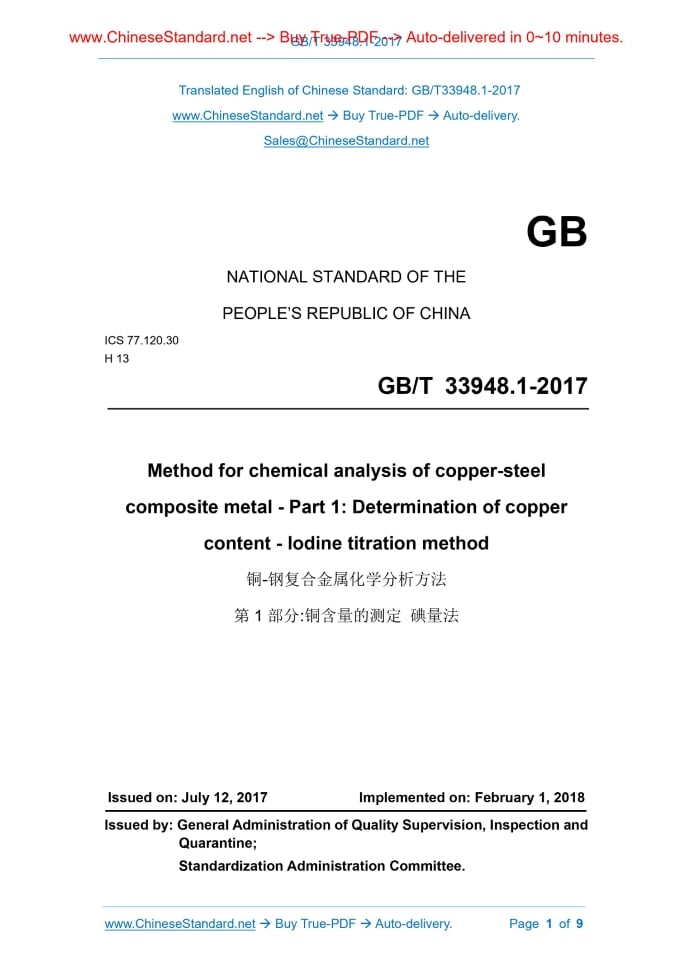
GB NATIONAL STANDARD OF THE PEOPLE’S REPUBLIC OF CHINA ICS 77.120.30 H 13 Method for chemical analysis of copper-steel composite metal - Part 1. Determination of copper content - Iodine titration method Issued on: JULY 12, 2017 Implemented on: FEBRUARY 1, 2018 Issued by. General Administration of Quality Supervision, Inspection and Quarantine; Standardization Administration Committee.
Table of Contents
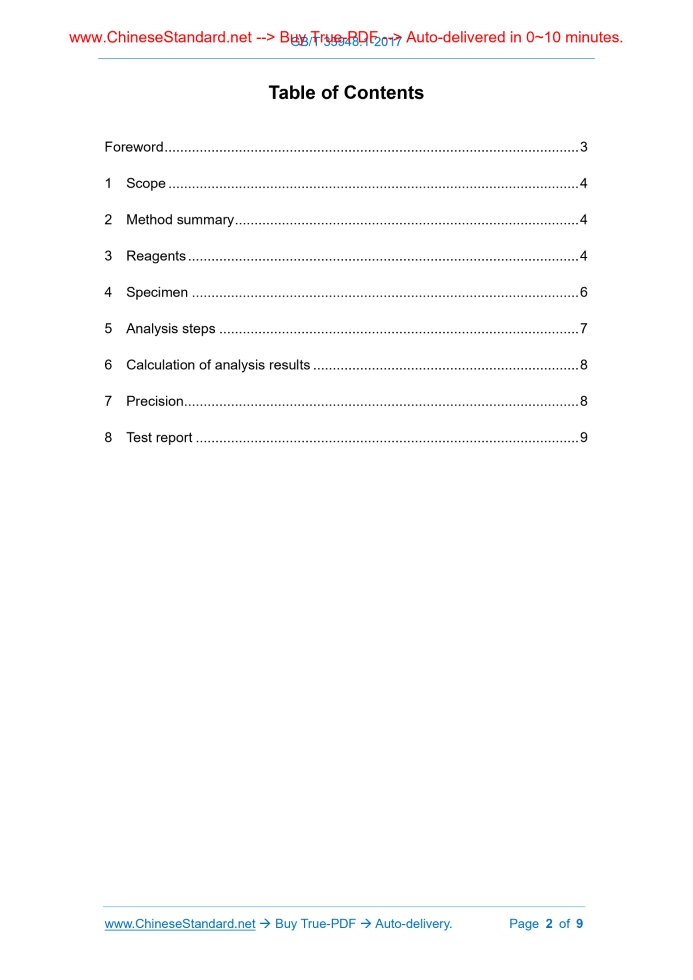
Foreword ... 3 1 Scope ... 4 2 Method summary ... 4 3 Reagents ... 4 4 Specimen ... 6 5 Analysis steps ... 7 6 Calculation of analysis results ... 8 7 Precision... 8 8 Test report ... 9 Method for chemical analysis of copper-steel composite metal - Part 1. Determination of copper content - Iodine titration method1 Scope
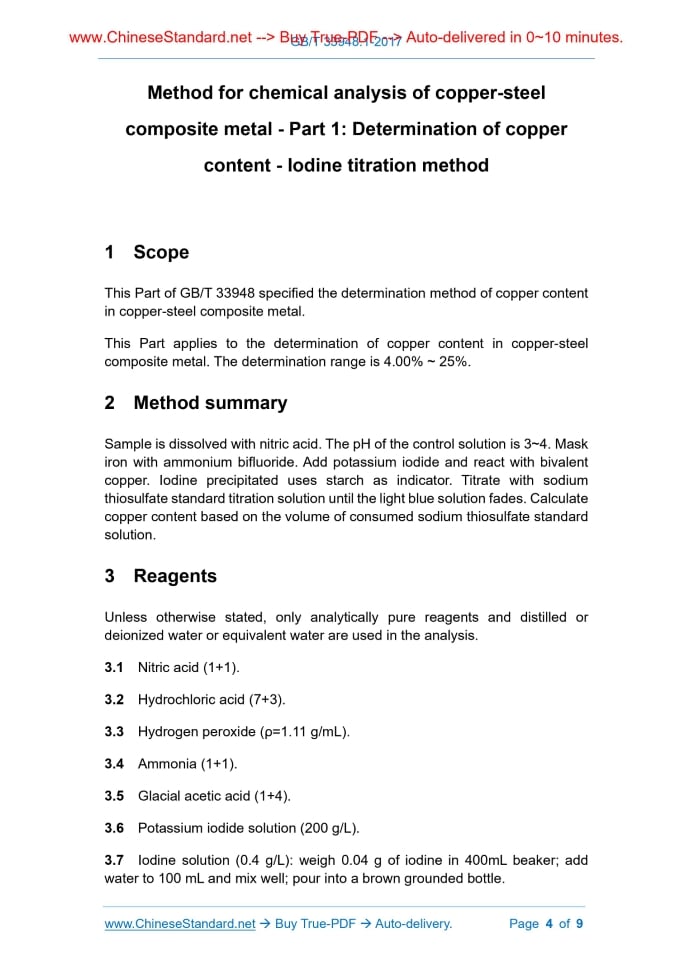
This Part of GB/T 33948 specified the determination method of copper content in copper-steel composite metal. This Part applies to the determination of copper content in copper-steel composite metal. The determination range is 4.00% ~ 25%.2 Method summary
Sample is dissolved with nitric acid. The pH of the control solution is 3~4. Mask iron with ammonium bifluoride. Add potassium iodide and react with bivalent copper. Iodine precipitated uses starch as indicator. Titrate with sodium thiosulfate standard titration solution until the light blue solution fades. Calculate copper content based on the volume of consumed sodium thiosulfate standard solution.3 Reagents
Unless otherwise stated, only analytically pure reagents and distilled or deionized water or equivalent water are used in the analysis. 3.1 Nitric acid (1+1). 3.2 Hydrochloric acid (7+3). 3.3 Hydrogen peroxide (ρ=1.11 g/mL). 3.4 Ammonia (1+1). 3.5 Glacial acetic acid (1+4). 3.6 Potassium iodide solution (200 g/L). 3.7 Iodine solution (0.4 g/L). weigh 0.04 g of iodine in 400mL beaker; add water to 100 mL and mix well; pour into a brown grounded bottle.5 Analysis steps
5.1 Test material Weigh 0.200 g of specimen (Clause 4), to the nearest of 0.0001 g. 5.2 Number of determinations Perform two determinations independently. Take the average value. 5.3 Blank test Perform the blank test with test materials. 5.4 Determination 5.4.1 Place the test material (5.1) in a 500-mL conical beaker. Add a small amount of water to wet. Add 10 mL of nitric acid (3.1). Cover the dish. Perform complete dissolution at low temperature (solution is transparent without impurities). If the test material is not completely dissolved, add 5 mL of hydrochloric acid (3.2). Add 3 mL of hydrogen peroxide (3.3) in 3 portions (shake for a moment for each adding) till the test material is completely dissolved (solution is transparent without impurities). Slowly concentrate the volume to 2 mL at low temperature. NOTE. Known substrates before dissolution contain manganese, chromium, silicon, nickel. The test material (5.1) can be placed in a 500 mL conical beaker. Add 5 mL of hydrochloric acid (3.2) at low temperature. Hydrogen peroxide is added dropwise in 5 portions (3.3), 2 mL for each (shake for a moment for each adding) till the test material is completely dissolved (solution is transparent without impurities). Add 10 mL of nitric acid (3.1). Cover the dish. Slowly concentrate volume to 2 mL at low temperature. 5.4.2 Remove for cooling. Wash dish and glass wall with water (up to 5 mL in volume). Boil. Remove for cooling to room temperature. Ammonia (3.4) is added dropwise until iron precipitation is complete (solution is viscous). Add ammonium bifluoride saturated solution (3.9) until red color disappears and it exceeds by 2 mL. Wash the watch glass and glass wall with water. Shake well. 5.4.3 Add 10 mL of potassium iodide solution (3.6). Shake well and dissolve. Immediately titrate with sodium thiosulfate standard titration solution (3.13). When the solution is light yellow, add 5 mL of starch solution (3.10). Continue titration with sodium thiosulfate standard titration solution (3.13) until the solution is light blue. Add 2 mL of potassium thiocyanate solution (3.11). Shake well to deepen blue. Continue titration with sodium thiosulfate standard titration solution (3.13) until the solution fades to blue. ......Source: Above contents are excerpted from the full-copy PDF -- translated/reviewed by: www.ChineseStandard.net / Wayne Zheng et al.