GB/T 33165-2016 English PDF
Price & Delivery
US$90.00 · In stock · Download in 9 secondsGB/T 33165-2016: Quantitative Analysis Method of Centre Segregation for High Carbon Steel Wire Rod
Delivery: 9 seconds. True-PDF full-copy in English & invoice will be downloaded + auto-delivered via email. See step-by-step procedure
Status: Valid
| Standard ID | USD | BUY PDF | Delivery | Standard Title (Description) | Status |
| GB/T 33165-2016 | 90 | Add to Cart | Auto, 9 seconds. | Quantitative Analysis Method of Centre Segregation for High Carbon Steel Wire Rod | Valid |
Click to Preview this PDF
Similar standards
GB/T 33165-2016: Quantitative Analysis Method of Centre Segregation for High Carbon Steel Wire Rod
---This is an excerpt. Full copy of true-PDF in English version (including equations, symbols, images, flow-chart, tables, and figures etc.), auto-downloaded/delivered in 9 seconds, can be purchased online: https://www.ChineseStandard.net/PDF.aspx/GBT33165-2016
GB NATIONAL STANDARD OF THE PEOPLE’S REPUBLIC OF CHINA ICS 77.040.99 H 24 Quantitative Analysis Method of Centre Segregation for High Carbon Steel Wire Rod Issued on: OCTOBER 13, 2016 Implemented on: SEPTEMBER 1, 2017 Issued by. General Administration of Quality Supervision, Inspection and Quarantine; Standardization Administration of PRC.
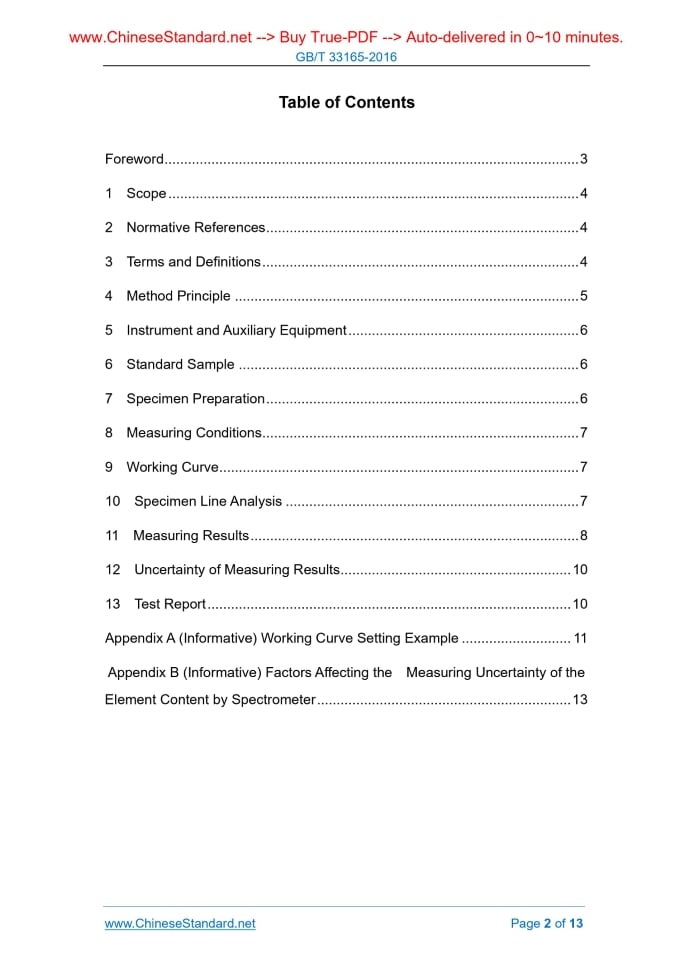
Table of Contents
Foreword ... 3 1 Scope ... 4 2 Normative References ... 4 3 Terms and Definitions ... 4 4 Method Principle ... 5 5 Instrument and Auxiliary Equipment ... 6 6 Standard Sample ... 6 7 Specimen Preparation ... 6 8 Measuring Conditions ... 7 9 Working Curve ... 7 10 Specimen Line Analysis ... 7 11 Measuring Results ... 8 12 Uncertainty of Measuring Results ... 10 13 Test Report ... 10 Appendix A (Informative) Working Curve Setting Example ... 11 Appendix B (Informative) Factors Affecting the Measuring Uncertainty of the Element Content by Spectrometer ... 13Foreword
This Standard was drafted as per the rules specified in GB/T 1.1-2009. This Standard was proposed by China Iron and Steel Industry Association. This Standard shall be under the jurisdiction of National Technical Committee for Standardization of Steel (SAC/TC 183). Drafting organizations of this Standard. Wuhan Iron and Steel Co., Ltd., China Metallurgical Information and Standardization Institute, and Tianjin Iron and Steel (Group) Co., Ltd. Chief drafting staffs of this Standard. Sun Yiqiang, Wu Lixin, Wang Zhifen, Chen Shihua, Yan Chengming, Han Rongdong, Deng Zhaojun, Zhang Long, and Luo Chunmin. Quantitative Analysis Method of Centre Segregation for High Carbon Steel Wire Rod1 Scope
This Standard specifies the terms, principle, instrument and auxiliary equipment, standard sample, specimen preparation, measuring conditions and methods, and result analysis for quantitative analysis of center segregation for high carbon steel wire rod by using spectrometer. This Standard is applicable to the high carbons steel hot-rolled wire rod with carbon content greater than 0.65%.2 Normative References
The following documents are essential to the application of this document. For the dated documents, only the versions with the dates indicated are applicable to this document; for the undated documents, only the latest version (including all the amendments) are applicable to this document. GB/T 4930 Microbeam Analysis - Electron Probe Microanalysis - Guidelines for the Specification of Certified Reference Materials (Crms) GB/T 13298 Inspection Methods of Microstructure for Metals GB/T 15074 General Guide of Quantitative Analysis by EPMA GB/T 21636 Microbeam Analysis - Electron Probe Micro Analysis (EPMA) - Vocabulary GB/T 27025 General Requirements for the Competence of Testing and Calibration Laboratories GB/T 30067 Standard Terminology Relating to Metallography3 Terms and Definitions
The following terms and definitions and those stipulated in GB/T 21636 and GB/T 30067 are applicable to this document.5 Instrument and Auxiliary Equipment
The testing laboratory shall meet the requirements of GB/T 27025; and have the following instrument and auxiliary equipment. a) Electron probe analyzer or scanning electron microscope for installing spectrometer accessories. b) Metallographic specimen preparation device, including specimen embedding, grinding, polishing and corrosion device. c) Metallographic microscope. d) Ultrasonic cleaning device.6 Standard Sample
6.1 Selection of standard sample It is recommended to use the carbon element standard sample that conforms to the provisions of GB/T 4930; the number of standard sample shall be no less than 3; the carbon element content range in standard sample shall cover the carbon element content of the specimen. 6.2 Treatment of standard sample The standard sample needs re-polishing before use; check the surface by the metallographic microscope to confirm whether there is contamination or other defects that affect the measurement. The surface of standard sample shall not spray or coat the covering layer, the standard sample shall be grounding by adopting conductive double-side adhesive, conductive copper foil tape or liquid silver glue sample connecting stage.7 Specimen Preparation
Take the cross-section of wire rod as the specimen, then make the metallographic polishing specimen as per GB/T 13298. After acid leaching the specimen into 2%~4% nitric acid alcohol solution, use glass knife, scalpel or other sharp tools to make parallel scratch mark on two sides of the segregation area, the scratch is approximately tangent to the edge of segregation area (see Figure 1). Through polishing again, the corrosion layer is completely removed from the specimen, while the scratch mark is retained.Appendix B
(Informative) Factors Affecting the Measuring Uncertainty of the Element Content by Spectrometer B.1 Sample contamination. including the water stains on the polishing surface, dust, and other contaminants. B.2 Sample electric charge accumulation. mainly caused by not grounding, poor grounding of the sample; or too high current and voltage. B.3 Measurement repeatability. including the fluctuation of measuring valued caused by the fluctuation of accelerated voltage, beam, and detector. B.4 Working curve. the linearity of working curve affects the measuring results. B.5 Standard sample. the uncertainty and nonuniformity of element content in standard sample affect the measuring results. B.6 Rounding off on the measuring results. the rounding off on measuring value affects the measuring results. ......Source: Above contents are excerpted from the full-copy PDF -- translated/reviewed by: www.ChineseStandard.net / Wayne Zheng et al.