GB/T 32382-2015 English PDF
Price & Delivery
US$90.00 · In stock · Download in 9 secondsGB/T 32382-2015: Thermal insulating products for build applications -- Determination of shear behaviour
Delivery: 9 seconds. True-PDF full-copy in English & invoice will be downloaded + auto-delivered via email. See step-by-step procedure
Status: Valid
| Standard ID | USD | BUY PDF | Delivery | Standard Title (Description) | Status |
| GB/T 32382-2015 | 90 | Add to Cart | Auto, 9 seconds. | Thermal insulating products for build applications -- Determination of shear behaviour | Valid |
Click to Preview this PDF
Similar standards
GB/T 32382-2015: Thermal insulating products for build applications -- Determination of shear behaviour
---This is an excerpt. Full copy of true-PDF in English version (including equations, symbols, images, flow-chart, tables, and figures etc.), auto-downloaded/delivered in 9 seconds, can be purchased online: https://www.ChineseStandard.net/PDF.aspx/GBT32382-2015
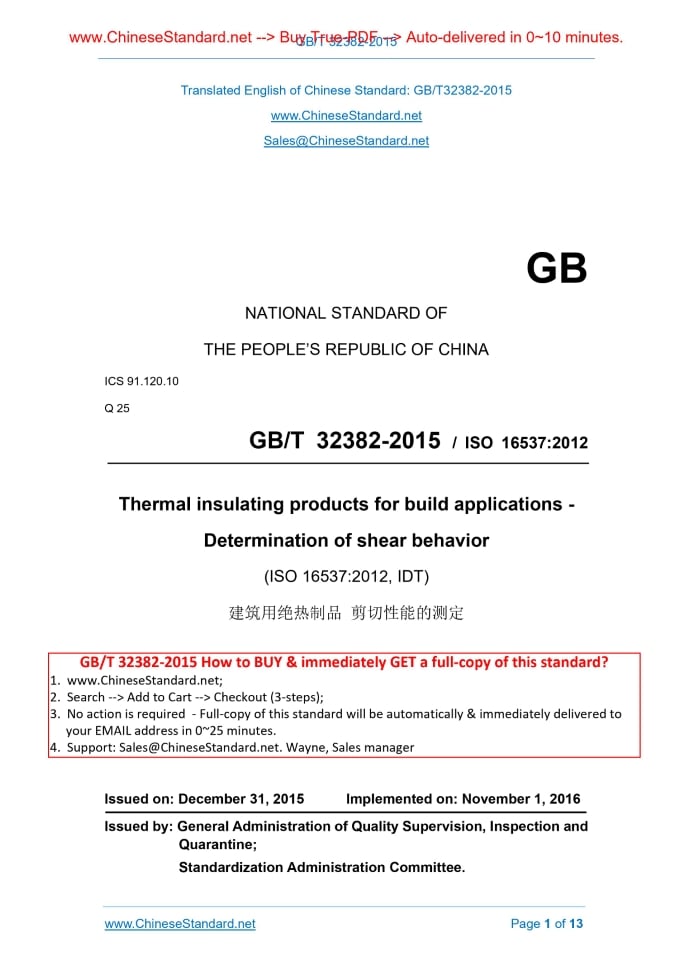
GB NATIONAL STANDARD OF THE PEOPLE’S REPUBLIC OF CHINA ICS 91.120.10 Q 25 GB/T 32382-2015 / ISO 16537.2012 Thermal insulating products for build applications - Determination of shear behavior (ISO 16537.2012, IDT) Issued on: DECEMBER 31, 2015 Implemented on: NOVEMBER 1, 2016 Issued by. General Administration of Quality Supervision, Inspection and Quarantine; Standardization Administration Committee.
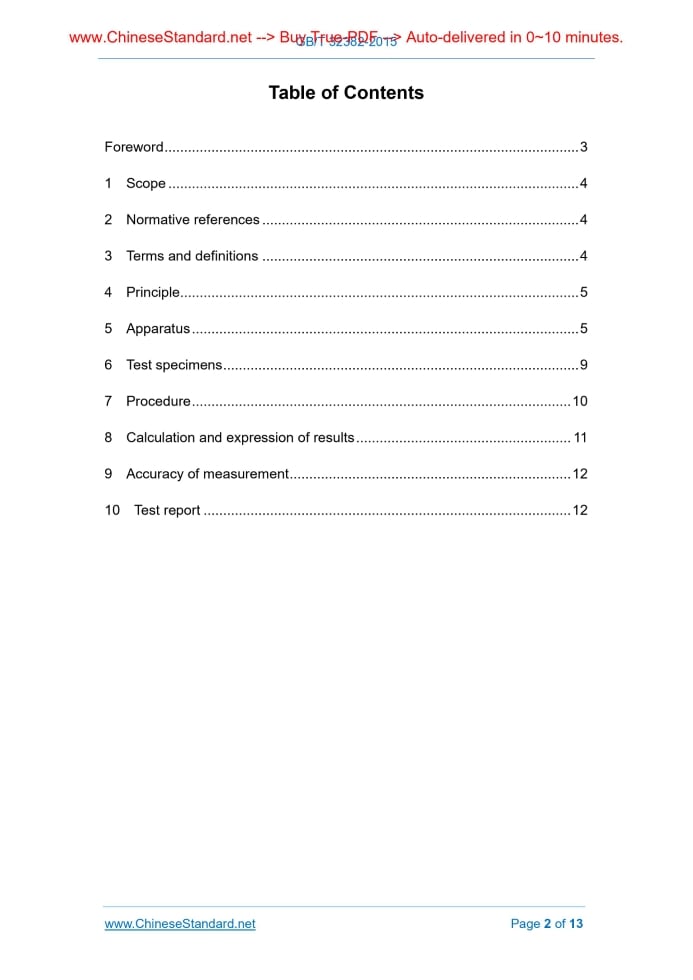
Table of Contents
Foreword ... 3 1 Scope ... 4 2 Normative references ... 4 3 Terms and definitions ... 4 4 Principle... 5 5 Apparatus ... 5 6 Test specimens ... 9 7 Procedure ... 10 8 Calculation and expression of results ... 11 9 Accuracy of measurement ... 12 10 Test report ... 12Foreword
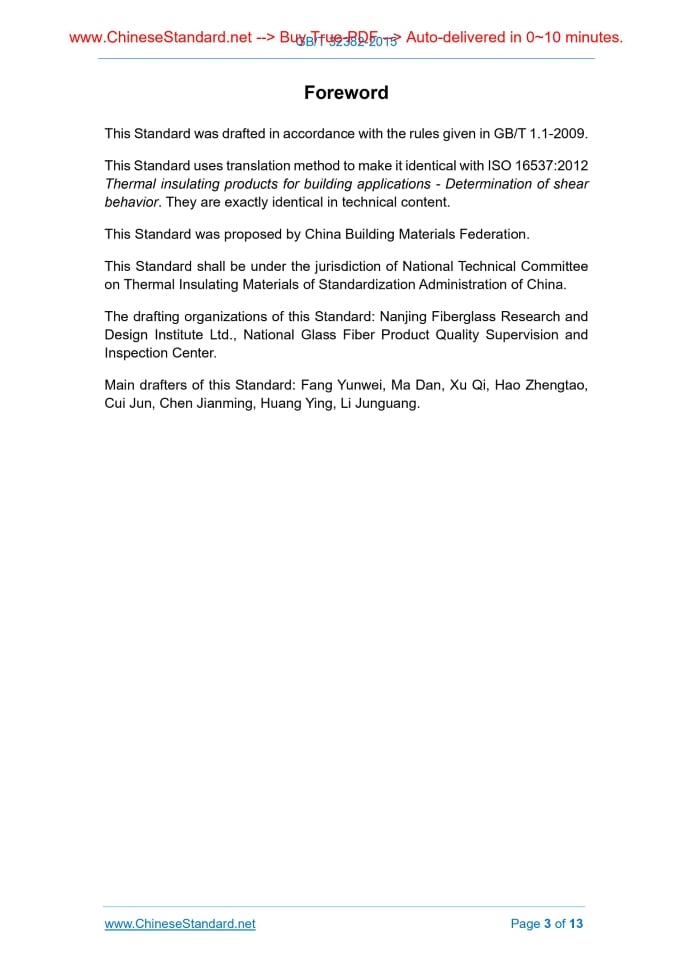
This Standard was drafted in accordance with the rules given in GB/T 1.1-2009. This Standard uses translation method to make it identical with ISO 16537.2012 Thermal insulating products for building applications - Determination of shear behavior. They are exactly identical in technical content. This Standard was proposed by China Building Materials Federation. This Standard shall be under the jurisdiction of National Technical Committee on Thermal Insulating Materials of Standardization Administration of China. The drafting organizations of this Standard. Nanjing Fiberglass Research and Design Institute Ltd., National Glass Fiber Product Quality Supervision and Inspection Center. Main drafters of this Standard. Fang Yunwei, Ma Dan, Xu Qi, Hao Zhengtao, Cui Jun, Chen Jianming, Huang Ying, Li Junguang. Thermal insulating products for build applications - Determination of shear behavior1 Scope
This Standard specifies the equipment and procedures for determining shear behaviour. It is applicable to thermal insulating products. NOTE The tests described in this Standard do not determine pure shear behaviour, but measure the effects of applying two opposite parallel forces to the major faces of the test specimen. The test is, however, called “shear” in this text by convention. The application of a force tangentially to the major surface of the test specimen is considered to represent more closely the stresses imposed upon thermal insulation products in many building applications, particularly walls, than other methods of measuring shear performance, e.g. bending tests.2 Normative references
The following referenced document is indispensable for the application of this document. For dated references, only the edition cited applies. For undated references, the latest edition of the referenced document (including any amendments) applies. ISO 29768 Thermal insulating products for building applications - Determination of linear dimensions of test specimens3 Terms and definitions
For the purposes of this document, the following definitions apply. 3.1 shear strength, ratio of the maximum force applied to the product, which will cause rupture along a plane parallel to the direction of the applied force, to the area of the plane on which the force acts 3.2 shear modulus; G shear stress divided by the corresponding relative deformation below the proportional limit, when the relationship is linear ......Source: Above contents are excerpted from the full-copy PDF -- translated/reviewed by: www.ChineseStandard.net / Wayne Zheng et al.