GB/T 31905-2015 English PDF
Price & Delivery
US$135.00 · In stock · Download in 9 secondsGB/T 31905-2015: Paper and board -- Determination of edge permeance
Delivery: 9 seconds. True-PDF full-copy in English & invoice will be downloaded + auto-delivered via email. See step-by-step procedure
Status: Valid
| Standard ID | USD | BUY PDF | Delivery | Standard Title (Description) | Status |
| GB/T 31905-2015 | 135 | Add to Cart | Auto, 9 seconds. | Paper and board -- Determination of edge permeance | Valid |
Click to Preview this PDF
Similar standards
GB/T 31905-2015: Paper and board -- Determination of edge permeance
---This is an excerpt. Full copy of true-PDF in English version (including equations, symbols, images, flow-chart, tables, and figures etc.), auto-downloaded/delivered in 9 seconds, can be purchased online: https://www.ChineseStandard.net/PDF.aspx/GBT31905-2015GB NATIONAL STANDARD OF THE PEOPLE'S REPUBLIC OF CHINA ICS 85-010 Y 30 Paper and board - Determination of edge permeance ISSUED ON: SEPTEMBER 11, 2015 IMPLEMENTED ON: APRIL 1, 2016 Issued by: General Administration of Quality Supervision, Inspection and Quarantine of PRC; Standardization Administration of PRC.
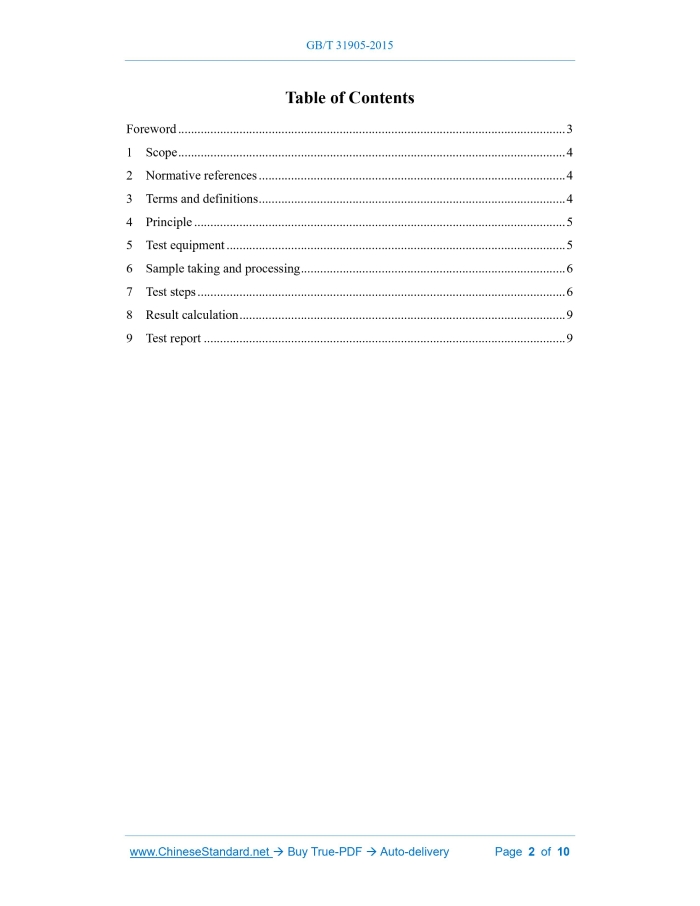
Table of Contents
Foreword ... 3 1 Scope ... 4 2 Normative references ... 4 3 Terms and definitions ... 4 4 Principle ... 5 5 Test equipment ... 5 6 Sample taking and processing ... 6 7 Test steps ... 6 8 Result calculation ... 9 9 Test report ... 9 Paper and board - Determination of edge permeance1 Scope
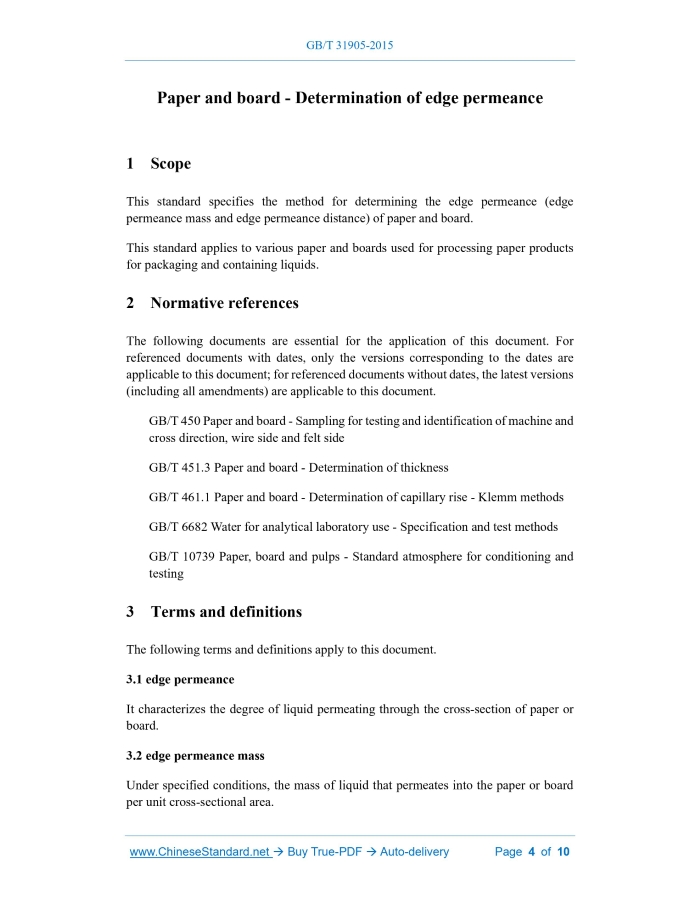
This standard specifies the method for determining the edge permeance (edge permeance mass and edge permeance distance) of paper and board. This standard applies to various paper and boards used for processing paper products for packaging and containing liquids.2 Normative references
The following documents are essential for the application of this document. For referenced documents with dates, only the versions corresponding to the dates are applicable to this document; for referenced documents without dates, the latest versions (including all amendments) are applicable to this document. GB/T 450 Paper and board - Sampling for testing and identification of machine and cross direction, wire side and felt side GB/T 451.3 Paper and board - Determination of thickness GB/T 461.1 Paper and board - Determination of capillary rise - Klemm methods GB/T 6682 Water for analytical laboratory use - Specification and test methods GB/T 10739 Paper, board and pulps - Standard atmosphere for conditioning and testing3 Terms and definitions
The following terms and definitions apply to this document. 3.1 edge permeance It characterizes the degree of liquid permeating through the cross-section of paper or board. 3.2 edge permeance mass Under specified conditions, the mass of liquid that permeates into the paper or board per unit cross-sectional area. 3.3 edge permeance distance The maximum distance a liquid can permeate into a cross-section of paper or board under specified conditions.4 Principle
4.1 Edge permeance mass The front and back of the sample are stuck with tapes; it is cut into a test piece of specified size; the test piece is put into the soaking solution for a certain period of time, then taken out, and the excess liquid on the surface is removed with absorbent paper. The masses of the test piece before and after immersion are weighed, and the difference between the mass of the test piece before and after immersion is divided by the cross- sectional area of the test piece to obtain the edge permeance mass. 4.2 Edge permeance distance The front, back and cross-section of the sample are stuck with tapes; it is cut into a test piece of specified size; the test piece is put into the soaking solution for a certain period of time, then taken out, and the excess liquid on the surface is removed with absorbent paper. The maximum distance that the liquid permeates into the sample is measured, that is, the edge permeance distance.5 Test equipment
5.1 Tape The tape shall be waterproof and non-absorbent, with a width greater than 30 mm. The tape used for edge permeance distance determination shall be transparent. 5.2 Metal roller The metal roller has a width of (200.0±0.5) mm, a diameter of (86.5±0.5) mm, a mass of (10.0±0.5) kg, and a smooth surface. 5.3 Balance The graduation value is 0.001 g. 5.4 Soaking solution The tertiary water for analytical laboratories, which meets the requirements of GB/T 6682. 5.5 Containers Stainless steel or glass containers for the soaking solution. 5.6 Grid A metal grid with brackets or hooks used to hold down the test piece to maintain the depth of the test piece immersed in the soaking solution. 5.7 Constant temperature water bath device It is used to maintain the temperature of the soaking solution; the temperature can be controlled at (95.0±2.0) ℃. 5.8 Stopwatch The reading accuracy is up to 1 s. 5.9 Absorbent paper The quantitative value is 200 g/m2~250 g/m2, and its longitudinal and transverse capillary rises measured according to GB/T461.1 shall be no less than 75 mm/10 min. When the quantitative value of a single layer of absorbent paper is less than 200 g/m2, multiple layers can be stacked to meet the above requirements. As long as the absorbency of absorbent paper can be guaranteed, it can be reused. 5.10 Steel ruler The graduation value is 1 mm.6 Sample taking and processing
Sample taking and processing shall be carried out according to GB/T 450 and GB/T 10739.7 Test steps
7.1 Determination of edge permeance mass 7.1.1 Cut a specimen of 100 mm×100 mm in size and mark the longitudinal and transverse directions of the specimen. 7.1.2 Determine the thickness T of the specimen according to GB/T 451.3. 7.1.3 Stick the tape (5.1) on the front and back of the specimen and press it flat with a metal roller (5.2). ......Source: Above contents are excerpted from the full-copy PDF -- translated/reviewed by: www.ChineseStandard.net / Wayne Zheng et al.