GB/T 29123-2025 English PDF
Price & Delivery
US$125.00 · In stock · Download in 9 secondsGB/T 29123-2025: Technology specifications for the operation and storage of fuel cell electric vehicles
Delivery: 9 seconds. True-PDF full-copy in English & invoice will be downloaded + auto-delivered via email. See step-by-step procedure
Status: Valid
GB/T 29123: Historical versions
| Standard ID | USD | BUY PDF | Delivery | Standard Title (Description) | Status |
| GB/T 29123-2025 | 125 | Add to Cart | Auto, 9 seconds. | Technology specifications for the operation and storage of fuel cell electric vehicles | Valid |
| GB/T 29123-2012 | 85 | Add to Cart | Auto, 9 seconds. | Specifications for hydrogen fuel cell vehicles in demonstration | Valid |
Click to Preview this PDF
Similar standards
GB/T 29123-2025: Technology specifications for the operation and storage of fuel cell electric vehicles
---This is an excerpt. Full copy of true-PDF in English version (including equations, symbols, images, flow-chart, tables, and figures etc.), auto-downloaded/delivered in 9 seconds, can be purchased online: https://www.ChineseStandard.net/PDF.aspx/GBT29123-2025
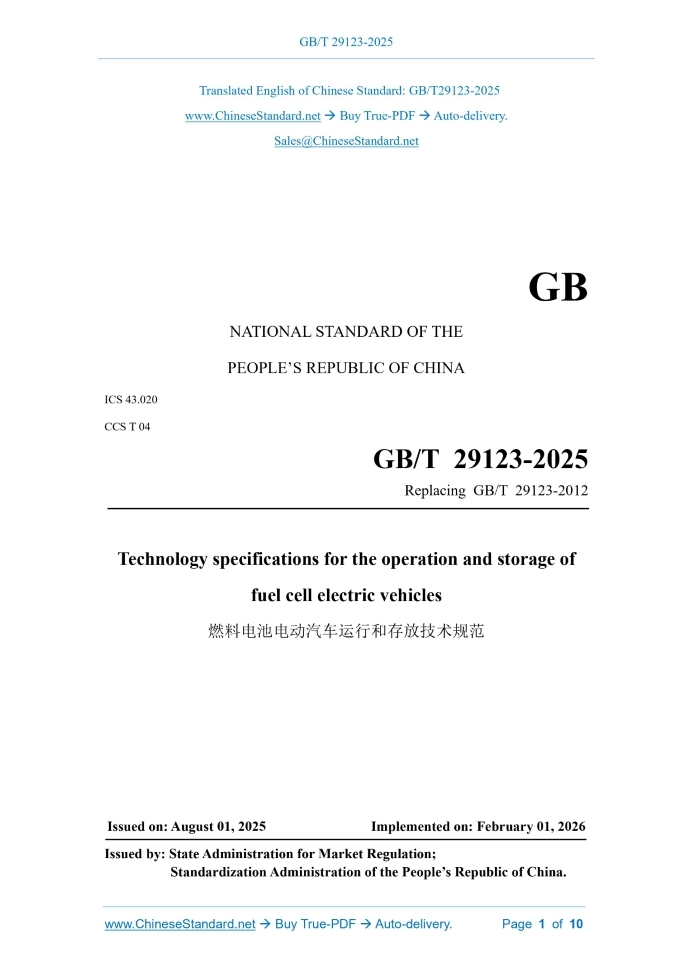
GB NATIONAL STANDARD OF THE PEOPLE’S REPUBLIC OF CHINA ICS 43.020 CCS T 04 Replacing GB/T 29123-2012 Technology specifications for the operation and storage of fuel cell electric vehicles Issued on: AUGUST 01, 2025 Implemented on: FEBRUARY 01, 2026 Issued by. State Administration for Market Regulation; Standardization Administration of the People’s Republic of China.
Table of Contents
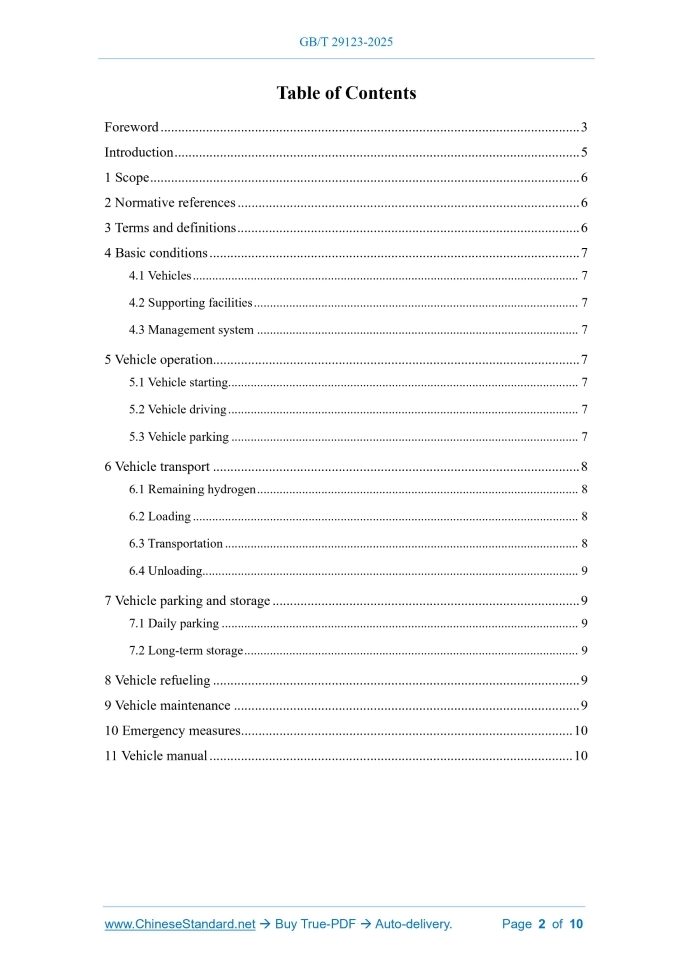
Foreword... 3 Introduction... 5 1 Scope... 6 2 Normative references... 6 3 Terms and definitions... 6 4 Basic conditions... 7 4.1 Vehicles... 7 4.2 Supporting facilities... 7 4.3 Management system... 7 5 Vehicle operation... 7 5.1 Vehicle starting... 7 5.2 Vehicle driving... 7 5.3 Vehicle parking... 7 6 Vehicle transport... 8 6.1 Remaining hydrogen... 8 6.2 Loading... 8 6.3 Transportation... 8 6.4 Unloading... 9 7 Vehicle parking and storage... 9 7.1 Daily parking... 9 7.2 Long-term storage... 9 8 Vehicle refueling... 9 9 Vehicle maintenance... 9 10 Emergency measures... 10 11 Vehicle manual... 10 Technology specifications for the operation and storage of fuel cell electric vehicles1 Scope
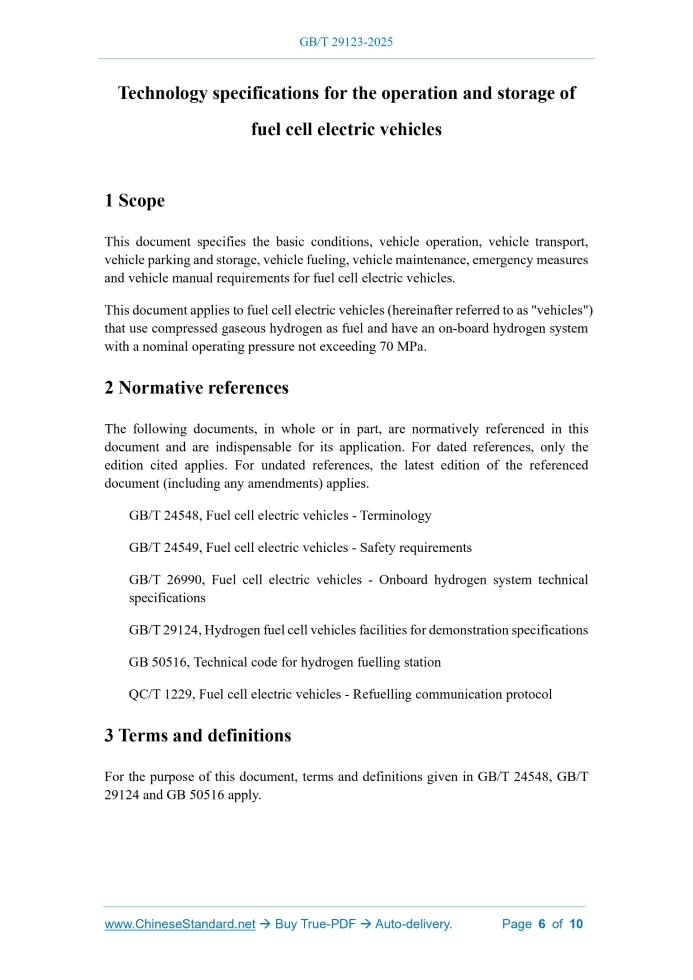
This document specifies the basic conditions, vehicle operation, vehicle transport, vehicle parking and storage, vehicle fueling, vehicle maintenance, emergency measures and vehicle manual requirements for fuel cell electric vehicles. This document applies to fuel cell electric vehicles (hereinafter referred to as "vehicles") that use compressed gaseous hydrogen as fuel and have an on-board hydrogen system with a nominal operating pressure not exceeding 70 MPa.2 Normative references
The following documents, in whole or in part, are normatively referenced in this document and are indispensable for its application. For dated references, only the edition cited applies. For undated references, the latest edition of the referenced document (including any amendments) applies. GB/T 24548, Fuel cell electric vehicles - Terminology GB/T 24549, Fuel cell electric vehicles - Safety requirements GB/T 26990, Fuel cell electric vehicles - Onboard hydrogen system technical specifications GB/T 29124, Hydrogen fuel cell vehicles facilities for demonstration specifications GB 50516, Technical code for hydrogen fuelling station QC/T 1229, Fuel cell electric vehicles - Refuelling communication protocol3 Terms and definitions
For the purpose of this document, terms and definitions given in GB/T 24548, GB/T 29124 and GB 50516 apply.4 Basic conditions
4.1 Vehicles The safety of the vehicle shall meet the requirements of GB/T 24549, and the onboard hydrogen system shall meet the requirements of GB/T 26990. 4.2 Supporting facilities Hydrogen fuelling stations, parking lots, maintenance workshops and other supporting facilities shall meet the requirements of GB/T 29124. 4.3 Management system The management system shall include a complete personnel organization and management system, safety management system, safe operating procedures, production safety responsibility system, risk management system, etc.5 Vehicle operation
5.1 Vehicle starting All mechanical connections to external facilities shall be disconnected before starting the vehicle. Vehicle starting shall be checked and operated according to the procedures specified by the manufacturer. 5.2 Vehicle driving The hydrogen concentration in the vehicle shall comply with the requirements of GB/T 24549. If any unexpected behavior or failure occurs during driving, such as a significant reduction in the driving power of the power system, an alarm or failure of the hydrogen leak alarm device, etc., the vehicle shall be able to send a clear signal to the driver, and the driver shall operate in accordance with the requirements of the manufacturer or operator. 5.3 Vehicle parking After the power source is cut off, the vehicle shall not produce any unexpected movement caused by its own propulsion system.6 Vehicle transport
6.1 Remaining hydrogen The remaining amount of hydrogen in the hydrogen storage tank of the onboard hydrogen system shall meet the driving range requirements during the transport process. When the vehicle is in a closed or semi-closed transport scenario such as a container or ship hold, the remaining hydrogen in the hydrogen storage tank of the onboard hydrogen system shall meet one of the following requirements. a) The remaining pure hydrogen driving range does not exceed 50 km; b) The state of charge (SOC) of the hydrogen storage cylinder does not exceed 10%. Note. The state of charge (SOC) of a hydrogen storage cylinder refers to the ratio of the hydrogen density in the vehicle-mounted hydrogen storage cylinder to the density of hydrogen at the nominal working pressure and 15 °C. 6.2 Loading 6.2.1 Vehicles shall be loaded in a well-ventilated area that meets relevant fire protection requirements. 6.2.2 Before loading, the condition of the transport vehicle shall be checked. Transport vehicles with abnormal conditions such as damage, defects, deformation, etc. shall not be used. 6.2.3 When loading, the vehicle shall be secured using tie-down straps, blocks or its own structure, and the securing strength shall meet the safety requirements of the relevant mode of transport. Operators shall follow the instructions of on-site commanders and control the vehicle speed when entering the loading space. When using other equipment loading modes, the hydrogen storage cylinders shall not be damaged, and the vehicle shall not be damaged during the fastening process. 6.2.4 After loading, the vehicles shall be turned off and a safe distance shall be maintained between vehicles and between the vehicle and the inner wall of the loading equipment. 6.3 Transportation 6.3.1 Closed or semi-enclosed spaces such as cabins or containers used for transporting vehicles shall have necessary ventilation measures to ensure that the hydrogen gas volume fraction in the environment does not exceed 1%. 6.3.2 Static elimination measures shall be taken on the transport vehicles used for transshipment. ......Source: Above contents are excerpted from the full-copy PDF -- translated/reviewed by: www.ChineseStandard.net / Wayne Zheng et al.