GB/T 23367.2-2009 English PDF
Price & Delivery
US$110.00 · In stock · Download in 9 secondsGB/T 23367.2-2009: Methods for chemical analysis of lithium cobalt oxide -- Part 2: Determination of lithium, nickel, manganese, magnesium, aluminium, iron, sodium, calcium and copper content -- Inductively coupled plasma atomic emission spectrometry
Delivery: 9 seconds. True-PDF full-copy in English & invoice will be downloaded + auto-delivered via email. See step-by-step procedure
Status: Valid
| Standard ID | USD | BUY PDF | Delivery | Standard Title (Description) | Status |
| GB/T 23367.2-2009 | 110 | Add to Cart | Auto, 9 seconds. | Methods for chemical analysis of lithium cobalt oxide -- Part 2: Determination of lithium, nickel, manganese, magnesium, aluminium, iron, sodium, calcium and copper content -- Inductively coupled plasma atomic emission spectrometry | Valid |
Click to Preview this PDF
Similar standards
GB/T 23367.2-2009: Methods for chemical analysis of lithium cobalt oxide -- Part 2: Determination of lithium, nickel, manganese, magnesium, aluminium, iron, sodium, calcium and copper content -- Inductively coupled plasma atomic emission spectrometry
---This is an excerpt. Full copy of true-PDF in English version (including equations, symbols, images, flow-chart, tables, and figures etc.), auto-downloaded/delivered in 9 seconds, can be purchased online: https://www.ChineseStandard.net/PDF.aspx/GBT23367.2-2009
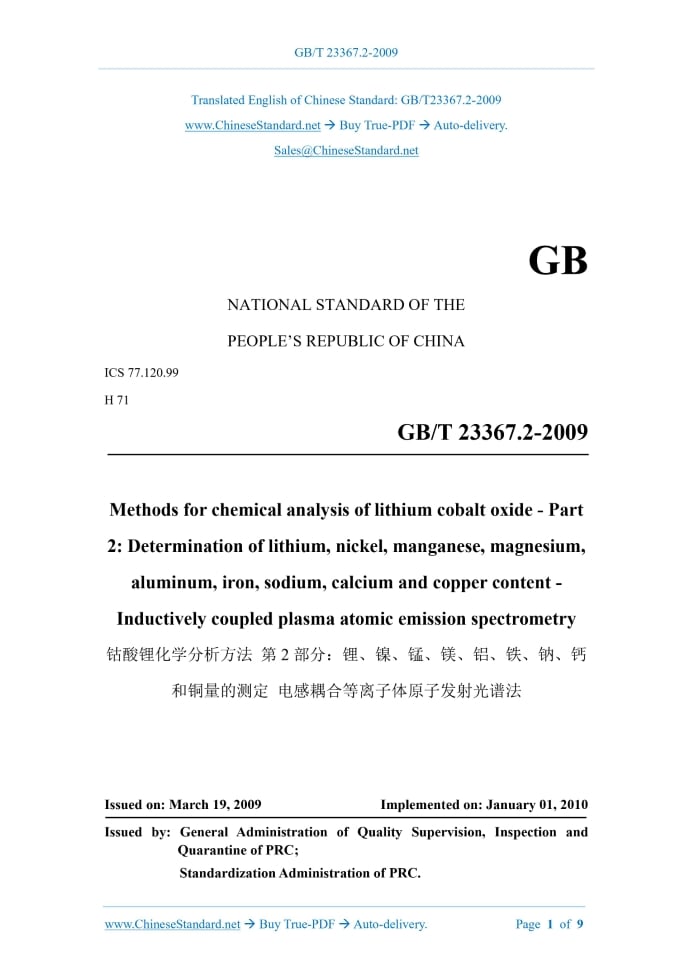
NATIONAL STANDARD OF THE PEOPLE’S REPUBLIC OF CHINA ICS 77.120.99 H 71 Methods for chemical analysis of lithium cobalt oxide - Part 2: Determination of lithium, nickel, manganese, magnesium, aluminum, iron, sodium, calcium and copper content - Inductively coupled plasma atomic emission spectrometry ISSUED ON: MARCH 19, 2009 IMPLEMENTED ON: JANUARY 01, 2010 Issued by: General Administration of Quality Supervision, Inspection and Quarantine of PRC; Standardization Administration of PRC.
Table of Contents
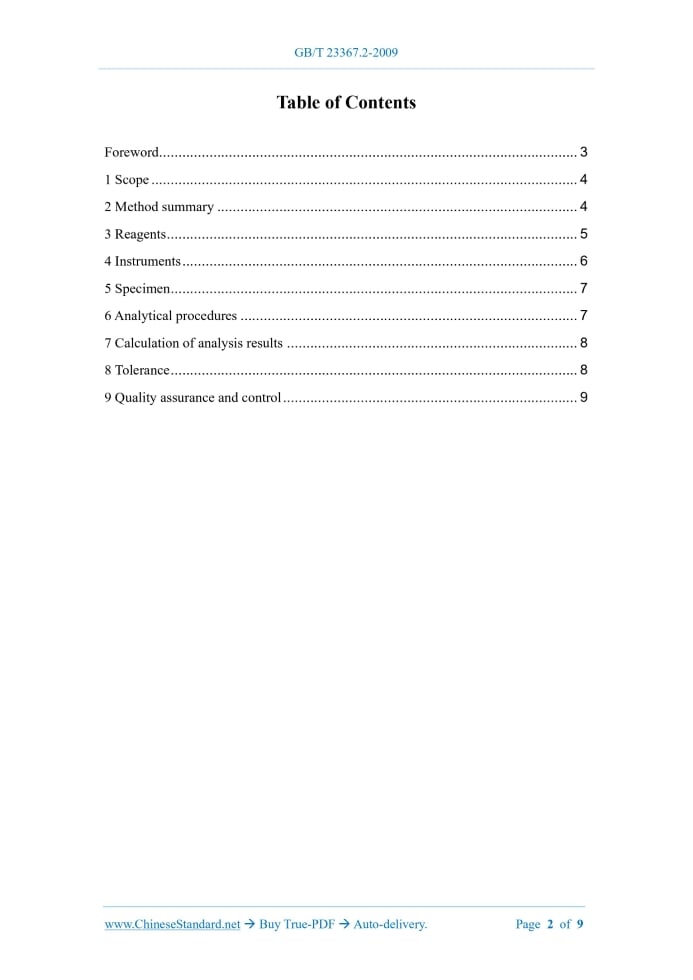
Foreword ... 3 1 Scope ... 4 2 Method summary ... 4 3 Reagents ... 5 4 Instruments ... 6 5 Specimen ... 7 6 Analytical procedures ... 7 7 Calculation of analysis results ... 8 8 Tolerance ... 8 9 Quality assurance and control ... 9 Methods for chemical analysis of lithium cobalt oxide - Part 2: Determination of lithium, nickel, manganese, magnesium, aluminum, iron, sodium, calcium and copper content - Inductively coupled plasma atomic emission spectrometry1 Scope
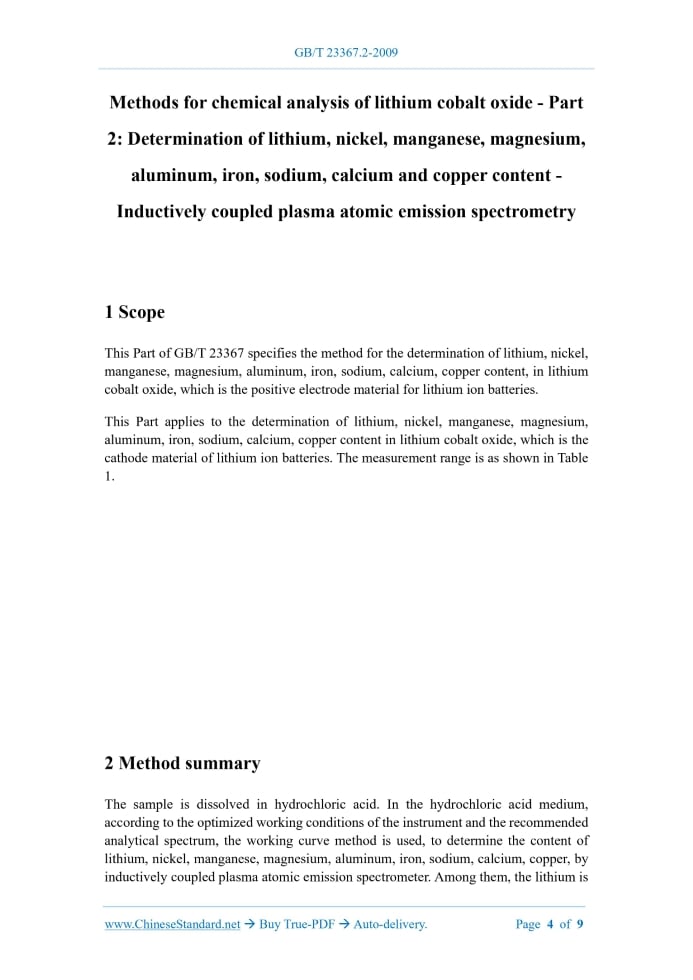
This Part of GB/T 23367 specifies the method for the determination of lithium, nickel, manganese, magnesium, aluminum, iron, sodium, calcium, copper content, in lithium cobalt oxide, which is the positive electrode material for lithium ion batteries. This Part applies to the determination of lithium, nickel, manganese, magnesium, aluminum, iron, sodium, calcium, copper content in lithium cobalt oxide, which is the cathode material of lithium ion batteries. The measurement range is as shown in Table 1.2 Method summary
The sample is dissolved in hydrochloric acid. In the hydrochloric acid medium, according to the optimized working conditions of the instrument and the recommended analytical spectrum, the working curve method is used, to determine the content of lithium, nickel, manganese, magnesium, aluminum, iron, sodium, calcium, copper, by inductively coupled plasma atomic emission spectrometer. Among them, the lithium is determined, by using a standard solution matched with a cobalt matrix, which has a similar composition to the specimen.3 Reagents
Unless otherwise stated, only reagents, that are confirmed to be superior grade and 18.2 MΩ·cm secondary purified water or water of equivalent purity, are used in the analysis. 3.1 Hydrochloric acid (1 + 1). 3.2 Hydrochloric acid (5 + 95). 3.3 Lithium standard storage solution: 1.00 mg/mL. 3.4 Nickel standard storage solution: 1.00 mg/mL. 3.5 Manganese standard stock solution: 1.00 mg/mL. 3.6 Magnesium standard storage solution: 1.00 mg/mL. 3.7 Aluminum standard storage solution: 1.00 mg/mL. 3.8 Iron standard storage solution: 1.00 mg/mL. 3.9 Sodium standard storage solution: 1.00 mg/mL. 3.10 Calcium standard storage solution: 1.00 mg/mL. 3.11 Copper standard storage solution: 1.00 mg/mL. 3.12 Cobalt matrix solution: Weigh 3.0000 g of metallic cobalt (mass fraction ≥ 99.99%), into a 400 mL beaker. Add 50 mL of hydrochloric acid (3.1). Dissolve it at low temperature. Transfer it into a 1000 mL volumetric flask. Use water to dilute it to the mark. Mix well. 1 mL of this solution contains 3.0 mg of cobalt. 3.13 Mixed standard solution A: Respectively pipette 10.00 mL of nickel standard storage solution (3.4), manganese standard storage solution (3.5), magnesium standard storage solution (3.6), aluminum standard storage solution (3.7), iron standard storage solution (3.8), sodium standard storage solution (3.9), calcium standard storage solution (3.10), copper standard storage solution (3.11), in a 100 mL volumetric flask. Use hydrochloric acid (3.2), to dilute it to the mark. Mix well. 1 mL of this solution contains 100 μg of nickel, manganese, magnesium, aluminum, iron, sodium, calcium, copper. 3.14 Mixed standard solution B: Pipette 10.00 mL of mixed standard solution A (3.13), put it in a 100 mL volumetric flask. Use hydrochloric acid (3.2), to dilute it to the mark. Mix well. 1 mL of this solution contains 10 μg of nickel, 10 μg of manganese, 10 μg of magnesium, 10 μg of aluminum, 10 μg of iron, 10 μg of sodium, 10 μg of calcium, 10 6.4.3 Measurement 6.4.3.1 After the instrument runs stably, according to the optimized working conditions of the instrument and the recommended analytical spectral line's wavelength (Table 2), use the standard series solutions (6.4.2.1), to determine the emission light intensity of nickel, manganese, magnesium, aluminum, iron, sodium, calcium, copper. Use the standard series solution (6.4.2.2), to measure the emission light intensity of lithium. The emission light intensity of the analyte element, in the standard series solution, is measured, from low to high. Take the mass concentration of the measured element as the abscissa AND the emitted light intensity as the ordinate, to automatically draw the working curve through computer. 6.4.3.2 Measure the emission light intensity of the tested element, in the sample solution and the accompanied sample blank solution. The computer automatically calculates the mass concentration of the tested element, from the working curve.7 Calculation of analysis results
The content of the element to be tested is calculated by the mass fraction of the element to be tested, wM; the value is expressed in %, which is calculated according to formula (1): Where: ρM - The mass concentration of the tested element in the test solution, in micrograms per milliliter (μg/mL); ρ0 - The mass concentration of the tested element in the blank solution, in micrograms per milliliter (μg/mL); V - The total volume of the test solution, in milliliters (mL); V1 - The volume of the divided test solution, in milliliters (mL); V2 - The volume of the test solution for determination, in milliliters (mL); m - The mass of the sample, in grams (g).8 Tolerance
The difference, between the analysis results between laboratories, shall not be greater than the allowable difference, which is listed in Table 4 below. ......Source: Above contents are excerpted from the full-copy PDF -- translated/reviewed by: www.ChineseStandard.net / Wayne Zheng et al.