GB/T 12326-2008 English PDF
Price & Delivery
US$85.00 · In stock · Download in 9 secondsGB/T 12326-2008: Power quality - Voltage fluctuation and flicker
Delivery: 9 seconds. True-PDF full-copy in English & invoice will be downloaded + auto-delivered via email. See step-by-step procedure
Status: Valid
GB/T 12326: Historical versions
| Standard ID | USD | BUY PDF | Delivery | Standard Title (Description) | Status |
| GB/T 12326-2008 | 85 | Add to Cart | Auto, 9 seconds. | Power quality - Voltage fluctuation and flicker | Valid |
| GB 12326-2000 | 719 | Add to Cart | 5 days | Specifications for hydrographic survey | Obsolete |
| GB 12326-1990 | RFQ | ASK | 3 days | Quality of electric energy supply--Admissible voltage fluctuation and flicker | Obsolete |
Click to Preview this PDF
Similar standards
GB/T 12326-2008: Power quality - Voltage fluctuation and flicker
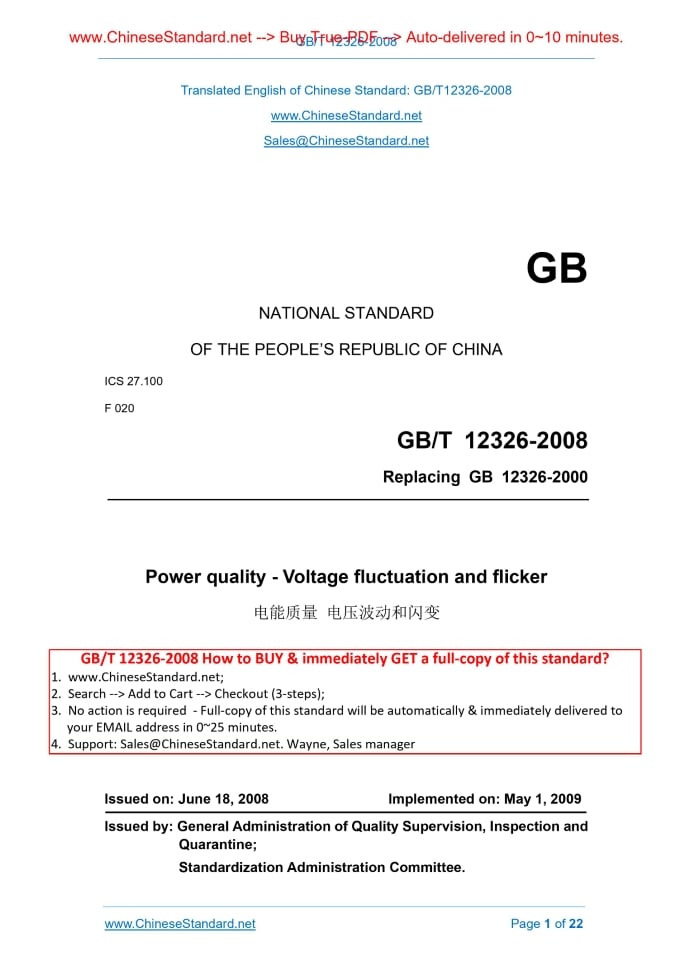
---This is an excerpt. Full copy of true-PDF in English version (including equations, symbols, images, flow-chart, tables, and figures etc.), auto-downloaded/delivered in 9 seconds, can be purchased online: https://www.ChineseStandard.net/PDF.aspx/GBT12326-2008GB NATIONAL STANDARD ICS 27.100 F 020 Replacing GB 12326-2000 Power quality - Voltage fluctuation and flicker Issued on. JUNE 18, 2008 Implemented on. MAY 1, 2009 Issued by. General Administration of Quality Supervision, Inspection and Quarantine; Standardization Administration Committee.
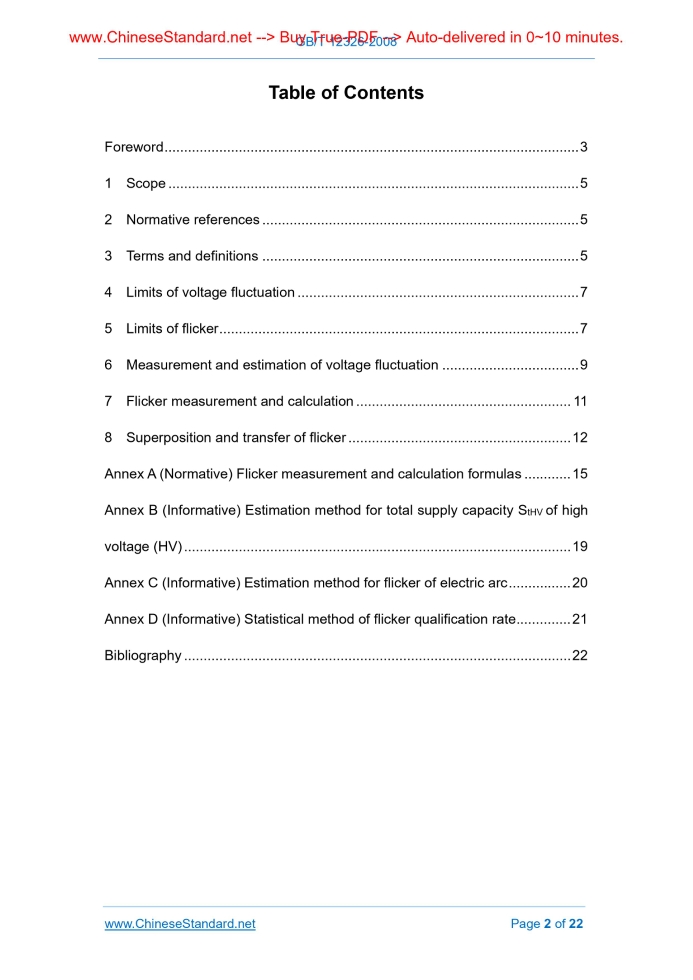
Table of Contents
Foreword... 3 1 Scope... 5 2 Normative references... 5 3 Terms and definitions... 5 4 Limits of voltage fluctuation... 7 5 Limits of flicker... 7 6 Measurement and estimation of voltage fluctuation... 9 7 Flicker measurement and calculation... 11 8 Superposition and transfer of flicker... 12 Annex A (Normative) Flicker measurement and calculation formulas... 15 Annex B (Informative) Estimation method for total supply capacity StHV of high voltage (HV)... 19 Annex C (Informative) Estimation method for flicker of electric arc... 20 Annex D (Informative) Statistical method of flicker qualification rate... 21 Bibliography... 221 Scope
This Standard specifies the limits and test, calculation and evaluation methods of voltage fluctuation and flicker. This Standard is applicable to the rapid change of the voltage of the common connection point caused by the fluctuating load under the normal operation mode of the AC 50Hz power system and the occasion where people may obviously feel the light flicker.2 Normative references
The following standards contain the provisions which, through reference in this Standard, constitute the provisions of this Standard. For dated references, subsequent amendments (excluding corrections) or revisions do not apply to this Standard. However, the parties who enter into agreement based on this Standard are encouraged to investigate whether the latest versions of these documents are applicable. For undated reference documents, the latest versions apply to this Standard. GB/T 156-2007 Standard voltage (IEC 60038.2002, MOD) GB 17625.2 Electromagnetic compatibility (EMC) - Limits - Limitation of voltage changes, voltage fluctuations and flicker in public low-voltage supply systems, for equipment with rated current ≤ 16 A (GB 17625.2-2007, IEC 61000-3-3.2005, IDT) GB/Z 17625.3 Electromagnetic compatibility--Limits--Limitation of voltage fluctuations and flicker in low-voltage power supply systems for equipment with rated current greater than 16A (GB/Z 17625.3-2000, idt IEC 61000-3- 5.1994)3 Terms and definitions
For the purposes of this document, the following terms and definitions apply. 3.1 point of common coupling; PCC the connection of more than one user in an electrical system 3.2 fluctuating load the load of varying power periodically or un-periodically taken from the supply network during production (or operation); for example, steel-making electric arc furnace, rolling mill, arc welding machine 3.3 voltage fluctuation a series of changes or successive changes in R.M.S. (valid value) 3.4 R.M.S. voltage shape; U(t) time function of periodic R.M.S. (valid value) per half fundamental wave voltage 3.9 long term severity; Plt calculated from the short-term flicker value Pst; reflects the magnitude of the flicker for a long time (several hours) (see Annex A); the basic recording period for long-term flicker is 2 h 3.10 cumulative probability function; CPF the abscissa represents the measured value, and the ordinate represents the percentage of time over the corresponding abscissa value for the total measured time (see Figure 2)4 Limits of voltage fluctuation
For the voltage fluctuation caused by point of common coupling in power system for any fluctuating load user, its limits are related to voltage change frequency and voltage level. For low voltage fluctuation frequency (e.g. r ≤ 1000 times/h) or regular periodic voltage fluctuation, its voltage fluctuation frequency and voltage fluctuation value can be determined by the measurement of R.M.S. voltage shape U(t). The limits of voltage fluctuation are shown in Table 1.5 Limits of flicker
5.1 For point of common coupling of power system, in the smaller mode of normal operation of the system, taking a week (168 h) as the measurement cycle, all long-term flicker values Plt shall meet the requirements of Table 2 for flicker limits. 5.2 Usually, the flicker value caused by point of common coupling in power system alone of any fluctuating load user shall meet the following requirements. 5.2.4 The third level regulation. For the single fluctuating load user which does not comply with the regulations of the second level, if it still exceeds its flicker limits after treatment, it shall relax the limit appropriately, based on PCC point actual flicker conditions and development forecast of grid. However, the flicker value of PCC point must comply with the provisions of 5.1.6 Measurement and estimation of voltage fluctuation
The voltage fluctuation can be described by R.M.S. voltage shape U(t). The relative voltage change d and rate of occurrence of voltage changes r are indicators to measure the voltage fluctuation size and speed. The relative voltage change d can be defined as.8 Superposition and transfer of flicker
8.1 The flicker and background flicker caused by n fluctuating loads are superimposed on the same node. Its short term severity can be calculated by the following formula. 8.2 The transfer of flicker on different bus bars in power system is shown as Figure 2.It can be calculated by the following simplified formula. ......Source: Above contents are excerpted from the full-copy PDF -- translated/reviewed by: www.ChineseStandard.net / Wayne Zheng et al.